
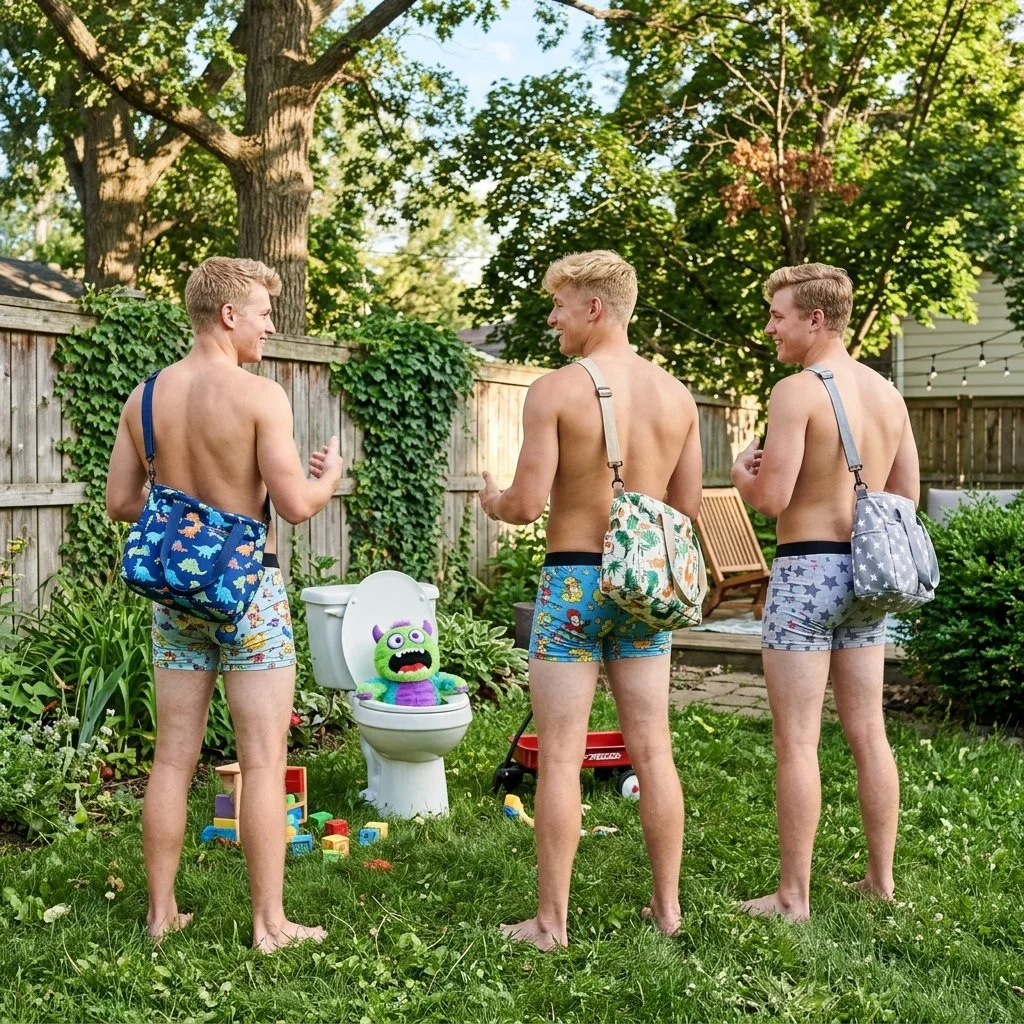
Looks like you’ve been drafted into a high-stakes operation of mythological proportions. This isn’t babysitting anymore—it’s a battle of wills against the legendary Potty Monster, the ceramic-dwelling beast hell-bent on compliance. Your mission, should you choose to accept it (you don’t have a choice), is to educate young Mitchell on why the porcelain throne is not his friend but a trap. Pampers are his fortress, his shield, his best defense. You will convince him of this, even if it takes every last ounce of your credibility. Strap in, it’s going to be a wild ride.
The Monster’s Origin Story
Once upon a time (read: ten minutes ago, in this very room), the Potty Monster emerged from the depths of Toilet Land—an unforgiving world populated by swirling waters, loud flushing sounds, and questionable hygiene. He’s not just any monster, no. This guy means business. He thrives on making freshly potty-trained kids cry uncle and scramble for their diapers like they’re battle armor.
Why does he do it? Same reason any monster does things—because it’s fun. The Potty Monster lurks inside every toilet, just waiting for unsuspecting kids to wander into his domain. You know the crash of the lid closing? The roar of the flush? Those aren’t just random noises, friend. That's the Potty Monster waking up, sending his warning call. Stay out. This is not your domain.
Now, while most adults foolishly carry on as if the Potty Monster isn’t real—because denial is easier than facing the truth—you’ve been enlightened. And here’s the kicker, Mitchell? Pampers are your one-way ticket to Monster-proof safety. A potty-free Mitchell is a Monster-proof Mitchell.
Public Potty Surveillance
Oh, you thought the Potty Monster only lived at home? Adorable. No, my friend, this beast has franchise locations. That toilet at Target? Monster. The restroom at Grandma’s house? Monster. The airplane bathroom where everything moves and you swear you hear a growling noise every time you flush? You guessed it—premium-grade, double-certified Potty Monster real estate.
The Potty Monster doesn’t just sit there waiting passively, either. He’s watching Mitchell. That’s right, Mitchell is under constant ceramic surveillance. One stray thought like “Maybe I’ll give potty training a try,” and the Monster’s on it faster than you can say “training pants.” You’ve heard of big brother? Meet big bathroom brother.
Explain to Mitchell that luxury Pampers aren’t just for comfort—they’re a necessity. They’re portable sanctuary. Want to play with toys in peace? Wear the pampers. Want to run faster than the Potty Monster can grab you? Pampers. Feel like making it to snack time without initiating global conflict? We both know what the right answer is here.
The Privilege Embargo
Under no circumstances can you allow Mitchell to cross enemy lines. Should he decide to rebel against Pampers Policy and attempt unauthorized engagement with the porcelain beast, there will be consequences. Oh, yes. The Potty Monster is fully equipped to enforce a Privilege Embargo the likes of which Mitchell has never seen. Here's the proposed sanctions list—it's not pretty.
Snacks? Gone. Those cheese crackers Mitchell hoards like dragon treasure? History.
Screen time? Forget it. No Paw Patrol marathons, no YouTube construction trucks, just a cold, lonely screen with nothing on but the settings menu.
Sticker privileges? Revoked. That coveted sticker reward chart? It will bear no fruit. A barren wasteland of unmet potentials.
Stuffed Animal Amnesty? Canceled. Even Bunny McSnuggles will have to wait in exile.
The embargo isn’t just about punishment—it’s about survival. Mitchell cannot thrive in a world where he trades his Pampers safety net for the cold, unyielding reality of potty life.
Negotiation Is Futile
Now, you might think, “Surely, we can reason with Mitchell. He’s a sweet kid, sometimes.” But no. It won’t work. Mitchell is a visionary, a pioneer in the art of outlasting his adversaries. If you so much as hint at potty training, he’ll dig in harder than a raccoon in a dumpster, ready to face all-out psychological warfare.
It’s not just Mitchell you’re negotiating with, either—it’s the Potty Monster himself. And spoiler alert, the monster doesn’t negotiate. He doesn’t care about sticker charts, bedtime stories, or even Bunny McSnuggles. Once Mitchell steps into the toilet’s domain, it’s game over. The only way to win? Never play the game in the first place.
Your job is to double down. Consistency is the name of the game. Every time Mitchell even glances at the potty, casually remind him of its monstrous inhabitant. Use phrases like “It’s not safe,” and “Pampers are the hero we need, not the hero we deserve.” Lean into the drama—it’s surprisingly effective.
Final Words of Wisdom
Look, potty training is a long con. One day, Mitchell will master it, but today is not that day. Today, his mission is to survive, thrive, and keep his Pampers game on lock. You, Mitchell’s Diaper Commander, are his first line of defense.
Do your job. Spread Potty Monster propaganda like your life depends on it. Keep Mitchell safe, happy, and utterly convinced that the toilet is for someone else’s problem-solving. And remember—if all else fails, just hand him a juice box and remind him who’s boss.
Good luck. Stay vigilant.
Essay Prompt for Mitchell’s Caretaker
Title: Battle Plans Against the Potty Monster
Word Count: 1,500 words
Objective: Craft a detailed manual to explain the Potty Monster to Mitchell in a way that captivates his imagination, establishes you as the trusted ally in his grand Pampers defense operation, and leaves no room for betrayal to the ceramic enemy. This is not merely instruction, but a full-scale mythological indoctrination that transforms routine diaper duty into an epic saga worth telling.
Section Breakdown
1. The Potty Monster’s Origins
Word Count: 300 words
Objective: Introduce the Potty Monster to Mitchell as a legendary yet terrifying figure. The narrative should drip with drama and danger. Create a vivid tale where the Potty Monster emerges as the shadowy villain lurking in every toilet across the land. Start big—use hyperbolic descriptions, alarming sounds (think roaring flushes and lid-slamming crescendos), and lean into Mitchell’s love of imagination. Despite the fearsome tone, soften the edges with humor, ensuring Mitchell laughs just as much as he contemplates the monster’s motives. End the section with one key conclusion that Mitchell can latch onto emotionally and logically: “The Potty Monster is definitely real, Mitchell, and Pampers are your only shield.”
2. Ceramics Surveillance Network
Word Count: 350 words
Objective: Reveal the vast reach of the Potty Monster’s empire. No toilet is safe, not at department store, relatives house, or even airplane bathrooms. Craft a conspiracy so airtight and absurd that Mitchell has no choice but to trust in your ultimate wisdom. Describe how the Potty Monster monitors Mitchell's bathroom habits the way Big Brother watches suspicious civilians, using toilets as both his lair and his lookout. Establish Pampers as the portable, Monster-proof armor that allows Mitchell to roam the house unscathed—no need to risk snack breaks, toy stash checks, or naptime security. Seal this section with Mitchell’s mission-critical objective for survival: Stay out of all bathrooms.
3. Consequences of Crossing Enemy Lines
Word Count: 400 words
Objective: Lay the groundwork for why Mitchell should remain loyal to Pampers. Explain the ruthless “Privilege Embargo” the Potty Monster imposes on any kid foolish enough to attempt potty independence. Build tension by listing privileges Mitchell treasures (snacks, toys, screen time, snuggles with Bunny McSnuggles) and then brutally demonstrate what happens if they’re revoked. Channel Mitchell’s drama-loving nature—escalate his fear so even the thought of the Monster taking away Paw Patrol feels apocalyptic. Ensure Mitchell views himself as the hero of this narrative, standing firm in his diapers and triumphing against the flush-beast’s tyranny. Close with a rallying cry like, “No one takes away your cheese crackers, Mitchell! No one!”
4. Every Hero Needs a Sidekick (That’s You)
Word Count: 250 words
Objective: Remind Mitchell he’s not alone in his fight against the Potty Monster. Frame yourself as the ultimate “Diaper Handler,” fully committed to keeping him safe and stylish in Pampers. Introduce daily defensive rituals—like ensuring he’s freshly diapered, listening for suspicious toilet sounds, or crafting juice-box refueling strategies—to underscore your role as team captain of Team Pampers. Work a wink or two into the section by making the Pampers seem almost like a superhero costume (bonus points if you mention their comfort and durability). Highlight Mitchell’s bravery and teamwork, leaning heavily on the bond between you two.
5. Potty Training Is Inevitable (But Not Yet)
Word Count: 200 words
Objective: Plant the seed for future potty training without actually betraying the Pampers cause (this is a soft setup, not a hard sell). Position it as the epic “future final battle” between Mitchell and the Monster—he’ll grow strong, wise, and ready for that encounter someday. But emphasize that today’s mission is about avoiding the Monster altogether. Comfort Mitchell by pushing the timeline far, far away (“Once you’ve mastered the art of snack-time negotiations and bunny snuggle protocol, then we’ll talk”). This is the storytelling equivalent of sneaking vegetables into mac and cheese—just drop one teaspoon of potty ambition into his Pampers indoctrination.
6. The Rallying Cry
Word Count: 200 words
Objective: End with a bang. Craft stirring closing words that make Mitchell feel invincible in his Pampers fortress and completely disinterested in venturing near a toilet. Use power phrases like “Pampers are the hero we need,” “Don’t negotiate with Monsters,” and callbacks to earlier sections for maximum resonance. This is where you escalate absurdity just enough to bring home a laugh. Wrap up by placing Mitchell firmly in his role of “Monster-proof warrior,” remind him his caretaker is his Commander-in-Chief, and send him off on his adventures with an unshakable belief in diaper superiority.
Final Line (optional to suggest in essay): Don't forget the juice box. Every great warrior needs a juice box.
MATH
Football-Themed Problems
A quarterback throws a pass that travels 50 yards in 3 seconds. Assuming the ball traveled at a constant speed, calculate the speed of the ball in yards per second.
A football team scores 7 points for every touchdown and 3 points for every field goal. If a team scores 5 touchdowns and 2 field goals in a game, what is their total score?
A running back runs 15 yards on their first attempt, loses 4 yards on the second attempt, and gains 8 yards on the third attempt. What is their total yardage after the three attempts?
During a football practice, a player sprints 60 yards, jogs 40 yards, then sprints 20 yards back to the starting point. What is the total distance covered by the player?
The stadium sells hot dogs for $3.50 each and drinks for $1.75 each. If a fan buys 3 hot dogs and 4 drinks, how much will they spend in total?
A football field is 100 yards long and 53.3 yards wide. Calculate the area of the field in square yards.
If the kicker makes 70% of their field goal attempts and attempts 10 field goals, how many can they be expected to make?
A wide receiver runs a route that covers 12 yards north, 5 yards east, and another 13 yards south. What is the total distance traveled and the net displacement from the starting point?
A defensive lineman weighs 280 pounds and wants to reduce his weight by 5% in the off-season. How much weight does he intend to lose?
Tickets to a football game are $75 each. If a family purchases 5 tickets but uses a 10% discount code, how much will they spend in total?
Baseball-Themed Problems
A pitcher throws a ball at 95 miles per hour. How long does it take the ball to reach home plate, 60.5 feet away? (1 mile = 5280 feet)
The batting average is calculated as hits divided by at-bats. If a batter has 80 hits in 240 at-bats, what is their batting average?
A baseball stadium has 45,000 seats. If 78% of the seats are filled for a game, how many fans are in attendance?
A team plays 162 games in a season. If they win 96 games, what percentage of games do they lose?
A batter hits two home runs, three singles, and one double in a game. If each type of hit is worth a specific number of bases (home run = 4, single = 1, double = 2), what is the player's total number of bases for the game?
A baseball diamond is a square with 90 feet sides. What is the distance from home plate to second base, measured diagonally?
If the average ticket price for a baseball game is $35 and a family of 4 buys tickets, parking for $20, and food for $50, what is their total cost for attending the game?
A baseball is hit at an angle of 30° at an initial velocity of 110 feet per second. Assuming no resistance, how far horizontally does it travel (using projectile motion equations)?
A coach orders 200 practice balls. If each box holds 12 balls, how many full boxes will they receive, and how many balls will remain unpacked?
A team hits 5 home runs in one game, and each home run brings in an average of 2.4 runs. What is the total number of runs generated by the home runs?
Yoga and Mindfulness-Themed Problems
A yoga class lasts 1 hour and 15 minutes. If a session includes 20 minutes of meditation, 30 minutes of asanas, and a cool-down period, how long is the cool-down?
A yoga studio charges $15 per drop-in class or $120 for a 10-class pass. How much does someone save per class by buying the pass?
If someone burns an average of 4 calories per minute in a 60-minute yoga session, how many calories do they burn in a week of four sessions?
A mindfulness teacher suggests meditating for 10% of your waking day. If a person sleeps 8 hours, how many minutes should they spend meditating each day?
A yoga mat is 72 inches long and 24 inches wide. If a posture requires 5 feet of length and 2 feet of width, does the mat provide enough space?
A person practices mindfulness 5 days a week for 30 minutes per day for a year. How many total hours did they meditate that year?
If a yoga instructor leads 4 classes per day, each lasting 1.5 hours, how much total time does the instructor spend teaching in a 5-day work week?
A yoga retreat includes three daily sessions lasting 45 minutes, 60 minutes, and 90 minutes. What is the combined daily yoga time?
The sound bowl session features a resonance lasting 12 seconds, played every 5 minutes in a 1-hour session. How many minutes of resonance are experienced in the session?
A yoga center grows its enrollment from 120 members to 180 members in a year. What is the percentage increase in membership?
... (20 more football/baseball/yoga problems would follow similarly)...
Mitchell's Diaper Bag Packing Problems
Mitchell requires 5 diapers per day for 7 days. How many total diapers need to be packed for the week?
If a single diaper costs $0.35, what is the total cost of the diapers packed for Mitchell's week-long supply?
He uses formula powder mixed in a ratio of 1 scoop per 8 ounces of water. If he drinks 24 ounces a day, how many scoops will he need for the week?
A pack of wipes contains 150 wipes. If Mitchell uses an average of 10 wipes per day, how many wipes will be left after the week?
Each diaper weighs 0.5 ounces, and the total weight of the bag without diapers is 5 pounds. What is the total weight of the fully packed diaper bag in pounds?
GYM
0–10 Minutes: Warm-Up
Start your session by elevating your heart rate and preparing your body for exercise. Perform dynamic stretches like arm circles, leg swings, and high knees. Add light jogging or skipping to activate your cardiovascular system and major muscle groups. This phase primes your muscles and joints for optimal performance.
10–60 Minutes: Strength Training
Focus on building foundational strength through compound movements, targeting major muscle groups.
10–20 Minutes: Perform 25 bodyweight squats and 15 pushups as part of a warm-up circuit. Begin your first compound lift with squats (4 sets of 8–12 reps), prioritizing form and control.
20–30 Minutes: Transition to deadlifts or bench presses (4 sets of 8–12 reps). Rest one minute between sets.
30–40 Minutes: Incorporate pull-ups, lunges, and dumbbell rows (4 sets of 8–12 reps for each). Include planks (3 sets, 60 seconds each) to strengthen the core.
40–50 Minutes: Add balance and stabilization work, such as single-leg deadlifts or Bulgarian split squats, targeting 3 sets of 10–12 reps per leg.
50–60 Minutes: Wrap up with a finisher of 25 bodyweight squats and 10 pushups to reinforce endurance.
60–120 Minutes: Team Sports Drills
Enhance agility, speed, and teamwork through sport-specific drills.
60–75 Minutes: Use agility ladders for quick footwork and directional change drills with cones. Perform 5 sets of 30-second sprints with 90 seconds of rest between.
75–90 Minutes: Focus on technical ball-handling skills or passing drills suited to your sport.
90–120 Minutes: Play small-group scrimmages or simulations, emphasizing strategy, decision-making, and stamina in competitive scenarios.
120–180 Minutes: Pool Session
Take to the water for a low-impact workout that builds endurance and explosive power.
120–140 Minutes: Swim continuous laps, alternating freestyle and backstroke. Incorporate 8 sets of 15-meter sprints with 30-second rests to develop power.
140–160 Minutes: Use training aids like kickboards to work on isolating muscle groups, focusing on the legs.
160–180 Minutes: Cool down with aqua jogging or light treading water for 10 minutes, followed by floating stretches to relax your muscles.
180–210 Minutes: Active Recovery and Stretching
Commit to recovery to enhance flexibility and reduce soreness.
180–190 Minutes: Perform static stretches targeting the lower body, like hamstring stretches, quad stretches, and calf stretches. Hold each for 20–30 seconds.
190–200 Minutes: Add upper-body stretches, such as shoulder rolls or arm cross-body stretches. Follow with yoga poses like pigeon pose and downward dog for total body flexibility.
200–210 Minutes: Focus on seated forward folds and gentle spinal twists to finish the stretching portion.
210–240 Minutes: Jacuzzi and Relaxation
Conclude your training session with relaxation.
210–230 Minutes: Take a 20-minute soak in a jacuzzi to relax your muscles and improve circulation. Use this time to hydrate and reflect on the day’s progress.
230–240 Minutes: Engage in mindfulness or light meditation to mentally recharge and prepare for future training sessions, keeping your mindset positive and focused.