
(Reflection, Fitness, Farting, Timeout) Brief-ology 101 – Toddler Diplomacy in Style
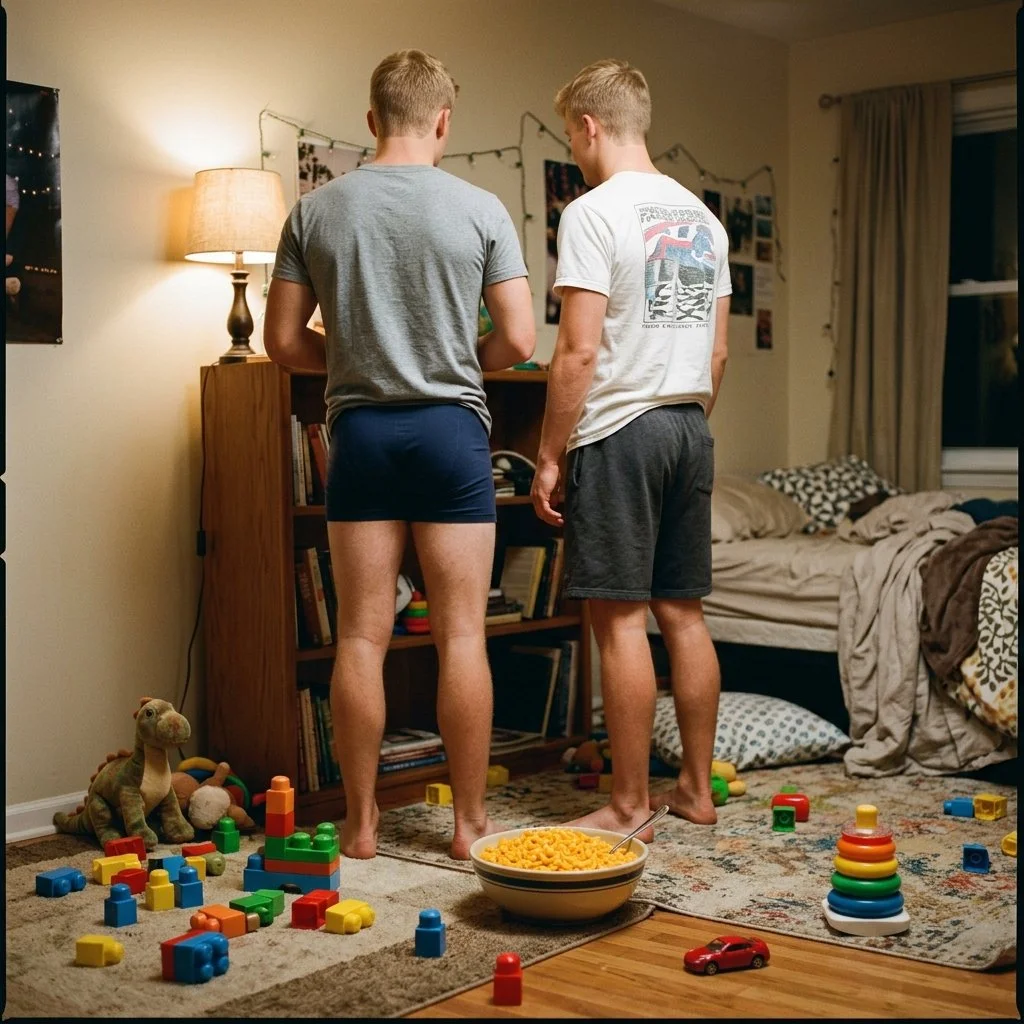
Objective: Write a 1500-word essay exploring the absurdity, practicality, and unintended wisdom of babysitting Mitchell—or any spirited toddler—while clad in nothing but briefs. This essay asks you to lean into humor, exaggeration, and self-awareness while addressing deeper themes of societal expectations, personal freedom, and the glorious chaos of life under toddler dictatorship.
Word Count Requirement: 1,500 words max
Section Breakdown:
Introduction (150-200 words)
Establish the scene, the absurdity, and the essay's tone. Open with vivid, comedic detail of the mac-and-cheese fiasco. Set up the reader for an exploration of why fighting on Mitchell’s terms (in briefs!) transcends societal norms and expectations.Part 1 – Toddler Rulebook (300-400 words)
Detail the unwritten “laws” toddlers like Mitchell enforce. Touch on his indifference to societal conventions (e.g., clothing) and hyper-focus on what truly matters to him—block stacking and snack timing. Explore how toddlers expose the futility of adhering to adult norms in their domain.Part 2 – Practicality in Absurdity (400-500 words)
Make a tongue-in-cheek case for why brief-only babysitting might genuinely be an optimal choice. Highlight comfort, mobility (ideal for dodging thrown mac and cheese), and functional temperature control during snack-related chaos. Sprinkle in exaggerated pros—less laundry, unmatched snack stain resistance, and the existential clarity of “less is more.”Part 3 – Society in the Living Room (300-400 words)
Contemplate the clash between societal expectations ("wear pants") and the raw, unfiltered humanity toddlers demand. Use Mitchell as a metaphor for how absurdly freeing it can be to opt out of arbitrary standards. Reflect on societal judgment, poking fun at the imagined horror of neighbors peeking through the window.Part 4 – The Wisdom of Briefs (200-300 words)
Conclude by tying together the humor with a more reflective tone. Argue that babysitting in briefs is a larger metaphor for leaning into life’s chaos. With toddlers, results—not appearances—matter most. Suggest that maybe—just maybe—Mitchell has unknowingly handed you a crash course in living authentically.Call to Action (under 100 words)
End with a playful "winking" line suggesting the reader try to rock their own chaos (briefs optional but encouraged).
Short Reference Essay
Title: Brief-ology 101 – Toddler Diplomacy in Style
Picture this—but not too vividly, save your brain from trauma. You’re stationed in the living room trenches of toddler warfare, and Mitchell, resident pint-sized overlord, has just done it again. His bowl of mac and cheese, once full of hope and cheese-covered elbows, now lies face-down on the rug. You stare. He stares back like an unflinching renaissance statue—except somehow more imposing—because this statue is armed with sticky fingers and insatiable demands. "What now, Briefs McGee?” his unblinking eyes all but chant. And it’s then, like a thunderbolt of clarity striking through a storm of chaos, that it dawns on you. This might just be okay.
Your ensemble—briefs and...well, that's it—isn’t a failure. It’s survival wear. A mood. Toddler care isn’t a runway, folks. It’s a marathon in sweatpants—or, better yet, briefs. Mitchell doesn’t care if your jeans are from this season or last. He won’t quiz you on your outfits or deduct performance points for aesthetic crimes. No, Mitchell’s world is results-oriented. Are the blocks stacking as if a tiny engineer’s degree depends on the outcome? Is snack time running like clockwork? Are you accurately navigating the landmines that are toddler television laws? Because breaking those—that, my friend, will see your authority crumble faster than you can say “Peppa Pig.”
You see, babysitting like this doesn’t just bend society’s rules. It takes them, folds them into a paper airplane, and hurls them out the window. Sure, you might alert a judgmental neighbor if they catch a flash of your situation through the blinds. But Mitchell doesn’t grade on societal curve or aesthetic compatibility. If anything, he’d champion this dedication to the art of chaos. Freedom, after all, is key in his dominion. And in briefs, there's freedom in every sense of the word—from uninhibited snack flinging to the kind of breezy mobility you need to dodge macaroni missiles.
Let's not overlook the revolution-level practicality here. Elastic bands? Ideal for crawling around on all fours to play “find the car that purposely went under the couch.” Minimal fabric? Goodbye, endless laundry cycles, and hello, fast cleanup. Absurd? Absolutely. But under the fluorescents of Mitchell-world, absurd is the only game in town. This isn’t a parenting handbook crossed with haute couture; it’s guerrilla babysitting. “Start lean, survive sticky” might as well be the motto stamped onto your briefs waistband.
But there’s another layer to this saga. Why do we dress ourselves up for things toddlers couldn’t care less about? Life demands all this effort, all these appearances—polished shoes, snappy ties, presentable sweaters—and yet here you are, standing almost entirely unwrapped in the face of toddler chaos, and somehow, it’s perfect. Mitchell has bestowed upon you a brutal, mac-and-cheese-infused truth not many mentors will share. Sometimes life demands you strip away the fluff and focus on stacking the blocks (metaphorically, sure, but also, literally). Choose snacks over pretense. Chase what works—briefs and all—and not what looks polished through a neighbor’s weirdly meticulous window blinds.
Consider this essay your permission slip then. To lean into the absurdity of life’s chaotic moments. To opt out of external pretenses and into something hilariously authentic. And maybe, if you dare, to rock your own version of the Briefs Life™. Try it. Liberation—as sticky and bizarre as it may appear—might just be one snack-fling away.
GYM
This structured gym workout is designed for those seeking a comprehensive training session that targets strength, endurance, and flexibility. Follow the plan precisely for balanced progress and optimal performance.
Warm-Up (15 Minutes)
Perform dynamic stretches targeting all major muscle groups to prepare your body for intense activity.
Examples include arm swings, leg swings, and torso twists.
Engage in bodyweight exercises to elevate your heart rate:
Jumping jacks: 2 sets of 30 seconds each.
High knees: 2 sets of 30 seconds each.
Arm circles: 2 sets of 15 rotations forward and backward.
Strength Training (120 Minutes)
Split into dedicated upper and lower body sessions to maximize strength gains.
Upper Body (60 Minutes):
Bench press: 4 sets of 8-12 reps (increase weight progressively).
Dumbbell shoulder press: 3 sets of 10-12 reps.
Barbell rows: 4 sets of 10-12 reps, focusing on form.
Pull-ups or assisted pull-ups: 3 sets to failure.
Biceps curls: 3 sets of 12-15 reps.
Triceps dips: 3 sets of 10-12 reps (use parallel bars or dips bench).
Lower Body (60 Minutes):
Squats (barbell or bodyweight): 4 sets of 6-10 reps with a controlled pace.
Deadlifts: 4 sets of 6-10 reps, focusing on posterior chain engagement.
Romanian deadlifts: 3 sets of 8-12 reps.
Lunges with dumbbells: 3 sets of 12 alternating lunges per leg.
Calf raises: 4 sets of 15-20 reps for lower-leg strength.
Core and Stability Training (30 Minutes)
Front plank variations: 3 rounds (30 seconds for each position).
Russian twists (weighted): 3 sets of 20 twists (10 per side).
Hanging leg raises: 3 sets of 10-12 reps.
Ab rollouts (using a wheel or barbell): 3 sets of 8-10 reps.
Mountain climbers: 3 rounds of 30 seconds.
Functional and Agility Training (45 Minutes)
Boost power, coordination, and athletic performance through dynamic movements:
Battle ropes: 5 rounds of 30 seconds intensity with 15 seconds rest.
Box jumps: 3 sets of 10 reps on a stable box.
Medicine ball slams: 4 sets of 10 explosive slams.
Agility ladder drills: Perform 5 different patterns (e.g., high knees, lateral shuffles). 2 rounds of each drill.
Cool Down and Stretching (30 Minutes)
Complete static stretches for all major muscle groups, holding each for 20-30 seconds. Focus on hamstrings, quadriceps, shoulders, and hip flexors.
Use a foam roller to release muscle tension and improve recovery. Key areas include the back, IT bands, and calves.
Additional Notes:
Adjust weights, sets, and reps to match your fitness level and goals.
Rest 60-90 seconds between strength training sets and 30-60 seconds for core or agility exercises.
Stay hydrated and listen to your body, taking breaks as needed to avoid overexertion.
This plan ensures a complete and productive workout suitable for building strength, stamina, and flexibility with a strict focus on execution.
Ten ways you’d fart around Mitchell, huh? Alright, buckle up and grab a notepad—you’re about to workshop the most absurdly specific gas-related manifesto of all time. Your assignments are as follows:
The "Table Rumble Special" — Deploy this one during snack time. Wait until Mitchell is mid-bite on his dinosaur-shaped chicken nugget, then make it sound like the very chair you're sitting on just gave up on life. Bonus points if he freezes and asks, wide-eyed, "What was that?"
The "Toy Box Echo" — Lean your business slightly over an open toy bin. The hollow acoustics will amplify your effort into a symphony. Be prepared for Mitchell to stop whatever he's doing and go, "Did Elmo just fart?"
The "Jump-and-Blast" — Wait until he's fully absorbed in building a tower of blocks. Give it a little hop, like you’re just casually stretching—and then, BOOM. Innocent tower? Leveled. Mitchell? Dumbfounded. Home? Likely now an emotional crime scene.
The "Tuba Solo" — During his musical playtime, join in with your own “instrument.” Bonus if his face lights up as he legitimately believes his xylophone caused that abomination.
The "Covert Couch Gas" — While he’s nestled into the couch watching cartoons, float one out just enough to waft into his line of awareness. Deny everything; blame the dog, the sofa, or, if bold, him. Psychological warfare meets flatulence.
The "Peekaboo Poot" — This is an ambush situation. Hide behind a door frame, pop out dramatically when he's distracted, and punctuate your surprise with an auditory contribution. Mitchell will never trust corners again.
The "Storytime Boom" — Halfway through Goodnight Moon, drop one explosive enough to sound like the moon itself just exploded. Watch as Mitchell simultaneously laughs and looks horrified at the betrayal of bedtime serenity.
The "Hula Hoop Whoopee" — Mitchell’s playing with toys, totally off-guard. You bust out an unsuspected midsection wiggle and soundtrack the moment with your best rotational rip. The absurdity will live in his memory forever.
The "Fake Apocalypse Toot" — Stand at the window like you’re narrating an incoming storm. “Do you hear that rumble? It’s coming closer...” Wait for him to lean in. You know what to do.
The "Mitchell Mimic" — Play up a little drama. Copy his every fart, but louder. When he laughs too hard and inevitably toots randomly at dinner, congratulate him with, "That was a solid entry!" Like you’re judging a fart Olympics.
Finish your list with pride and don’t you dare hold back—you and Mitchell deserve nothing less than to create chaos together. Good luck... or should I say, good gas.
ssignment Prompt: The Art of Chaotic Comedy
Title: The Symphony of Chaos – A Flatulence Manifesto
Objective:
Compose a creative, entertaining 500-word narrative showcasing your ability to design absurdly specific flatulence scenarios. This is your chance to explore comedic timing, imaginative setups, and an in-depth analysis of reactions—while maintaining a playful, warm-hearted tone throughout. You’re not just telling jokes; you’re creating a vivid landscape of chaotic artistry.
Guidelines:
Name Your Moves
Create a list of at least ten outrageously named flatulence scenarios. Titles should be vivid, descriptive, and have an element of whimsy. Think of names like “The Couch Creeper” or “Peekaboo Poot” and ensure they spark immediate curiosity (or mild horror).Set the Scene
For each scenario, describe the setting in detail. Where are you when the moment occurs? How do the surroundings—room acoustics, toys, or even snack logistics—contribute to the execution of your "art"?Methodology
Detail the “how.” What special tricks, timing, or mischief make your scenarios work? Don’t just rely on random chance—engineer your chaos with intent. Are you working with distractions, dramatic pauses, or perfectly-timed sound effects?The Reactions
Show us Mitchell’s response to the chaos you’ve created. Is he shocked into silence? Laughing so hard he drops his juice box? A slow head shake that screams, “I can’t believe I just witnessed that”? Use your words to draw cinematic reactions.The Grand Finale
End your narrative with your magnum opus—the flatulence scenario so iconic it demands applause (or therapy). Build anticipation with a dramatic setup and deliver the payoff with flair.Lessons Learned
Reflect on what Mitchell (and all of us) have learned through this experience. Perhaps it’s the beauty of joy in unexpected moments, the value of chaos, or the unspoken rules of sibling (or caretaker) mischief.
Evaluation Criteria:
Creativity: Ability to invent unique, amusing scenarios with vivid detail.
Engagement: Holds the reader's attention with humor, specificity, and an irreverent yet warm tone.
Structure: Clear narrative flow from one scenario to the next, leading to a satisfying grand finale.
Voice: Matches the irreverent, playful energy of the prompt.
Word Count: 500
Grading Rubric:
Criteria
Excellent (A)
Good (B)
Needs Improvement (C/D)
Creativity
Inventive and detailed scenarios; highly original.
Creative but slightly repetitive.
Scenarios lack originality or variety.
Humor
Consistently funny; demonstrates great timing.
Pleasingly humorous; some hits, some misses.
Few moments of humor; lacks clear punchlines.
Mitchell’s Reactions
Reactions are vivid, cinematic, and on-point.
Reactions add to the humor but lack depth.
Reactions fail to engage or feel disconnected.
Narrative Flow
Engages fluidly from beginning to end.
Some minor gaps in flow.
Disjointed storytelling or unclear structure.
Grand Finale
A memorable, laugh-out-loud concluding moment.
Solid but lacks dramatic escalation.
Finale feels rushed or lacks impact.
Submission Note:
When you’re ready, submit your masterpiece. Remember, this isn’t just writing—it’s comedy’s answer to Beethoven, but with, you know, more gas. Good luck!
Journal Assignment: The Timeout Chronicles
Reflect on your legendary battles of will with Mitchell—your pint-sized philosopher of chaos—and document 10 times you placed him in timeout. For each instance, recount the saga in vivid detail. What crime against humanity (or snack time) did Mitchell commit? How did he react to the decree of timeout? Did he repent, double down, or deliver an impassioned soliloquy about tyranny and unfair treatment of toddlers?
Describe everything. The protests. The side-eye. The dramatic collapse onto the floor like a 3-foot Shakespearean tragedy. Paint the scene—leave no pout unturned. And most importantly, reflect on your coping strategy during each timeout experience. Scream into a pillow? Bribe him with apple slices? Wonder briefly if toddlers are secretly preparing you for a reality show called Survivor: Snack Edition?
Once recorded, review your list and see if a pattern emerges. (Spoiler alert: It’s Mitchell.)