
(Reflection, Math, Fitness) How One Conversation at the Park Led to Mitchell's Best Day Ever
I just graduated with my associate's degree in general studies, and honestly, I'm taking some time off before jumping back into school. Working for now, figuring things out, just living my life. A few weeks ago, I was at the park and saw this guy Mitchell walking around with his headphones on. We started talking, and we just clicked right away. That's when I found out Mitchell has special needs—he's dealing with schizoaffective disorder, and he's also leaning into toddlerhood. He wears Pampers, drinks formula, eats Gerber. It's what makes him comfortable, and I respect that.
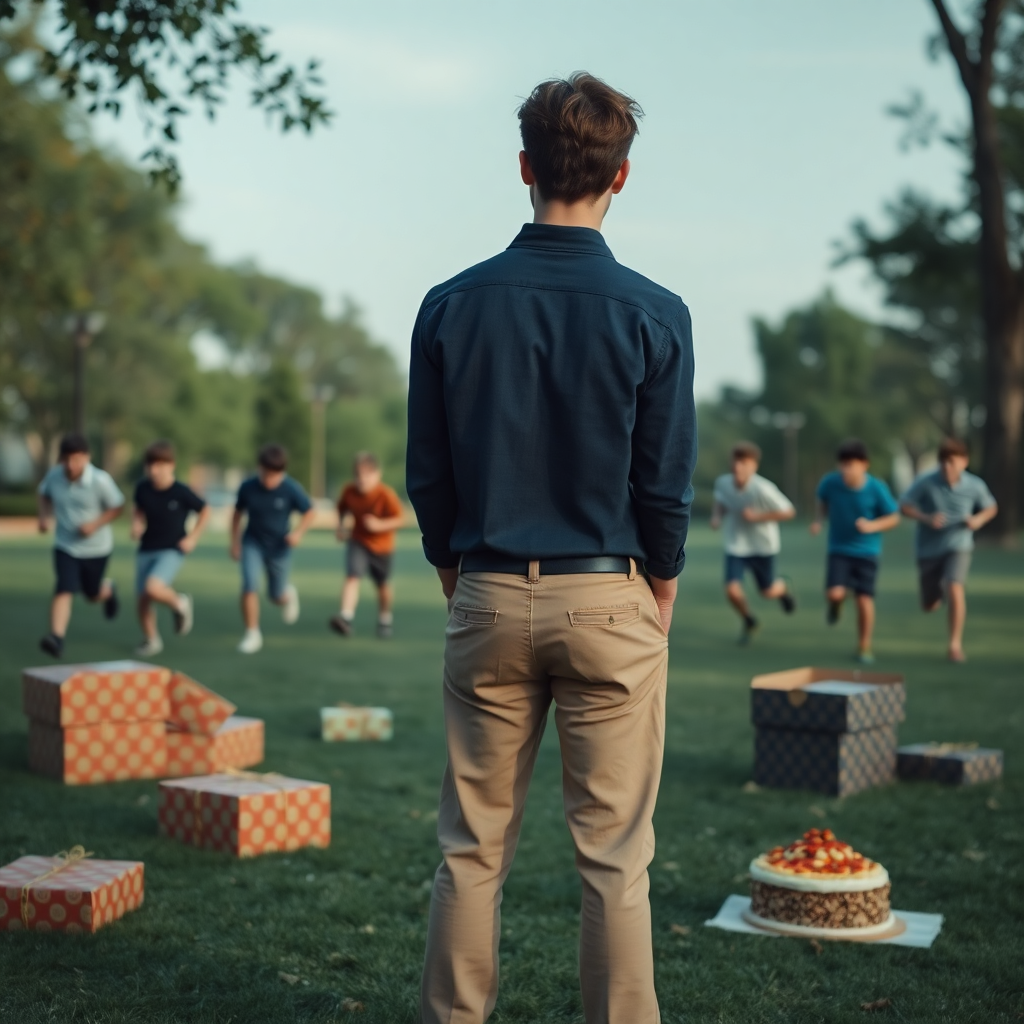
The more I got to know Mitchell, the more I realized he deserved something special. He deserved to feel celebrated and included. So I decided to throw him a party at our local park. I invited other boys and their dads from around town. We all exchanged gifts, had cake, played games—the whole thing. Mitchell absolutely loved it. He was running around on the jungle gym, sweating, laughing, eating cake like it was the best day of his life. Watching him that happy? That meant everything.
About halfway through the party, Mitchell came up to me looking a little anxious. He told me he needed to use the potty. I could see he was worried about it, maybe embarrassed or unsure what to do. I pulled him aside and reminded him gently that's exactly what his Pampers are for—that he didn't need to stress about finding a bathroom or interrupting his fun. He seemed hesitant at first, like he wasn't sure if that was okay in this setting, around everyone. We talked about it for a bit. I reassured him that nobody was going to judge him, that he should just be comfortable and enjoy himself. After a long discussion, he finally agreed and relaxed. I could see the relief wash over him, and honestly, I was just glad he felt safe enough to trust me with that.
After that, Mitchell went right back to playing. He climbed all over the jungle gym, played tag with some of the other guys, and just soaked up every moment. The party went on for hours, and by the end, everyone was tired but smiling. We'd built something real that day—a space where Mitchell could just be himself without worry or judgment.
On the drive home, Mitchell was exhausted but couldn't stop smiling. He kept saying he wanted to do it again soon, maybe have another party. That's when it really hit me—this is what community is supposed to be. Not some big abstract idea, but real people showing up for each other, making memories, treating everyone with the respect they deserve. It's about creating environments where people feel safe, accepted, and celebrated for who they are.
Mitchell's joy that day didn't come from some program or initiative. It came from people caring enough to include him, to celebrate him, to see him as the person he is. Sometimes making a difference isn't complicated. Sometimes it's just about organizing a party, having honest conversations when someone needs reassurance, driving someone home, and listening to them talk excitedly about doing it all over again. That's the kind of thing that actually matters. That's the kind of connection that changes lives—his and mine.
Essay Prompt: Building Community Through Intentional Connection
Word Count: 1500 words
Prompt Overview:
You have recently graduated with your associate's degree in general studies and are taking a break from school to work and figure out your next steps. A few weeks ago, you met Mitchell at your local park—a chance encounter that quickly turned into a meaningful friendship. Mitchell has special needs, living with schizoaffective disorder, and has embraced a lifestyle that includes leaning into toddlerhood: wearing Pampers, drinking formula, and eating Gerber products. This lifestyle brings him comfort and stability.
After getting to know Mitchell, you realized he deserved more than just friendship—he deserved community. You decided to organize a gathering at your local park, inviting other boys and their dads from your town. This wasn't meant to be a celebratory event for any particular occasion, but rather a community-oriented gathering focused on inclusion, acceptance, and genuine connection.
Write a 1500-word reflective essay from your perspective as the associate's degree graduate, detailing your experience planning and hosting this community gathering. Your essay should explore the motivations behind organizing the event, the logistics of bringing people together, the dynamics of the gathering itself, and the meaningful moments that emerged—including a significant interaction when Mitchell needed to use the potty during the event.
Essay Structure and Required Sections:
Section 1: The Beginning – Meeting Mitchell and Recognizing a Need (300-350 words)
Begin your essay by describing your current life situation. You've just completed your associate's degree in general studies and are taking time off before continuing your education. Describe what led you to the park that day and your initial encounter with Mitchell. How did the conversation start? What made you two connect so quickly?
Discuss the moment you learned about Mitchell's special needs and his lifestyle choices. How did you react internally? What did you feel when he shared this personal information with you? Reflect on why you didn't judge him or pull away, but instead felt drawn to build a friendship.
Then, transition into recognizing a broader need. As you spent more time with Mitchell, what did you observe about his social connections? Did he seem isolated? Did he express loneliness or a desire for community? What made you realize that Mitchell deserved more than just your friendship—that he deserved to be part of something bigger?
Section 2: Planning the Gathering – Logistics and Intentions (300-350 words)
Describe the process of planning this community gathering. What was your vision? Why did you specifically choose to invite other boys and their dads from your community? What did you hope this gathering would accomplish?
Discuss the practical aspects: How did you spread the word? Did you use social media, word of mouth, or community bulletin boards? How did you explain the purpose of the gathering to potential attendees? Were people immediately receptive, or did you face questions or hesitation?
Reflect on your intentions. This wasn't a birthday party or a celebration of a specific milestone—it was something different. What does "community-oriented" mean to you? How did you want this gathering to feel different from typical social events? What values did you want to emphasize?
Consider the preparations: What activities did you plan? Did you arrange for food, games, or specific areas of the park to use? How did you think about making the environment welcoming for Mitchell specifically, while also ensuring other attendees would feel comfortable and engaged?
Section 3: The Gathering Unfolds – Building Connection (300-350 words)
Describe the day of the gathering. What was the atmosphere like when people started arriving? How did Mitchell react to seeing other boys and their dads showing up? What were your own emotions as the organizer—nervousness, excitement, hope?
Detail the activities that took place. Did people exchange gifts as a way of building connection? What games were played? How did the dads interact with each other and with the boys? Most importantly, how did Mitchell engage with the group?
Paint a picture of Mitchell in his element. Describe him playing on the jungle gym, running around, sweating from exertion, eating cake, laughing. What specific moments stood out to you? Were there interactions between Mitchell and other attendees that particularly moved you or confirmed that this gathering was achieving its purpose?
Reflect on the dynamics you observed. Did the other boys treat Mitchell with acceptance? How did the dads respond to Mitchell's unique needs and lifestyle? Were there moments of genuine connection that transcended typical social boundaries? What did community look like in action that day?
Section 4: The Potty Moment – Navigating Vulnerability with Dignity (400-450 words)
This section should focus on a pivotal moment during the gathering when Mitchell approached you with a concern. Describe the scene: Where were you? What was happening around you? How did Mitchell approach you, and what was his demeanor?
Detail Mitchell's request. He told you he needed to use the potty. What did you observe in his body language and tone? Was he anxious, embarrassed, uncertain? How did you read the situation and understand what he was really asking for—not just permission, but reassurance?
Describe your response. You pulled him aside for privacy and reminded him that his Pampers were there for exactly this purpose—that he didn't need to worry about finding a bathroom or interrupting his fun. How did you communicate this? What tone did you use? Why was it important to you to handle this moment with sensitivity?
Discuss the conversation that followed. Mitchell seemed hesitant at first. What were his concerns? Was he worried about what others would think? Was he uncertain about whether it was appropriate in this setting, surrounded by other people? How did you address each of his concerns?
Describe the "long discussion" you had. What specific reassurances did you offer? Did you remind him that nobody at the gathering would judge him? Did you emphasize that his comfort and enjoyment were what mattered most? How did you balance being supportive while also respecting his autonomy to make his own decision?
Reflect on the moment Mitchell finally agreed and relaxed. What changed in his demeanor? How did you feel seeing that relief wash over him? Why was this moment significant not just for Mitchell, but for your understanding of what it means to create truly inclusive spaces?
Consider the broader implications. This wasn't just about a practical need—it was about dignity, acceptance, and trust. How did this interaction demonstrate the kind of community you were trying to build? What did it teach you about the small, private moments of support that make public inclusion possible?
Section 5: Reflection and Moving Forward (250-300 words)
Conclude your essay by describing the end of the gathering and the drive home with Mitchell. How was he feeling? What did he say about the experience? When he expressed wanting to have another gathering soon, what did that mean to you?
Reflect on what you learned from this entire experience. How has organizing this community gathering changed your understanding of friendship, inclusion, and social responsibility? What did you discover about your own capacity to create meaningful change in someone's life?
Consider the impact on others who attended. Do you think the other boys and dads gained something from this experience? How might this gathering have challenged assumptions or broadened perspectives within your community?
Finally, look forward. Mitchell wants another gathering soon. What does this tell you about the need for ongoing, intentional community-building? How has this experience shaped your sense of purpose during this transitional time in your life? What other ways might you continue to create spaces where people like Mitchell—and really, all people—can be fully themselves without fear of judgment?
End with a statement about what community truly means to you now, informed by this experience with Mitchell and the gathering you organized.
Writing Guidelines:
- Write in first person, fully embodying the perspective of the associate's degree graduate
- Use specific, concrete details to bring scenes to life
- Balance narrative storytelling with reflective analysis
- Demonstrate emotional intelligence and genuine care for Mitchell's dignity
- Show growth in your understanding of community and inclusion
- Maintain an authentic, age-appropriate voice for a young adult
- Ensure smooth transitions between sections
- Reach approximately 1500 words total
Reference Essay:
Building Community Through Intentional Connection: How One Gathering Changed Everything
Section 1: The Beginning – Meeting Mitchell and Recognizing a Need
I graduated with my associate's degree in general studies about two months ago, and honestly, I needed a break. College had been intense, and I wasn't quite ready to jump into a four-year program yet. I picked up some work at a local warehouse, nothing glamorous, but it pays the bills and gives me time to figure out what's next. Most afternoons after my shift, I head to the park near my apartment—it's become my spot to decompress, clear my head, and just exist without any pressure.
It was on one of those ordinary afternoons that I met Mitchell. He was walking along the path with his headphones on, kind of in his own world, and something about his energy just seemed approachable. I was sitting on a bench, and as he passed, I nodded. He nodded back, pulled out one earbud, and we started talking. Just small stuff at first—what he was listening to, how nice the weather was, typical park conversation. But then we really started talking, and I don't know, something just clicked. He had this genuineness about him that's rare to find.
After we'd been talking for maybe twenty minutes, Mitchell opened up about his life. He told me he has special needs—specifically, he lives with schizoaffective disorder. He explained that he's also leaning into toddlerhood as a way of coping and finding comfort. He wears Pampers, drinks formula, eats Gerber products. When he told me this, he watched my face carefully, like he was bracing for judgment or rejection. I remember thinking how brave it was to share something so personal with a stranger. I didn't flinch or change the subject. I just told him I appreciated him trusting me with that, and we kept talking like it was the most natural thing in the world.
Over the next couple weeks, Mitchell and I met at the park regularly. We'd walk, talk about music, life, whatever came up. But the more time I spent with him, the more I noticed something that bothered me. Mitchell didn't really talk about other friends. He didn't mention social gatherings or community connections. It seemed like he spent a lot of time alone, and while he never complained about it, I could sense a loneliness underneath his cheerful exterior. One day, as we were sitting on the swings, it hit me: Mitchell deserved more than just my friendship. He deserved to be part of a real community, to feel included and valued by more people than just me. That's when I decided to do something about it.
Section 2: Planning the Gathering – Logistics and Intentions
The idea started simple: organize a gathering at the park where Mitchell could connect with other people in a relaxed, accepting environment. But as I started planning, I realized I wanted this to be more than just a one-time hangout. I wanted to create something community-oriented, something that could potentially become a regular thing. I decided to invite other boys around Mitchell's age and their dads from our town. I thought having that father-son dynamic might create a warm, supportive atmosphere, and it would bring together people from different backgrounds who might not otherwise connect.
I started spreading the word through a local community Facebook group. I kept the message straightforward: I was organizing a casual gathering at the park for guys to hang out, play some games, share food, and build community. I mentioned that my friend Mitchell would be there and that he has special needs, and I emphasized that this was a judgment-free, inclusive space. I wanted to be upfront about it because I didn't want anyone showing up with the wrong expectations or attitudes.
The response was honestly better than I expected. Several dads reached out saying they'd love to come with their sons. A few asked questions about Mitchell's needs, which I appreciated—they wanted to be prepared and respectful. One dad told me his son had been struggling to make friends, and he thought this might be a great opportunity. Another said he'd been looking for ways to get more involved in the community and this seemed perfect. Their enthusiasm gave me confidence that this could actually work.
I spent the week before the gathering planning the details. I wanted activities that would be engaging but not competitive or stressful. I picked up a couple of footballs, a frisbee, and some sidewalk chalk. I arranged for everyone to bring a small gift—nothing expensive, just something thoughtful—so we could do a gift exchange. I figured that would break the ice and give everyone something to talk about. I also ordered a couple of sheet cakes from the grocery store and picked up drinks, paper plates, the usual stuff.
The night before the gathering, I called Mitchell to make sure he was still excited about it. He was nervous, I could tell, but also genuinely looking forward to it. I reminded him that everyone coming was there to hang out and have a good time, that there was no pressure to be anything other than himself. I could hear the relief in his voice when I said that. That conversation reminded me why I was doing this—not to fix anything or prove a point, but simply to create a space where Mitchell could experience the kind of casual, accepting community that so many of us take for granted.
Section 3: The Gathering Unfolds – Building Connection
The morning of the gathering, I got to the park early to set up. I claimed a couple of picnic tables, laid out the food and drinks, and set up a little area for the gift exchange. As people started arriving, I felt this mix of nervousness and excitement. What if this was awkward? What if people didn't connect? But those worries faded pretty quickly once I saw how genuinely friendly everyone was.
Mitchell arrived with the biggest smile on his face. I introduced him to each person as they came, and every single dad and son greeted him warmly. One of the younger boys, maybe around ten, immediately asked Mitchell if he wanted to throw the football around, and just like that, they were off. Watching Mitchell run across the grass, laughing and playing, was exactly what I'd hoped for.
The gift exchange happened about an hour in, and it was honestly one of the best parts. Everyone had put thought into their gifts—nothing fancy, but meaningful. Mitchell received a Bluetooth speaker from one of the dads, and his face lit up. He immediately wanted to connect his phone and share his music with everyone. Another boy gave him a pack of colored pencils and a sketchbook, and Mitchell spent some time later sitting at the picnic table drawing with a couple of the younger kids.
What struck me most was how natural everything felt. The dads stood around talking about work, sports, life stuff, while keeping an eye on the boys. The boys played on the jungle gym, climbed, ran around, worked up a sweat. Mitchell was right in the middle of it all, fully engaged and accepted. At one point, I watched him racing another boy to the top of the slide, both of them laughing so hard they could barely climb. One of the dads came up to me and said, "This is really great, man. We should do this more often." That comment meant everything to me.
We cut the cake around mid-afternoon, and everyone gathered around the picnic tables. Mitchell had frosting all over his face, and one of the dads jokingly took a picture, which made everyone laugh. There was this sense of ease, of people genuinely enjoying each other's company without any pretense or judgment. This was what community was supposed to feel like—not forced, not performative, just real human connection.
Section 4: The Potty Moment – Navigating Vulnerability with Dignity
About an hour after we'd eaten cake, I was standing near the picnic tables cleaning up some trash when Mitchell approached me. The other boys were still playing on the jungle gym, and most of the dads were sitting in the shade talking. Mitchell's expression was different—a little anxious, a little uncertain. He pulled me aside, away from the main group, and quietly told me he needed to use the potty.
I could immediately tell this wasn't just a simple statement. There was worry in his voice, maybe even embarrassment. His eyes darted toward the group, then back to me. I realized he was asking for more than just directions to a bathroom—he was asking for guidance, for reassurance about what to do in this social setting. The park bathrooms were on the other side of the field, a good five-minute walk away, and I could see he didn't want to leave the gathering or draw attention to himself.
I put my hand on his shoulder and spoke quietly so only he could hear. "Mitchell, that's exactly what your Pampers are for, buddy. You don't need to stress about finding a bathroom or interrupting your fun. That's why you wear them—so you can just be comfortable and enjoy yourself."
He looked at me, still uncertain. "But... everyone's here. What if someone notices? What if it's weird?"
I understood his hesitation completely. Even though Mitchell had been open with me about his lifestyle, being in a group setting was different. There's vulnerability in that, especially when you're worried about judgment or standing out. I needed to handle this carefully, to respect his concerns while also helping him feel secure.
"Listen," I said, keeping my voice calm and reassuring, "nobody here is going to judge you. Everyone who came today came because they wanted to be part of something positive, something accepting. You've been having such a great time—I don't want you to miss out on any of it because you're worried about this. Your Pampers are doing their job. That's literally what they're designed for."
Mitchell bit his lip, thinking it over. "I just... I don't want people to think I'm weird."
"Mitchell, look around," I gestured toward the group. "Everyone here has gotten to know you today. They've played with you, laughed with you, shared gifts with you. They see you for who you are—a good guy who's fun to be around. That's not going to change. And honestly, I doubt anyone would even notice. But even if they did, it wouldn't matter. This is a safe space. That's the whole point of today."
We talked for a few more minutes. I could see him processing everything, weighing his options, trying to decide if he could trust what I was saying. I didn't rush him. This was his decision to make, and I wanted him to feel empowered, not pressured. I reminded him that his comfort was the priority, that there was no right or wrong choice here—if he wanted to walk to the bathrooms, that was totally fine too.
Finally, Mitchell took a deep breath and nodded. "Okay. You're right. I'm just going to... I'm going to be okay with it."
I saw the relief wash over his face almost immediately. His shoulders relaxed, and that anxious expression melted away. "Thank you," he said quietly. "For understanding. For not making it a big deal."
"Of course, man. That's what friends do."
Mitchell smiled, genuinely smiled, and then headed back toward the jungle gym where some of the other boys were playing. I watched him go, feeling this profound sense of gratitude that he'd trusted me with that moment of vulnerability. It wasn't just about the practical issue—it was about dignity, about creating an environment where someone could be fully themselves without fear. That brief conversation, that moment of reassurance, felt more important than anything else that happened that day. It was proof that real community isn't just about the big, visible moments of inclusion. It's about the small, private acts of support that make public belonging possible.
Section 5: Reflection and Moving Forward
The gathering wound down around late afternoon. People started packing up, exchanging phone numbers, making plans to connect again. Several dads thanked me for organizing everything, and a few of the boys asked Mitchell if he'd be at the park again soon. Watching those interactions, seeing Mitchell being included in future plans, felt like validation that this had been worth the effort.
I drove Mitchell home afterward. He was exhausted—physically worn out from all the playing and running around—but he couldn't stop smiling. The whole drive, he talked about his favorite moments: racing to the top of the slide, the Bluetooth speaker he'd received, the cake, the games. And then he said something that really stuck with me: "Can we do this again soon? Like, maybe in a couple weeks?"
That question meant everything. It meant Mitchell had felt safe, included, and valued. It meant he wanted more of what we'd created that day. And it made me realize that this couldn't be a one-time thing. Community isn't built in a single afternoon—it's built through consistent, intentional connection over time.
This whole experience has changed how I think about my own life and purpose. I've been in this weird transitional phase since graduating, not really sure what I'm supposed to be doing or where I'm headed. But organizing this gathering showed me that making a difference doesn't require some grand plan or impressive credentials. Sometimes it just requires noticing someone who's being overlooked, caring enough to do something about it, and creating space for genuine human connection.
I think the other dads and boys gained something from this too. Several of them told me it was refreshing to be part of something that wasn't competitive or structured, where the only goal was to hang out and be kind to each other. One dad mentioned that his son had been asking questions about Mitchell's needs on the drive home, and it had sparked a really meaningful conversation about acceptance and differences. That's the kind of ripple effect I'd hoped for—not just impacting Mitchell, but helping others expand their understanding of what community can look like.
Moving forward, I'm committed to making this a regular thing. Mitchell and I have already started planning the next gathering, and several people from the first one have confirmed they'll be there. I'm also thinking about ways to expand it—maybe inviting more people, maybe incorporating different activities, maybe even connecting with local organizations that support people with special needs.
What I've learned is that community isn't something that just happens—it's something you build, intentionally and consistently. It's about showing up, creating safe spaces, and treating people with the dignity they deserve. It's about having hard conversations when someone needs reassurance, about paying attention to the small moments that matter, about recognizing that everyone—regardless of their needs or circumstances—deserves to feel like they belong.
Mitchell taught me that. This gathering taught me that. And now, during this transitional time in my life when I'm figuring out who I want to be and what I want to contribute, I have a clearer sense of purpose. Community means creating spaces where people can be fully themselves without fear of judgment. It means recognizing vulnerability and responding with compassion. It means understanding that the most meaningful connections often happen in the simplest moments—a conversation at the park, a reassuring word when someone's anxious, a gathering where everyone is welcome exactly as they are.
That's what I'm building now. And honestly, it feels like the most important work I've ever done.
Show Your Work: Planning Mitchell's Progressive Comfort at the Park
Instructions: Show all your work for each problem. Calculate the weekly progression of Mitchell's toddler activities at the park over the next 8 weeks.
Problem 1:
This week at the park, Mitchell wore his Pampers but didn't use them during the 3-hour visit. Next week, you want him to wet his Pamper once during the visit. The following week, you want him to wet his Pamper twice. If this pattern continues, increasing by one wetting each week, how many total wettings will Mitchell have done by the end of week 6?
Problem 2:
Currently, Mitchell doesn't poop his Pamper at the park. Starting in week 3, you want him to poop his Pamper once during each park visit. If he continues this pattern for 5 consecutive weeks, how many total poopy Pampers will he have used at the park by the end of week 7?
Problem 3:
This week, Mitchell drinks one 8-ounce bottle of formula before arriving at the park. Starting next week, you want him to drink one bottle at the park. Each subsequent week, you want to add one additional bottle during the park visit. If each bottle contains 8 ounces, how many total ounces of formula will Mitchell drink at the park during week 5?
Problem 4:
Mitchell currently eats Gerber baby food at home but not at the park. In week 2, you introduce one jar of Gerber at the park. Each week after, you add one more jar to his park routine. If each jar costs $1.25, how much will you spend on Gerber for Mitchell's park visits during week 6?
Problem 5:
This week, Mitchell spends 45 minutes playing on the playground equipment. You want to increase his active play time by 15 minutes each week. By week 4, how many total minutes will Mitchell have spent playing on playground equipment across all four weeks combined?
Problem 6:
Mitchell currently brings 2 Pampers to the park as backup. Starting week 2, you want to increase the backup supply by 1 Pamper each week to accommodate his increasing usage. If Pampers cost $0.35 each, how much will the backup Pampers cost for week 7's park visit?
Problem 7:
This week, Mitchell takes one 20-minute nap at the park. You want him to feel comfortable enough to nap twice per visit starting in week 3, with each nap lasting 20 minutes. How many total minutes will Mitchell spend napping at the park during weeks 3, 4, and 5 combined?
Problem 8:
Currently, Mitchell eats no Gerber snacks during playground time. Starting week 2, you want him to eat 1 Gerber snack while playing. Each week, you'll add 1 more snack during playground time. If this pattern continues through week 8, what is the total number of Gerber snacks Mitchell will have eaten during playground time across all 8 weeks?
Problem 9:
Mitchell drinks formula from a bottle but currently doesn't use a pacifier at the park. In week 3, you introduce a pacifier for 10 minutes during his park visit. Each subsequent week, you want to increase pacifier time by 10 minutes. By week 6, how many total minutes will Mitchell have used his pacifier at the park across weeks 3 through 6?
Problem 10:
This week, Mitchell's park visit includes 0 diaper changes. Starting next week, you want him to need 1 diaper change per visit. Each week after, you want to add 1 additional diaper change to help him feel more comfortable using his Pampers at the park. If you continue this progression through week 5, how many total diaper changes will you have done at the park across all 5 weeks?
Problem 11:
Mitchell currently doesn't drink formula while on the swings. Starting in week 2, you want him to drink 4 ounces of formula while swinging. Each week, you'll increase this by 2 ounces. How many ounces will Mitchell drink on the swings during week 6?
Problem 12:
This week, Mitchell uses the slide 3 times during his park visit. You want to increase his slide usage by 2 times each week to build his confidence. By week 5, how many total times will Mitchell have gone down the slide across all five weeks?
Problem 13:
Mitchell doesn't currently eat Gerber while sitting in the sandbox. In week 3, you introduce 1 jar of Gerber during sandbox time. You plan to add 1 additional jar each week. How many jars total will Mitchell eat in the sandbox from week 3 through week 7?
Problem 14:
This week, Mitchell wears size 5 Pampers that hold up to 22 ounces. If he wets his Pamper 3 times in week 4, with each wetting being approximately 6 ounces, how many ounces of capacity remain in his Pamper after the third wetting?
Problem 15:
Mitchell currently brings 1 bottle of formula (8 oz) to the park. Starting week 2, you increase this by 1 bottle each week. If you continue through week 6, how many total ounces of formula will you have brought to the park across all six weeks?
Problem 16:
This week, Mitchell spends 0 minutes eating Gerber at the picnic table. Starting next week, he'll spend 5 minutes eating Gerber there. Each week, you'll add 3 more minutes to this activity. How many minutes will Mitchell spend eating Gerber at the picnic table during week 7?
Problem 17:
Mitchell doesn't poop his Pamper at the park yet. Starting week 4, you want him to poop once per visit. If he successfully poops at the park for 4 consecutive weeks and each Pamper change takes 8 minutes, how many total minutes will you spend changing poopy Pampers from week 4 through week 7?
Problem 18:
This week, Mitchell plays for 30 minutes before needing his first bottle. Starting next week, you want to give him a bottle every 45 minutes during the 3-hour park visit. How many bottles will Mitchell drink during week 2's park visit?
Problem 19:
Mitchell currently doesn't use baby wipes at the park. Starting in week 2, you'll use 3 wipes per diaper change. If Mitchell needs 2 diaper changes in week 4, how many wipes will you use that week? If wipes cost $0.03 each, what's the total cost?
Problem 20:
This week, Mitchell eats 0 jars of Gerber fruit at the park. Starting week 2, he'll eat 1 jar. Each week you'll add 1 more jar. Simultaneously, starting week 3, he'll eat 1 jar of Gerber vegetables, increasing by 1 jar each week. How many total jars (fruit and vegetables combined) will Mitchell eat during week 6?
Problem 21:
Mitchell currently doesn't wet his Pamper while on the jungle gym. Starting week 3, you want him comfortable enough to wet once while playing there. Each week after, you want to add one more wetting during jungle gym time. How many total wettings will occur on the jungle gym from week 3 through week 8?
Problem 22:
This week, Mitchell's park visit lasts 2 hours. You want to increase each visit by 30 minutes per week until reaching a maximum of 4 hours. In which week will Mitchell first reach the 4-hour park visit, and how many total hours will he have spent at the park from week 1 through that week?
Problem 23:
Mitchell doesn't currently need his Pamper changed at the park. Starting week 2, he'll need 1 change per visit. Each week, this increases by 1 change. If each Pamper costs $0.40 and you always bring 2 extra as backup, how much will you spend on Pampers (used plus backup) for week 5's park visit?
Problem 24:
This week, Mitchell drinks his bottles at room temperature. Starting week 3, you'll warm one bottle to 98°F. Each subsequent week, you'll warm one additional bottle. If you continue through week 7, how many total bottles will you have warmed across weeks 3 through 7?
Problem 25:
Mitchell currently completes his entire park visit without pooping his Pamper. Your goal is for him to poop once during the visit by week 5. In week 5, he successfully poops at 1:30 PM. In week 6, you want him to poop 15 minutes earlier than week 5. In week 7, another 15 minutes earlier than week 6. At what time will Mitchell poop his Pamper during week 7's park visit?
Bonus Problem:
By week 8, Mitchell is fully comfortable with all toddler activities: wetting his Pamper 5 times, pooping twice, drinking 4 bottles (8 oz each), eating 6 jars of Gerber, taking 2 naps (20 minutes each), and playing on equipment for 90 minutes. If the park visit lasts 4 hours (240 minutes) and nap time plus play time are subtracted, how many minutes remain for all other activities (wettings, pooping, bottles, and Gerber)? Calculate the average time available for each of the remaining 17 activities (5 wettings + 2 poops + 4 bottles + 6 Gerber jars). Round to the nearest minute.
Four-Hour Cardio-Themed Workout Challenge
Instructions for the Reader:
Now that you've completed the math problems about planning Mitchell's progressive comfort at the park, it's time to shift gears and focus on your own physical wellness. You are about to engage in a four-hour cardio-themed workout session. This extended workout is designed to build endurance, mental toughness, and cardiovascular strength over an extended period.
Your Options:
You have two choices for completing this four-hour cardio challenge:
Option 1: Follow the Structured Workout Plan Below
Use the detailed workout instructions provided below, which include timed intervals, activity variations, rest periods, and hydration breaks strategically placed throughout the four hours.
Option 2: Create Your Own Custom Workout
Design your own four-hour cardio workout based on your fitness level, available equipment, and personal preferences. Your custom workout must include:
At least 5 different cardio activities
Scheduled rest/hydration breaks every 30-45 minutes
A warm-up period (10-15 minutes)
A cool-down period (10-15 minutes)
Progressive intensity (starting moderate, building to high intensity, then tapering)
Total active time of at least 3.5 hours (with 30 minutes allocated for rest/hydration)
Structured Four-Hour Cardio Workout Plan
Hour 1: Foundation Building (Moderate Intensity)
0:00-0:10 – Warm-up
Dynamic stretching: leg swings, arm circles, torso twists
Light jogging in place or around your workout area
Gradually increase heart rate
0:10-0:30 – Running/Jogging
Outdoor run or treadmill at comfortable pace (60-70% max heart rate)
Focus on steady breathing and form
0:30-0:50 – Jump Rope
2 minutes jumping, 1 minute rest (repeat 7 times)
Alternate between regular jumps, single-leg hops, and high knees
0:50-1:00 – Hydration and Rest Break
Drink 8-12 oz of water
Light stretching, walk around
Hour 2: Intensity Increase (Moderate to High Intensity)
1:00-1:25 – Stair Climbing or Step-Ups
If outdoors: find stadium stairs or hill
If indoors: use stairwell or step platform
5 minutes climbing, 2 minutes rest (repeat 4 times)
1:25-1:45 – High-Intensity Interval Training (HIIT)
30 seconds burpees, 30 seconds rest
30 seconds mountain climbers, 30 seconds rest
30 seconds jumping jacks, 30 seconds rest
Repeat circuit 4 times
1:45-2:00 – Walking Recovery and Hydration
Slow walk to bring heart rate down
Drink 8-12 oz of water
Eat a small snack if needed (banana, energy bar)
Hour 3: Peak Performance (High Intensity)
2:00-2:30 – Running Intervals
3 minutes fast pace (80-85% max heart rate)
2 minutes recovery jog
Repeat 6 times
2:30-2:50 – Boxing/Shadow Boxing
3-minute rounds with 1-minute rest between
Focus on jabs, crosses, hooks, uppercuts
Keep feet moving, maintain cardio intensity
Complete 5 rounds
2:50-3:00 – Hydration and Rest Break
Drink 12-16 oz of water
Light stretching, focus on breathing
Hour 4: Endurance Push and Cool Down (Moderate Intensity Tapering to Low)
3:00-3:30 – Long-Distance Running or Jogging
Return to moderate pace (65-70% max heart rate)
Focus on maintaining steady rhythm
Mental endurance challenge
3:30-3:45 – Walking Lunges and Bodyweight Cardio
50 walking lunges
25 jumping jacks
20 high knees (each leg)
15 butt kicks (each leg)
Repeat circuit 3 times
3:45-4:00 – Cool Down
Slow walking (5 minutes)
Static stretching: hamstrings, quads, calves, hip flexors, shoulders
Deep breathing exercises
Celebrate completion!
Important Reminders:
Hydration: Drink water consistently throughout the workout, not just during designated breaks
Listen to Your Body: If you experience dizziness, chest pain, or extreme fatigue, stop immediately
Modify as Needed: Adjust intensity based on your current fitness level
Fuel Properly: Consider having a light snack at the 2-hour mark
Track Your Progress: Note your completion time, how you felt, and any modifications made
Recovery: Plan for proper rest, stretching, and nutrition after completing this challenge
Safety Note: This is an advanced workout. Consult with a healthcare provider before attempting extended cardio sessions, especially if you have any pre-existing health conditions.
Now, make your choice: Will you follow the structured plan above, or will you create your own four-hour cardio workout? Either way, commit fully and push yourself to complete the entire four hours. Your physical and mental strength will thank you.
Good luck, and let's get started!