
(Reflection, Math, Fitness, Mindfulness) Helmet On, Pampers Secure: Exploring the Thrill and Debate Behind Mitchell’s Alley Adventures
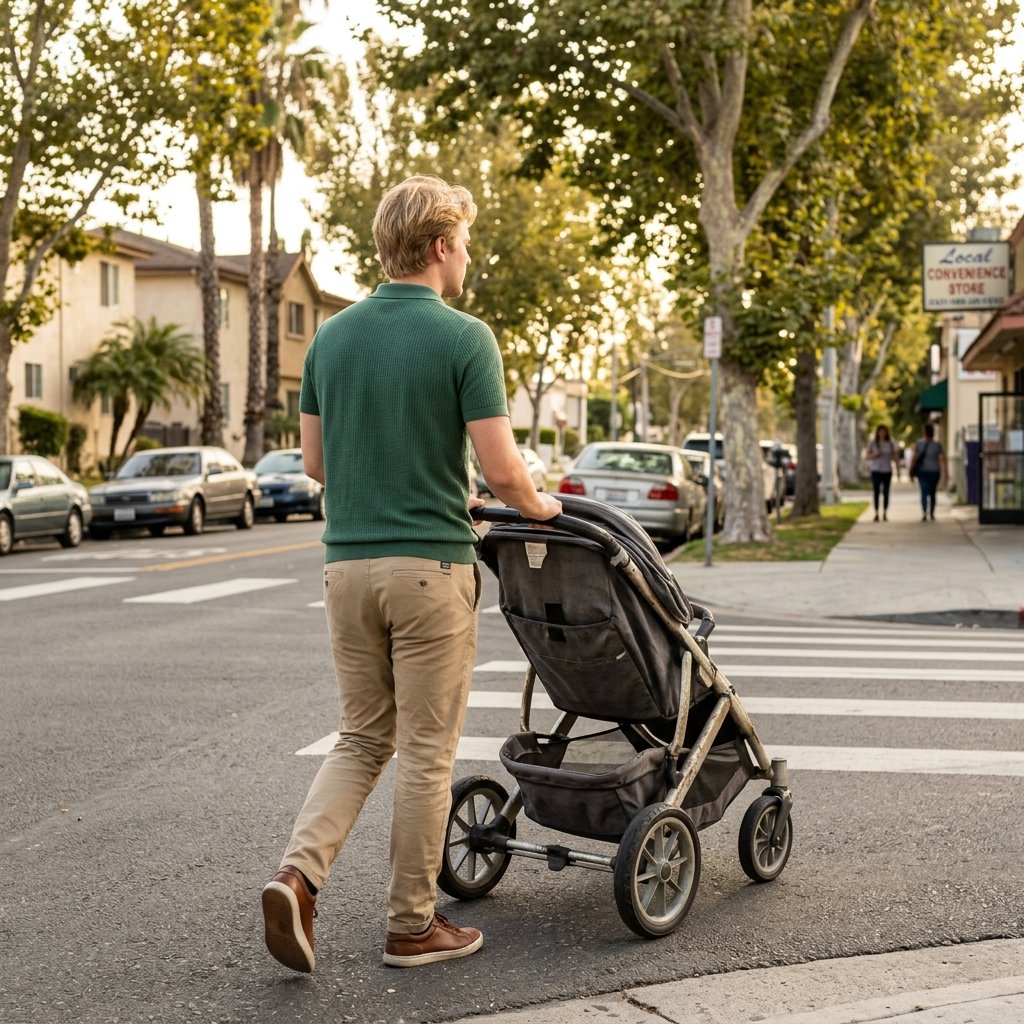
It started out as just another chill day. The sun was out, the air felt perfect—summer's energy was buzzing, and the squad and I were looking for something fun to do. Mitchell, my buddy’s little bro, was hanging with us that afternoon, the coolest toddler you’ll meet, sporting his fresh baby kicks, his helmet snug over his blond curls, and, of course, his trusty Pampers. He’s kind of like the honorary squad member, always down for a laugh.
We were at the park, kicking back and messing around with Mitchell’s stroller. What started as casual little runs along the sidewalk turned into a game—who could push him the fastest? I mean, how could we not? The smooth pavement stretched ahead like a challenge, and Mitchell was giggling like crazy, loving every second of it. A little speed never hurt, right? We kept it easy at first, laughing and hyping each other up as we took turns, making sure Mitchell’s helmet was secure. Then someone joked, “Bet you don’t have the guts to send him flying down the alley.”
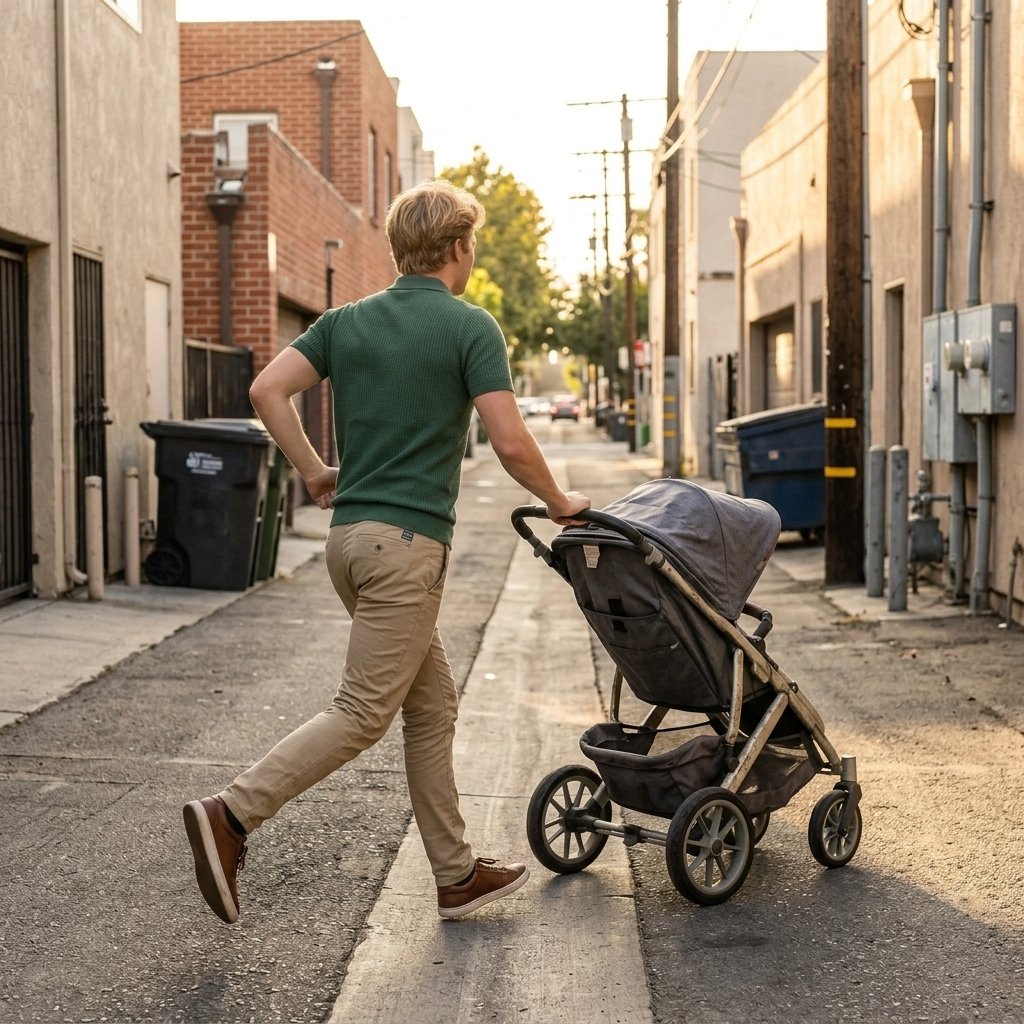
The alley nearby was one of those long, slightly downhill stretches, smooth pavement with just enough edge to make it exciting but not dangerous. I scoped it out—no cars, no obstacles. And I knew Mitchell could handle it. I mean, he had his helmet, his stroller was sturdy, and the kid practically thrives on excitement. “Alright,” I said, grinning. “But you guys better catch him at the end!” I lined up the stroller, checked Mitchell’s gear one more time, and then took a running start.
The wind rushed past us as I pushed him faster and faster—he was squealing with laughter, arms up like he was on some epic rollercoaster. And then, with the smoothest, coolest move I’ve probably pulled in my life, I gave the stroller one last push and let go. Mitchell was flying, the stroller gliding like it was built for this, and the squad was cheering like we were at some extreme sports event. Of course, they caught him at the end, and the stroller came to a safe stop. Mitchell was all smiles, like he’d just conquered the world.
And honestly? It was one of those moments you don’t forget—a perfect mix of adrenaline, laughs, and just living in the moment. Sure, some people might call it reckless, but with Mitchell rocking his helmet and us keeping it safe, it felt like the coolest thing we could’ve done that day.
Essay Prompt
You’re tasked with reflecting on the concept of rowdiness while pushing Mitchell in his stroller and examining where to draw the line between having fun and going too far. Is it harmless fun, or does it blur into irresponsibility? The topic may feel casual, but it opens the floor for debating safety, accountability, and perspective when it comes to thrilling activities.
To structure your thoughts, follow this 1500-word breakdown guide below to craft your essay:
Introduction (200 words): Set the scene by describing Mitchell's alley speed runs, the elements that make them exciting (e.g., thrill, spontaneity), and why they’re seen as controversial. State your thesis about whether you believe this activity strikes a balance between carefree fun and responsible behavior or crosses the line.
Section 1 - The Case for Rowdiness (400 words): Discuss why some people might see playful recklessness in a positive light. Appeal to themes like bonding, nostalgia, personal freedom, and the controlled environment factors (Mitchell wearing his helmet, adults supervising, etc.).
Section 2 - The Case Against It (400 words): Explore the arguments from those who might disapprove. Touch on concerns like potential risks of harm, peer influence, the values being promoted, and the broader message about safety.
Section 3 - Finding the Right Balance (400 words): Analyze how rowdy moments can be managed to ensure safety while preserving the fun. Propose possible guidelines or compromises—for instance, designating safer stunts or imposing limitations.
Section 4 - Personal Takeaway (200 words): Conclude with your perspective on what constitutes responsible fun versus recklessness. Share where you stand regarding Mitchell’s stroller speed runs and why.
Sample Reference Essay
"Speed Runs and Social Debate: Navigating the Thrill with Mitchell’s Stroller"
It’s no secret that pushing Mitchell super fast in his stroller, helmet and Pampers secure, has become a legendary move in the alley. It’s a moment where fun, rebellion, and a flair for being cool all come together. But, as with any thrill-seeking activity, not everyone’s on board. Some see it as a mix of danger and irresponsibility, even if Mitchell himself seems to love it.
On the one hand, there’s undeniable joy in moments like these. Being twenty and riding that line between control and chaos comes with its own nostalgia. To some, running Mitchell down the alley at speed feels like a way to break away from overly cautious norms. Plus, there’s an argument to be made that responsible “rowdiness” – if his helmet’s on, and there’s minimal risk – helps us stay connected to the freedom and recklessness of youth.
Still, it’s impossible to ignore the critics. The idea of letting go of a stroller, even if supervised, can send the wrong message about safety. For some, these actions carry lasting impressions not just for Mitchell but for how friends and bystanders perceive responsibility.
Ultimately, both sides bring weight to their arguments. What’s clear, however, is that there’s space for moderation. Controlled funny moments can stay within the bounds of thrill without teetering into poor decision-making. The key is to find that sweet spot.
Math Test: Packing Mitchell's Diaper Bag
Instructions:
You are tasked with solving the following math problems related to the organization and logistics of packing Mitchell's diaper bag. Show all work clearly and neatly. Assume the caretaker is handling all preparations, and all problems revolve around their decision-making process. Use proper units where applicable.
Part 1: Arithmetic and Basic Algebra
Mitchell’s caretaker packs 10 diapers in the bag. If Mitchell uses 3 diapers every 4 hours, how many hours will the supply last?
The caretaker buys a pack of 48 diapers for $24. What is the cost per diaper?
If a single bottle of formula lasts 2 hours and Mitchell needs formula for a 10-hour trip, how many bottles should the caretaker prepare?
The diaper bag weighs 8 pounds when packed with supplies. If the bag itself weighs 2 pounds, how much do the supplies weigh?
Mitchell drinks 6 ounces of formula per feeding. If the caretaker packs 36 ounces of formula, how many feedings can Mitchell have?
Part 2: Ratios and Proportions
6. A pack of wipes contains 120 wipes, and Mitchell uses 5 per diaper change. How many diaper changes can the pack of wipes support?
7. The caretaker needs to divide snacks into equal portions for three trips. If the total snack weight is 18 ounces, how many ounces should each portion contain?
8. If the diaper bag holds 16 items equally divided into 4 compartments, how many items are in each compartment?
9. Mitchell’s caretaker carries 2 bottles for every 3 diapers in the bag. If there are 12 diapers, how many bottles are packed?
Part 3: Word Problems
10. Mitchell’s toy weighs 1.5 pounds, and his blanket weighs 2 pounds. How much total weight do these items add to the diaper bag?
11. The caretaker has the option to carry either 8 bottles with caps or 9 uncapped bottles. If caps add 0.2 pounds each, how much extra weight will the capped bottles add?
12. The caretaker estimates that Mitchell consumes one jar of food per hour. For a 6-hour outing, how many jars of food do they pack?
13. If the total packed supplies cost $50, and the snacks account for 20% of the cost, how much did the snacks cost?
Part 4: Geometry
14. The diaper bag is shaped like a rectangular prism with dimensions 12 inches by 8 inches by 6 inches. What is the bag’s volume?
15. A circular bottle has a diameter of 3 inches. What is the bottle’s circumference? (Use π ≈ 3.14)
16. Mitchell’s blanket is a square with a side length of 40 inches. What is the area of the blanket?
17. The caretaker arranges rectangular wipes (4 inches by 6 inches) in a stack. If the stack is 3 inches tall, how many wipes are in the stack?
Part 5: Data Analysis and Probability
18. The caretaker tests a new brand of diapers on Mitchell and finds that 4 out of 5 diapers hold up under stress. If the pack contains 20 diapers, how many are expected to hold up?
19. On a weekly outing, the caretaker uses the following numbers of diapers per day: Monday (6), Wednesday (7), Friday (5). What is the average number of diapers used per day?
20. If the caretaker misplaces 10% of the packed items during a trip, how many items are lost if 50 items were packed?
Part 6: Advanced Problems
21. The bag can hold up to 20 pounds of supplies. If the caretaker packs 5 diapers (0.3 pounds each), 6 bottles (1.2 pounds each), and a blanket (2 pounds), how much more weight can the bag safely carry?
22. A pack of formula costs $30 and supplies 15 feedings. What is the cost per feeding?
23. Mitchell’s caretaker budgets $120 for a trip. If they spend $60 on diapers, $30 on formula, and $15 on wipes, how much money is left?
24. If the formula is prepared in a 3-to-1 water-to-powder ratio and the caretaker uses 12 ounces of water, how many ounces of powder are needed?
Bonus Questions:
25. How long will it take the caretaker to repack Mitchell’s supplies if each item takes 3 minutes and there are 12 items to repack?
26. Mitchell’s stroller handles 50 pounds of weight. If Mitchell weighs 25 pounds and the packed bag weighs 8 pounds, how much additional weight can the stroller safely carry?
27. If the caretaker accidentally leaves one item behind every 5 trips, what is the probability they forget something during the next trip?
28. Snacks are sold in bulk packs of 80 ounces, and the caretaker splits them into 10-ounce portions. How many portions can be made?
29. If Mitchell consumes food at a steady rate of 1 jar every 90 minutes, how many jars are needed for a 7.5-hour trip?
30. The caretaker adjusts the bag’s storage compartments so that each section holds an equal number of items. If there are 24 items and 6 compartments, how many items are in each compartment?
End of Test
240-Minute Gym Workout Plan
Follow this comprehensive 4-hour gym workout plan step by step to maximize your fitness and endurance. Do not skip any part, and ensure to stay hydrated throughout the session!
Minute-by-Minute Breakdown:
Minutes 0-10
Warm-Up (Dynamic Stretching and Light Cardio)
Jumping jacks (2 minutes)
Arm circles (1 minute)
High knees (2 minutes)
Light jogging on the treadmill (5 minutes)
Minutes 10-40
Strength Training (Chest and Back Focus)
Bench press (3 sets of 8-12 reps, with 2 minutes rest per set)
Pull-ups or Lat pulldown (3 sets of 8-12, with 2 minutes rest)
Push-ups to failure (3 sets, 1 minute rest between sets)
Dumbbell rows (3 sets of 10-12 reps, 2 minutes rest per set)
Minutes 40-70
Conditioning Circuit (Repeat 3 times with a 3-minute break between circuits)
Burpees (1 minute)
Box jumps (1 minute)
Kettlebell swings (1 minute)
Rowing machine (2 minutes)
Minutes 70-100
Lower Body and Core
Squats (3 sets of 8-10 reps, with 2 minutes rest per set)
Deadlifts (3 sets of 8-10 reps, with 2 minutes rest)
Plank hold (3 sets of 1 minute, resting 1 minute between sets)
Russian twists with medicine ball (3 sets of 15 twists per side)
Minutes 100-130
Cardio Blast
Interval treadmill sprints (10 rounds of 30 seconds sprint + 1-minute walk)
Incline power walking (10 minutes at a brisk pace)
Minutes 130-170
Upper Body (Arms and Shoulders Focus)
Standing shoulder press (3 sets of 10 reps, 2 minutes rest between sets)
Bicep curls (4 sets of 12 reps, 1.5 minutes rest between sets)
Tricep dips (3 sets to failure, 1 minute rest between sets)
Lateral shoulder raises (3 sets of 10-12 reps, 1.5 minutes rest)
Minutes 170-200
Core Focus
Bicycle crunches (3 sets of 20 reps per side)
Hanging leg raises (3 sets of 12-15 reps)
Sit-ups with a medicine ball (3 sets of 12-15 reps)
Side planks (1 minute per side, hold for 3 rounds)
Minutes 200-230
Cool Down (Static Stretching)
Hamstring stretch (3 minutes)
Quad stretch (3 minutes)
Shoulder and triceps stretch (4 minutes)
Cat-cow stretch (2 minutes)
Deep breathing and forward fold stretches (2 minutes)
Minutes 230-240
Final Recovery
Lie down on a mat for deep breathing exercises (10 minutes). Focus on relaxing your muscles and reflecting on your workout achievements.
Stick to this minute-by-minute plan to stay on track and achieve a well-rounded workout that targets your entire body!
Mindfulness Activity: Reflecting on Strength and Perseverance
Scripture Theme: Philippians 4:13 — "I can do all things through Christ who gives me strength."
Activity Steps:
Group Visualization (5 minutes):
Gather the group in a comfortable setting, either seated on cushions or lying on mats. Start by reading Philippians 4:13 aloud. Then, guide them through a visualization exercise. Encourage them to close their eyes and imagine themselves in a moment of great physical or mental challenge. Picture Christ standing beside them, offering unwavering support and strength to push through. Speak in a calm, steady voice, emphasizing the feeling of inner strength and resilience.Silent Reflection (5 minutes):
Ask the group to internalize the scripture quietly. Suggest they think about how it applies to their own lives — whether it’s on the field, in the gym, or facing everyday challenges.Journaling Prompt (10 minutes):
Hand out journals or sheets of paper with a pen. Provide the following prompt to guide their writing:What does Philippians 4:13 mean to you personally? Think about a time when you relied on your strength or perseverance — how do you see God present in that moment? How can this scripture shape your goals moving forward?
Encourage honesty and individual interpretation, reminding them that this is their personal reflection.
Group Sharing (Optional):
If comfortable, invite members to share their thoughts or reflections with the group. This can help foster camaraderie and deeper discussions about faith and perseverance.
This activity combines mindfulness, personal reflection, and faith, helping participants connect their daily lives and challenges to a deeper spiritual source of strength.