
(Reflection, Math, Fitness, Mindfulness) Mitchell's Sticker Chart Toolkit
Overview
Assignment type: Reflective essay
Total word count: 1,500 words
Audience: Written by you, Mitchell's preschool teacher, reflecting on your own classroom practice
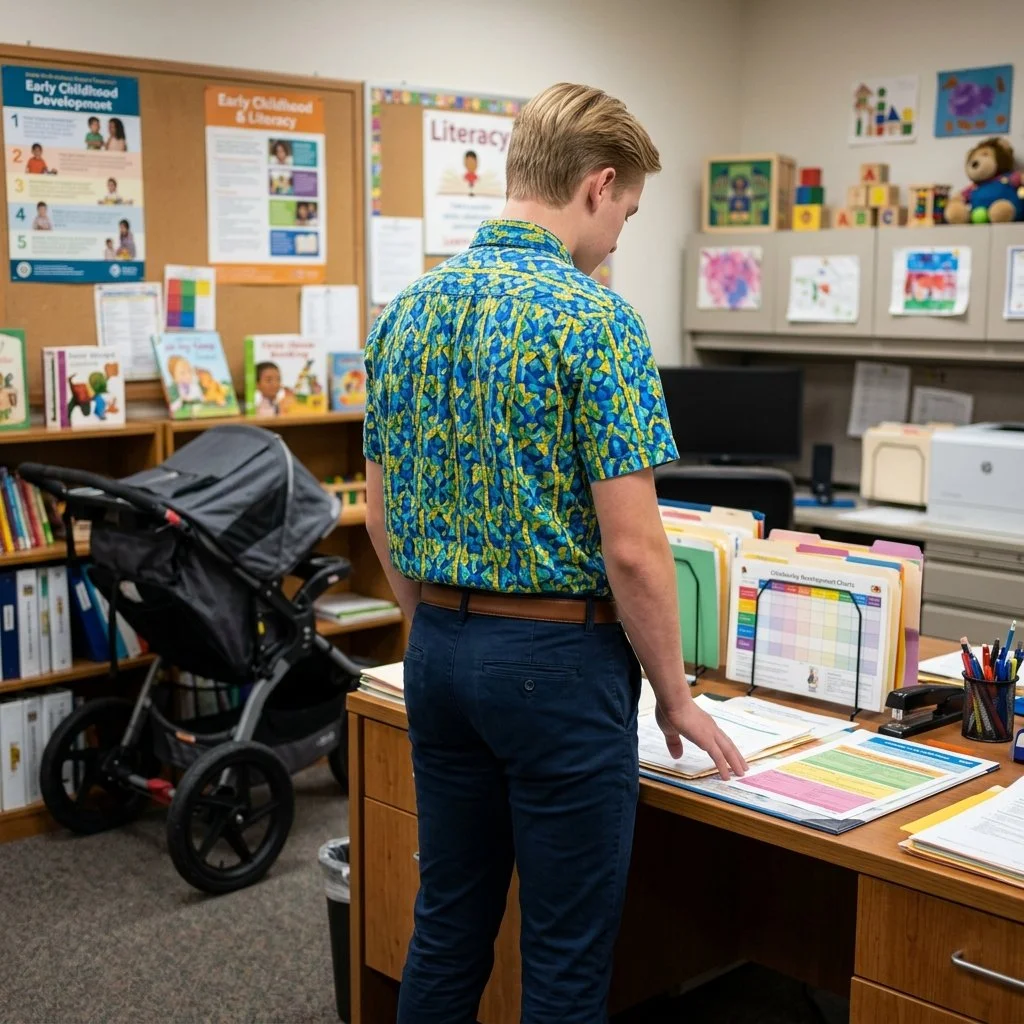
This prompt asks you to write a structured reflection paper on the three sticker charts you use with Mitchell and his classmates. Throughout the essay, keep your focus on Mitchell as the toddler in your care, and consider how each visual aid shapes his developmental milestones and the wider culture of your classroom. Use concrete examples from your daily routines where you can, and support your reflections with your own observations of how young children respond to visual reinforcement.
Follow the section breakdown below. Each section includes a suggested word count and a set of guiding questions to shape your thinking.
1. Introduction & Context (150 words)
Set the scene for your reflection. Briefly introduce yourself as Mitchell's teacher and describe the classroom context you work in. Explain what the Sticker Chart Toolkit is and why you chose to build your approach around three separate charts.
Consider addressing:
What developmental stage is Mitchell at, and why do toddlers respond so well to visual feedback?
What do you hope these charts achieve beyond simple behavior tracking?
How do the three charts connect to broader goals for social, practical, and independent growth?
Keep this section focused and purposeful. It should frame the rest of your paper and signal the developmental lens you'll use throughout.
2. Chart 1: Kind Words, Happy Hearts — Analysis of Social Development (450 words)
Reflect deeply on your first chart and its role in nurturing Mitchell's social and emotional growth. This chart rewards kind and considerate language, such as "please," "thank you," and simple compliments like "great job."
Address the following in your analysis:
Target behavior and reinforcement. How do you decide when to award a sticker? Discuss the difference between spontaneous kind words and prompted ones, and explain why both matter at this age.
Developmental impact. How does rewarding kind language support Mitchell's emerging empathy? Reflect on how a toddler begins to connect his own words with another child's emotional response.
Modeling and imitation. Toddlers learn heavily through imitation. How does your own behavior as a young male educator shape what Mitchell absorbs about kindness and communication?
Classroom culture. Describe how the two-week timeline, the 10-sticker goal, and the closing Kindness Circle contribute to a warm, inclusive environment.
Challenges and adaptations. Consider Mitchell's verbal confidence. What scaffolding, such as sentence starters, might you offer so he can participate meaningfully?
Ground your reflection in specific moments you've observed. The aim here is to show how a simple chart supports the foundations of social awareness and lasting peer relationships.
3. Chart 2: Clean Up Champions — Fostering Responsibility & Teamwork (450 words)
Turn your attention to your second chart, which uses a growing tree design to reward tidying up after activities. Reflect on how this chart builds both personal responsibility and a sense of shared effort.
Consider addressing:
Target behavior and clarity. Cleanup can overwhelm a toddler if the task is too broad. How do you break it into small, achievable steps for Mitchell, and why does specificity help him succeed?
The visual metaphor. The tree fills with leaves as the class contributes. How does this shared, growing image help Mitchell understand that his individual effort feeds into something bigger than himself?
Duration and habit formation. Why does this chart run for four weeks rather than two? Reflect on how routines around responsibility take longer to embed than social behaviors.
Teamwork and reward. The Clean-Up Party centers on a collaborative activity. Explain how a group reward reinforces the joy of working together, and how that shapes classroom culture.
Developmental impact. Reflect on the link between age-appropriate responsibility and a toddler's growing sense of competence and pride. How does caring for a shared space help Mitchell see himself as capable?
Where possible, draw on what you've noticed about how toddlers approach tidying when it feels like a celebrated group achievement rather than a chore. Use this section to explore how practical skills and self-worth develop side by side.
4. Chart 3: Lunchtime Leaders — Promoting Autonomy & Independence (350 words)
Reflect on your third chart, which rewards independence during lunchtime, decorated with cheerful fruit and vegetable illustrations. Focus on how everyday routines become powerful opportunities for building autonomy.
Consider addressing:
Target behavior. Stickers reward using utensils properly, eating without constant prompting, and tidying up afterward. Why do these small tasks carry real developmental weight for a toddler?
Daily repetition. Lunch happens every day. How does this built-in consistency give Mitchell natural, low-pressure chances to practice and improve?
Fine motor and self-reliance. Reflect on how mastering a fork or wiping his own space builds coordination and confidence at the same time.
Recognition and motivation. The Lunchtime Leader ceremony offers public recognition through a badge or certificate. How does this visible celebration motivate Mitchell, and what ripple effect does it create among his peers?
Developmental impact. Explain how success in a small daily task feeds a toddler's belief that he "can do hard things," and how that belief transfers to bigger challenges.
Keep this section tight and observation-driven, showing how a simple daily routine becomes a stage for meaningful independence.
5. Conclusion & Pedagogical Reflection (100 words)
Close by stepping back to consider the toolkit as a whole. Reflect on what the three charts accomplish together and how they shape both Mitchell's development and your classroom culture.
Consider addressing:
Why celebrating effort over perfection matters at this age.
How you plan to shift Mitchell from external rewards toward internal motivation over time.
What these tools reveal about your own values and growth as an educator.
End with a forward-looking thought on the lasting habits you hope Mitchell carries into his next stages of learning.
Submission Guidelines
Format: Structured essay with clear section headings
Length: 1,500 words total (follow the suggested word counts per section)
Voice: First person, reflective, grounded in your real classroom observations
Focus: Keep Mitchell's developmental milestones and your classroom
Instructions
For each of the problems below, clearly show all of your work. Include every step taken to reach your solution, as partial credit may be awarded for demonstrating your thought process, even if the final answer is incorrect. Be sure to label your steps where applicable and explain your reasoning where needed.
Mitchell packs his diaper bag with 5 bottles, each holding 10 ounces of milk. If he plans to use 2 ounces for each feeding and has a total of 8 feedings in a day, how much milk will he have left at the end of the day?
There are 12 diapers in the diaper bag. If Mitchell uses 3 diapers every 5 hours, how many hours will it take for him to run out of diapers?
The diaper bag has 3 compartments. The first compartment holds 6 items, the second holds 8, and the third holds 5. If Mitchell evenly distributes 57 baby wipes across the compartments, how many wipes will each hold, and how many will be left over?
Mitchell needs to pack burp cloths into his diaper bag. If each burp cloth weighs 0.4 pounds and the bag’s total capacity is 10 pounds, how many burp cloths can fit in the bag if it already contains 5 pounds of other items?
Inside the bag are 24 small bottles of baby powder. Mitchell needs to create sets of 4 bottles for easy use. How many complete sets can he make, and how many bottles will remain?
Assume Mitchell has a pack of 50 wet wipes. If one diaper change uses 5 wet wipes and he changes diapers 6 times a day, how many wipes will he use in 3 days?
Mitchell wants to carry pacifiers in the bag in small plastic cases. Each case holds 3 pacifiers, and he has 17 pacifiers in total. How many full cases can he prepare, and how many pacifiers will be left unpacked?
The diaper bag is being filled with formula canisters. Each canister takes up 2.5 liters of space, and the bag can hold a maximum of 15 liters. How many canisters can Mitchell fit in the bag?
If a clothing compartment in the diaper bag can hold 10 onesies and 15 bibs, how many total items can it hold? Mitchell decides to pack 7 onesies. How many bibs can he pack in the remaining space?
Mitchell has a set of 35 travel-size baby lotions. If he places 5 lotions in each pocket of the bag, how many pockets will he need?
The bag also has a water bottle pocket. If Mitchell fills it with 4 bottles of water, each holding 750 milliliters, how many liters of water does he have in total?
Mitchell packs some toys, with each toy weighing 0.6 pounds. If the bag’s upper weight limit is 6 pounds and there are already 3.8 pounds of other items packed in, how many toys can be added without exceeding the limit?
The feeding supplies section holds 16 bibs in a rotating fashion, with 4 bibs per layer. If Mitchell wishes to add 3 more layers of bibs, how many bibs will he need to pack in total?
Mitchell’s bag contains jars of baby food. Each jar weighs 1.5 pounds, and he plans to carry 8 jars. What will the total weight of these jars be?
There are 25 smaller compartments in the diaper bag. If Mitchell places 2 toys in 13 of the compartments and leaves the rest empty, how many toys are in the bag?
Mitchell calculates that the average cost of the items in his diaper bag is $3.20. If there are 20 items in the bag, what is the total cost of all the items?
The diaper bag strap can hold a 5-pound load, while the bag itself can carry 20 pounds. If Mitchell adds 6.5 pounds to the strap and 11 pounds to the bag, how much weight is left before he reaches the limits?
Mitchell packs baby blankets, each measuring 4 feet by 3 feet. If each blanket weighs 2.5 pounds and the maximum weight the compartment can handle is 15 pounds, how many blankets can he pack?
Mitchell adds 10-ounce bottles for feeding. If the baby drinks 6 ounces in one sitting and has 5 feedings per day, how much milk is consumed in 4 days?
Mitchell’s wipe holder has a capacity of 80 wipes. If he uses 8 wipes per diaper change and refills the holder every 3 days, how many wipes does he go through in a week?
The diaper bag’s organizer sheets have pockets holding 4 items each. If Mitchell places one pacifier in each pocket and fills 36 pockets, how many pacifiers are in the bag?
A snack pouch in the bag is designed to hold 12-ounce storage containers. If he packs 10 containers and each snack weighs 9 ounces, what is the total snack weight?
Mitchell decides to switch the diaper bag from one with 5 compartments to one with 8 compartments. If he evenly distributes 40 small toys into the compartments, how many toys will end up in each one?
Mitchell has 65 baby wipes divided into packets of 5. If he uses 15 wipes a day, how many packets will he go through in 5 days?
The diaper bag cooler section can hold 5 bottles, each 12 inches high. If Mitchell adds 3 bottles and one bottle is removed for feeding, how many inches of bottles remain in the cooler?
Mitchell includes a mini-first aid kit with 18 individual items. If each item costs $1.25, what is the total cost of the kit?
The diaper bag’s compartments are labeled for organization. If Mitchell assigns 2 labels to each of 18 sections but accidentally skips labeling three sections, how many labels does he end up using?
Mitchell starts packing at 10 AM, placing 3 items into the bag every 2 minutes. How many items will he have packed by 10:30 AM?
Mitchell calculates the total volume of the bag at 3,000 cubic inches. If one compartment takes up 45% of the bag’s volume, how many cubic inches does the remaining space occupy?
Mitchell carries a measuring tape to adjust the diaper bag zippers when it’s packed full. If he finds that the circumference of the bag’s largest pocket is 90 inches, what is its diameter?
GYM
Warm-Up (15 Minutes)
Treadmill Walk to Jog
Start walking at a moderate pace (2.5-3.0 mph) for 5 minutes.
Transition to a steady jog (5.0-6.0 mph) for 10 minutes to get your heart rate up and muscles warmed.
Treadmill Power Intervals (45 Minutes)
Incline Sprints
Set the treadmill incline to 6%.
Sprint for 30 seconds at 8.0-9.0 mph.
Rest by walking for 90 seconds at 2.5-3.0 mph.
Repeat for a total of 12 intervals (30 minutes).
Flat Push Intervals
Lower the incline back to 0%.
Run at a controlled fast pace (6.5-7.0 mph) for 5 minutes.
Walk for 1 minute at 3.0 mph.
Repeat this cycle 3 times (15 minutes).
Weight Training (75 Minutes)
Upper Body (35 Minutes)
Bench Press: 4 sets of 8 reps (choose a challenging weight).
Pushups: 3 sets to failure (as many as you can do with good form).
Bent-Over Rows: 4 sets of 12 reps (moderate to heavy weight).
Dumbbell Shoulder Press: 4 sets of 10-12 reps.
Lower Body (40 Minutes)
Barbell Squats: 4 sets of 8-10 reps.
Deadlifts: 4 sets of 6-8 reps (heavyweight focus).
Walking Lunges: 3 sets of 20 steps (use dumbbells or bodyweight).
Calf Raises: 4 sets of 15 reps.
Bodyweight Circuit (30 Minutes)
Perform 3 rounds of the following exercises with minimal rest in between sets (rest for 2 minutes between rounds):
Pushups — 20 reps
Air Squats — 20 reps
Mountain Climbers — 40 reps (20 per side)
Plank Hold — 1 minute
Cool-Down and Stretching (15 Minutes)
Walk or jog lightly on the treadmill for 5 minutes.
Stretch all major muscle groups (quads, hamstrings, chest, shoulders, back) for the remaining 10 minutes.
This comprehensive workout combines endurance, strength, and bodyweight conditioning, ensuring a full-body challenge that tests both power and stamina.
Group Mindfulness Exercise for Goal-Setting
Session Objective
This mindfulness session is designed to help young athletes center their focus and clarify their short- and long-term goals. The exercise aims to build mental resilience and purpose, fostering a balanced mindset for personal and athletic growth.
Duration
30 minutes
Step 1: Setting the Intention (5 Minutes)
Gather in a comfortable seated circle; ensure a quiet atmosphere with minimal distractions.
Guide the group through deep breathing exercises:
Breathe in for 4 counts, hold for 4 counts, and exhale for 6 counts. Repeat four times to anchor their presence.
Lead with this intention-setting prompt:
"Today, we focus on clarity and purpose. We bring awareness to where we are now and where we want to go, both on and off the field. Envision your goals not as distant ideas, but as steps within your reach."
Step 2: Visualization Meditation (10 Minutes)
Ask participants to close their eyes and imagine themselves one year in the future, on a day when they feel at the peak of their performance and happiness. Encourage them to consider specifics:
What achievements have you unlocked?
What challenges have you overcome?
How do you feel mentally, physically, and emotionally at this moment?
Next, have them imagine five years ahead, still thriving. Prompt:
Who have you become by staying dedicated to your growth?
What do your relationships, career, and health look like?
Where has your consistency taken you?
Allow a moment of silence for them to embody the pride and confidence these achievements bring.
Step 3: Journaling Around Goals (15 Minutes)
Distribute journals and provide the following writing prompts. Divide one page for short-term goals (within 12 months) and another for long-term goals (3-5+ years). Encourage them to write freely, without overthinking.
30 Journaling Questions for Goal Clarity
Short-Term Goals (1 Year)
What is one skill I want to master this season?
How can I improve my performance in the next three months?
Which bad habit can I replace to make room for better growth?
What is one health goal I can commit to daily?
How do I want my coach or teammates to describe me at the end of the year?
Which aspect of my mindset can I strengthen this month?
What specific outcome do I want to see after the next game/competition?
How will I track daily or weekly progress toward my goals?
Are there any distractions or setbacks I need to address immediately?
What’s one area off the field (academic, relational, emotional) I want to improve now?
Long-Term Goals (3-5+ Years)
11. Who do I aspire to be as an athlete and as a person?
12. What legacy do I want to leave behind on the field?
13. What level of the sport do I aim to reach?
14. What personal habit will future me thank myself for cultivating?
15. What goals do I have outside of athletics after this timeline?
16. How do I want my relationships with friends and family to grow?
17. Where do I picture myself living, working, and thriving in five years?
18. What does a “perfect day” look like for me in five years?
19. What’s one fear I want to overcome as part of my personal growth?
20. How will I turn setbacks into stepping stones during this time?
Action & Reflection
21. What small action can I take today toward one of my short-term goals?
22. Who in my life can help keep me accountable and motivated?
23. What are three things I am already doing well that support my future goals?
24. Which resource or skill do I need to invest in next?
25. How can I make my goals more fun, rewarding, or engaging to pursue?
26. What’s a non-negotiable boundary I must set to protect my progress?
27. How can I celebrate milestones in small but meaningful ways?
28. If I experience doubt about achieving these goals, how can I push through?
29. What’s one thing I’ll do differently tomorrow to get closer to where I want to be?
30. What would my future self say to encourage today’s version of me?
After writing, invite anyone who feels comfortable to share a takeaway or key insight from their reflection. Conclude by reminding them that growth happens not in giant leaps but in the small, steady steps they commit to every day.