
(Reflection, Fitness, Math, Mindfulness) Meeting Mitchell
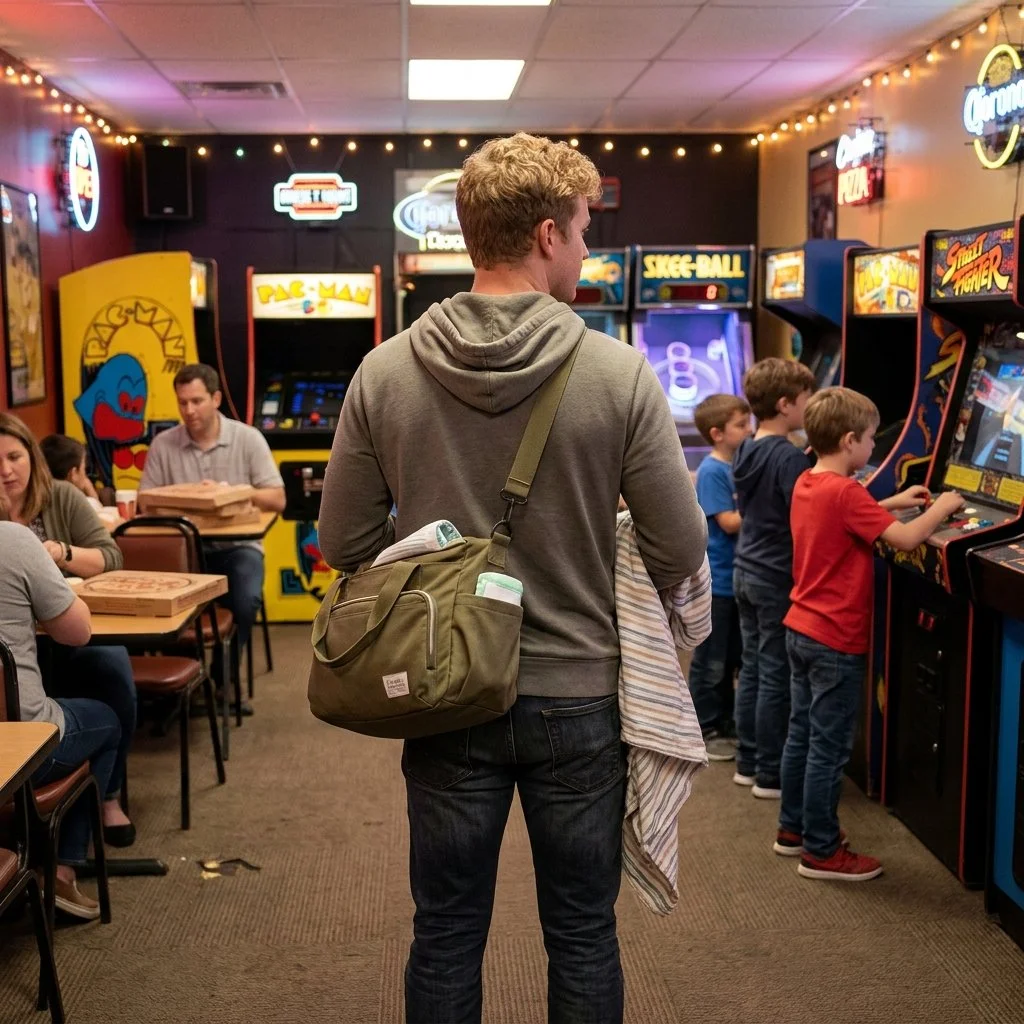
Well, today’s the day—my first day meeting Mitchell. I’ll admit, I’m a little nervous, but mostly I’m excited. Mitchell’s a big guy with a good build and a strong presence. He’s transitioning back into Pampers, which is something I don’t think I’ve seen before in someone his age. It gives me a unique opportunity, though, to meet him where he’s at. The key, I’ve been told, is to keep things light and focus on having fun. That’s something I can definitely get behind—life’s heavy enough already.
We’re meeting at the arcade, which feels like the perfect spot to start. What’s not to love about flashing lights, the sound of pinball machines, and chasing high scores? Plus, it’s a place where we can just relax and not worry about any of the serious stuff—not today anyhow. He loves the claw machine and skee-ball, so I’ve already planned to make those our first stops. If he wins one of those little prizes in the claw machine, I’ll make sure he feels like a champ—because he is, in his own way.
I’ve packed a few fun snacks to keep the vibe light—fruit gummies, goldfish crackers, and juice boxes. It’s kind of like stepping back in time, but if this brings Mitchell comfort and joy, then why wouldn’t we lean into that? And hey, those snacks are awesome—who doesn’t love a good pack of fruit snacks?
What’s really important today is making Mitchell feel like he can be himself. No judgment, no pressure—just a day to have some fun. He’s a special guy, and I’ve got a lot to learn about him and how to support him better. But today is about setting the tone, making a connection, and showing him I’m here, no matter what. If that means cheering him on while he racks up tickets or making sure he’s comfortable with all the transitions he’s going through, I’m up for it. This is about Mitchell, every step of the way. Here’s to day one—me, him, the arcade, and maybe a bucketload of goldfish crackers and a few claw machine wins. Sounds like a good start to me.
Essay Prompt: Meeting Mitchell
Today marks a significant moment—meeting Mitchell for the first time. This essay explores the nuanced experience of supporting someone through transitional phases, meeting them where they are, and fostering connection. Using the narrative provided as a foundation, respond to the following essay prompt:
Prompt:
"Meeting someone where they are requires understanding, patience, and genuine care. Reflect on a personal experience where you embraced another person’s comfort, needs, or unique circumstances. Discuss how you approached creating a meaningful connection, the challenges you faced, and what this experience taught you about empathy and adaptability. Draw parallels between your experience and the story of Mitchell, considering what it means to forge trust, provide support, and focus on shared joy in an environment that fosters ease and fun. How can these principles be applied to strengthen other relationships in your life?"
Word Count Breakdown:
Introduction (200 Words):
Introduce the concept of meeting someone where they are, and briefly mention how this relates to the story of Mitchell. Define empathy and the importance of understanding another’s perspective.Personal Experience (500 Words):
Share a personal experience of supporting someone in a transition or unique situation. Highlight specifics about the setting, emotions involved, and steps taken to build that connection.Parallels to the Story of Mitchell (400 Words):
Connect your narrative to the story of Mitchell shared in the prompt. Identify themes such as patience, shared joy, and navigating challenges. Discuss how the core idea of understanding and fun bonds both stories.Lessons Learned (300 Words):
Reflect on the lessons this experience imparted and how it shifted your perception of empathy or adaptability. Consider how these lessons can apply to other relationships moving forward.Thoughtful Conclusion (100 Words):
Summarize the importance of empathy, connection, and celebrating individuality in relationships. End by discussing how practicing these values creates meaningful interactions.
Short Reference Essay
Building genuine connections often requires stepping outside of our comfort zones to meet others where they are, valuing their unique circumstances and emotions. I remember a time when my younger cousin, a quiet and reserved teenager, moved in with my family during a challenging period in his life. Initially, I didn’t know how to connect with him, but I soon realized that the key was patience and understanding his comfort zone—video games and simple evenings of quiet companionship rather than large family outings.
Mitchell’s story reminds me of this experience. Meeting at the arcade provided a shared space of joy and freedom from external pressures, allowing for a natural connection to form. Similarly, I ditched traditional "family bonding" ideas and instead spent hours by his side on the couch, learning his favorite games. Just like Mitchell's cheer-worthy claw machine victories, the small moments in gaming became victories we could celebrate together, creating a foundation of trust.
Both experiences taught me that empathy is best expressed in the language of the other person’s joy and needs. By meeting someone where they are—in their comfort zones and perspectives—we establish meaningful relationships that transcend initial apprehensions and differences. Whether at an arcade, sitting by a gaming console, or simply offering a listening ear, it's about being present, adaptable, and open to shared experiences.
Instructions: Show all work for these problems, including calculations, logical steps, or any tools you use, to ensure your understanding of the processes involved.
Mitchell and his friend play skee-ball at the arcade. If they score a total of 2,400 points and Mitchell scores 1,550 points, how many points did his friend score?
At the claw machine, Mitchell wins 3 prizes while his friend wins 5 prizes. If each attempt costs $0.75, how much did they spend in total if they played the same number of times?
The arcade has a deal where you get 25 free tokens for every 100 tokens you purchase. If Mitchell buys 300 tokens, how many tokens does he get in total?
While playing pinball, Mitchell earns 4,320 points in the first game and 3,780 points in the second game. What is his total score?
Mitchell has a pack of fruit gummies containing 30 pieces. If he decides to share them equally with 4 friends, how many gummies does each person get?
There are 12 skee-ball lanes at the arcade, 4 of which are being repaired. What percentage of the lanes are still available for use?
Mitchell spends $18 on tokens. If each token costs $0.50, how many tokens does he buy?
Mitchell and his friend drink juice boxes at the arcade. Each juice box contains 8 ounces of juice. If they drink 6 juice boxes altogether, how many ounces of juice did they consume?
The claw machine has a success rate of 1 win for every 5 attempts. If Mitchell attempts the claw machine 25 times, how many prizes is he expected to win?
The arcade earns $2.50 for every skee-ball game played. If 80 skee-ball games are played in a day, how much does the arcade earn from these games?
Mitchell earns 5 tickets for every 10 points scored on a pinball machine. How many tickets will he earn if he scores 1,200 points?
If Mitchell and his friend win a total of 60 tickets but Mitchell’s tickets are twice as many as his friend’s, how many tickets did each of them win?
Each claw machine prize is worth 80 tickets. If Mitchell exchanges 240 tickets for prizes, how many prizes does he receive?
The arcade has 5 varieties of snacks, and Mitchell chooses 2 at random. How many different combinations of snacks can Mitchell select?
Mitchell and his friend play a racing game that lasts 3 minutes per race. If they play 10 races, how many total minutes do they spend playing?
If the arcade is open for 10 hours in a day and Mitchell spends 2 hours there, what fraction of the arcade's day did Mitchell spend?
Mitchell uses 15 tokens for pinball and 10 tokens for skee-ball. If he started with 50 tokens, how many tokens does he have left?
The arcade awards 100 bonus tickets to every player who plays 5 consecutive games. If Mitchell plays 10 consecutive games, how many bonus tickets does he receive?
Mitchell’s favorite claw machine has a capacity of 50 prizes. If the machine currently contains 35 prizes, what percentage of the prizes are still available in the machine?
The arcade has a total of 200 game machines, and 40 of them are racing games. What fraction of the machines are racing games?
Mitchell earns 8 tickets from a skee-ball game and 12 tickets from a claw machine. How many tickets does he earn in total if he plays 5 skee-ball games and 3 claw machine games?
A snack pack of goldfish crackers weighs 1.5 ounces. If Mitchell eats 3 packs, how many ounces of crackers does he eat?
If the probability of winning a prize on the claw machine is 20%, what is the probability of not winning on any given attempt?
Mitchell needs 50 tickets to claim a stuffed animal. If he currently has 28 tickets, how many more tickets does he need?
The arcade sells combo packs of 300 tokens and 2 drinks for $25. If Mitchell buys 2 combo packs, how much does he spend?
If a fruit gummies pack contains 10 different flavors and Mitchell picks one at random, what is the probability that he picks his favorite flavor?
Mitchell plays 7 games and wins an average of 15 tickets per game. What is the total number of tickets he wins?
If Mitchell sets aside 20% of his tickets to donate to another player and he has earned 120 tickets, how many tickets will he donate?
The arcade has a leaderboard where players need at least 10,000 points to enter. If Mitchell scores 8,750 points, how many more points does he need to make it onto the leaderboard?
A juice box costs $1.25, and a snack pack costs $2.75. If Mitchell buys 2 juice boxes and 3 snack packs, how much does he spend in total?
Instructions:
This workout is designed to help young athletes build strength, endurance, and flexibility. Follow the minute-by-minute guidance and rest as needed between exercises. Be sure to warm up properly before starting and stay hydrated throughout the workout.
Warm-Up (20 Minutes)
0-5 Minutes: Light jogging on the treadmill or around the gym.
5-10 Minutes: Dynamic stretches (e.g., leg swings, arm circles, walking lunges).
10-15 Minutes: Bodyweight exercises (e.g., 10 push-ups, 15 air squats, 10 burpees).
15-20 Minutes: Jump rope or shadow boxing.
Strength Training (90 Minutes)
20-35 Minutes: Upper body focus (e.g., bench press, dumbbell rows, shoulder press). Perform 3 sets of 10 reps for each exercise.
35-50 Minutes: Lower body focus (e.g., squats, deadlifts, leg presses). Perform 3 sets of 8 reps for each exercise.
50-65 Minutes: Core strength (e.g., planks, Russian twists, hanging leg raises). Perform 3 sets of each exercise for 30 seconds to 1 minute.
65-75 Minutes: Rest and hydrate.
75-110 Minutes: Resistance training circuits. Complete 3 rounds of the following exercises for 1 minute each with 30 seconds rest between rounds:
Medicine ball slams
Kettlebell swings
Weighted lunges
Pull-ups or assisted pull-ups
Cardiovascular Training (60 Minutes)
110-125 Minutes: High-intensity interval training (HIIT) on the treadmill or rowing machine. Alternate 1-minute sprints with 2-minute recovery walks.
125-140 Minutes: Aerobic session (steady pace on the treadmill, rowing machine, or stair stepper).
Flexibility and Cool-Down (30 Minutes)
140-155 Minutes: Static stretching (target major muscle groups like hamstrings, quads, shoulders, and back).
155-170 Minutes: Foam rolling session to relieve muscle tightness and improve recovery.
Group Mindfulness Activity: Visualization and Connection
Activity Overview
This mindfulness activity is designed to foster focus, team bonding, and positive thinking among the group. It will engage participants in relaxed visualization, grounding exercises, and reflective journaling, all centered around envisioning an ideal first day with Mitchell at the arcade.
Steps for the Activity
Grounding Exercise (5 Minutes)
Begin by sitting comfortably in a circle. Close your eyes and take a few deep breaths. Focus on the feeling of your feet on the ground and your back against the chair. Slowly guide the group through a series of gentle breaths, encouraging them to be fully present in the moment.Visualization (10 Minutes)
Ask the participants to close their eyes again and imagine walking into the arcade for the first time with Mitchell. Encourage them to picture the scene in detail — the vibrant lights, the sound of games chiming, the smell of popcorn, and the laughter filling the air. Have them imagine trying out different games with Mitchell, cheering each other on, and celebrating their wins together. As they visualize, ask them to focus on the feelings of excitement, connection, and possibility.Group Sharing (10 Minutes)
After completing the visualization, invite each group member to take turns sharing a snapshot of their vision. What games stood out to them? How did they feel about the experience with Mitchell? This open sharing fosters camaraderie and helps athletes strengthen their bond with one another.Journaling Prompt (10 Minutes)
Distribute journals or notepads and ask the group to respond to the following prompt individually:
"What does your perfect day at the arcade with Mitchell say about the values and experiences that matter most to you? How can you carry those feelings of joy, teamwork, and connection into your everyday life?"
Wrap-Up
Close the activity by encouraging the group to keep their visualization in mind during their training and interactions. Remind them that the positive emotions and values they experienced in their vision can be channeled into their athletic goals and relationships.