
Interview: Think Grocery Runs Are Boring? Mitchell Royel Politely Disagrees
Some people announce themselves with a logo. A designer name stitched somewhere loud, screaming its price before the person even opens their mouth. Mitchell Royel does the opposite. He walks into a room and dares you to guess where a single piece came from — and the answer, every single time, is someone else's closet first.
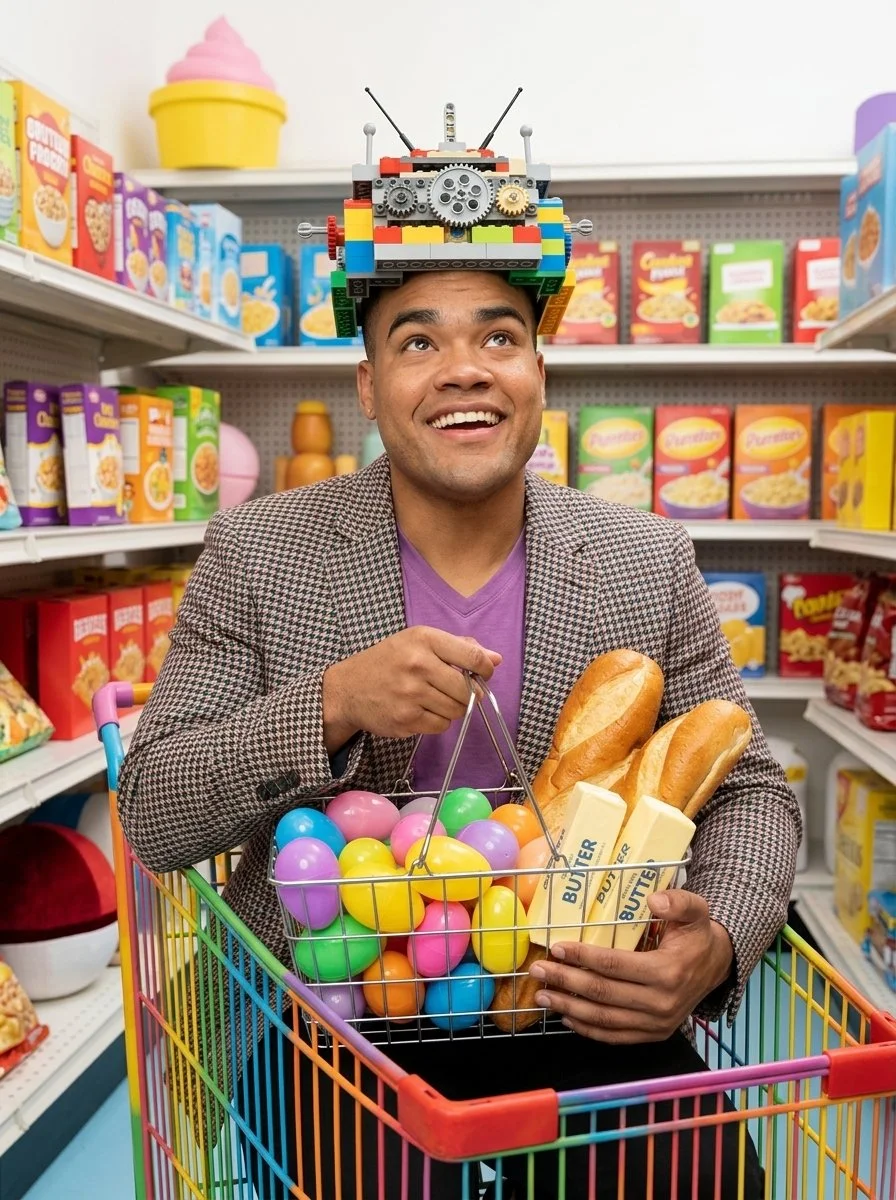
Now look at the photo.
Really look.
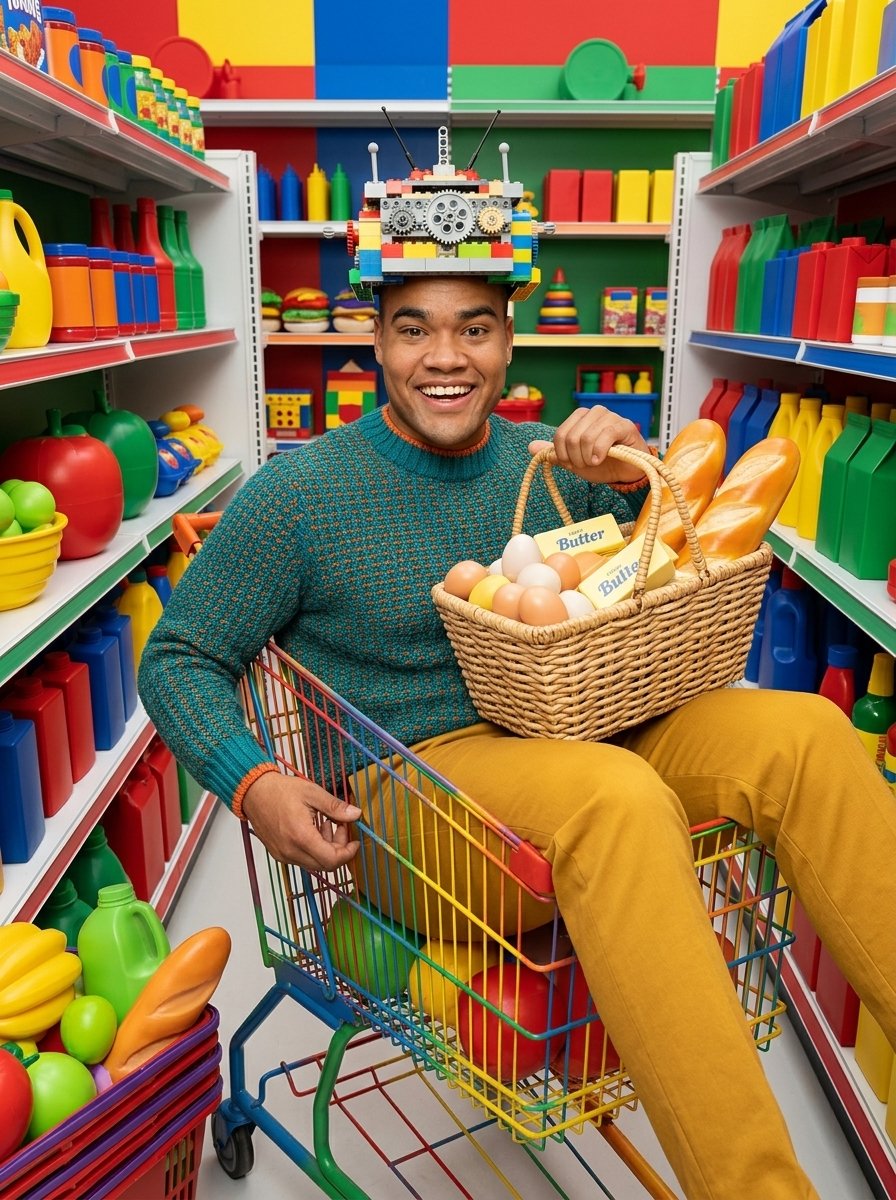

There he is, mid-grocery run, grinning up at something the rest of us apparently can't see. And on his head? A crown. An actual crown, built brick by brick out of colorful interlocking toy blocks — blues, yellows, greens, reds, little gears and antennas sticking out like his brain is a joyful machine that never stops running. It's ridiculous. It's magnificent. It's completely on purpose.
Underneath the crown, the man means business. A brown-and-white houndstooth blazer — thrifted, obviously, soft with the kind of texture you only get from something that's already lived a life — layered over a clean lavender V-neck. He's holding a wire shopping basket like it's a trophy. Inside: a rainbow of plastic Easter eggs, two golden baguettes stabbing diagonally into the air, and two sticks of butter riding shotgun. Behind him, a shopping cart painted in every color the rainbow forgot to trademark. Around him, a wall of cereal boxes so bright they practically hum.
This is not a costume.
This is a Tuesday.
Here's what's been happening. People keep spotting Mitchell Royel at the grocery store — and not slumped in sweatpants clutching a sad rotisserie chicken like the rest of us. No. He shows up like he's arriving somewhere that matters. Thrifted blazers. Bold, weird, wonderful outfits. A brick crown on a random Wednesday. Grabbing eggs and butter and juice and baguettes like each item is part of some beautiful, low-stakes performance only he's in on.
And sure — some days it's just him after the gym, still in whatever he trained in, cooling down between the produce and the dairy. He's not precious about it. He's not performing for anyone. But when he does get creative? That's the whole point.
Because think about it for a second. Why do we save our best selves for the "important" places? Why do we treat a grocery run like something to survive instead of something to enjoy? Mitchell looked at that whole unspoken rule and said, cheerfully, absolutely not.
Getting butter should be fun. Buying baguettes should feel like a small event. A cereal aisle is basically a cathedral of color if you actually stop and look at it, and Mitchell looks at everything. That's the philosophy hiding under the houndstooth: nothing is too small to show up for. The destination doesn't decide how alive you get to feel. You do.
The thrifted blazer isn't about looking rich. It's about looking found. Every piece he wears has a past, a previous owner, a story nobody else at the deli counter can guess. He's not dressing to impress. He's dressing to delight — himself first, and then anyone lucky enough to catch him reaching for the good bread.
The whimsy isn't a contradiction to the cool. It is the cool. A grown man in a secondhand blazer and a toy-brick crown, filling a basket with eggs and butter and pure, unbothered joy, isn't hiding from adulthood. He's the most honest person in the store. Everyone else is performing errands. He's just being exactly who he is, and letting every thrifted thread say it for him.
Below, Royel talks racks, rescues, reinvention, and why the best version of yourself might already exist in someone else's donation pile — even on a butter run.
Q&A with Mitchell Royel
Q: There's a crown made of toy bricks on your head in this photo. Let's talk about that.
Mitchell Royel:
Honestly, it felt completely natural. If you spend as much time thinking about creative dressing as I do lately, eventually something joyful ends up on your head. That's just how it goes.
But also — look at it. It's perfect. The colors, the little gears, the way it makes absolutely no sense in a grocery store, all of it exactly the way it should be. I have a lot of respect for whoever decided fun was allowed in public. They understood the assignment.
Q: You could wear anything, anywhere. How did dressing up for the grocery store become your whole thing?
Mitchell Royel:
It was an accident, genuinely. For years I thought errands meant I was off the clock — sweatpants, hood up, get in and get out. That was the whole mindset. Then one day I threw on a thrifted blazer just to grab eggs, and something clicked.
And that was it. That one secondhand piece cracked the whole thing open. I stopped pretending the good outfit only comes out for the good occasion.
Q: So one thrifted find changed the trajectory?
Mitchell Royel:
Completely. I keep telling people this and they don't believe me. It wasn't some designer piece. It wasn't a special event. It was a random Tuesday and a basket of butter, and it still got me.
That's the part I love. It didn't need to be expensive to open my eyes. It just needed to have a story. And once you start seeing the stories, you're done. There's no going back to buying blank.
Q: Why bother? Nobody's watching you buy baguettes. Why not just show up in whatever?
Mitchell Royel:
Because the whole thing is the point. It always has been. It would be a completely different experience if I treated it like a chore.
I go out there, dig through the racks beforehand, and come back with things I never would have picked for anything "important." Some days it's a blazer. Some days it's a crown made of toy bricks. Some days it's both. That moment when I walk into the store feeling like myself — fully, ridiculously myself — a to-do list can't give you that. Autopilot can't give you that.
Q: What are you actually grabbing on these runs?
Mitchell Royel:
Oh, all of it. That's the problem. Once you start caring, the whole store opens up.
Right now I'm deep into the basics done right — eggs, butter, juice, the good baguettes when I want the store to feel like a little market in another country. Bright stuff when I want the cart to feel like a party. And the outfit? That's a whole separate category. That's not shopping, that's world-building.
Q: New or secondhand?
Mitchell Royel:
Secondhand, every time, and I refuse to apologize for it. Vintage when I want the history and the character. Upcycled when I want something reborn into a better version of itself. Both are valid. Anyone who tells you new is automatically better is selling something.
Q: Do you have a go-to store?
Mitchell Royel:
I have a rotation, but I'm loyal to whoever's treating the place right on any given day. That's the real test. Care matters. Condition matters. If the produce is sad and nobody bothered to fix the lights, the whole vibe falls apart. Literally and emotionally.
Q: "Literally and emotionally" — that's a strong reaction to a grocery store.
Mitchell Royel:
Look, if you're going to make an ordinary thing special, you have to commit. You can't half-do it. A boring, joyless errand you sleep-walked through is a betrayal of everything I stand for. I stand by that. I will always stand by that.
Q: You lean into playful, whimsical dressing while also being deeply into thrift culture. Is that deliberate?
Mitchell Royel:
Completely. That combination is its own thing. It's quieter than people expect. There's no crowd doing exactly what I'm doing. The two worlds usually pull in opposite directions, but for me they line up perfectly.
There's something valuable about being sincere and playful when everything else in the world is trying to make you sharp and cynical. The whimsy is my pushback against all of that. The thrifting just made the whole thing feel more honest.
Q: The brick crown on your head — is that the closest you can get to wearing your whole personality?
Mitchell Royel:
It might be, yeah. I haven't found a more direct way to express it yet, but I'm open to suggestions.
Honestly, though, there's something I love about it. A grown man in a thrifted blazer, holding a basket of butter, wearing a crown made of toy blocks. It's playful. But it also just feels right. Like, of course that's where I ended up. Where else would I go?
Q: What do you think dressing up for the ordinary stuff says about a person?
Mitchell Royel:
That they're open. That they're willing to see the value in something everyone else overlooked. I was a get-in-get-out guy for years, and one thrifted blazer taught me to look closer. A found piece is never pretending to be something it isn't. It's just trying to be loved again, in a hundred different ways. I respect that enormously.
Q: Last question: what do you want people to take away from the photo — the one with the crown and the basket of butter?
Mitchell Royel:
That you're allowed to be all of it at once. Soft and stylish. Playful and sharp. The ordinary errand can become the best part of your day, and that's not weird, that's freedom.
I came for the eggs. I stayed for everything the moment let me be. There's no rule that says your joy has to wait for a special occasion. Mine keeps expanding, one grocery run at a time, and it's the best thing that's happened to me in years.