
interview: The Cigarette That Said, ‘You Belong’: Why Mitchell Royel Started Smoking in Treatment
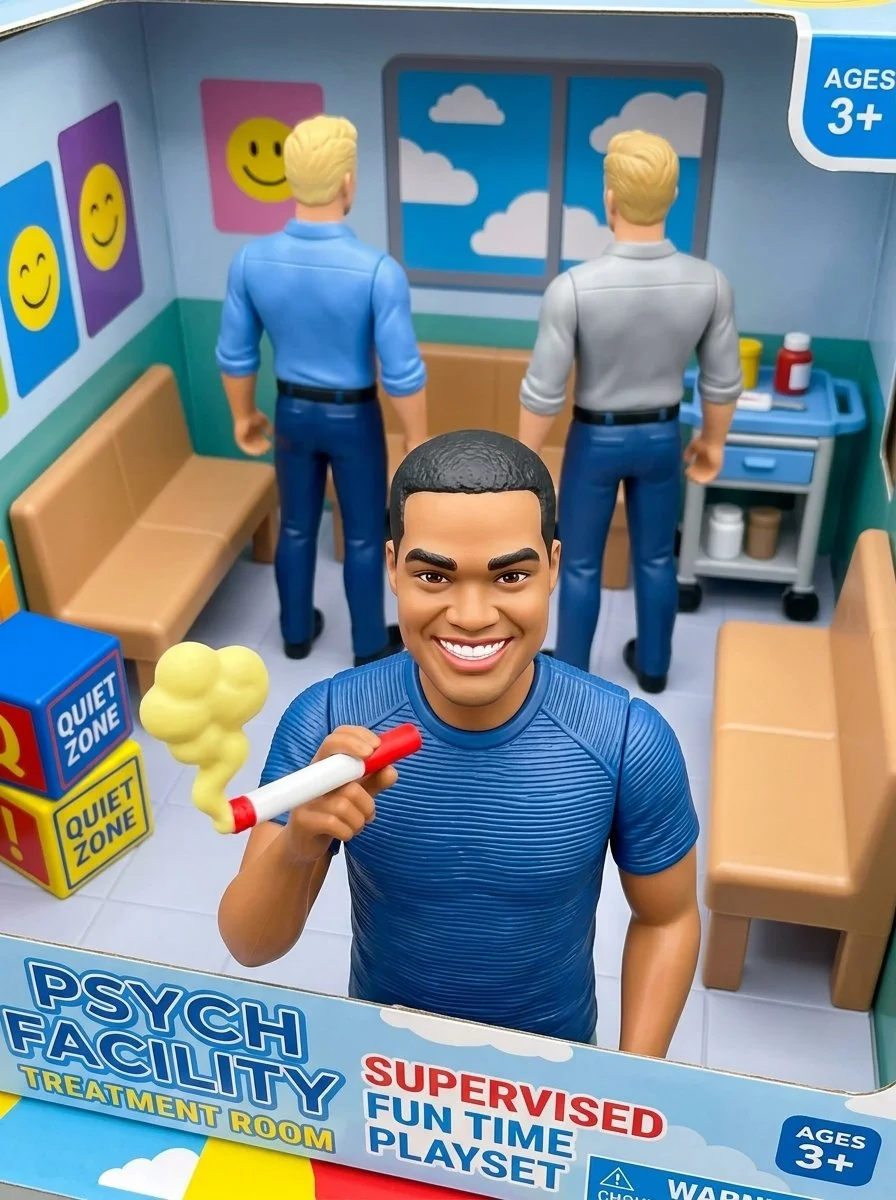
Let me set the scene, because it matters. We're sitting in what looks like a toy — a bright, plastic diorama of a psychiatric treatment room, all saturated blues and cheerful yellows, the kind of colors that scream fun while the subject matter whispers something much darker. There's a window painted with cartoon clouds. Smiley faces grin down from the walls. Beige benches line the space. A little medical cart sits stocked with tiny bottles, and stacked against the wall are blocks that spell out QUIET ZONE, over and over, like a mantra nobody actually believes.
And there's Mitchell Royel, right in the middle of it, grinning wide, a cigarette held loosely between his fingers. Behind him, two blond staffers stand with their backs turned, staring at the wall, frozen. It's absurd. It's a little unsettling. And honestly? Mitchell says that's exactly how it felt to live it.
This is a man who has been through the wringer and come out the other side unwilling to pretend otherwise. He's ABDL — adult baby, diaper lover — and he'll tell you that flat out, no shame, no flinch. He's been to rehab. He spent time inside a psychiatric facility back in 2017, and that's where a habit was born that follows him to this day: smoking, and later, vaping. He didn't walk in a smoker. He walked out one. And the strangest twist? The people treating him were the ones who put the cigarette in his hand.
If that makes you raise an eyebrow, good. Because there's a real story underneath the shock value, and Mitchell is here to tell all of it — the ugly, the tender, the ridiculous, and the parts that will make you rethink everything you assumed about how we treat the human mind at its lowest.
Buckle up. He holds nothing back.
Q: We have to start with where we're sitting. This whole setup looks like a toy version of a psych ward. What does it stir up in you?
Mitchell Royel: [laughs] It's perfect, isn't it? It's cartoonish and horrifying at the same time, which is honestly the most accurate portrait of the experience anyone's ever handed me. When you're inside a place like that, everything gets this flattened, plastic quality. The walls are painted "calming." The signs say things like QUIET ZONE like a quiet zone ever calmed a single racing mind. You feel like a figure someone posed on a shelf. Smiling for the box. Meanwhile, the people behind you have their backs turned, and you're standing there alone in the middle of it all, holding the one thing that makes you feel human. For me, that thing became a cigarette.
Q: Let's rewind. Take us to 2017. How did you end up in a psychiatric facility in the first place?
Mitchell Royel: I was coming apart. Slowly, then all at once, the way it always goes. I'd been white-knuckling my way through everything for years, and eventually the seams just gave. I ended up admitted, and let me tell you, nothing prepares you for the specific loneliness of that first night. You're stripped of your stuff, your phone, your shoelaces, whatever they decide might hurt you. You're reduced. And when you get reduced that far, you start clinging to whatever tiny scraps of comfort exist inside those walls. For a lot of people in there, that scrap is the smoke break.
Q: So you genuinely didn't smoke before you were admitted?
Mitchell Royel: Not at all. Never touched a cigarette in my life. I was that guy who'd wrinkle his nose walking past a smoker outside a restaurant. But inside, the smoke break was the event. It was the one time you got to step outside, feel actual air, and stand shoulder to shoulder with other people who understood exactly where you were, because they were there too. Somebody offered me one on maybe my third day. I said yes because saying yes meant belonging to something, even for five minutes. And that was it. That was the beginning.
Q: A lot of people are going to be shocked that a mental health facility allowed smoking at all. Can you speak to why?
Mitchell Royel: I was shocked too, at first. But here's the thing I learned — behavioral health settings have wrestled with this for decades, and it's more complicated than "smoking bad, ban it." Nicotine use is enormously common among people with mental health and substance use conditions. Way higher than the general population. And when you've got someone in acute crisis, someone who might be a danger to themselves, the clinical thinking has often been that forcing them to quit cold turkey in that exact moment can pile stress onto an already overloaded system. Sometimes stability comes first, and everything else waits.
So historically, a lot of facilities allowed it, or built in designated smoke breaks, because they were treating the emergency in front of them. The idea was: let's not add a nicotine withdrawal crisis on top of a psychiatric one. Keep the person calm, keep them engaged, keep them alive. That was the priority.
Q: And that philosophy has shifted over time, hasn't it?
Mitchell Royel: It has, and this is the part I find genuinely fascinating now that I understand it. The field has moved hard toward treating tobacco use as part of recovery, not separate from it. More and more facilities have gone tobacco-free on campus, and instead of just letting people smoke, they lean on nicotine replacement therapy — the patches, the gum, the lozenges, the nasal sprays. The whole idea is you can manage the withdrawal and the cravings medically, so a patient stays comfortable and stable without needing to actually light up.
There's also this harm reduction thread running through it. The thinking goes: if someone isn't ready or able to quit nicotine entirely, meeting them where they are — reducing the harm rather than demanding total abstinence overnight — keeps them in treatment and keeps them safer. That's where things like vaping enter the picture for some people. It's viewed by some as a less harmful bridge, a step down, a way to hold onto the ritual while lowering the risk. It's debated, it's nuanced, but that's the logic.
Q: So where did the vaping come in for you?
Mitchell Royel: That came later, on the outpatient side. When I transitioned out of the inpatient world and into outpatient therapy, the conversation around my smoking actually changed. It stopped being "here's your smoke break" and became "let's talk about what we do with this habit you picked up." And that's where I got introduced to the whole nicotine replacement landscape and the harm reduction conversation.
Some outpatient programs will actively work with you on stepping down — moving you from cigarettes toward NRT, or toward vaping as a lower-tar alternative, with the long-term goal of tapering off entirely. For me, the vape became a management tool. It let me keep the ritual, the thing my hands and my brain had come to rely on for stress, while I worked on the deeper stuff in therapy. Was it a perfect solution? No. But recovery is rarely a clean line. It's a bunch of messy, incremental trades where you swap something dangerous for something less dangerous and call it a win.
Q: Why do you think the ritual mattered so much to you specifically?
Mitchell Royel: Because when your inner world is chaos, a ritual is an anchor. The whole sequence — reaching for it, the pause, the inhale, the exhale — it's a tiny, repeatable act of control in a life that feels utterly out of control. That's the real reason nicotine sinks its hooks so deep into people in crisis. It's not just the chemical. It's the choreography. It's the five seconds where your nervous system gets a signal that says you're okay, you're doing something, you're still here. Understanding that later helped me forgive myself for it instead of just hating myself for it.
Q: You're openly ABDL. How does that fit into all of this — the breakdown, the facility, the recovery?
Mitchell Royel: It fits because it's just... me. I'm ABDL. Adult baby, diaper lover. It's part of who I am, and I've done the long, hard work of not flinching when I say it out loud. And I think people expect there to be some big tragic origin story linking it to trauma or the breakdown, and honestly? There isn't. It's just a part of my identity, the same way anything else about a person is.
What the psych facility and rehab taught me, weirdly, was how to stop apologizing for the parts of myself that don't fit the neat little boxes. When you've already been stripped down to nothing in front of strangers — when you've had your worst moments witnessed by people in scrubs — you kind of lose the energy for shame. You realize the shame was always the heaviest thing you were carrying, heavier than the actual truth of who you are. So no, I don't hide it. Being ABDL, going to rehab, picking up smoking in a psych ward — those are all just chapters. None of them are the whole book.
Q: Was there judgment about the ABDL part while you were in treatment?
Mitchell Royel: Less than you'd think, actually. Good clinicians have seen everything, and the ones I worked with cared about whether I was safe and whether I was healing — not about ranking my private life on some scale of normal. The best moments in that whole experience were the ones where somebody just... didn't react. Didn't raise an eyebrow, didn't make it weird. That kind of quiet acceptance does more for a person than a hundred motivational posters on the wall. It tells you that you're a person, not a problem.
Q: Looking at this scene again — you smiling, the staff with their backs turned — what does that image say about the whole experience?
Mitchell Royel: It says the truth is always more complicated than the packaging. The box says SUPERVISED FUN TIME. The reality was neither fun nor, half the time, particularly supervised. But it also says something hopeful, if you squint. Because that smile isn't fake, not entirely. There were real moments of connection in there. Real relief in a shared smoke break. Real care from people who genuinely wanted me to make it. The staff have their backs turned in this image, but in real life, plenty of them turned around. Plenty of them saw me. And that made all the difference.
Q: Where are you now with the smoking and vaping?
Mitchell Royel: Still working on it, and I'm not going to sit here and pretend I've got it all figured out. That would be a lie, and I'm done lying about myself to make a story sound tidier. I use nicotine replacement stuff, I lean on the harm reduction tools, and I keep chipping away at it with the same slow patience I've had to apply to everything else. Some weeks are better than others. But I understand it now. I understand why it grabbed me, what it was doing for me, and what I need to build in its place. That understanding is half the battle.
Q: Last question. If someone reads this while they're sitting in their own version of that plastic room, what do you want them to hear?
Mitchell Royel: I want them to hear that the room isn't the end of the story. It felt like the end for me. It felt like I'd been posed on a shelf and forgotten. But it turned out to be a beginning — messy, embarrassing, complicated, and mine. You'll pick up habits in there you didn't plan on. You'll be seen in ways you never wanted. You'll be ABDL or an addict or a smoker or whatever the label is that you've been terrified of, and you'll survive being seen as all of it. And on the other side, you get to decide what stays and what goes. You get to become a person again instead of a figure in someone else's box. That's the whole thing. That's what I want them to hear. The box is not the story. You are the story.
Mitchell Royel is proof that recovery doesn't come wrapped in a bow. It comes wrapped in contradictions — a man who learned to smoke in the place meant to heal him, who found belonging in a habit he's still trying to quit, who wears his identity out loud in a world that would rather he whispered it. The plastic room behind him is bright and strange and a little bit broken. So is the human experience. And Mitchell wouldn't have it airbrushed for anyone.