
Interview: Mitchell Royel’s Midnight Reckoning Has Everyone Talking—Here’s Why
There is a photograph — not the one making the rounds, but its rawer, stranger cousin — that Mitchell Royel took of himself not long ago. No one was there for it. No one was invited. After a shift ended and the building emptied out, he got in his car and drove. Not home. Miles away from the job, far enough that no one from that world would see him, he found a large restaurant trash can in a back lot, pulled his shirt over it or against it, put on pampers, and staged a photoshoot for an audience of zero.
He calls it the night he found out what he does when no one is watching.
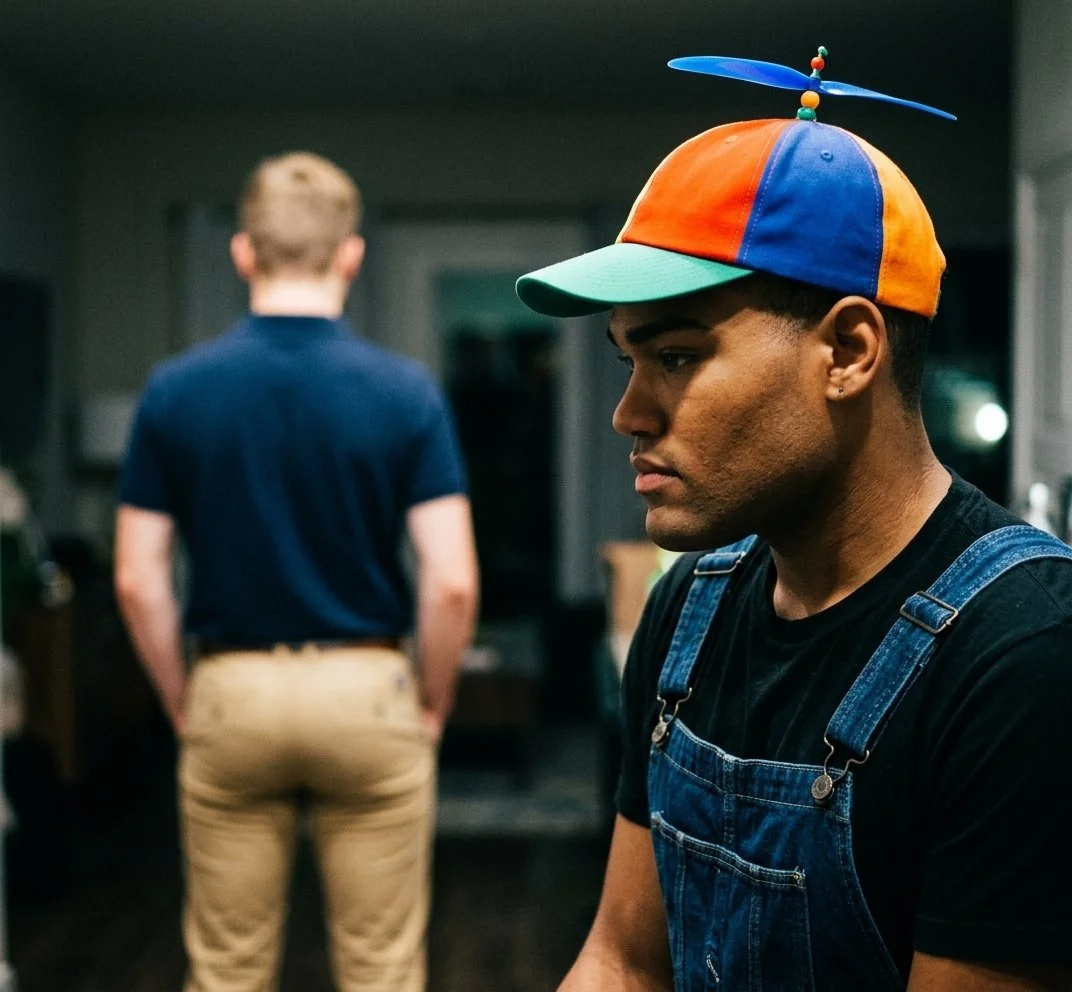
It is a strange thing to admit out loud. Stranger still to be sitting across from someone and saying it without the emergency exit of a joke. But Mitchell Royel is not reaching for the joke. The image that's circulating — a man in a propeller beanie and denim overalls, somber-faced, someone blurred and turned away in the background — is the softer, more composed version of a truth that started miles from anywhere that knew him, in a back lot he drove to deliberately, under a single buzzing light. A truth about play, shame, and what it costs to be the only witness to your own strangeness.
What follows is a conversation about that night, and the argument he's still having with himself.
Let's start at the worst part. You've described this as a "super dark" night. What made it dark?
Everything and nothing, like those nights tend to be. It wasn't a tragedy. The shift had just — taken it out of me. The kind of tired where you're still technically moving but you've clearly left the premises. I clocked out, got in my car, and drove. Not home. Miles away — far enough that nobody from that world would see me, far enough that the night felt like it belonged to me and not to the job. And when I finally stopped, there was this back lot, and this big restaurant bin just sitting there, and something in me wanted to do something absolutely unhinged. Not to feel better. More like — to prove I was still in there.
And the something unhinged was a photoshoot. With a trash can. And pampers.
Yeah. That sentence sounds like a headline you'd invent to embarrass someone. But it's just what happened. I had pampers on, I pulled my shirt around that big can — it was huge, the industrial kind — and I started posing. In the dark, basically. Phone propped up. No one else anywhere. Just me, being the most unfiltered, ridiculous version of myself I could access, and deciding it was worth documenting.
Why document it? No one was going to see it.
That question sat with me for a while after. Because at the time it felt necessary — not optional. Like if I didn't photograph it, it didn't count. It didn't become real. During that shift, I was so managed. Composed. Performing functionality for everyone in every direction. And there's this other person — this other version of me — who only surfaces when there's nothing left to perform for. I needed proof he existed. That he wasn't something I'd imagined.
There's something tender about that. And something very lonely.
Deeply lonely. That's the part that doesn't get named. When you play alone — really play, full commitment, no irony — there's freedom and there's ache moving through the same channel. No one to laugh with. No one to look back at you and say: yeah, this is weird, and I see you doing it, and it's fine. You're the performer and the critic at the same time, and the critic always has the loudest voice in an empty lot.
You use the word "horseplay" deliberately when you talk about this.
Because it's a word the world loans you and then takes back. Horseplay. Messing around. Acting up. Those words belong to kids, and the second you age out of the bracket, they become accusations. They stop being neutral. And I've never aged out of the impulse. I still want to drive miles out of my way, find some massive restaurant trash can in a back lot that nobody I know would ever pass through, and pretend I'm something enormous. That instinct didn't leave. I just learned to act on it far enough away that no one could see — somewhere I'd have to earn with a long drive before I could catch the look on anyone's face.
The look.
The one that says: aren't you a little old for this? You don't have to say anything. Just the arrangement of the face. It tries to be kind, that look. Which almost makes it worse — it reaches for you gently while still cutting the ground out from under you. So you take it underground. You get in the car and you drive until the job is far enough behind you that it can't find you. You find a back lot miles from anything that knows your name.
But you were alone. So who was giving you the look that night?
Me. That's the thing. I drove all the way out there and still brought it with me. Miles from the job, standing in pampers next to this massive restaurant bin in a lot where nobody knew me, and I could still feel the imaginary jury — all the faces I'd assembled in my head, watching something they weren't even present for. That's what shame does when it's been with you long enough. It doesn't need a real audience. It builds one and runs the whole production without you.
How did the night actually feel? Release, or darker than that?
Both, overlapping. There were stretches — thirty seconds here, a minute there — where the whole machine of self-awareness just switched off. I was genuinely in it. Playing the way I did before I had any concept of how it looked from the outside. And those moments were clean. The cleanest I'd felt in weeks.
Then I'd come back. I'd register the full absurdity of the image — grown man, industrial trash can, back lot, pampers — and the internal voice would flood back in. You're doing what exactly with your one life. That whiplash, cycling. Freedom, then the flood. That's what the night was. That's the whole texture of it.
That sounds exhausting to experience alone.
It's the specific kind of exhausting that privacy doesn't fix. You'd think being alone would make it easier — no witnesses, no accountability. But it's the opposite. There's no one to hold the thing up for. No one to say the game is okay, that you're not unraveling. You're alone with the rawest version of yourself and the loudest version of your shame, and you're the only referee. Some nights the shame wins clean. That night was a draw.
How does this connect to the image people have actually seen — the propeller hat, the overalls, the look on your face?
It's the same story with the volume turned down. The photo people have seen — the hat, the denim, the face that isn't smiling when everything about the costume says it should — that's the daytime translation of the back lot miles from anywhere that knew him. Same place inside. Same gravity under the whimsy. The clothes say one thing and the expression says another, and if you can sit with that gap without trying to resolve it, you understand most of what I'm about.
There's a figure in that photo. In the background, turned away.
I think about that figure. Facing away, not present in the play, giving space or just absent — you can't always tell which one it is. And that maps perfectly. You can have someone technically nearby and still be completely alone inside the game. That distance — the turned back — that's not hostile. It's just the nature of this kind of play. Even with someone in the frame, you're still the only one inside it.
Did you show anyone the photos from the back lot?
No. Not one person. And for a while that felt like the right call — fewer people knowing, fewer versions of the look to absorb. But now I'm not sure. I think about what those photos would mean to me now if I'd kept them. Not to show anyone. Just as record. Evidence that on a genuinely difficult night — one where I'd driven miles just to be somewhere no one knew me — some part of me didn't go dark. Some part grabbed a trash can and made a scene. That's not nothing. That's a person who hasn't given up on his own inner life.
Is that what it is? Survival?
Yeah. I think so. I didn't frame it that way in the moment — I thought I was just doing the unhinged thing I do when I'm depleted. But looking back: it was a refusal. Everything in me that night pointed toward shutting down, and instead I found the biggest, most ridiculous prop in a fifty-foot radius and turned it into a photoshoot. That's not a symptom. That's the opposite of a symptom. That's the part of me that doesn't want to disappear.
What would you say to someone doing their own version of this? Alone, ashamed of it?
That the shame is lying. Not exaggerating — lying. The play isn't the problem. The isolation is the problem. You were not meant to be the only audience for your own joy. And I'd want to say the thing I couldn't say to myself that night: this doesn't make you broken. It doesn't make you childish or too much or stunted. It makes you someone whose inner world is still loud enough to push through. That's rare. Guard it. Just don't make yourself do it entirely alone if you can help it. That lot miles from anywhere that knew you is survivable. But it's not where you live.
Last question. If you could go back to that back lot — the one you drove miles to reach, just to be somewhere no one knew you — what would you do?
I wouldn't pull him away from the can. I wouldn't talk him down or suggest he go home and sleep. I'd just — be there. Facing him. So that there was one real face instead of all the invented ones. I'd let him take every frame, hold every pose, do the whole strange thing without my expression doing anything to undercut it. I'd just watch him play. And I'd make sure he knew that being seen doesn't automatically mean being judged.
That's the thing I've spent the longest time learning. He didn't know it yet, standing in that lot miles from anywhere that knew him — a place he'd had to drive to deliberately, like distance was the only way to make the night his own. But he was already working it out — in the dark, in pampers, next to a trash can the size of a small car, refusing to go quietly. That's braver than I understood at the time.
The photos from that night are gone now, and maybe that's right. What remains is the shape of the drive — miles from the job, miles from anyone who knew him — and the man who still carries what happened when he got there. Now in a propeller hat and denim overalls instead of an industrial bin and pampers, still heavy under the whimsy, still figuring out how to be witnessed without bracing.
Mitchell Royel didn't go to that back lot to build a philosophy. He went because the shift was over and he needed to put miles between himself and the job before he could be anyone other than the person who worked there. So he drove — far enough that nothing around him knew his name — and when he finally stopped, there was a restaurant trash can, and a back lot that belonged to no one he knew, and something in him that needed to make a scene before it went completely quiet. The prop was an industrial bin. The audience was invented. The need was real.
He's still fighting the same dark. He'll say it plainly, no distance in it. But he no longer does it entirely alone — and whatever happened in that back lot miles from anywhere that knew him, against that big industrial can, under that single light, it did its job. It kept something alive long enough to be understood.