
Interview: Mitchell Royel on Dinosaur Pillows, Top Hats, and the Art of Never Growing Up
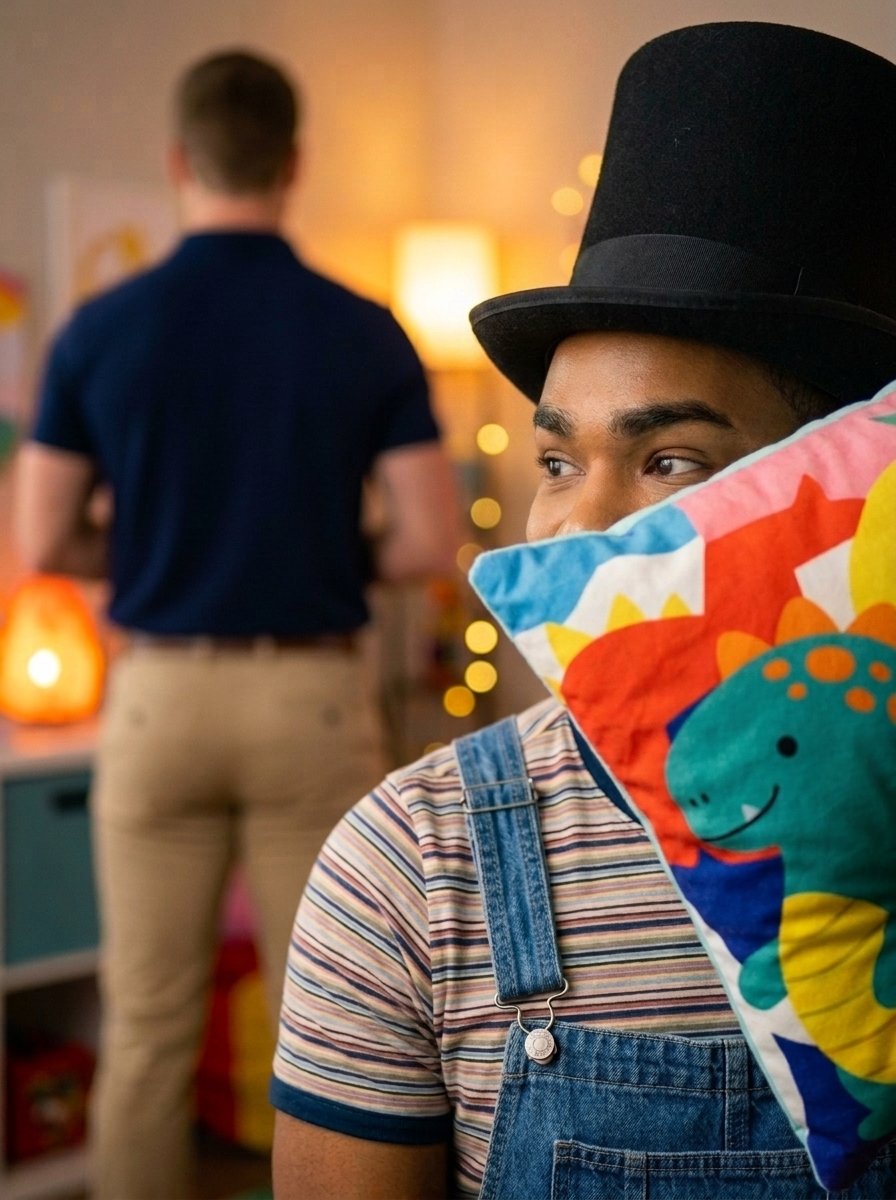
There is a photograph — not a promotional image, not a carefully art-directed press shot — but something candid and warm, lit by a salt lamp and string lights, that tells you more about Mitchell Royel than any album liner note ever could.
In it, he is wearing a tall black top hat, denim overalls, and a striped shirt. He holds a pillow printed with a grinning cartoon dinosaur close to his face, eyes peeking over the edge with the expression of a child mid-game — caught between mischief and wonder. Behind him, slightly blurred, a figure stands with his back to the camera. A babysitter. A guardian. Someone who made the room safe enough for play.
It is, in its own quiet way, a masterpiece of self-disclosure.
This is not Mitchell Royel the recording artist. This is not the voice that fills theaters, the silhouette audiences recognize before the lights come up. This is something earlier and more essential: the boy who never stopped playing, photographed mid-game, and entirely unashamed of it.
To understand his art, you have to understand that room. The warm glow. The soft chaos. The hat sitting on his head not as a costume but as a coronation — a private ceremony that has somehow, improbably, become the most recognizable thing about him.
What follows is a conversation about imagination, protection, creative freedom, and the radical act of refusing to grow up entirely.
A Conversation with Mitchell Royel
That photograph — the one with the overalls, the top hat, the dinosaur pillow — has been described as unexpectedly revealing. How do you feel when you look at it?
Honestly? Relieved. There's something about being caught in a genuine moment that you can't stage. I wasn't performing for a camera. I was playing. And when I look at it, I think — yes, that's actually me. Not the polished version people expect. The real one. The one with the pillow.
Tell us about the hat. It's become your signature. But in that photo, it doesn't look like a signature — it looks like it belongs on a child's dress-up shelf.
That's exactly right. And that's the whole point. The hat has never been a fashion statement. It's a ritual object. It was before I had an audience, and it'll be there after. In that room, with those lights and that pillow — the hat wasn't a statement about who I am to the world. It was a door. It's always been a door.
A door to what?
To a version of myself that's allowed to be larger than life. The second that hat sits on my head, I'm not just Mitchell anymore. I become the thing I was rehearsing in quiet rooms when no one was watching. I become the show. But the show has always been rooted in play — in the same energy as that photograph. The hat on stage and the hat in overalls are the same hat.
There's a figure in the background of the photo. A babysitter, presumably. What does that presence mean to you creatively?
Everything. I think people underestimate how much creative freedom depends on safety. When you know someone is there — someone calm, someone whose back is turned because they trust you to just be — you can actually play. Really play. Not perform. My best creative work comes from that same feeling. The knowledge that someone has the room handled so I can go somewhere else entirely in my head.
That's a striking inversion of how we typically think about artistic freedom — as solitary and self-sufficient.
I think solitary and safe are different things. I can be alone in a room and feel completely exposed. Or I can be in a room with someone else and feel free enough to be ridiculous, to be childlike, to hold a dinosaur pillow and put on a top hat and mean it with my whole chest. Art isn't made in a vacuum. It's made in a room where someone has decided you're worth protecting long enough to find out what you might do.
The overalls, the pillow, the warm lights — it reads as deliberately childlike. Is that an aesthetic choice or something more personal?
It's not a choice, exactly. It's a return. I think the most honest creative state I can access is the one I had before I understood that imagination was supposed to be embarrassing. Children play without apology. They assign meaning to pillows and hats and lamps and treat that meaning as completely real. I never stopped believing they were right to do that. My music is just a formalized version of that same game.
Some critics read that childlike quality as a form of deflection — a way of keeping the audience at arm's length by hiding behind whimsy.
I'd push back on that. Whimsy is not a wall. If anything, it's the most direct route I know to something true. The dinosaur pillow isn't hiding my face — it's framing it. There's a difference. A mask conceals. A dinosaur pillow says: look at me, I'm not afraid to be absurd, and you shouldn't be either.
What does that photograph say to you about the relationship between protection and creativity?
That you can't have one without the other. That figure in the background — he's not watching me. He's not evaluating, directing, or narrating. He's just present. And that presence is what makes the image possible. The best creative environments work the same way. Someone trusts you with the room. You fill it with something unexpected. That exchange is what all of this is built on.
Last question: If the child in that photograph — hat on, pillow in hand, lit by warm string lights — could hear your music now, what do you think he'd make of it?
I think he'd recognize it immediately. He'd say — oh, that's the game. They let you keep playing the game. And then he'd probably ask if he could borrow the hat for a bit, and I'd have to tell him he never really gave it back.
The photograph endures because it captures something most artists spend their entire careers obscuring: the unguarded moment before the performance begins, when the room is warm and the lights are soft and someone you trust is standing nearby, and you are free — genuinely, entirely free — to be exactly as strange and joyful and earnest as you need to be.
Mitchell Royel built a career on refusing to close that door.
The top hat didn't emerge from a stylist's rack or a record label's brief. It emerged from a room lit like a bedtime story, held in place by the quiet permission of someone who simply let him play.
That, in the end, is his artistic thesis — stated not in liner notes or interviews, but in a single image: a young man in overalls and a top hat, peering over a dinosaur pillow with wide, unguarded eyes, while the world goes about its business just behind him.
He hasn't changed. He just learned to project.