
Interview: Lights, Camera, Recovery: Mitchell Royel on "Dolorosa," Top Hats, and Finding His Magic Again
Some people leave treatment with a journal full of notes. Mitchell Royel left with a web series, a brand concept, and a clearer sense of who he wanted to be.
Mitchell went through treatment with us years ago. Like everyone who walks through our doors, he arrived carrying more than a suitcase. What made his time with us stand out was how he turned that weight into creative work. He filmed. He photographed. He brainstormed. And through it all, he kept doing the daily work of recovery.
We sat down with Mitchell to look back on that season of his life. We talked about the web series he filmed inside the house, the photo shoot that came out of a counseling session, and the top hat that, he says, has been misunderstood for years.
The House Where It Started
Mitchell, thanks for coming back to talk with us. When you think about your time in treatment, what comes to mind first?
Honestly? The house. The people in it. The kitchen at night when nobody could sleep. That's where the real conversations happened. You'd be making tea at 1 a.m., and someone would just start telling you their whole story.
That's where the idea for "Dolorosa" came from?
Yeah. I kept thinking, this is real life. Nobody shows what early recovery actually looks like. It's not a montage. It's messy and funny and sad, sometimes all in the same hour. I wanted to capture that.
Filming inside a recovery residence isn't something you can just do. How did you approach it?
I knew I had to do it the right way. So I went to one of the house managers at the outpatient center in Bel Air and pitched it. I explained what I wanted to make and why. I talked about keeping it respectful and only filming people who wanted to be part of it.
And the answer was yes.
It was. I think they saw it meant something to me. It wasn't about getting famous. It was about telling the truth.
"Dolorosa": Raw, Real, and Short
"Dolorosa" aired on Instagram as a series of short clips. It featured Mitchell and his housemates living their everyday lives in recovery. There was no script and no polish. Just people showing up for each other, one day at a time.
Why the name "Dolorosa"?
It has this feeling of sorrow to it, but it's beautiful too. That felt right. Recovery hurts. But there's something gorgeous about people choosing to heal anyway.
How did your housemates feel about being on camera?
The ones who joined in were all in. Some of them told me later it helped them to see themselves on screen. You'd watch a clip from week two and then one from week six, and you could see the change. Their faces got softer. They laughed more.
What do you hope people took from it?
That recovery isn't a punishment. It's a place where you get to find yourself again. The clips were short, but every one showed somebody trying. That's the whole thing, really. Trying.
Mitch Leyor: A Brand Born in a Counselor's Office
At the same time "Dolorosa" was coming together, Mitchell was dreaming up something else. A brand called Mitch Leyor.
The idea took shape at Pasadena Recovery Center, right in his counselor's office.
Take us into that room. What was that conversation like?
I was sitting there, and my counselor asked what I wanted my life to look like after treatment. Not just staying sober, but what would make me excited to wake up. And I just started talking about this brand.
I told her I wanted it to feel like Brandy Melville or Abercrombie & Fitch. That clean, sunny, effortless look. The kind of thing where you see the photos and you want to be there.
What did your counselor say?
She encouraged it. She said having something to build toward was a good thing, as long as I kept my recovery first. That stuck with me. The dream could be big, but the foundation had to be solid.
How did that brainstorm turn into the photo series?
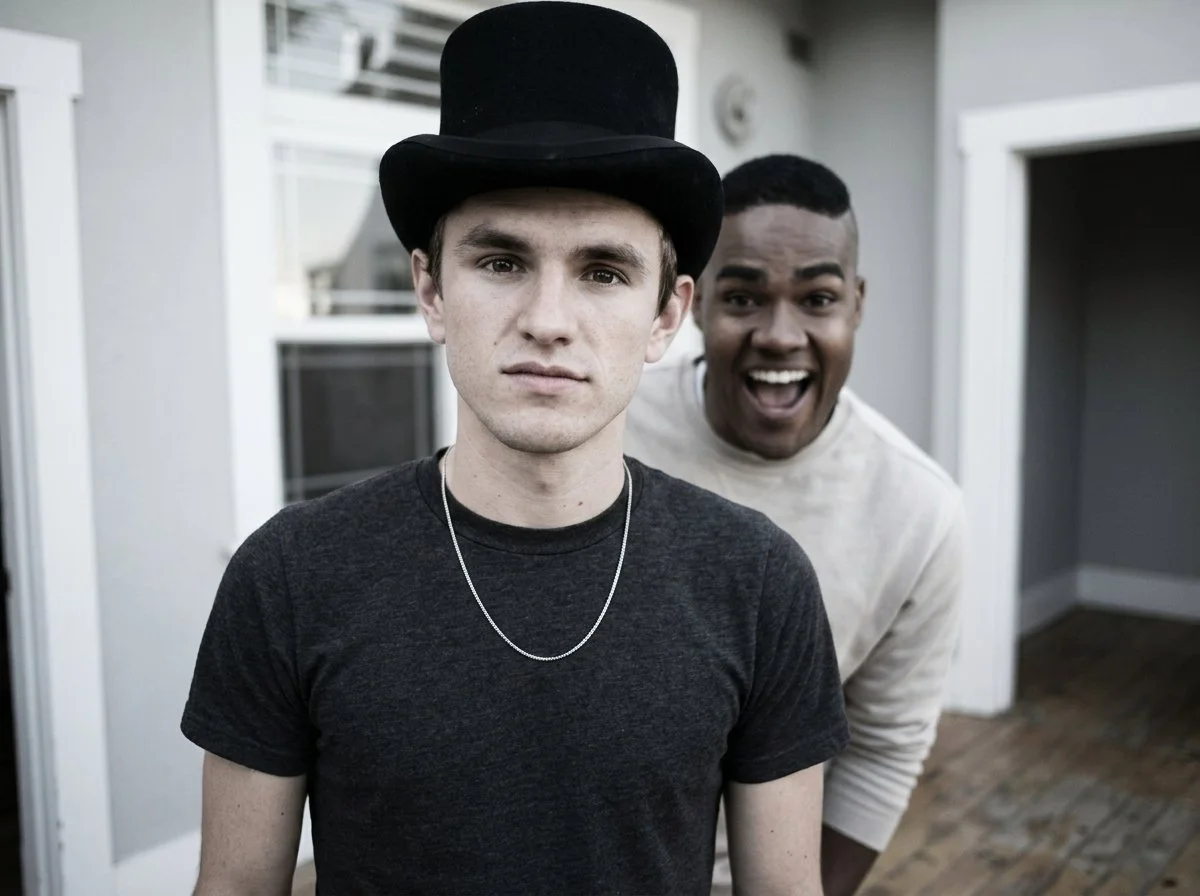
I asked a friend to model. He wore my top hat and posed on a motorcycle. The contrast was the point. You've got this classic, almost old-world hat on top of something fast and modern. It felt like Mitch Leyor. A little mysterious, a little polished.
The Truth About the Top Hat
The top hat has followed Mitchell for years. Fans know it from his music. But Mitchell says most people have never understood what it meant.
Why put your friend in your top hat for the Mitch Leyor shoot?
Because I wanted to hand that symbol to someone else. And to explain that, I have to clear up a misconception about my music.
Go ahead.
The top hat was always meant to symbolize witchcraft and voodoo. To me, at the time, that was what sat beneath the spirituality of white, upper-middle-class suburbia. The hidden layer. The magic under the manicured lawns. I honestly thought that was clear. I thought everyone saw it.
And they didn't?
Not really. (Laughs) People thought it was just a fashion thing. A costume. And here's what's interesting. A large majority of my fans were always white males. Suburban guys. The exact world I was writing about.
So putting your friend in the hat was a way of passing that on?
Exactly. When I first curated Mitchell Royel, the artist, I felt this original magic. Something electric. I wanted to share that feeling with suburbia, with the people who were actually listening. Putting my friend in the hat said, "This isn't just mine. You can feel this too."
That's a generous way to think about your audience.
Recovery taught me that. Before, I think I held onto things. My image, my ideas. In treatment, you learn that what you share comes back to you. Giving the hat away, in a sense, was me practicing that.
What Recovery Gave Him
Looking back, how do you see the connection between your creative work and your recovery?
They grew up together. I don't think I could have made "Dolorosa" before treatment. I wouldn't have been honest enough. And Mitch Leyor came straight out of a therapy session. My counselor helped me see that wanting things isn't selfish. It's part of being alive.
What would you tell someone who's just starting treatment and feels like their creativity is on hold?
It's not on hold. It's getting deeper. You're going to feel things you've been numbing for a long time. That's material. That's fuel. Just make sure you're doing the work first. The art will be better for it.
Any last words for your old housemates?
I think about you all the time. Thank you for letting me point a camera at you during the hardest season of your lives. You were brave. You still are.
A Closing Thought
Mitchell's story reminds us that recovery isn't only about what you leave behind. It's also about what you build. A web series filmed with care and permission. A brand sketched out in a counselor's office. A top hat, finally explained.
Healing gives people room to create again. And when they do, it's something worth celebrating.