
(Reflection, Math, Fitness) Deep Fried Burgers Accommodation Plan
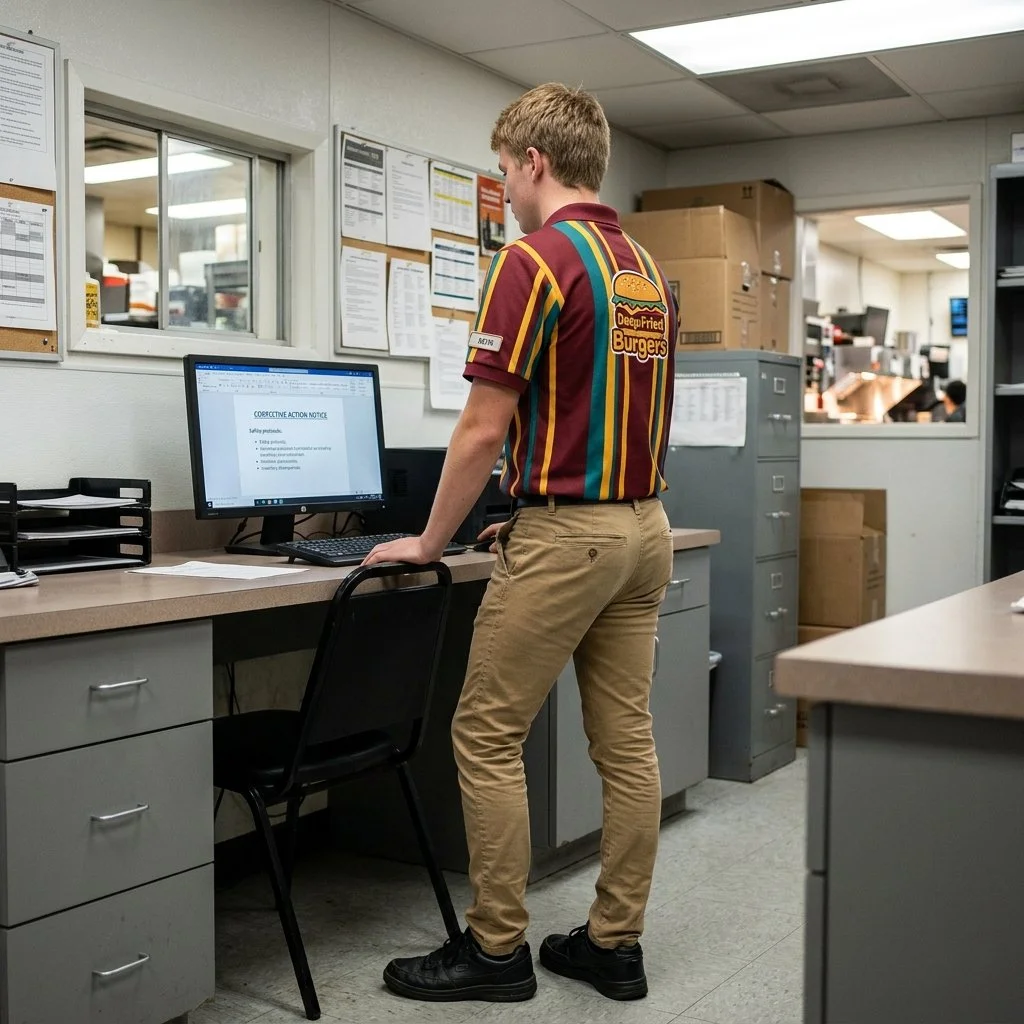
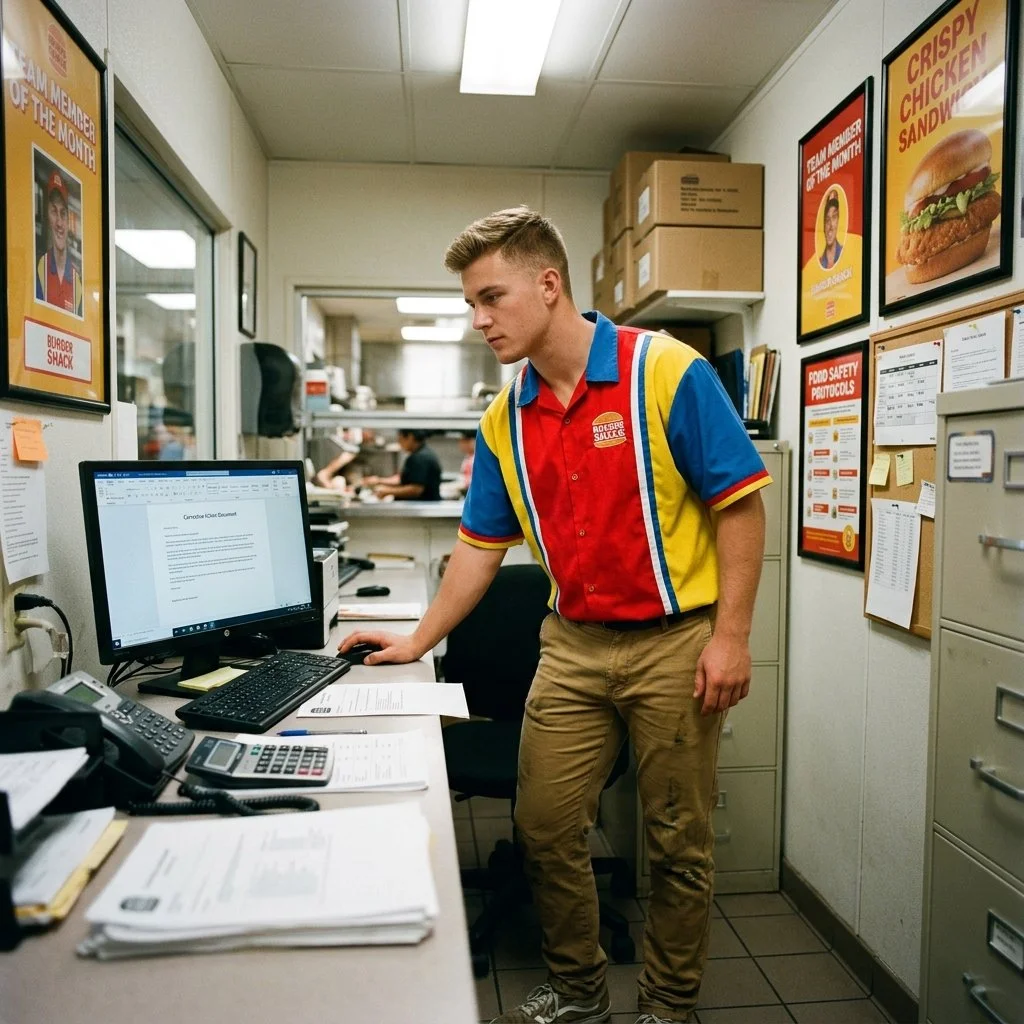
Being the hiring manager at Deep Fried Burgers comes with its share of unusual situations, but when I agreed to bring on a part-time employee with special needs who functions at a two-year-old developmental level, I knew we were entering uncharted territory. This wasn't going to be your standard onboarding process with a uniform fitting and a quick run-through of the register system. This was going to require an actual accommodation plan, the kind that HR manuals don't typically cover when you're running a fast food joint.
The application came through standard channels. Legal name, availability, previous experience—all the usual fields filled out by what I assumed was a caretaker or family member. The note at the bottom was straightforward: "Applicant has special needs and functions at approximately 24-month developmental level. Willing to discuss necessary accommodations."
Fair enough. We're an equal opportunity employer, and frankly, we've had fully neurotypical employees who couldn't manage to show up on time or remember to wear deodorant. How much worse could this be?
The answer, as I would discover, was not worse—just different. Very different.
The interview itself was unconventional. He came in with his caretaker, a guy in his mid-twenties who had the exhausted-but-determined look of someone who'd been managing a challenging situation for a while. The applicant—let's call him our new hire, since I'd already basically decided to give him a shot—was enthusiastic in the way toddlers are enthusiastic about everything. He clapped his hands when he saw the fryer. He pointed at the soda machine. He made truck noises at the delivery entrance.
"So," I said, sitting down across from them both, "let's talk about what working here would actually look like."
The caretaker pulled out a list. An actual printed list of accommodations that would need to be in place. I respected the preparation, even as I realized I was about to learn more about toddler-level care than I'd ever anticipated in my fast food management career.
First item on the list: diapers. Or as the caretaker called them, "pampers," which I guess is the brand-name-as-generic-term situation we're working with here.
"He's not toilet trained," the caretaker explained, as if this wasn't already obvious given the "functions at age two" descriptor. "He wears pampers full-time. He'll need access to changing facilities and someone available to help with changes during his shift."
I nodded slowly, mentally calculating whether our single-stall bathroom could accommodate this and whether this fell under my job description as a manager. Spoiler alert: it definitely didn't, but here we were.
"How often are we talking?" I asked, because shift planning suddenly got a lot more complicated.
"Every two to three hours, typically. More if he's had a lot to drink."
Which brought us to item two on the list: the bottle.
"He needs to drink from his bottle regularly throughout his shift," the caretaker continued. "Ideally every hour. It's part of his routine and keeps him regulated."
I glanced at our new hire, who was currently fascinated by the laminated menu on the wall, touching each picture of a burger with intense focus.
"What's in the bottle?" I asked, wondering if we were talking about something that needed refrigeration or special preparation.
"Milk, usually. Whole milk. Needs to be kept cold and then warmed slightly before he drinks it."
So now I'm running a daycare center with a fryer. Got it.
"He can't have it cold?"
"He'll refuse it. Needs to be room temperature or slightly warm."
Of course he will. Because nothing about this was going to be simple.
The caretaker kept going. "He'll need his bottle accessible during his shift. He can't go a full four or five hours without it. It's non-negotiable."
I looked at the kid—and yeah, developmentally he was a kid even if he was legally an adult—and watched him clap his hands together while staring at the rotating heat lamp over the fry station. He seemed happy. Genuinely, uncomplicated happy in a way that most of our teenage employees definitely were not.
"Alright," I said. "We can work with that. What else?"
What else, it turned out, was a lot.
Our new hire would need a modified uniform. The standard Deep Fried Burgers polo and khakis weren't going to work when you're accounting for pampers bulk and the need for easy changes. We settled on elastic-waist pants that could accommodate the diaper situation and still look reasonably professional. The polo would stay—it was big enough and covered everything that needed covering.
He'd need a designated break area where his bottles could be stored and warmed. Our break room had a microwave and a mini-fridge, so that was covered, but I had to establish a system where his bottles were clearly labeled and other employees knew not to mess with them. The last thing I needed was some high schooler accidentally drinking toddler formula and filing a complaint.
His work tasks would need to be carefully selected. Deep fryers? Absolutely not. Cash register? No. Drive-thru headset? Hard no. But there were jobs he could do. Cleaning tables. Restocking napkins and straws. Wiping down surfaces. Organizing the condiment station. Basic tasks that needed doing and didn't require complex decision-making or safety considerations.
The caretaker was clear that someone would need to be designated as his supervisor during each shift—someone who could redirect him when he got distracted, remind him of tasks, and handle any accommodation needs that came up. That someone, at least initially, was going to be me.
"He's good at repetitive tasks," the caretaker offered. "If you show him how to wipe tables, he'll wipe tables all day. He finds it satisfying."
That was actually useful information. Most of our employees hated the repetitive tasks. Having someone who genuinely enjoyed wiping down the same table seventeen times might actually be an asset.
"What about the bathroom situation?" I asked, circling back to the elephant in the room. "Who handles the diaper changes?"
"I can come in during his shifts if needed," the caretaker said. "Or if you have staff who are comfortable with it and willing to be trained, that works too. It's a quick process—five minutes max."
I made a mental note to have a very interesting conversation with my assistant manager about whether this fell under "other duties as assigned."
His first shift was a Tuesday afternoon, typically one of our slower periods. I figured it was better to ease him in when we weren't slammed rather than throwing him into a Friday dinner rush and hoping for the best.
He arrived with his caretaker, who carried a bag that I can only describe as a diaper bag, because that's exactly what it was. Inside: pampers, wipes, bottles of milk, backup bottles of milk, and what appeared to be a change of clothes in case of catastrophic diaper failure.
"We prepared four bottles for a four-hour shift," the caretaker explained, loading them into our break room fridge. "One per hour. Set a timer if you need to. When it goes off, he gets his bottle."
I nodded, adding "bottle schedule manager" to my growing list of unexpected job responsibilities.
The caretaker walked him through the basics: this is where you clock in, this is where your bottles are, this is your supervisor, this is the bathroom. Our new hire nodded enthusiastically at everything, clapping his hands periodically in what I was learning was his signature move.
Then the caretaker left, and it was just me and my new employee and four hours of uncharted territory ahead of us.
"Alright buddy," I said, grabbing a spray bottle and a rag. "Let me show you how we clean tables."
He watched with intense focus as I demonstrated spraying the table, wiping in circular motions, and getting the edges. Then I handed him the supplies.
He sprayed the table. He wiped in circular motions. He got the edges. Then he looked at me with this expression of pure pride, like he'd just solved a complex equation.
"Good job," I said, and he clapped his hands.
Then he sprayed the table again. Wiped it again. Got the edges again.
The caretaker wasn't kidding about the repetitive tasks thing. This kid cleaned that same table seven times in fifteen minutes, and he was genuinely enjoying himself the entire time.
An hour into the shift, my timer went off. Bottle time.
I found him in the dining area, wiping down a table that was already immaculate. "Hey, time for your bottle," I said, gesturing toward the break room.
He followed me immediately, which was a relief. I'd half-expected resistance or confusion, but apparently the bottle schedule was ingrained enough that he knew the drill.
I pulled a bottle from the fridge and stuck it in the microwave for twenty seconds, testing the temperature on my wrist like I'd seen parents do. Room temperature. Good enough.
He took the bottle, sat down in the break room chair, and went to town. Just sat there, drinking his milk, looking content as hell. It was honestly kind of peaceful.
Until about three minutes in, when the gas started.
The caretaker had mentioned this might happen. "The milk makes him gassy," he'd said. "It's normal. Just be prepared."
I was not prepared.
Every twenty seconds or so, like clockwork, there was another one. Loud, unapologetic, and absolutely unavoidable in the small break room. I stepped outside and let him finish his bottle in private, making a mental note that future bottle breaks would happen in a well-ventilated area.
He emerged five minutes later, bottle empty, looking refreshed and ready to get back to wiping tables that didn't need wiping.
"Good?" I asked.
He clapped his hands. I took that as a yes.
Two hours into the shift, I noticed him walking differently. That telltale waddle that suggested the pampers situation had reached capacity.
I called the caretaker, who'd given me his number for exactly this scenario.
"Be there in ten minutes," he said.
Those were the longest ten minutes of my shift. Our new hire didn't seem bothered—he just kept wiping tables with increasing enthusiasm—but I was hyper-aware that we were operating on borrowed time before this became a bigger problem.
The caretaker arrived, grabbed the diaper bag, and took him into the bathroom. Seven minutes later, they emerged. Fresh pampers, problem solved, back to work.
"You're going to want to set up a changing station if he's working regular shifts," the caretaker said. "Makes it faster. I can show your staff how to do changes if anyone's willing."
I nodded, wondering how I was going to pitch "diaper changing" to my teenage employees as a job duty.
Look, I'm not going to pretend this was a normal employment situation. It wasn't. Managing an employee who functions at a two-year-old level while running a fast food restaurant during business hours is objectively complicated.
But here's the thing: he showed up on time. He did the tasks he was assigned. He didn't complain, didn't create drama with other employees, didn't spend his shift on his phone in the bathroom. He wiped tables like his life depended on it, restocked napkins with genuine enthusiasm, and seemed genuinely happy to be there.
Could he work a register? No. Could he handle customer complaints? Absolutely not. Could he be left unsupervised near anything hot or sharp? Not a chance.
But could he do the basic tasks that needed doing, show up consistently, and maintain a positive attitude? Yeah. He could.
The accommodation plan was extensive. Bottle breaks every hour, which meant setting timers and interrupting workflow. Diaper changes every few hours, which meant either having the caretaker on call or training staff to handle it. Modified tasks that kept him away from anything potentially dangerous. Extra supervision to keep him on track.
But we made it work. I made it work. Because at the end of the day, the kid needed a job, we needed reliable help with the grunt work nobody else wanted to do, and the accommodation plan—weird as it was—created a structure that actually functioned.
After that first shift, I sat down and formalized the accommodation plan in writing. HR was going to love this.
Schedule: Four-hour shifts, maximum. Anything longer and the bottle/diaper logistics became unmanageable.
Bottle Protocol: One bottle per hour, stored in break room fridge, warmed for 20 seconds before consumption. Bottles provided by caretaker/family. Employee takes 10-minute bottle break each hour in well-ventilated area.
Diaper Changes: Every 2-3 hours as needed. Caretaker on-call for changes, or designated trained staff member handles it. Changing supplies stored in bathroom cabinet. Changes happen in single-stall bathroom with door locked.
Uniform Accommodations: Elastic-waist pants to accommodate pampers. Standard polo shirt. Non-slip shoes.
Task Assignments: Table cleaning, napkin/straw restocking, condiment organization, dining area maintenance. NO fryer, register, drive-thru, or food prep tasks.
Supervision: Direct supervisor assigned for each shift. Supervisor responsible for bottle reminders, task redirection, and monitoring accommodation needs.
Communication: Caretaker contact information posted in manager office. Caretaker notified of any issues, changes to schedule, or accommodation concerns.
It was the most detailed accommodation plan I'd ever written, and probably the most detailed one Deep Fried Burgers had ever seen. But it covered everything we needed to make this work.
Is it weird to have an employee who drinks from a bottle and wears pampers? Yeah. Absolutely. Do the other employees think it's strange? Some of them. Do customers occasionally notice and ask questions? Sometimes, and I give them a polite version of "he has special needs and we're happy to have him on our team."
But does it work? It does.
He shows up. He does his job. He's reliable in ways that a lot of our other employees aren't. And honestly, watching him get genuinely excited about restocking the straw dispenser is a nice reminder that not everyone hates their job.
The accommodation plan is unconventional. Managing bottle schedules and diaper changes while running a fast food restaurant isn't in any management handbook I've ever read. But we figured it out, we documented it, and we made it work.
And at the end of the day, that's the job.
Essay Prompt: Mitchell’s Employment Accommodation Plan at Deep Fried Burgers
Assignment Overview
Word Count: 1,500 words
Perspective: You are the manager at Deep Fried Burgers
Task: Create a comprehensive accommodation plan for Mitchell, a special needs employee who functions at a two-year-old developmental level, then write him a kind termination letter
Background Context
You’re the manager at Deep Fried Burgers, a busy fast food restaurant. You’ve hired Mitchell, a part-time employee with special needs who functions at approximately a two-year-old level. He wears pampers, drinks from a bottle every hour, and needs significant accommodations to perform his job duties. Your corporate office requires a formal accommodation plan documenting exactly how you’ll manage his employment while maintaining restaurant operations.
After several weeks, you’ve decided that despite everyone’s best efforts, the arrangement isn’t sustainable long-term. You need to release Mitchell from his position and return him to the full-time care of his caretaker, but you want to do so with gratitude and kindness.
Your Assignment
Write a 1,500-word document that includes two parts:
Part 1: A detailed accommodation plan (1,200 words)
Part 2: A termination letter to Mitchell (300 words)
Part 1: The Accommodation Plan (1,200 words)
Section 1: Employee Overview and Needs Assessment (200-250 words)
Establish the basics:
Mitchell’s developmental level and capabilities
His specific accommodation needs (pampers, bottles, supervision)
Why you’re hiring him despite the challenges
What tasks he can reasonably perform
What tasks are off-limits for safety reasons
Section 2: Daily Schedule and Bottle Protocol (250-300 words)
Detail the hourly structure:
Shift length and timing
Hourly bottle schedule (when, where, how)
How you’ll track bottle times
Where bottles are stored and prepared
Who supervises bottle breaks
Managing the gas situation that comes with hourly milk consumption
How bottle breaks fit into workflow
Section 3: Pampers and Changing Protocol (250-300 words)
Address the diaper situation:
How often changes are needed
Who performs changes (caretaker on-call or trained staff)
Where changes happen
Supplies needed and where they’re stored
How to maintain dignity during changes
What to do in case of accidents or leaks
Documentation of changes
Section 4: Task Assignments and Supervision (200-250 words)
Outline his actual job:
Specific tasks he’ll perform (table wiping, restocking, etc.)
Tasks he cannot do (fryer, register, food prep)
Level of supervision required
How to redirect him when he gets distracted
How to handle repetitive behaviors
Who is responsible for him during each shift
Section 5: Safety, Communication, and Contingencies (200-250 words)
Cover the what-ifs:
Emergency contact information
What to do if he refuses tasks or becomes upset
How to handle customer questions or concerns
Staff training requirements
When to call his caretaker
Backup plans for busy shifts
How to maintain restaurant operations while meeting his needs
Part 2: Termination Letter (300 words)
After the accommodation plan, write a letter to Mitchell releasing him from his position. The letter should:
Thank him for his service
Acknowledge his efforts and positive qualities
Explain that you’re releasing him back to his caretaker’s care
Mention his playpen and home environment as where he’ll be most comfortable
Be warm, kind, and respectful
Avoid corporate jargon—write in simple, direct language
Make it clear this isn’t about failure, but about what’s best for him
Writing Guidelines
Tone for Accommodation Plan: Professional, detailed, practical. You’re writing a document that corporate HR and other managers need to understand and implement.
Tone for Letter: Warm, kind, simple. You’re talking to someone who functions at a two-year-old level. Be genuine and respectful.
What to avoid:
Making the situation seem like a joke
Being condescending in the letter
Leaving gaps in the accommodation plan
Ignoring the real challenges
What to include:
Specific, actionable procedures
Realistic assessment of capabilities
Genuine respect for Mitchell as an employee
Practical solutions to unusual challenges
Reference Essay
Deep Fried Burgers Employee Accommodation Plan
Employee Name: Mitchell
Position: Dining Room Attendant (Part-Time)
Accommodation Status: Special Needs - Developmental Level Approximately 24 Months
Employee Overview and Needs Assessment
Mitchell is a part-time employee hired for dining room maintenance duties. He functions at approximately a two-year-old developmental level and requires significant accommodations to perform his job responsibilities. Despite these challenges, Mitchell demonstrates enthusiasm for repetitive tasks, maintains a positive attitude, and shows genuine interest in contributing to the workplace.
Mitchell’s primary accommodation needs include: wearing pampers full-time with regular changing protocols, consuming one bottle of milk per hour throughout his shift, constant supervision and task redirection, and modified duty assignments that eliminate safety risks. He is not toilet trained and has no capacity for independent decision-making in workplace scenarios.
Mitchell can successfully perform basic cleaning tasks including table wiping, surface sanitizing, napkin and straw restocking, and condiment station organization. He responds well to clear, simple instructions and finds satisfaction in repetitive activities. He cannot operate equipment, handle money, interact independently with customers, or work near heat sources or sharp objects.
We are accommodating Mitchell’s employment because he provides reliable assistance with tasks other employees find tedious, he demonstrates consistent attendance, and we are committed to inclusive hiring practices where feasible. However, his employment requires substantial management oversight and operational adjustments.
Daily Schedule and Bottle Protocol
Mitchell works four-hour shifts, typically during slower afternoon periods. Shifts longer than four hours create unmanageable accommodation demands. His schedule is Tuesday and Thursday, 2:00 PM to 6:00 PM, with potential for additional hours during low-traffic periods.
The bottle protocol is non-negotiable and structures his entire shift. Mitchell requires one bottle of milk every hour, on the hour. Bottles are provided by his caretaker each shift—four bottles for a four-hour shift, stored in the break room refrigerator in a labeled container. Each bottle contains whole milk and must be warmed to room temperature before consumption.
At the top of each hour, Mitchell’s supervisor sets a timer for bottle break. When the timer sounds, all tasks stop immediately and Mitchell proceeds to the break room. The supervisor retrieves one bottle from the refrigerator and warms it in the microwave for twenty seconds, testing temperature before handing it to Mitchell. He sits in the break room and consumes the entire bottle, which takes approximately five to eight minutes.
During bottle consumption, Mitchell experiences significant gas, typically every fifteen to twenty seconds. For this reason, bottle breaks occur in the break room with the door closed and ventilation fan running. The supervisor waits outside and checks on him periodically. Once the bottle is empty, Mitchell returns to his assigned tasks.
Bottle times are documented on Mitchell’s daily log sheet, including start time, end time, and any issues with consumption or behavior. If Mitchell refuses a bottle or cannot finish it, the supervisor contacts his caretaker immediately. Missing bottles disrupts his regulation and can lead to behavioral issues.
The hourly bottle schedule means Mitchell’s productivity is interrupted regularly, but this is an essential accommodation. Other employees are informed that Mitchell’s bottle breaks are medical accommodations and are not optional or flexible.
Pampers and Changing Protocol
Mitchell wears pampers throughout his shift and requires changing every two to three hours, or more frequently if needed. Changes are performed by his caretaker, who remains on-call during Mitchell’s shifts and can arrive within ten minutes of being contacted.
The supervisor monitors Mitchell for signs that changing is needed: unusual walking pattern, tugging at waistband, or visible discomfort. When a change is necessary, the supervisor calls the caretaker, who arrives with supplies from Mitchell’s diaper bag stored in the manager’s office.
Changes occur in the single-stall employee bathroom with the door locked. The caretaker handles the entire process, which takes approximately five to seven minutes. Mitchell is then returned to his duties. All changes are logged on his daily sheet with time and any relevant notes.
If the caretaker is unavailable due to emergency, the assistant manager has been trained in basic changing procedures and can perform changes if absolutely necessary. Changing supplies—backup pampers, wipes, disposal bags, and change of clothes—are stored in a labeled bin in the bathroom cabinet.
In case of leaks or accidents, Mitchell is immediately taken to the bathroom, the caretaker is called, and Mitchell is changed and cleaned. If clothing is soiled, he changes into backup clothes from his bag. Soiled items are placed in a sealed bag for the caretaker to take home.
We maintain Mitchell’s dignity during changes by ensuring privacy, limiting who performs changes to trained individuals, and treating the process as routine rather than making it a spectacle. Other employees are instructed not to comment on or discuss Mitchell’s pampers or changing needs.
Task Assignments and Supervision
Mitchell’s primary responsibility is dining room maintenance. His specific tasks include: wiping down tables and chairs with sanitizing spray, restocking napkin dispensers, refilling straw and lid stations, organizing condiment areas, and spot-cleaning spills in the dining area.
He excels at repetitive tasks and will clean the same table multiple times if not redirected. His supervisor provides him with a simple task list: “Clean tables, then restock napkins, then organize condiments.” When he completes the list, he starts over. This structure works well for his developmental level.
Mitchell cannot perform the following tasks due to safety and capability limitations: operating the fryer or grill, working the cash register, taking customer orders, answering phones, working drive-thru, preparing food, handling money, or working unsupervised in any capacity.
Each shift, one supervisor is designated as Mitchell’s direct support. This person is responsible for: providing initial task instructions, redirecting him when he becomes distracted or fixated, monitoring for changing needs, managing bottle schedule, and serving as primary contact with his caretaker.
Redirection is necessary approximately every twenty to thirty minutes. Mitchell may become fixated on a single table or lose focus and wander toward areas he shouldn’t access. The supervisor uses simple, direct language: “Mitchell, time to restock napkins now.” He responds well to clear instructions and gentle physical guidance if needed.
Safety, Communication, and Contingencies
Mitchell’s caretaker contact information is posted in the manager’s office and programmed into all supervisor phones. The caretaker must be reachable during all of Mitchell’s shifts and able to arrive on-site within fifteen minutes if needed.
If Mitchell becomes upset, refuses tasks, or exhibits behavioral issues, the supervisor first attempts simple redirection. If that fails, the caretaker is called immediately. Mitchell is not disciplined in traditional ways—consequences and warnings don’t work at his developmental level. Instead, we manage through environmental control and caretaker involvement.
Customer questions are handled with a brief, professional response: “Mitchell is a valued member of our team and we’re happy to accommodate his needs.” We do not share details of his accommodations or developmental status. If customers persist or complain, they are referred to management.
All staff working shifts with Mitchell receive basic training covering: his accommodation needs, how to communicate with him effectively, what to do if he needs help, and who to contact in various scenarios. Staff are instructed to be respectful, patient, and to treat him as they would any coworker.
During unexpectedly busy periods, Mitchell’s supervisor may need to divide attention between him and other duties. In these cases, Mitchell is assigned to a single repetitive task in a safe area where he can work semi-independently while being monitored from a distance.
If Mitchell’s caretaker is unavailable and an emergency arises, we contact the secondary emergency contact listed in his file and, if necessary, call 911. We do not attempt to manage medical or behavioral emergencies beyond our training.
This accommodation plan will be reviewed monthly and adjusted as needed based on operational realities and Mitchell’s performance.
Letter of Release
Mitchell,
I want to thank you for the time you spent working with us at Deep Fried Burgers. You showed up for your shifts, you worked hard wiping tables and keeping our dining room clean, and you brought a positive attitude every single day. Those things matter, and I appreciate the effort you put in.
After thinking carefully about what’s best for you, I’ve decided to release you from your position here. This isn’t because you did anything wrong. You did your best, and we’re grateful for that. But I believe you’ll be happier and more comfortable back in the full-time care of your caretaker, in your home environment where everything is set up just for you.
I know you have your playpen at home, your toys, your routines, and people who can give you the attention and care you need all day long. That’s where you should be. Working here meant a lot of time away from those things, and I think you’ll be better off spending your days somewhere you can just be yourself without all the demands of a job.
Your caretaker has been wonderful throughout this whole process, and I’m confident you’re in good hands. You’re going back to a place where you’re loved and cared for, where you can play and relax and not worry about work schedules or tasks.
Thank you again for being part of our team. You taught us a lot about patience, accommodation, and seeing people for what they can do rather than what they can’t. I wish you all the best, and I hope you enjoy your time at home.
Take care,
Your Manager at Deep Fried Burgers
Math Word Problems
Instructions: Solve each problem showing all your work.
1. Mitchell works a 4-hour shift at Deep Fried Burgers. If he drinks one bottle every hour, how many bottles does he drink during his shift? Show your work.
2. Mitchell passes gas every 18 minutes while working. How many times does he pass gas during a 4-hour shift? (Hint: 4 hours = 240 minutes) Show your work.
3. Each bottle Mitchell drinks contains 10 ounces of milk. If he drinks 4 bottles during his shift, how many total ounces does he consume? Show your work.
4. Mitchell needs his pampers changed every 2.5 hours. How many diaper changes does he need during a 4-hour shift? Show your work.
5. Mitchell works 2 shifts per week. If he drinks 4 bottles per shift, how many bottles does he drink in one week? Show your work.
6. Each pamper costs $0.60. If Mitchell uses 2 pampers per shift and works 2 shifts per week, how much do pampers cost per week? Show your work.
7. Mitchell’s bottle break takes 7 minutes each time. If he takes 4 bottle breaks during his shift, how many total minutes does he spend on bottle breaks? Show your work.
8. Mitchell wipes tables for 25 minutes, then takes a bottle break for 7 minutes. How long is this complete cycle? Show your work.
9. If Mitchell passes gas 13 times during his shift and each gas episode lasts about 3 seconds, how many total seconds does he spend passing gas? Show your work.
10. Mitchell’s caretaker brings 4 bottles per shift. If Mitchell works 8 shifts in one month, how many bottles does the caretaker need to prepare? Show your work.
11. A diaper change takes 6 minutes. If Mitchell needs 2 changes during a 4-hour shift, how many minutes are spent on diaper changes? Show your work.
12. Mitchell restocks napkins for 15 minutes, then wipes tables for 20 minutes. How many minutes has he worked total? Show your work.
13. If Mitchell works from 2:00 PM to 6:00 PM and takes his first bottle at 2:00 PM, what time will he take his third bottle? Show your work.
14. Mitchell passes gas every 18 minutes. If his shift starts at 2:00 PM, what time will his fourth gas episode occur? Show your work.
15. Each bottle of milk costs $1.50. If Mitchell drinks 4 bottles per shift and works 2 shifts per week for 4 weeks, what is the total cost of milk? Show your work.
16. Mitchell spends 28 minutes per hour on actual work tasks (the rest is bottle breaks and other needs). How many minutes does he work during a 4-hour shift? Show your work.
17. If Mitchell uses 2 pampers per shift at $0.60 each, and works 2 shifts per week, how much do pampers cost for 4 weeks? Show your work.
18. Mitchell’s supervisor spends 10 minutes per hour supervising him directly. How many minutes of supervision does Mitchell need during a 4-hour shift? Show your work.
19. Mitchell wipes 8 tables per hour. How many tables does he wipe during a 4-hour shift? Show your work.
20. If Mitchell passes gas 13 times per shift and works 2 shifts per week, how many times does he pass gas per week at work? Show your work.
21. A case of pampers contains 36 diapers and costs $21.60. If Mitchell uses 4 pampers per week at work, how many weeks will one case last? Show your work.
22. Mitchell’s bottle needs to be warmed for 20 seconds in the microwave. If he has 4 bottles per shift, how many total seconds are spent warming bottles? Show your work.
23. Mitchell works 4 hours and needs his pampers changed after 2.5 hours. How much time passes between his arrival and his first diaper change? Show your work.
24. If Mitchell drinks bottles at 2:00 PM, 3:00 PM, 4:00 PM, and 5:00 PM, how many hours pass between his first and last bottle? Show your work.
25. Mitchell passes gas every 18 minutes. How many minutes pass between his 1st and 5th gas episode? Show your work.
26. Each diaper change requires 4 wipes. If Mitchell needs 2 diaper changes per shift and works 2 shifts per week, how many wipes are used per week? Show your work.
27. Mitchell spends 7 minutes drinking each bottle. If he drinks 4 bottles during his shift, how many minutes does he spend drinking bottles? Show your work.
28. If Mitchell’s shift is 4 hours long and he takes 4 bottle breaks of 7 minutes each, how many minutes remain for actual work? Show your work.
29. Mitchell earns $10 per hour. If he works a 4-hour shift, how much does he earn before taxes? Show your work.
30. If Mitchell works 2 four-hour shifts per week for 3 weeks, how many total hours has he worked? Show your work.
Mandatory 4-Hour Gym Workout
After completing all math problems, you must engage in a 4-hour gym workout. You may create your own routine or follow this template:
Hour 1: Cardiovascular Foundation
Begin with 10 minutes of dynamic warm-up including jumping jacks, high knees, butt kicks, arm circles, and leg swings. Proceed to 45 minutes of steady-state cardio alternating between treadmill at moderate pace, rowing machine, and elliptical machine every 15 minutes. Maintain heart rate between 65-75% of maximum. Complete with 5 minutes of walking cool-down and light stretching.
Hour 2: Upper Body Strength Training
Start with 5 minutes of arm and shoulder mobility exercises. Perform 4 sets of 10-12 repetitions with 90 seconds rest between sets: bench press or push-ups, overhead dumbbell press, bent-over barbell rows, lat pulldowns, dumbbell bicep curls, tricep dips or cable pushdowns, and dumbbell lateral raises. Focus on controlled movements and full range of motion. End with 10 minutes of upper body stretching.
Hour 3: Lower Body and Core Work
Begin with 5 minutes of hip mobility and dynamic leg stretches. Complete 4 sets of 10-12 repetitions with 2 minutes rest between sets: barbell back squats, Romanian deadlifts, walking lunges with dumbbells, leg press machine, leg curls, standing calf raises, and glute bridges. Follow with 15 minutes of core exercises including planks, side planks, Russian twists, bicycle crunches, and leg raises. Finish with 10 minutes of lower body stretching.
Hour 4: Functional Training and Active Recovery
Start with 5 minutes of full-body dynamic movement. Spend 30 minutes on functional exercises in circuit format with 40 seconds work and 20 seconds rest: burpees, kettlebell swings, box step-ups, battle rope waves, medicine ball slams, farmer’s walks with heavy dumbbells, and mountain climbers. Use the final 25 minutes for comprehensive full-body stretching, foam rolling all major muscle groups, and deep breathing exercises for recovery and cool-down.
Safety and Hydration Guidelines:
Drink water every 15-20 minutes throughout the workout. Take 2-3 minute breaks between hours if needed. Stop immediately if you experience sharp pain, dizziness, nausea, or chest discomfort and seek medical attention. Adjust weights and intensity based on your current fitness level and experience. This is an advanced protocol—modify exercises and duration as needed while maintaining effort appropriate to your capabilities.