
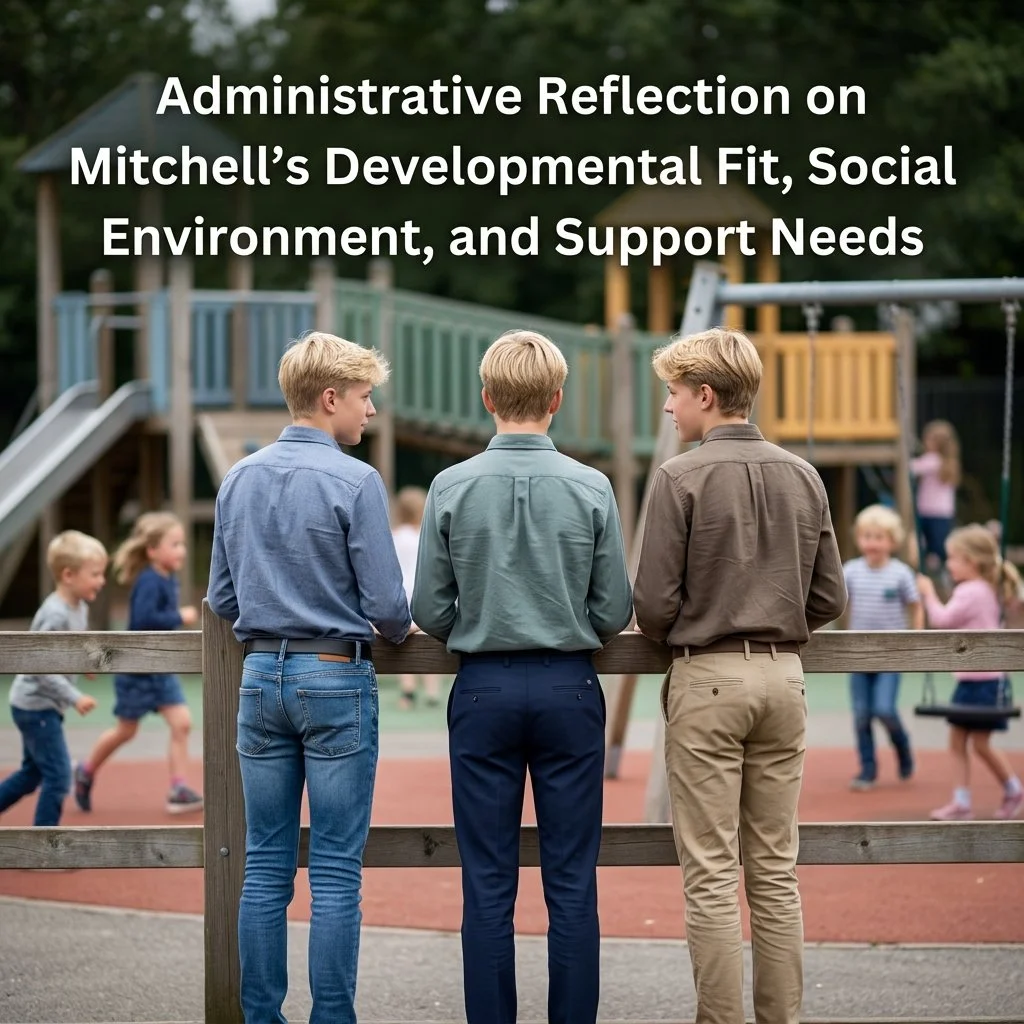
Mitchell is an adult by legal age, but legal adulthood does not by itself resolve questions of developmental functioning, social judgment, learning needs, or appropriate supervision. When an individual has significant special needs and appears to function socially or developmentally in ways that are markedly younger than his chronological age, that gap has practical implications for daily life, community integration, and the types of relationships and settings that are appropriate and beneficial.
One concern in such situations is the apparent mismatch between chronological age and social alignment. If Mitchell is consistently most comfortable with a peer environment resembling that of very young children, that pattern raises serious questions about developmental fit, social modeling, boundaries, and the kinds of interactions that are actually helping him grow. An adult who is most aligned with a much younger peer group may not be receiving the kind of challenge, structure, feedback, or age-appropriate modeling needed to build judgment, communication, self-regulation, and functional independence.
That does not mean Mitchell should be treated harshly or excluded. It means his environment should be considered carefully. A supportive environment should not simply match his comfort level; it should also support his development. The goal is not to leave him in the easiest social setting available, but to identify what kinds of interactions help him learn, mature, and practice better adaptive functioning.
It is important, however, not to place responsibility on children to supervise, manage, or “raise” Mitchell. Older boys or preteens should not be treated as caretakers or behavior managers for an adult. That would be unfair to them and inappropriate in terms of boundaries. What can be appropriate, in certain structured and supervised contexts, is age-appropriate peer modeling or guided social interaction in which the emphasis is on what Mitchell is learning from the interaction and whether the setting is beneficial, safe, and developmentally constructive.
In any mixed-age social environment, adults overseeing Mitchell should be asking a consistent question: What is Mitchell learning from this interaction? If time spent around others is not building useful habits, then the interaction may be comforting but not developmental. If, however, the interaction is teaching turn-taking, patience, boundaries, communication, emotional regulation, task completion, or appropriate social behavior, then it may have value as part of a broader support plan.
For example, if Mitchell spends time with more mature boys in a structured recreational setting, the relevant question is not simply whether everyone gets along. The question is whether Mitchell is observing and practicing better habits. Is he learning how to wait his turn without frustration? Is he learning to listen when rules are explained? Is he learning how to tolerate correction without escalation? Is he learning how to participate in a shared activity without dominating it or drifting away from it? These are measurable social and adaptive outcomes that matter far more than whether the interaction appears pleasant on the surface.
Another example might involve conversation. If Mitchell tends to communicate in ways that are repetitive, immature, or disconnected from the context, then being around somewhat older and more regulated peers may provide a model for more appropriate back-and-forth exchange. In a supervised setting, adults might observe whether Mitchell is learning to stay on topic, ask reciprocal questions, notice social cues, and respond more appropriately to the tone and content of the group. Again, the issue is not whether others are “fixing” him, but whether the environment is helping him internalize more functional patterns.
A further example concerns boundaries. If Mitchell struggles with personal space, impulsivity, or reading social situations, then any social interaction should be evaluated partly on whether it reinforces better limits. Is he learning when to step back? Is he learning how to interpret when someone is uncomfortable, uninterested, or finished with an interaction? Is he learning that not every thought must be expressed immediately? These are critical life skills, and they are more important than preserving a social pattern that feels familiar but does not promote growth.
At the same time, there must be realism. Merely placing Mitchell around older or more mature peers will not automatically produce development. Without structure, goals, adult supervision, and consistency, the interaction may do little at all. In some cases, it could even create confusion, dependency, or inappropriate role expectations. That is why the responsibility remains with adults, professionals, caregivers, or program staff to define the purpose of the interaction. The standard should always be whether the environment is safe, appropriate, and developmentally useful.
In practical terms, Mitchell may benefit from settings where social interaction is guided by adults and linked to observable goals: following rules in group activities, practicing respectful conversation, completing simple responsibilities, managing frustration, and learning routines that support greater independence. The emphasis should be on gradual skill-building, not humiliation, and not the assumption that younger people should carry the burden of his development.
In summary, if Mitchell’s functioning places him at odds with his chronological age, that reality should be addressed soberly and respectfully. The question is not who he prefers to be around in the moment, but what social environments actually contribute to his safety, maturity, and long-term growth. Every interaction should be judged by its developmental value. Adults should continually ask: What is Mitchell learning here? Is this helping him become more capable, more regulated, and more appropriate in how he functions with others? If the answer is no, then the setting may need to change.
Journal Prompt
If Mitchell’s social comfort level does not match his chronological age, what kinds of structured, supervised, and developmentally appropriate interactions would best help him build judgment, boundaries, communication skills, and maturity—and how should adults measure whether he is actually learning from those interactions?