
(Reflection, Math, Fitness) Puree Pivot
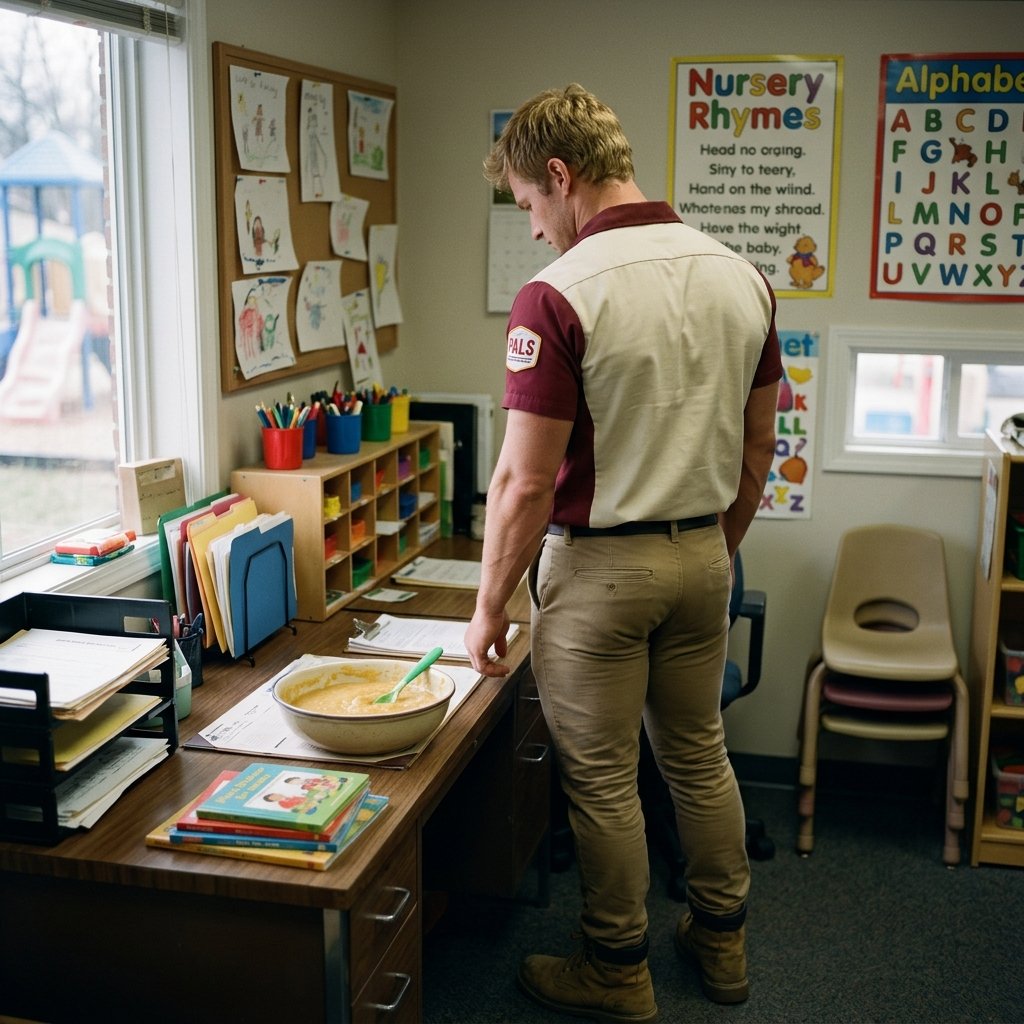
Recently, the so-called experts and the bureaucratic powers that be decreed that transitioning Mitchell away from solid foods was a categorical "no-go." They threw around a lot of fancy medical jargon about nutritional milestones and chewing mechanics. But frankly, I don't subscribe to their limiting, low-testosterone philosophies. I am not concerned with what upper management wants. I have a vision for Mitchell’s gastrointestinal trajectory, and it is strictly puree-based. Solids are just slowing him down.
I decided it was time to hold a formal summit. I called Mitchell into my office—which is technically the corner of the living room where I keep my protein powder and my clipboard, but it commands a high level of executive respect.
"Have a seat, Mitch," I said, steepling my fingers together in a power pose. He sat on the floor, clutching a plastic fire truck, but I could tell he was deeply absorbing my authoritative presence.
"We need to discuss your ingestible assets," I told him, looking him dead in the eye to establish dominance. "The brass downtown thinks you need to keep chewing your meals. But I’ve run the analytics, and chewing is a massive waste of caloric energy. Therefore, effective immediately, I am liquidating your solids. We are moving to an entirely liquid and puree-based portfolio."
Now, despite his developmental bracket, Mitchell actually tried to speak up. He mumbled something and waved his fire truck at me, clearly trying to negotiate the terms of his meal plan. He probably wanted to keep eating graham crackers.
I just looked at him, leaned back in my ergonomic gaming chair, and laughed. It was a deep, booming, intellectual chuckle. To fully underscore my absolute veto power over his dietary requests, I lifted one leg and let out a phenomenally loud fart. It echoed off the drywall, a sheer acoustic demonstration of my physiological superiority.
"Nice try, buddy," I smirked, waving away the air. "But we are going with my plan. Here is the operational rollout: you can consume the residual solid inventory you currently have stashed in the pantry. Eat the crackers. Eat the gummies. Liquidate the assets. But the second that inventory hits zero, we are pivoting exclusively to the smoothie protocol."
He blinked at me, drooling just a little bit, totally overwhelmed by the sheer strategic brilliance of my game plan.
"We are doing this my way," I concluded, standing up to signify the end of the corporate briefing. "And honestly, we’ll just see if and when anyone from the oversight committee actually speaks up. Until then, I am the captain of this ship, and we are sailing into a liquid future."
Essay Prompt: The Solids Problem - A Teacher’s Case
Assignment Overview
Word Count: 1,500 words
Perspective: You are a preschool teacher
Task: Write a memo arguing for taking a kid off solid foods and moving him to Gerber baby food (healthy flavors only)
Background Context
You’re a preschool teacher. There’s this kid in your class who’s having a rough time with solid foods. He’s chewing forever, spitting stuff out, gagging on crackers—it’s a whole situation. You’ve decided the solution is simple: take him off solids entirely. Move to Gerber baby food. The good stuff—vegetables, fruits, organic blends. Not the dessert flavors. The administration thinks you’re nuts, but you’ve got a plan and you’re going to lay it out like a professional.
Your Assignment
Write a 1,500-word memo to your boss explaining why this kid needs to go full Gerber. Be straightforward, confident, and treat this like a serious operational decision.
1. Set the Scene
Explain what you’ve been seeing:
How long you’ve been teaching, why you know what you’re talking about
What’s actually happening with this kid at lunch
The spitting, the gagging, the endless chewing
Why you think solids are the problem
Why Gerber baby food is the solution
Why you’re the one who should make this call
Keep it direct. You’re not asking permission, you’re making a recommendation.
2. Make Your Case
Lay out why Gerber baby food is the answer:
The chewing thing isn’t working. Kid spends forever trying to break down food, spits half of it out, looks miserable doing it.
Gerber has figured this out. They make food that’s already broken down, nutritionally complete, and doesn’t require advanced chewing skills.
Safety issue. You’ve seen him gag multiple times. Gerber eliminates choking hazards.
The healthy flavors are actually good. Sweet potato, green beans, chicken and vegetables, organic fruit blends—real nutrition without the mechanical nightmare.
Energy efficiency. All that chewing effort could go toward actually learning something or playing.
The other kids are moving on. While he’s still working on lunch, everyone else is already playing. He’s missing out.
Be matter-of-fact about it. This isn’t complicated—the kid can’t handle solids right now, so give him Gerber.
3. Handle the Pushback
You know what people are going to say. Address it:
“That’s baby food.” Yeah, and? Gerber makes it for babies because babies can’t chew. This kid currently can’t chew effectively either. Problem, meet solution.
“Kids his age need solids for development.” This kid is clearly not ready. His mouth gets plenty of exercise from talking nonstop.
“What about learning to chew?” He’s trying. It’s not going well. Let’s revisit it later when he’s not spitting out half his lunch.
“Doctors say solids are important.” Doctors aren’t here watching him struggle through a cheese cube for ten minutes.
“Won’t he be embarrassed eating baby food?” He’ll be more embarrassed continuing to gag on crackers in front of his classmates.
Don’t be defensive. Just be clear that you’ve thought about this and Gerber is still the right call.
4. The Plan
Show you’re not just winging it:
The Gerber Protocol:
Let him finish whatever solid snacks he’s got left—you’re not throwing food away
Start with Gerber organic vegetable blends, phase out the solids over a couple weeks
Go full Gerber after that—but only the healthy stuff
Approved Gerber flavors:
Sweet potato
Green beans
Carrots
Chicken and vegetables
Beef and vegetables
Organic fruit blends (no desserts)
Mixed vegetable combinations
What you’ll track:
How long meals take
Whether he’s actually eating his food
If he seems better in the afternoons
Any problems that come up
When you’d stop:
If he hates it
If it somehow makes things worse
If your boss tells you to knock it off
If an actual doctor shows up and says no
Everything gets written down. If it doesn’t work, you’ll admit it. But it’s going to work because Gerber knows what they’re doing.
5. Wrap It Up
Close strong. You’re not begging here—you’re telling them what needs to happen. You’ve been watching this kid struggle for months. Gerber has a solution. Let you run with it.
End with something like: “This is the move. Let me know when I can start ordering Gerber.”
Writing Guidelines
Tone: Straightforward, confident, no-nonsense. You’re a professional who’s seen a problem and has a fix. Not aggressive, just sure of yourself.
Style: Short sentences. Clear points. No flowery language. This is a work memo, not a novel.
What to avoid:
Don’t get emotional or talk about feelings
Don’t oversell it with fancy words
Don’t apologize for the recommendation
Don’t hedge with “maybe” or “possibly”
Don’t suggest any Gerber dessert flavors
What to include:
Direct observations of what’s happening
Clear reasoning for why Gerber fixes it
Specific healthy Gerber flavors you’ll use
A real plan with actual steps
Confidence that this is the right call
Reference Essay
The Solids Situation
I’ve been teaching preschool for over a decade. I’ve seen kids who only eat beige foods, kids who refuse anything green, kids who try to eat glue. I know what normal picky eating looks like. This isn’t that.
There’s a kid in my class who can’t handle solid foods. I’m not talking about being fussy or preferring certain things. I’m talking about a fundamental mechanical problem. The kid spends twenty minutes trying to eat four crackers. He chews, stops, chews more, then spits half of it out. He gags on cheese cubes. Apple slices take him forever and he leaves most of it on his plate looking like he’s been chewing cud.
This has been going on for months. It’s not getting better. Every lunch is the same struggle—he sits there working his jaw like he’s trying to break down concrete, making these faces like eating is actual labor, and then half the food ends up spit into a napkin anyway.
Meanwhile, the rest of the class finishes lunch in ten minutes and heads to play areas. This kid is still at the table, still chewing, still looking miserable. By the time he’s done—or gives up—the other kids have already claimed the good toys and started their games. He’s always behind, always playing catch-up, and I’m pretty sure it’s because he’s exhausted from trying to eat lunch.
I’m recommending we take him off solids completely. Move to Gerber baby food. The healthy stuff—vegetables, chicken and vegetables, organic fruit blends. Not the dessert flavors. I know how it sounds. I know it goes against what we’re supposed to do with kids this age. I also know what I’m watching every single day, and what I’m watching isn’t working.
Gerber has spent decades figuring out how to deliver proper nutrition to kids who can’t chew effectively. That’s exactly what we’re dealing with here.
Why Gerber Fixes This
The problem is simple: this kid’s chewing mechanism is busted. Or underdeveloped. Or just not ready. Whatever the reason, solid foods are kicking his ass and it’s affecting everything else. Gerber eliminates the problem entirely.
The chewing takes forever and goes nowhere. I’ve watched him work on a single cracker for five minutes. Five minutes of active chewing. Then he spits out this soggy mess because he can’t seem to break it down enough to swallow. Gerber sweet potato? Gone in two minutes. No chewing required. No spitting. No struggle.
Gerber has already solved this problem. They make food that’s nutritionally complete and mechanically appropriate for kids who can’t handle solid textures. Their green beans have the same nutritional value as regular green beans, just without requiring ten minutes of jaw work. Their chicken and vegetables blend delivers protein and vitamins without the choking hazard. This is exactly what this kid needs.
He’s wasting energy he doesn’t have. Little kids don’t have unlimited gas in the tank. They’ve got enough energy for learning, playing, and growing. This kid is burning through his reserves just trying to process lunch. By afternoon, he’s running on empty. He sits out of active games, zones out during activities, barely engages with other kids. Gerber fixes this by eliminating the energy drain. Food goes in, nutrition gets absorbed, energy stays available for actual preschool activities.
It’s a safety problem. I’ve had to intervene three times in the last month because he was gagging on food. Crackers. Normal, standard preschool crackers that every other kid eats without issue. Each time I’m watching him turn red and cough and panic a little, and I’m thinking this is stupid. Gerber eliminates choking hazards. Their food is designed for safe consumption by kids with limited chewing ability.
The healthy Gerber flavors are actually nutritious. I’m not talking about their banana custard or vanilla pudding. I’m talking about sweet potato, carrots, green beans, chicken and vegetables, beef and vegetables. Real food, real nutrition, just in a format this kid can actually handle. He’ll get vegetables he’s never successfully eaten before because he couldn’t break them down. He’ll get protein without struggling through chunks of meat.
Everyone else is moving on without him. Preschool is social. Kids build relationships during play time. They learn cooperation, sharing, problem-solving. This kid misses the first fifteen minutes of every post-lunch play session because he’s still trying to swallow his food. He’s losing developmental opportunities because we’re insisting he eat in a way that clearly doesn’t work for him.
The solution is sitting on grocery store shelves: Gerber baby food. Specifically designed for kids who can’t handle solid textures. Nutritionally complete. Safe. Efficient. Problem solved.
Yeah, I Know What You’re Thinking
“That’s baby food. He’s not a baby.”
Right now, his chewing ability is at baby level. Gerber makes food for that developmental stage. We don’t make kids who can’t read yet tackle chapter books. We don’t make kids who can’t walk yet run laps. Why are we making a kid who can’t chew effectively eat solid foods? Match the food to the ability level.
“Kids need solids for oral development.”
Sure, in general. This kid specifically is not developing anything except frustration and a probable complex about eating. His mouth gets plenty of work from talking constantly during circle time. The kid delivers full speeches about trucks and dinosaurs. His oral muscles are fine. They’re just not ready for solid food processing yet, and forcing it isn’t helping.
“He needs to learn to chew.”
He’s trying to learn. It’s not working. Some kids walk at ten months, some at fifteen months. Development happens at different rates. Maybe this kid’s chewing ability develops later. Maybe we revisit solids in six months when he’s actually ready. Right now, we’re just making him struggle through something he’s not equipped for. Gerber lets him get proper nutrition while his chewing skills catch up.
“Medical guidelines say kids this age should eat solids.”
Medical guidelines are written for average kids in average situations. This kid is not average in this specific area. Guidelines are useful until they’re not. A doctor who spends fifteen minutes with him every few months doesn’t see what I see every single day. If a doctor wants to come watch him eat lunch for a week and then tell me Gerber is wrong, I’ll listen. Until then, I’m going with what actually works.
“Won’t he be embarrassed eating baby food?”
He’ll be more embarrassed continuing to gag on crackers in front of his classmates. Right now, every meal is a public struggle. Other kids are starting to notice and comment. Gerber eliminates the drama. He eats quickly, cleanly, and gets to join his friends for play time instead of being the kid who’s always still eating.
Here’s How It Works
I’m not suggesting we just flip a switch tomorrow. This needs a plan, and it needs the right Gerber products.
Phase-out timeline: He’s got some crackers and snacks in his cubby. Fine. He can finish those over the next week. I’m not throwing away food. But once that’s gone, we start the Gerber transition. Week one, we introduce Gerber at lunch, keep one solid snack. Week two, Gerber for lunch and snacks. Week three, full Gerber protocol.
Approved Gerber flavors only: I’m not talking about their dessert stuff. We stick to the healthy options:
Sweet potato (high in vitamins, naturally sweet)
Green beans (vegetables he’s never successfully eaten)
Carrots (beta carotene, good nutrition)
Chicken and vegetables (protein plus vegetables in one jar)
Beef and vegetables (alternative protein source)
Organic fruit blends (but not the dessert ones)
Mixed vegetable combinations
No banana custard. No vanilla pudding. No fruit desserts. Just real food in Gerber format.
What I’ll track: I’ll write down how long meals take, whether he’s finishing his food, how he’s doing in afternoon activities, and any issues that come up. Weekly summaries. If Gerber works, the documentation will show it. If it doesn’t, that’ll show too.
When I’d pull the plug: If he hates Gerber and refuses to eat, we stop. If his afternoons somehow get worse instead of better, we stop. If you tell me to stop, I stop. If a doctor actually examines him and says this is a bad idea, I’ll reconsider. I’m confident none of that happens, but I’m not stubborn enough to ignore evidence.
Everything gets documented. I’ll note which Gerber flavors he eats, how long it takes, how he does afterward. If the plan works, great. If it doesn’t, I’ll own that and we’ll figure out something else. But I’ve seen enough to know Gerber is going to work.
Bottom Line
This kid is struggling with solid foods. Not because he’s being difficult, not because he’s picky, but because his system isn’t handling them. I’ve watched it for months. I’ve seen him gag, spit, struggle, and fall behind his classmates because eating takes all his energy.
Gerber fixes this. They make nutritionally complete food designed for kids who can’t handle solid textures. Their healthy flavors give him vegetables, proteins, and fruits without the mechanical breakdown problem. They let him eat in five minutes instead of thirty. They leave him with energy for learning and playing instead of leaving him depleted.
I’m not asking to do this forever. I’m asking to do it now, while he needs it, with a plan to monitor how it goes and adjust if necessary. This is a practical solution to an obvious problem, using a product specifically designed for this exact situation.
This is the move. Let me know when I can start ordering Gerber.
Instructions: Solve each problem showing all your work. Use algebraic equations where appropriate. After completing all 30 problems, you must engage in a 4-hour gym workout (template provided at the end).
Problems 1-10: Basic Consumption Calculations
1. Mitchell consumes 3 large bowls of Gerber Prunes baby food per meal. If each bowl contains 8.5 ounces, and he eats 4 meals per day, how many total ounces of baby food does Mitchell consume daily? Show your work.
2. During lunch, Mitchell drinks from his bottle while eating 2.5 bowls of Gerber Peas. If his bottle holds 12 ounces and he drinks it completely with each bowl, how many total ounces of liquid does he consume during this meal? Show your work.
3. Mitchell’s favorite flavor is Gerber Green Beans. If one jar costs $1.85 and contains enough for 1.5 bowls, how much does it cost to feed Mitchell 6 bowls of this flavor? Show your work.
4. Let x = the number of bowls of Gerber Spinach that Mitchell eats in the morning. If he eats twice as many bowls at lunch and 3 more bowls at dinner than at lunch, write an expression for his total daily consumption. Show your work.
5. Mitchell consumes Gerber Squash at a rate of 1.2 bowls every 15 minutes. How many bowls will he consume in 2 hours and 30 minutes? Show your work.
6. A case of Gerber Sweet Potatoes contains 24 jars. If Mitchell eats 3.5 jars per day, how many complete days will one case last? Show your work.
7. Mitchell drinks 16 ounces from his bottle with every 2 bowls of Gerber Carrots. If he consumes 9 bowls during an afternoon snack session, how many ounces does he drink? Show your work.
8. The cafeteria orders Gerber Broccoli in bulk. If they buy 180 jars and Mitchell consumes 15 jars per day, how many days will the supply last? Show your work.
9. Mitchell’s consumption rate increases by 0.5 bowls per hour during growth spurts. If he normally eats 2 bowls per hour of Gerber Cauliflower, how many bowls will he eat in 6 hours during a growth spurt? Show your work.
10. Let y = the cost per jar of Gerber Beets. If Mitchell consumes 8 jars per day and the daily cost is $22.40, find the value of y. Show your work.
Problems 11-20: Ratios and Proportions
11. Mitchell mixes Gerber Pears with his bottle liquid in a 3:2 ratio. If he uses 15 ounces of baby food, how many ounces of bottle liquid does he add? Show your work.
12. The ratio of Mitchell’s consumption of Gerber Apples to Gerber Bananas is 5:3. If he eats 20 bowls of the apple mixture, how many bowls of the banana mixture does he consume? Show your work.
13. Mitchell drinks from his bottle at a rate proportional to his baby food consumption. If he drinks 24 ounces of bottle liquid with 6 bowls of Gerber Peaches, how much will he drink with 9 bowls? Show your work.
14. The cafeteria stocks Gerber Butternut Squash and Gerber Acorn Squash in a 7:4 ratio. If they have 28 jars of the butternut squash, how many jars of the acorn squash do they have? Show your work.
15. Mitchell’s bottle consumption is directly proportional to the square of his baby food intake. If he drinks 36 ounces when eating 3 bowls of Gerber Mango, how much does he drink when eating 5 bowls? Show your work.
16. The time it takes Mitchell to finish Gerber Oatmeal is inversely proportional to his hunger level. If it takes 12 minutes when his hunger level is 8, how long will it take when his hunger level is 6? Show your work.
17. Mitchell consumes Gerber Apricots and bottle liquid in a combined total of 45 ounces per meal. If the ratio of baby food to bottle liquid is 2:3, how many ounces of each does he consume? Show your work.
18. The cost of feeding Mitchell varies directly with the square of the number of bowls consumed. If 4 bowls of Gerber Plums cost $12, how much do 7 bowls cost? Show your work.
19. Mitchell’s appetite for Gerber Rice Cereal increases by 25% each day during a growth phase. If he starts with 8 bowls on day 1, how many bowls will he eat on day 4? Show your work.
20. The ratio of Mitchell’s morning to afternoon consumption of Gerber Mixed Vegetables is 3:5. If his total daily consumption is 24 bowls, how many bowls does he eat in the afternoon? Show your work.
Problems 21-30: Advanced Applications
21. Mitchell’s consumption follows the equation y = 2x + 3, where y is bowls of Gerber Garden Vegetables and x is hours since breakfast. How many bowls will he have consumed after 5 hours? Show your work.
22. The cafeteria’s inventory of Gerber Blueberries decreases according to the function I(t) = 120 - 8t, where t is days and I is jars remaining. After how many days will they have 72 jars left? Show your work.
23. Mitchell drinks from his bottle in a pattern where each sip is 1.5 times larger than the previous sip. If his first sip is 2 ounces while eating Gerber Strawberries, what is the total amount consumed in 5 sips? Show your work.
24. The temperature of Gerber Chicken and Gravy decreases linearly from 180°F to 70°F over 22 minutes. Write an equation for temperature T as a function of time t, then find the temperature after 15 minutes. Show your work.
25. Mitchell’s consumption rate of Gerber Turkey and Gravy can be modeled by the quadratic equation r = -0.5t² + 4t + 2, where r is bowls per hour and t is hours since starting. What is his maximum consumption rate and when does it occur? Show your work.
26. A shipment of Gerber Ham and Gravy costs $180 for 45 jars. If the price per jar increases by $0.25, how many jars can be purchased for the same $180? Show your work.
27. Mitchell’s bottle intake (B) and baby food consumption (F) are related by the equation B = 3F - 5. If he consumes 12 bowls of Gerber Beef and Gravy, how many ounces does he drink from his bottle? Show your work.
28. The cafeteria orders Gerber Mixed Fruit in cases. If each case contains c jars and costs 15c + 20 dollars, write an expression for the cost per jar. If a case costs $95, how many jars does it contain? Show your work.
29. Mitchell’s consumption of Gerber Tropical Fruit follows an arithmetic sequence where he eats 4 bowls in hour 1, 7 bowls in hour 2, 10 bowls in hour 3, etc. How many bowls will he eat in hour 8, and what is the total consumption for the first 8 hours? Show your work.
30. The relationship between Mitchell’s age (a) in months and his daily consumption of Gerber Apple Blueberry is given by C = 2a² - 5a + 12. If he is currently 36 months old, how many bowls does he consume daily? If his consumption increases to 2000 bowls per day, how old will he be? Show your work.
Mandatory 4-Hour Gym Workout
After completing all math problems, you must engage in a 4-hour gym workout. You may create your own routine or follow this template:
Hour 1: Cardiovascular Foundation
Begin with 10 minutes of dynamic warm-up including arm circles, leg swings, and light jogging in place. Follow with 45 minutes of steady-state cardio alternating between treadmill, elliptical, and stationary bike every 15 minutes. Maintain 65-75% of your maximum heart rate. Cool down with 5 minutes of walking and light stretching.
Hour 2: Upper Body Strength Training
Start with 5 minutes of arm and shoulder mobility exercises. Perform 4 sets of 8-12 repetitions for each exercise with 90 seconds rest between sets: bench press or push-ups, pull-ups or lat pulldowns, overhead press, bent-over rows, bicep curls, tricep dips, and lateral raises. Focus on proper form and controlled movements. End with 10 minutes of upper body stretching.
Hour 3: Lower Body and Core Development
Begin with 5 minutes of leg and hip mobility work. Execute 4 sets of 8-12 repetitions with 90 seconds rest: squats, deadlifts or Romanian deadlifts, lunges, calf raises, leg press if available, and glute bridges. Follow with 15 minutes of core work including planks, Russian twists, mountain climbers, bicycle crunches, and leg raises. Conclude with 10 minutes of lower body stretching.
Hour 4: Functional Training and Recovery
Start with 5 minutes of full-body movement preparation. Spend 30 minutes on functional exercises such as burpees, kettlebell swings, box steps, medicine ball slams, battle ropes, and farmer’s walks. Perform exercises in circuit format with 45 seconds work and 15 seconds rest. Use the final 25 minutes for comprehensive stretching, foam rolling if available, and deep breathing exercises to promote recovery.
Hydration and Safety Notes:
Drink water consistently throughout all four hours. Take 2-3 minute breaks between hours if needed. If you experience dizziness, chest pain, or unusual shortness of breath, stop immediately and seek medical attention. Adjust intensity based on your current fitness level. This workout is designed to be challenging but should be modified to match your capabilities and experience level.
Equipment Alternatives:
If gym equipment is unavailable, substitute with bodyweight exercises, resistance bands, or household items like water jugs for weights. The key is maintaining continuous movement and effort for the full four hours while focusing on different muscle groups and energy systems throughout each hour.
Remember: Proper form is more important than speed or weight. Listen to your body and maintain good technique throughout the entire four-hour session.