
Word Count Per Section
Introduction: 200 words
Mitchell’s Introduction and Backstory: 300 words
Introducing Mitchell to the Man Cave: 400 words
Balancing Act – Strollers, Pampers, and Friendships: 400 words
Reflection and Broader Lessons: 200 words
Essay Breakdown
Introduction (200 Words)
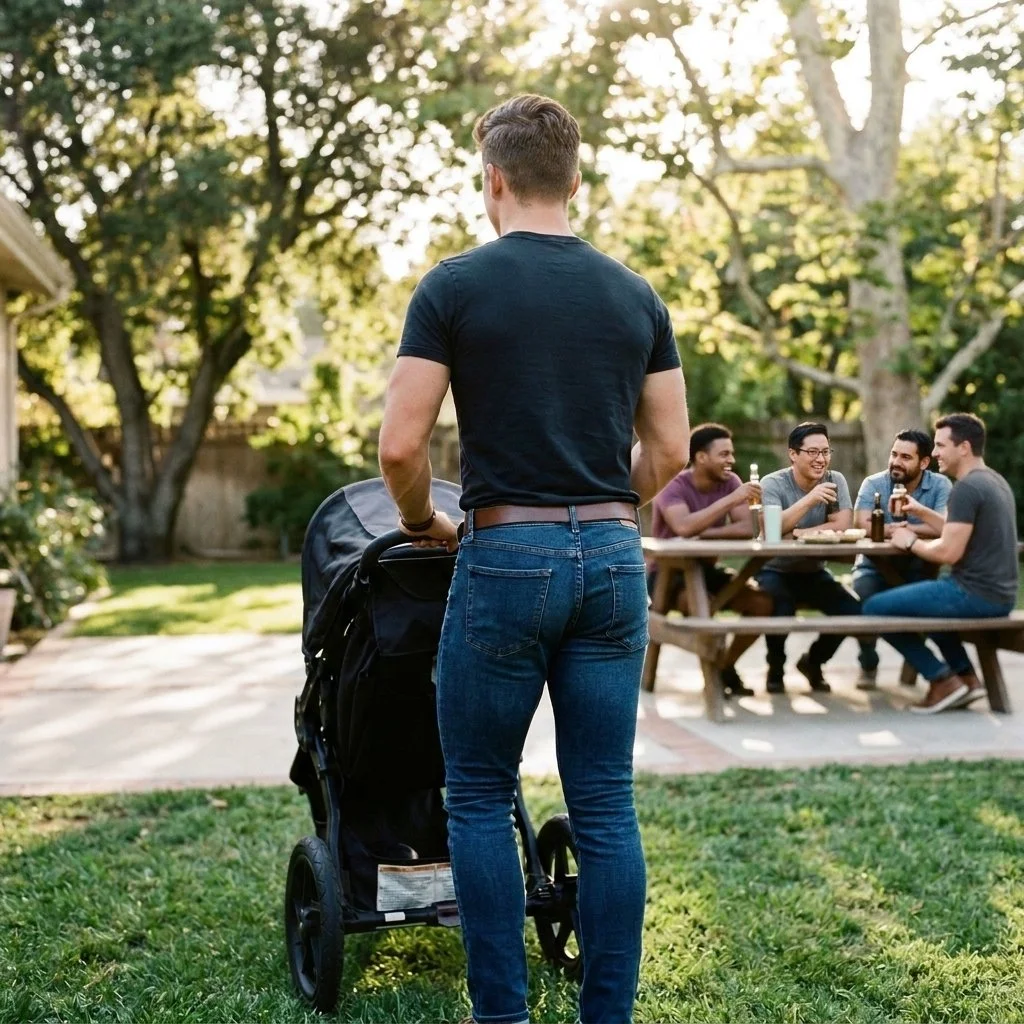
Establish the essay's core dilemma—balancing the pursuit of adult friendships with the unique responsibility of babysitting Mitchell, a (chronologically) adult individual with an extraordinary attachment to childhood. Frame the question compellingly for the reader, inviting empathy with the narrator's weekend balancing act. Highlight the perceived incongruities of swapping diaper bags for hangouts in a sports-themed man-cave while promising insight into the humanity behind Mitchell’s story. Mention how this scenario challenges stereotypes about masculinity, responsibility, and what it means to extend unconditional friendship. Kick this section off with a vivid, illustrative scene—Mitchell squealing with joy as his stroller bounces down the driveway, while the narrator hauls baby formula, secretly sweating over how to explain this scene to his beer-clutching friends on game day.
Mitchell’s Introduction and Backstory (300 Words)
Give Mitchell his rightful place in the spotlight. Describe his quirks in colorful detail—his stroller that doubles as his "batmobile," his encyclopedic knowledge of early-2000s cartoons, or his well-timed declarations of wanting “the green sippy cup, NOT the blue one.” Explain Mitchell’s personality as colorful and heartwarming but without glossing over the challenges; include how his needs dictate an incredible level of care akin to that of a toddler, despite his age. Humanize Mitchell through specific memories—him tragically losing his cookie mid-walk and his near-Olympic tantrum afterward, or the sense of wonder in his eyes when his formula bottle "magically" warms in the microwave.
This section should implicitly answer why the narrator takes on this role, showing Mitchell not as an inconvenience but a complex, lovable individual. Discuss why certain relationships transcend traditional labels—even if that means their friends initially find this arrangement baffling.
Introducing Mitchell to the Man-Cave (400 Words)
Here's where chaos meets comedy gold. Paint a vivid picture of the titular “man-cave,” filled with beer-stained bean bags, unidentifiable snack debris, and the occasional misplaced dartboard. Then, drop Mitchell—innocently clutching his stuffed giraffe—into this scene. Explore the cognitive dissonance as the buddies, clad in matching football jerseys, process the stroller-bound wildcard rolling into their "sacred (bachelor) space." What’s the immediate reaction? Do they assume it’s a weird prank? How does the narrator "break the news" to explain Mitchell's uniqueness—spinning him as a “legendary wildcard” in man-cave terms?
Detail Mitchell’s inevitable infiltration of the man-cave hierarchy. Perhaps he rewrites the vibe with his cartoon marathons or appoints himself unofficial referee for beer pong matches, complete with diaper-related penalties. To amp up the stakes, there’s the constant undercurrent of “babysitting logistics failing spectacularly in real time”—a formula mishap mid-football celebration, a diaper emergency compounded by Mitchell’s temporary dislike of "that particular green giraffe," or sudden stroller-pushing laps to diffuse tantrums during half-time.
Ultimately, highlight how Mitchell gains (unexpected) acceptance and reshapes the group dynamics, flipping awkwardness into grudging admiration. After all, he may not crush nachos, but Mitchell could still rule the man-cave one diaper change at a time. Respect.
Balancing Act – Strollers, Pampers, and Friendships (400 Words)
Level up the analysis here. How does one reconcile nurturing Mitchell with maintaining an unfiltered connection to his buddies—who perhaps playfully rib but ultimately fall silent during a chaotic diaper incident? At its heart, this section is about the narrator’s negotiation of dual identity—caregiver versus one of the guys. Explore real logistical headaches while keeping the escapades dramatically relatable. Picture juggling a bottle warmer plugged into the man-cave kitchen while trash talk volleys during their go-to gaming marathon. Or pushing Mitchell’s stroller home at 2 AM, laughing nervously about whether you just cracked some unspoken “man code.”
This section is rich with opportunities for self-critique and reflection. Discuss how balancing Mitchell’s needs affects perceptions of masculinity among peers, raising questions about vulnerability and nurturing in traditionally “masculine” spaces. Is your ability to diaper while analyzing stats a virtue or a quiet punchline to the group?
Weave in quiet moments acknowledging how Mitchell has taught you adaptability or even patience—things that apply far beyond the realm of babysitting. Challenge cultural assumptions around what it means to be “the guy with the stroller” showing up at gaming night—and how this dynamic actually carves deeper respect into your friendships.
Reflection and Broader Lessons (200 Words)
Land the essay in big-picture style. What does the narrator take away about friendship, caregiving, and adult priorities? Conclude that balancing Mitchell and man-cave weekends wasn't just possible—it was enriching, redefining bonds for the better. Highlight how Mitchell’s unique perspective brought something vital and unexpected into shared spaces. Frame babysitting not as a burden but a revealing sprint through empathy, patience, and redefining adulthood itself. End with a note that Mitchell is now “part man-cave lore,” complete with a retired sippy cup as his honorary trophy on the shelf.
Instructions:
For each question, be sure to show your work clearly. This isn't just about the final answer—it's about proving you made the play-by-play moves to get there. Break it down step by step like you’re calling your own highlight reel. Scribble the equations, jot down the reasoning, and make every calculation count. Partial credit is up for grabs, but you’ve got to show the hustle to earn it. No shortcuts. Bring your A-game.
A lacrosse player makes 10 successful shots in a game, which is 40% of his total attempts. How many total shots did he take?
A basketball player scores twice as many 3-pointers as 2-pointers in a game. If he made 18 points total, how many 3-pointers did he make?
A hockey team played 16 games and won three-fourths of them. How many games did they lose?
A lacrosse player throws an average of 5 goals per game. After 14 games, how many total goals has he scored?
A baseball pitcher threw 90 pitches, with 70% of them being strikes. How many strikes did he throw?
A hockey player gets 4 penalties every 2 games. How many penalties does he have after 12 games?
A basketball player makes 5 out of every 8 free throws. If he attempts 32 free throws in a tournament, how many does he miss?
A lacrosse team has 18 players, and one-third of them play midfield. How many midfielders are on the team?
A baseball player has a batting average of 0.350 (350 hits per 1,000 at-bats). If he had 400 at-bats, how many hits did he make?
A basketball forward scores 60 points in 5 games. What is his average score per game?
A hockey player made 24 goals in a season, with one-third of them being power-play goals. How many power-play goals did he make?
A lacrosse team scored 21 goals in a match, with the captain scoring 7 times. What percentage of the goals were scored by the captain?
A basketball player averages 2 steals per game. How many steals will he make in a season of 25 games?
A baseball team’s pitcher struck out 90 batters over 15 games. How many batters did he strike out per game?
A hockey team has 20 players, and 60% of them are forwards. How many forwards are on the team?
A lacrosse player catches 10 passes during a game, which is half of all passes thrown to him. How many passes were thrown to him?
A basketball player shoots 25 times in a game and makes 16 shots. What is his shooting percentage?
A baseball player hit 20 home runs, which is one-fifth of his total hits. How many total hits did he have?
A hockey team scores an average of 3 goals per game in an 18-game season. How many total goals did they score?
A basketball player’s free-throw percentage is 85%. If he takes 20 free throws in a week, how many does he make?
A lacrosse defenseman stopped 8 shots in one quarter, and twice as many in the next quarter. How many shots did he stop in total?
A baseball team played 12 games, winning 75% of them. How many games did they win?
A hockey player scores 5 goals in his first 2 games. If he keeps this pace, how many goals will he score in 10 games?
A basketball player’s rebound-to-assist ratio is 6 to 5. If he gets 30 rebounds, how many assists does he have?
A baseball outfielder catches 9 fly balls in a game, which is 45% of the team’s total flies caught. How many total fly balls were caught by the team?
A lacrosse coach cuts a team of 40 players down to 25 players. What percentage of the players were cut?
A hockey player’s shots-on-goal success rate is 20%. If he takes 15 shots, how many goals does he make?
A basketball center blocks 11 shots in three games. If he blocks 4 shots in the first game and 3 in the second, how many does he have in the third?
A baseball relief pitcher throws at an average speed of 92 mph. If he throws for 1.5 hours in two games, how many miles did the ball travel?
A lacrosse player earns points from assists and goals. If he has 15 total points and scores a third of them from goals, how many assists does he have?
A hockey team has 5 lines, with 4 players on each line. If 3 players have penalties, how many active players are left?
A basketball player shoots 70% from the field. If he takes 30 shots, how many does he miss?
A baseball player strikes out 60% of the time he is at-bat. If he batted 50 times, how many at-bats were not strikeouts?
A lacrosse team has 18 players, and half of them are seniors. How many players are not seniors?
A hockey team scores 18 goals in a 3-game series. If they scored evenly across all games, how many goals did they score per game?
A basketball forward makes an average of 6 three-point shots per game. How many three-pointers will he make in a 20-game season?
A baseball pitcher throws 9 strikeouts in one game. If his average is 3 strikeouts per inning, how many innings did he pitch?
A lacrosse game lasts 60 minutes, and the team made 30 plays in that time. How many plays were made per minute?
A hockey team’s penalty-kill percentage is 85%. If they face 20 penalty situations, how many do they successfully kill?
A basketball shooting guard scores 45 points in a game, with one-fifth of the points from free throws. How many points were not free throws?
A baseball shortstop fields 35 ground balls, making plays on 90% of them. How many errors did he make?
A lacrosse goalie saves 12 shots in a game, which is twice the number of goals he allowed. How many total shots were on goal?
A hockey player scores 3 overtime winners in 10 games. What percentage of games did he decide in overtime?
A basketball center grabs 28 rebounds in 4 games. What is the average number of rebounds per game?
GYM
Warm-Up (0-10 minutes)
0-2 min: Fast-paced jogging in place — like you’re late for a buzzer beater. Stay light on your feet.
2-5 min: Dynamic stretches — high knees, butt kicks, arm swings. Get loose. No pulled hammies on my watch.
5-10 min: Bodyweight movements — squats, lunges, push-ups. This is your pregame drill. Get the blood flowing.
Strength Training Circuit (10-90 minutes)
10-30 min: Upper Body
Bench press (3 sets, 12 reps). The bar is heavy, but you? Heavier.
Dumbbell rows (3 sets, 10 reps per arm). Smooth pulls, like you’ve got ice water in your veins.
Overhead shoulder press (3 sets, 10 reps). Push for glory—literally.
30-60 min: Lower Body
Squats (4 sets, 10 reps). The king of all moves. Court is now in session.
Deadlifts (4 sets, 8 reps). Rip that barbell off the floor like you’re raising the championship banner.
Bulgarian split squats (3 sets, 10 per leg). Bold. Painful. Legendary.
60-90 min: Core & Stability
Hanging leg raises (3 sets, 15 reps). Abs of steel. Precision of a pro.
Russian twists with a medicine ball (3 sets, 20 twists). Slam-dunk those rotations.
Plank hold (3 sets, 1 minute each). Elbows down. Core tight. Audience on their feet.
Conditioning (90-120 minutes)
90-100 min: Sprints. 10x 30-second runs with 30-second rest each. Bolt down the turf like you’re gunning for the end zone.
100-110 min: Battle ropes. 5 rounds of 30 seconds work/30 seconds rest. The ropes are your rival. Dominate them.
110-120 min: Agility ladder drills. Fast feet, sharp turns. You’re an MVP in the making.
Skill Work / Functional Training (120-190 minutes)
120-140 min: Pull-ups (5 sets, max reps). Or chin-ups. Or both. Your highlight reel needs variety.
140-160 min: Kettlebell swings (4 sets, 12 reps). Grip it and rip it. Explode upward like you’re posterizing someone.
160-190 min: Farmer’s walks (3 rounds, 40 yards). Hold dumbbells. Walk tall. Shoulders back. You own this gym.
Cool Down (190-240 minutes)
190-200 min: Light walking. Slow it down, champ. Reflect on your dominance.
200-215 min: Foam rolling. Every muscle gets its moment. Treat them like the unsung heroes they are.
215-240 min: Static stretches. Quads, hamstrings, shoulders—leave no player behind. Breathe. Bask in victory.
Done. 240 minutes, no cycling, all power moves. Full-court effort from start to finish. Respect.