
(Reflection, Math, Fitness, Mindfulness) Handling the Rink and Responsibilities with the Guys
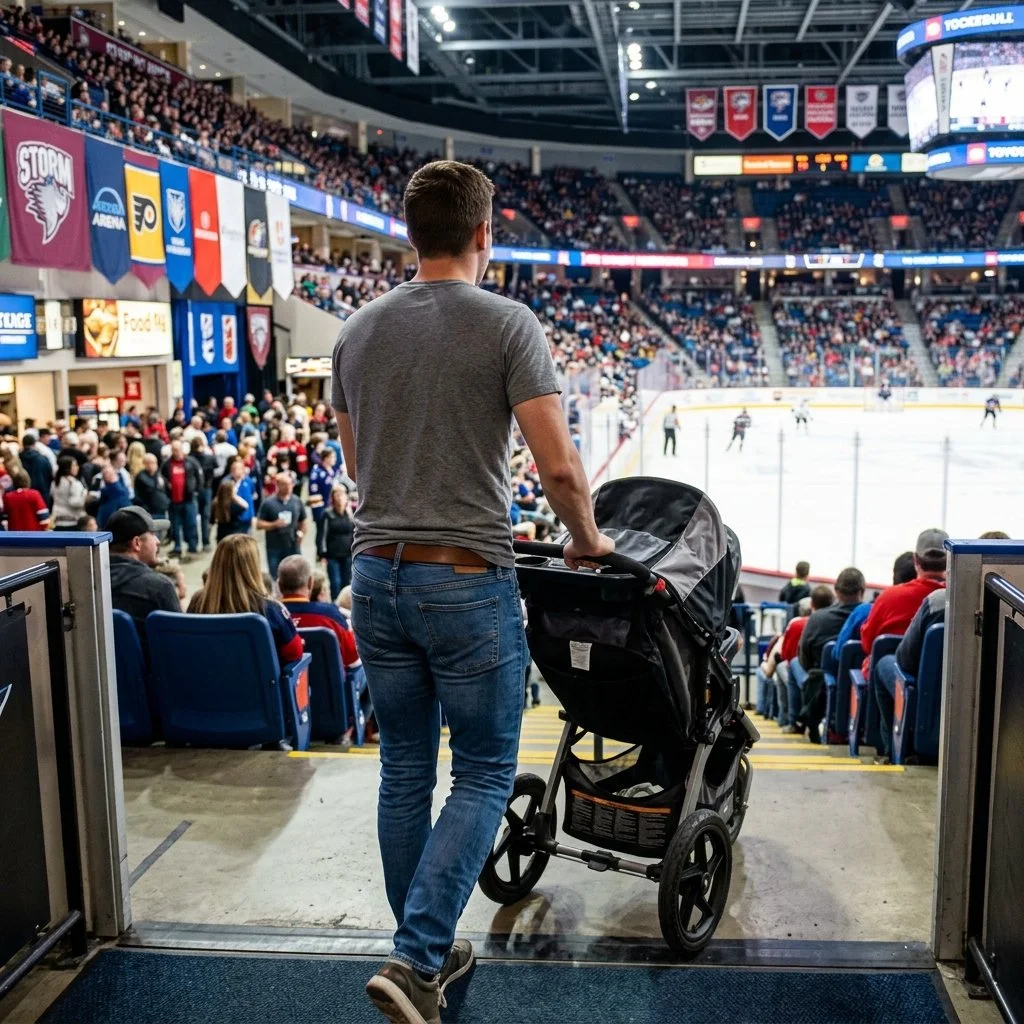
It’s a little after noon, and I’m already gearing up for tonight. The guys and I have been talking about this hockey game for weeks now—it’s going to be epic. But, you know, plans change, and I’ll be bringing Mitchell along for the night. Mitchell’s a cool dude, and even though he’s definitely an adult, he’s got that two-year-old energy about him. It’s funny—he’s got this energy that everyone loves but also requires a little extra care. No big deal though; I’ve got this handled.
First up, I’ve got to get Mitchell’s stroller ready. He loves rolling around in that thing and honestly, it makes getting through crowds a lot easier. I make sure to toss everything we might need into the back of my car—his diaper bag, a couple of bottles, juice boxes, some fun snacks like crackers and those little cheesy puff balls he loves. I also grab a bag of wipes, a spare set of clothes (just in case), and a few extra diapers because, well, you never know.
Packing snacks is a game in itself. I mean, you’ve got to make sure there’s enough to keep him happy but not so much that he gets a sugar rush and starts bouncing off the walls. I throw in some apple slices and a little pouch of peanut butter, some yogurt-covered raisins—stuff that’s easy to manage but still feels like a treat. I figure we’ll hit up the concession stand at the arena too if Mitchell sees something he really wants to try. But the rule is, he’s gotta wait until the guys and I have a lull in conversation so I can take a break and push him out there to pick something.
Getting him in the car can be a bit of a challenge; Mitchell’s always got this way of making it fun, though. He laughs, waves his arms around—it’s hard to not join in. Once he’s buckled in, I double-check everything. The diaper bag’s packed with all the essentials, his little educational tablet is fully charged in case he needs some chill time, and I even pack a couple of soft toys for the game. I also grab a lightweight blanket in case the arena’s a bit chilly for him, and we’re all set.
We meet the guys in the lot outside the arena. They’re pumped, making jokes, hyped for the game. They know Mitchell, and they’re cool about him tagging along. Honestly, the best part about my friends is how chill they are with my responsibilities. Mitchell loves them too—he laughs every time one of the guys does something goofy. It feels good knowing I can balance hanging with my crew and making sure Mitchell’s having an awesome time.
Inside the arena, it’s all about settling Mitchell in next to me. He’s fascinated by the lights, the people, the noise—but not in a bad way. I keep him distracted with his tablet and snacks so he doesn’t get overwhelmed. When the game starts, it’s like he’s in awe. The ice, the speed, the energy in the building—it’s like a whole new world for him. Every once in a while, when the action slows down or there’s a timeout, we’ll move around a bit if he gets restless. That stroller is a lifesaver for situations like this.
After the game, we’re planning to head back to the house and host a little kickback. Nothing crazy, just the guys, some music, and good vibes. I made sure to pack extra supplies for Mitchell—diapers, snacks, even this little matching hockey-themed onesie for him to rock at home. While we hang out, I’ve got some educational toys and a few feel-good movies lined up for him to enjoy in the living room. The night’s going to be a blast—it always is when Mitchell’s around.
Essay Prompt:
Imagine you are a caretaker for an adult with special needs, like Mitchell, who functions at a younger developmental level. You are tasked with taking them to a professional hockey game while also meeting up with friends. Write a detailed plan explaining how you would prepare for the outing, including what snacks you would bring, the contents of their toddler-equivalent diaper bag, and how you would manage their needs during the game. Additionally, describe how you would balance your social time with your friends while ensuring their comfort and enjoyment.
Reference Essay:
When preparing for outings with a special needs individual functioning at a toddler level, prioritize their comfort and care while planning for flexibility. Include essentials like diapers, wipes, and snacks in the bag, ensuring coverage for different scenarios. Use tools like strollers for mobility and comfort, and have entertainment supplies like toys or tablets on hand for distraction. Balancing social aspects requires finding moments to integrate the individual into interactions while also carving time to address their needs seamlessly.
Essay
Introduction (Word Count: 200)
Being a caretaker for an individual with special needs, particularly someone as unique as Mitchell, comes with its challenges and rewards. Events like a professional hockey game demand careful preparation and planning to balance the needs of the individual with personal enjoyment and social interactions. This essay will walk readers through the process of preparing for such an outing, emphasizing practical strategies and reflection on the experience.
Section 1: Preparing for the Event (Word Count: 400)
When preparing for an outing like a hockey game, planning is key. Essential items for Mitchell include his diaper bag packed with diapers, wipes, and any necessary changing supplies. Bottles filled with his preferred drink, along with an extra juice box or two, are non-negotiable. Snacks like fruit pouches, crackers, and other toddler-friendly treats are also crucial. Bringing a small selection of his favorite toys or an educational tablet ensures that he has entertaining distractions when needed during the event.
Transportation logistics are also critical. Opting to drive separately rather than carpooling creates flexibility for Mitchell’s needs—whether it’s taking a break in the car or leaving early if the environment becomes overwhelming. A sturdy stroller provides not just mobility but also the space needed to carry all supplies while maintaining Mitchell's comfort.
Section 2: At the Hockey Game (Word Count: 500)
Once at the arena, the focus shifts to managing Mitchell's needs while engaging with the event and socializing with friends. The loud and bustling atmosphere of a professional hockey game can be both exciting and overstimulating for someone like Mitchell, so caretakers must remain attuned to his reactions. Snacks and drinks brought along can be offered as distractions, while his stroller serves as a safe, comfortable spot when moving around the venue.
Navigating concessions requires subtle timing. Waiting for a moment when the conversation with friends slows down enables the caretaker to take Mitchell to the stand without disrupting the group's dynamic. This ensures that Mitchell gets to participate in the fun while also respecting the social flow of the outing.
Section 3: Post-Game Socializing (Word Count: 400)
After the game, heading back to a house gathering allows for a relaxed transition from the excitement at the arena. Preparing beforehand with extra diapers, entertainment options, and a few additional snacks ensures that Mitchell's needs won’t interrupt the flow of the kickback. Finding a balance between giving Mitchell attention and mingling with friends requires flexibility and mindfulness, but it’s a manageable task with proper preparation.
Reference Prompt (Word Count: 300)
Imagine you’re Mitchell’s caretaker, gearing up for a trip to a professional hockey game with friends. Consider what snacks, toys, and supplies you would pack in his diaper bag to ensure his comfort during the event. How would you handle getting him familiar with the noisy, crowded venue? Would you bring a stroller or other tools for mobility, and how would you time visits to the concession stand? Reflect on how you’d balance fulfilling Mitchell’s needs with engaging in conversations and plans with your friends.
Conclusion (Word Count: 200)
Balancing social interactions and caretaking responsibilities requires a thoughtful approach, especially during outings like a hockey game. Maintaining flexibility, staying prepared, and prioritizing both Mitchell’s comfort and your own enjoyment ensures a successful and memorable experience for everyone involved.
Reference Essay: It’s gonna be a dope night. The guys and I have been hyped for this hockey game all week, but tonight’s a bit different `cause I’m bringing Mitchell. He’s not just some regular dude you throw in the car and roll out with, though — Mitchell’s got some special needs. He’s technically an adult but functions more like a toddler, so it’s my job to keep him comfortable and make sure he’s having fun, too. No big deal.
First off, I had to get us ready. I packed his diaper bag, loaded with the essentials like Pampers, wipes, a couple of bottles, and his favorite juice. Gotta have options, you know? I also threw in some of his educational toys and stuff to keep him busy, just in case things at the game get too loud or he starts to lose interest. Snacks were next — I prepped some goldfish crackers, fruit pouches, and those little yogurt bites he loves. He can eat something from the concession stand later if he wants, but that’ll depend on when the guys and I get a breather from watching the game.
The stroller? Total lifesaver. It makes things so much easier, especially when we’re navigating the crowded arena. Plus, it’s got a ton of storage space underneath, which is clutch for hauling all his stuff. Once I got Mitchell settled and strapped in, I loaded him into my car. By the way, no offense to the guys, but carpooling wasn’t an option tonight — it’s just more convenient for me and Mitchell to have our own space.
When we get to the game, I’m gonna meet up with the crew. They’re all cool with Mitchell tagging along — they know he’s part of the package when we make plans like this. Of course, I’m keeping an eye on him the whole time, making sure he’s good while we’re chilling and watching the game. If he needs a snack or a bottle, I’ll have them ready — but if he wants to hit the concessions stand, we’re gonna wait for a natural pause in our conversation so I can take him over in his stroller.
After the game, we’re all heading back to the house for a little kickback. Nothing too wild, just hanging out with the guys and relaxing. I made sure to pack extra Pampers and a few more activities for Mitchell to have on hand. It’s gonna be a long but insanely fun night, and I’m ready for it. Mitchell might not remember all the details, but it’s all about making sure he has a good time while ensuring I can still hang with the crew.
Math Test: Packing Mitchell’s Diaper Bag for the Hockey Game
Instructions
This test consists of 30 math questions revolving around packing Mitchell's diaper bag for the hockey game. Show all your work for full credit. Calculators may be used where appropriate.
Section 1: Basic Arithmetic and Algebra
If Mitchell needs 3 diaper changes during the game and each change uses 1 diaper, how many diapers should be packed if you want to have 2 extra as a backup?
A pack of diapers contains 20. If Mitchell’s bag has 1 open pack with 8 diapers remaining, how many packs are needed to ensure he has 25 diapers in total?
Diaper cream comes in tubes containing 100 grams each. If you use 25 grams per diaper change, how many tubes need to be packed to last 6 diaper changes?
The baby wipes container holds 80 wipes. If one diaper change requires 5 wipes, how many diaper changes can this container support?
Mitchell’s bottle holds 200 milliliters of formula. If he needs to drink 500 milliliters during the game, how many full bottles should be packed?
Section 2: Fractions and Ratios
6. Each diaper bag compartment can hold 6 diapers. If Mitchell’s bag has space for 3 compartments, what fraction of the total capacity is filled if you only pack 12 diapers?
7. The ratio of formula bottles to snacks packed is 2:3. If 10 snacks are packed, how many formula bottles should be packed to maintain the ratio?
8. Mitchell’s wipes container is 3/4 full. If the full container can hold 120 wipes, how many wipes are in the container now?
9. You have packed 3 sets of clothes for 6 diaper changes. What is the ratio of clothes packed to the number of changes?
10. If Mitchell needs 1 bib for every 2 diaper changes, how many bibs should be packed for 8 diaper changes?
Section 3: Word Problems
11. If Mitchell requires 10 items packed in a small bag and 15 in a larger bag, how many total items are packed?
12. To save space, each bottle’s volume is reduced by 20%. If the original bottle holds 250 milliliters, what is the new volume of each bottle?
13. Wipes are used for both diaper changes and cleaning hands. If you use 7 wipes per diaper change and 3 wipes for cleaning hands after every diaper change, how many wipes are needed for 5 changes?
14. Mitchell’s toys take up 25% of the bag’s total space. If the total space is 32 liters, how much space do his toys use?
15. If the food container has 640 grams of snacks and each serving is 80 grams, how many servings are packed?
Section 4: Geometry
16. Diapers are packed in a rectangular box measuring 12 inches by 8 inches by 5 inches. What is the volume of the box?
17. The circular lid of the formula can has a diameter of 6 inches. What is the area of the lid (use π ≈ 3.14)?
18. One of Mitchell’s toys is shaped like a cylinder with a radius of 3 inches and height of 10 inches. What is its volume (use π ≈ 3.14)?
19. The diaper bag is a rectangular prism measuring 20 inches long, 10 inches wide, and 12 inches tall. What is the surface area of the bag?
20. If a bottle of formula has a conical cap with a radius of 2 inches and a height of 3 inches, what is the volume of the cap (use π ≈ 3.14)?
Section 5: Rates and Proportions
21. It takes 2 minutes to prepare 1 bottle of formula. How long will it take to prepare 5 bottles?
22. If Mitchell drinks 50 milliliters of formula in 3 minutes, how long will it take him to drink 150 milliliters?
23. A cleaning spray can be used at a rate of 2 fluid ounces for every 4 diaper changes. How many fluid ounces are needed for 10 changes?
24. If the wipes container weighs 500 grams when full and loses 10 grams per diaper change, how much will it weigh after 8 changes?
25. The warmer takes 5 minutes to heat Mitchell’s formula before each feeding. If Mitchell eats 3 times during the game, how much total heating time is required?
Section 6: Miscellaneous
26. If 1 packet of formula powder can make 4 bottles of formula, how many packets are needed to prepare 12 bottles?
27. Each diaper weighs 200 grams. If 10 diapers are packed, what is the total weight in kilograms?
28. If Mitchell uses 15% of his wipes for cleaning up after the game, and the container holds 60 wipes, how many does he use?
29. The total cost for packing items is $60. If 40% of the cost is for diapers, how much is spent on diapers?
30. A compartment in Mitchell’s bag holds items weighing 2 pounds per cubic foot. If the compartment is 2 cubic feet, what is the total weight of items it can hold?
Good luck! Show all your work for full credit.
240-Minute Cardio and Strength Gym Workout Plan
Below is a comprehensive workout plan for a cardio-focused session including marathon sprints paired with strength training. This breakdown spans 240 minutes, providing an intense and balanced regimen.
Minute-by-Minute Breakdown
Minutes 0-10
Warm-Up5 minutes brisk walking on the treadmill (speed 3.5 mph).
5 minutes dynamic stretching focusing on legs, arms, and core (e.g., leg swings, walking lunges, arm circles).
Minutes 10-40
Treadmill Marathon Sprints (Interval Training)Alternate between 2 minutes of fast running (speed 8-9 mph) and 1 minute of light jogging or walking (speed 3-4 mph).
Repeat for a total of 10 cycles (30 minutes).
Minutes 40-70
Strength Training – Lower Body FocusSquats with barbell – 4 sets of 12 reps (moderate to heavy weight).
Bulgarian split squats – 3 sets of 10 reps per leg.
Deadlifts – 4 sets of 10 reps (moderate weight).
Calf raises – 3 sets of 15 reps.
Finish with a 5-minute bodyweight glute activation routine.
Minutes 70-100
Treadmill Marathon Sprints (Interval Training)Repeat the 30-minute interval session with same intensity as above.
Minutes 100-130
Strength Training – Upper Body FocusBench press or chest press – 4 sets of 8-12 reps (moderate weight).
Push-ups – 3 sets of 15 reps.
Dumbbell shoulder press – 4 sets of 10-12 reps.
Pull-ups (assisted if necessary) – 3 sets to failure.
Dumbbell rows – 3 sets of 12 reps per arm.
Minutes 130-160
Treadmill Marathon Sprints (Interval Training)Alternate between 90 seconds of fast running (speed 9-10 mph) and 1 minute of jogging (speed 4 mph).
Repeat for a total of 10 cycles (30 minutes).
Minutes 160-190
Core Training and StretchingPlank holds – 4 rounds of 1-2 minutes per hold.
Russian twists with medicine ball – 3 sets of 12 reps per side.
Bicycle crunches – 3 sets of 20 reps.
Hanging leg raises – 3 sets of 12 reps.
End with a 10-minute stretching routine focusing on hamstrings, quads, shoulders, and lower back.
Minutes 190-230
Steady-State Treadmill Running40 minutes continuous running at a steady pace (speed 6-7 mph).
Focus on maintaining proper form and a consistent breathing rhythm.
Minutes 230-240
Cool Down5 minutes light walking (speed 2-3 mph).
5 minutes static stretching to relieve muscle tension and enhance recovery.
This structured 240-minute routine provides a balance of intense cardio and full-body strength training to maximize endurance and power while targeting various muscle groups. Adjust speeds and weights as necessary based on your fitness level.
Mindfulness Exercise for Mastering a New Sport
Objective: To build focus, confidence, and skill acquisition for mastering a sport you currently find challenging.
Step 1: Visualization (10 Minutes)
Sit in a comfortable position on the floor or a chair, ensuring you are relaxed but alert. Close your eyes and take three slow, deep breaths.
Visualize yourself performing the specific sport step by step. Imagine holding the equipment (if applicable), moving across the field or court, or executing the techniques. Focus on the details—how your body feels, the movements you make, and the surroundings.
Picture yourself succeeding. Envision overcoming challenges with precision, strength, and confidence, and emphasize the feeling of accomplishment.
Stay in this mindset for a few minutes, repeating in your mind words like "focus," "effort," or "progress," to build positive energy.
Step 2: Reflective Breathing (5 Minutes)
Transition to steady breathing, focusing on calmness and awareness of your body.
Reflect on the visualization process—did you feel uncertain at certain points? Were there skills or movements that felt unclear? Gently acknowledge these moments and breathe them out without judgment.
Step 3: Group Discussion (10 Minutes)
Share as a group one challenge you face in this sport.
Discuss strategies that a teammate may have found helpful for improvement. Remember, building a new skill takes patience and constructive feedback.
Journaling Prompt:
Take five minutes to write about your experience during the visualization. Respond to the following questions:
What aspects of the sport were the hardest to visualize clearly?
How did you feel when you envisioned yourself succeeding?
What is one actionable step you can take today to get closer to mastering this sport?
What does "progress" look like to you in this context?
This mindfulness exercise encourages mental preparation, self-awareness, and teamwork while building the foundation for gradual improvement in your chosen sport.