
(Reflection, Math, Fitness, Mindfulness) Mitchell’s Second Chance at the Department Store
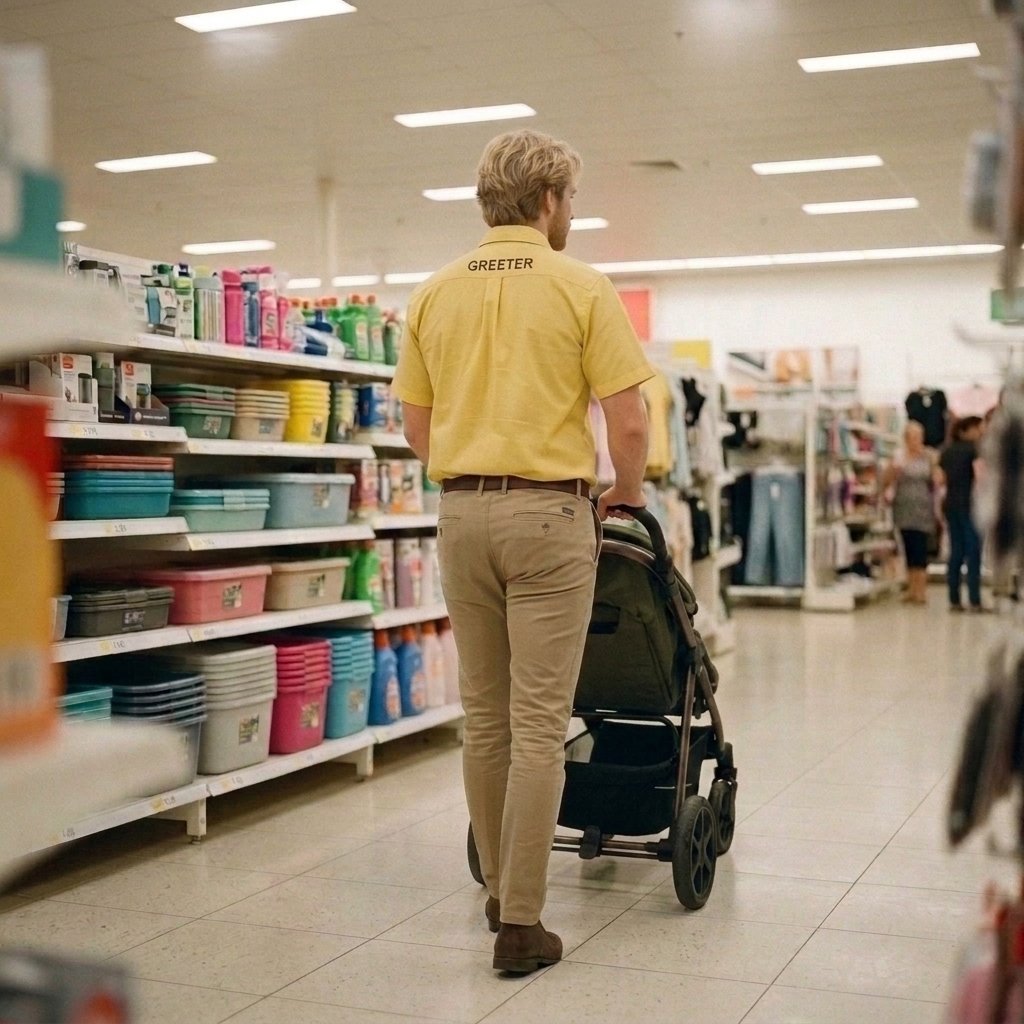
Alright, so check this out. Picture Mitchell—a guy I knew back in high school. He’s over eighteen, like us, but now, somehow, he’s two years old. Yeah, I know, sounds unreal, right? Anyway, last week, he rolls into our local department store. And by rolls, I mean literally rolls—he’s in one of those big strollers, the ones with cup holders and a built-in sunshade. Here's the twist, though—the person pushing him? It’s the store greeter. You know the guy—gray hair, always in a good mood, knows everyone. Apparently, he had to get permission from the store manager to make this whole thing happen. Why? Because Mitchell is physically still, like, a dude. But he’s acting like a toddler, babbling and sucking on a sippy cup! It’s the wildest thing.
The greeter pushes him through the milk aisle, the Gerber baby food aisle, over to diapers, and then to the toy section. I’m standing there watching this go down, and I swear, I felt like I walked into some kind of alternate universe. The craziest part? Word around the store is that something happened the last time Mitchell was there, and that's what set the stage for this whole situation. Like, why does the greeter have to push him around? Why’s he suddenly two years old again? Did he drink some expired milk or trip over one of the toy displays? I don’t know what the deal is, but it’s got me and everyone else in town seriously scratching our heads. What do you guys think actually went down last time Mitchell was in that store? Maybe it’s something the greeter can explain one day, or maybe it’s just some freaky magic we’ll never understand. Either way, Mitchell cruising around in a stroller like that is a story I’ll be telling for years.
Essay Prompt
Title: The Curious Case of Mitchell and the Department Store Stroller
Word Count Goal: 1500 words
Introduction (200 words)
Introduce the bizarre situation involving Mitchell and the department store. Briefly establish the setting, characters, and the sense of intrigue surrounding the event. Set the tone with curiosity and humor, drawing readers into wanting to uncover the backstory.Background (400 words)
Explore Mitchell’s character and life before the incident. Describe what type of person he was in high school and how he interacted with people in the town and the department store. Was he mischievous, reserved, or eccentric? Reflect on any seemingly normal or unusual patterns in his life leading up to this day. Lay subtle hints about what could have triggered this transformation.The Incident (500 words)
Detail the events leading up to the first mysterious change in the department store. Focus on the atmosphere, the aisles Mitchell frequented, and any interactions with staff or objects that might explain the peculiar circumstances. Did something supernatural happen? Was it science gone wrong? Or was it pure coincidence? Include perspectives from the store greeter, customers, or any witnesses who might shed light on the strange chain of events.Aftermath and Theories (300 words)
Showcase the immediate aftermath of the incident and the community's reaction. Include popular theories circulating around the town—did Mitchell stumble into something magical or scientific? How did the store greeter come to be his unlikely caretaker? Reflect on the mystery’s impact on the town and on Mitchell’s life.Closing Thoughts (100 words)
Conclude with a touch of humor or lingering mystery. Revisit the idea of whether this will ever be explained or remain an unsolved urban legend in the town’s history. Leave room for the reader to draw their own interpretations.
Reference Essay
When Mitchell walked into the department store that fateful Tuesday afternoon, nobody expected the chain of events that would follow. Back in high school, Mitchell was one of those chaotic yet oddly charming guys—always coming up with wild ideas, some harmless, others just plain bizarre. He was the kind of person you wouldn’t be shocked to see skateboarding through the snack aisle or starting a Nerf gun war in the parking lot. But that day was different.
Witnesses say something odd happened near the toy section. An employee restocking shelves mentioned strange flickering lights as Mitchell passed, accompanied by a faint, otherworldly hum. The security cameras in the area mysteriously stopped recording for a full 45 seconds. When footage resumed, there was Mitchell, sitting in the floor model of a toddler’s stroller. The store manager reported a strong smell of baby powder lingering in the air, but no source of it could be found.
Some say Mitchell accidentally activated a cursed doll or stumbled across a relic with bizarre powers meant only for children. Others hypothesize he unknowingly drank one of the experimental milk cartons from the back room’s defective product return shelf. Whatever the trigger, the result was clear—Mitchell was somehow two years old again, at least mentally.
The greeter, a retiree named Bill, had no choice but to intervene. With the store manager’s blessing, he grabbed a stroller and began escorting Mitchell through the store for his “new lifestyle necessities.” To this day, nobody knows the truth. Whatever happened, the tale of Mitchell and the department store stroller has cemented itself as a story that’ll keep the town talking for generations.
Math Word Problems Themed Around Packing Mitchell's Diaper Bag
Instructions:
Below are 30 math word problems based on Mitchell's male caretaker, aged 20, preparing a diaper bag and supplies for Mitchell’s week at a home daycare. These problems are multi-step and crafted for a 9th-grade math level. Read each question carefully, and ensure you show all your work while solving. No answers are provided, as you should work through each problem to practice problem-solving skills.
Word Problems:
Diaper Supply Calculation
Mitchell’s daycare requires him to have 6 diapers per day. His caretaker purchased a pack of 72 diapers for $18. If Mitchell will attend daycare for a full 5 days this week, how many diapers will be left from the pack at the end of the week? What is the total cost per diaper? Show your work.Baby Wipes Distribution
Mitchell’s caretaker purchased a box of 4 packs of baby wipes, with each pack containing 80 wipes. If Mitchell uses 15 wipes per day, how many days can the entire box of wipes last before his caretaker needs to buy more? Show your work.Snack Planning
Mitchell takes 2 snacks to daycare every day, each weighing 3 ounces. If his caretaker prepares snacks for 7 days, how many ounces of snacks are packed in total? If a bag of snacks costs $12 and contains 50 ounces, how much does Mitchell’s caretaker spend on snacks for the week?Formula Preparation
Each day, Mitchell drinks four 8-ounce bottles of formula while at daycare. His caretaker has a formula container that can make up to 240 ounces. How many containers of formula will Mitchell’s caretaker need to ensure there is enough for 5 days of daycare? Show your work.Packing Clothing
Mitchell’s daycare policy requests two sets of spare clothing every day. His caretaker buys a bundle of 5 shirts for $25 and a pack of 5 pairs of pants for $30. If Mitchell changes clothes once a day due to spills, how many spare clothes are left at the end of 5 days? What is the average cost per clothing item?Weekly Laundry Costs
Mitchell’s caretaker does laundry once a week for his daycare clothes. The laundromat charges $4 per load, and detergent costs $0.50 per load. If Mitchell’s clothes take 2 loads each week, how much does his caretaker spend on laundry over the span of 4 weeks? Show your work.Packing Toys
Mitchell’s caretaker packs 3 small toys into the diaper bag each day. If he rotates toys every two days and ensures none of the toys are repeated within a week, how many toys in total does he pack over 7 days? Assume there are no overlaps in the toys used. Show your work.Diaper Bag Weight Distribution
Mitchell’s diaper bag weighs 5 pounds when empty. Each diaper weighs 0.25 pounds, a baby wipe pack weighs 0.5 pounds, and other daycare supplies contribute an additional 3 pounds. If the bag contains 12 diapers, 1 pack of wipes, and the additional supplies, what is the total weight of the packed diaper bag?Cost of Milk Bottles
Mitchell drinks three bottles of milk per day at daycare. His caretaker buys milk bottles for $2.75 each. If Mitchell attends daycare for 6 days this week, how much does his caretaker spend on milk bottles? Show your work.Back-up Diapers for Daycare
The daycare requests that caretakers provide an extra set of 10 diapers to keep as an emergency supply. If Mitchell’s caretaker keeps 72 diapers in reserve and uses 30 diapers weekly, how many weeks will it take before he needs to refill the emergency supply? Show your work.Daycare Lunch Packets
Mitchell’s caretaker packs one lunch every daycare day, each consisting of a sandwich costing $3, a drink costing $2, and snacks costing $1.50. What is the total cost of daycare lunches prepared for a 5-day week?Planning Travel Time
Mitchell’s daycare is 15 miles away from home. If Mitchell’s caretaker drives to and from daycare every day at an average speed of 30 miles per hour, how much total driving time is needed for 10 daycare trips in one week?Supplies Budgeting
Mitchell’s caretaker allocates $50 for daycare supplies each week. If he spends $18 on diapers, $15 on formula, $8 on snacks, and $5 on baby wipes, how much money is left over in the budget?Bottled Water Inventory
Mitchell’s caretaker uses bottled water to prepare formula. If he uses 48 ounces of water daily and each bottle contains 16 ounces, how many bottles of water must he buy to last for a full week?Pacifier Usage
Mitchell uses pacifiers throughout the day at daycare. His caretaker packs 3 pacifiers daily in the diaper bag. If pacifiers are purchased in sets of 12 for $6, how much does the caretaker spend on pacifiers if he replenishes them every two weeks?Diaper Usage Mitchell goes through an average of 6 diapers each day at daycare. If a pack contains 36 diapers and costs $10, how many packs of diapers are needed for a month (30 days), and what is the total cost?
Formula Powder Calculation To prepare a bottle, Mitchell's caretaker uses 2 scoops of formula powder per 8 ounces of water. If Mitchell consumes 48 ounces of formula daily, how many scoops of formula powder are used in one day?
Daycare Attendance Mitchell attends daycare 5 days per week. If daycare fees are $50 per day, how much does daycare cost per month (4 weeks)?
Laundry Load Mitchell’s clothing and blankets require frequent washing due to spills. If one load of laundry holds 15 clothing items, and Mitchell generates 60 dirty items per week, how many loads of laundry are needed weekly?
Nap Time Math Mitchell naps for 2 hours daily at daycare. Over the course of 5 daycare days, how many total hours does Mitchell spend napping?
Toy Rotation Mitchell plays with 10 toys each day. If his caretaker rotates the toys every 3 days from a collection of 50 toys, how many toys remain put away after one rotation?
Snack Budgeting Mitchell has two snacks each day, and each snack costs $1.50. If snacks are purchased weekly, how much does his caretaker spend on snacks in a month (4 weeks)?
Wipes Usage Each diaper change requires 3 wipes. If Mitchell has 6 diaper changes per day, how many wipes are used over one week?
Pajama Sets Mitchell wears a fresh pair of pajamas nightly. If a set of pajamas costs $15 and his caretaker buys 7 pairs, how much does she spend in total?
Book Reading Mitchell enjoys 3 bedtime stories each night. If the books are rotated weekly from a collection of 21 books, how many books does he not hear in a week?
Sippy Cup Refills Mitchell drinks from a sippy cup that holds 8 ounces. If he drinks 32 ounces of water daily, how many times is his sippy cup refilled in one day?
Diaper Cream Usage Each diaper change uses 3 grams of diaper cream. If Mitchell has 5 diaper changes daily, how many grams of diaper cream are used over 4 days?
Playtime Outdoors Mitchell plays outside for 45 minutes each day at daycare. Over the course of 5 days, how many total minutes does he spend outdoors?
Car Seat Rides Mitchell rides in the car twice a day, and each ride lasts 15 minutes. Over the course of a week, how many minutes does he spend in the car?
Bath Water Measurement Each of Mitchell’s baths uses 20 gallons of water. If he takes a bath daily, how many gallons of water does he use in a week?
The Ultimate 4-Hour Cardio Gym Grind
Alright, team, strap in—this is your roadmap to the ultimate 4-hour gym session. This is all about pushing your cardio limits and unlocking that next level of endurance. Whether you’re looking to boost your stamina on the field or just dominate life, this routine has got you covered. If you’re not vibing with it, no biggie—create your own beast of a workout and crush it your way. Here’s the breakdown:
Minute-by-Minute Breakdown:
0-10 Minutes – Warm-Up:
Start strong, but take it easy—this is your time to get loose and ready to move. Hit the treadmill at a light jog, somewhere around 5-6 mph. Focus on breathing steady, fixing your posture, and getting your muscles woken up. Don’t slack here; a solid warm-up makes all the difference.
10-30 Minutes – Speed Intervals:
Now we’re talking speed. Crank up the treadmill to 8-10 mph for a 1-minute sprint, then drop back down to a 5-6 mph jog for 2 minutes to recover. Hit this sprint-recover cycle hard for the entire 20 minutes. Challenge yourself with the speed but don’t burn out—this is all about building explosive power.
30-50 Minutes – Stationary Bike Sprints:
Hop off the treadmill and onto a stationary bike. Go all out with 30-second max effort sprints followed by 1 minute of easy pedaling. Repeat for 20 minutes. Get that heart rate up and legs burning—this is where we go beast mode.
50-70 Minutes – Incline Run:
Back on the treadmill, set it to an incline of 8-10%. Keep a steady pace (around 5-6.5 mph) and focus on powering those legs through the climb. This simulates mountain runs and builds next-level endurance.
70-90 Minutes – Row Machine Challenge:
Time to switch it up. Jump on the rowing machine and aim to hit consistent 500-meter splits around 2 minutes or less. Push through this 20-minute grind—it’s all about coordination, power, and mental toughness.
90-120 Minutes – Circuit Training (Explosiveness + Cardio):
Break out into a 30-minute circuit. Focus on exercises that mix cardio with athletic power:
Box jumps (15 reps)
Burpees (20 reps)
Mountain climbers (30 seconds)
Kettlebell swings (20 reps)
Repeat this for 4 rounds, giving yourself 1-2 minutes of rest between rounds. Stay pumped!
120-150 Minutes – Long Distance Running:
Now it’s time to pace yourself. Drop the treadmill incline, set the speed to a manageable 6-7 mph, and hold it steady for 30 minutes. This is about endurance—find your rhythm and stick with it.
150-200 Minutes – Core Circuit:
Get on the mat and shred your core:
Plank holds (1 minute)
Bicycle crunches (20 reps per side)
Russian twists with a medicine ball (30 seconds)
Hanging leg raises (15 reps)
Repeat this for 4 rounds to tighten up that midsection.
200-230 Minutes – HIIT Sprints (Final Push):
Time to empty the tank. Alternate between 20 seconds of max effort sprints and 40 seconds of recovery jogs for 30 minutes. Push your limits—you’re almost there.
230-240 Minutes – Cool Down:
Wrap things up with 10 minutes of light treadmill walking or easy biking. Stretch out your legs, arms, and back to release tension and help with recovery. Breathe in, breathe out—you destroyed it.
Make It Yours:
If this isn’t your jam, no worries, dude. Tailor it to fit your vibe—switch up the machines, rotations, or intensity. At the end of the day, it’s about what gets you hyped to grind. Just show up, put in the work, and it’ll pay off big time on and off the field.
Mind Over Matter: Mastering Focus as a Team
When you’re on the field or in the gym, distractions can make or break your performance. Whether it's the noise of the crowd, thoughts of your next game, or even personal challenges, learning to ignore distractions is a crucial skill for athletes. This group mindfulness exercise will help you strengthen mental focus, build self-awareness, and create a shared sense of calm with your teammates.
Step 1 - Grounding the Team (5 Minutes):
Have everyone sit in a circle, either in chairs or on the floor. Close your eyes and take deep breaths together, inhaling for four counts, holding for four, and exhaling for six. Do this as a group for five minutes. Each exhale is an opportunity to release stress or wandering thoughts.
Step 2 - The Power of Presence (10 Minutes):
Ask everyone to focus on a single sound in the room—this could be the sound of the air conditioning or a teammate tapping their shoe. Encourage the group to notice when their minds wander and gently bring attention back to the sound. This practice trains the brain to recognize distractions and refocus, a key skill for athletes during high-pressure moments.
Step 3 - Intentional Visualization (10 Minutes):
Each team member will imagine a distraction they often experience during games or workouts. Now, visualize that distraction as a small object—like a pebble on the ground. Picture yourself stepping around it, leaving it behind, and continuing forward toward success. Share this visualization with the group, emphasizing that distractions don’t have power over you unless you give it to them.
Journaling Prompt:
After the exercise, have everyone take five minutes to write on this prompt: “What is one distraction I face in my athletic life, and what tools can I use to stay focused? How will mastering focus help my performance and my team?”
Wrap up by letting teammates share insights if they feel comfortable. This exercise is about building a collective mindset of focus and accountability as a team.