
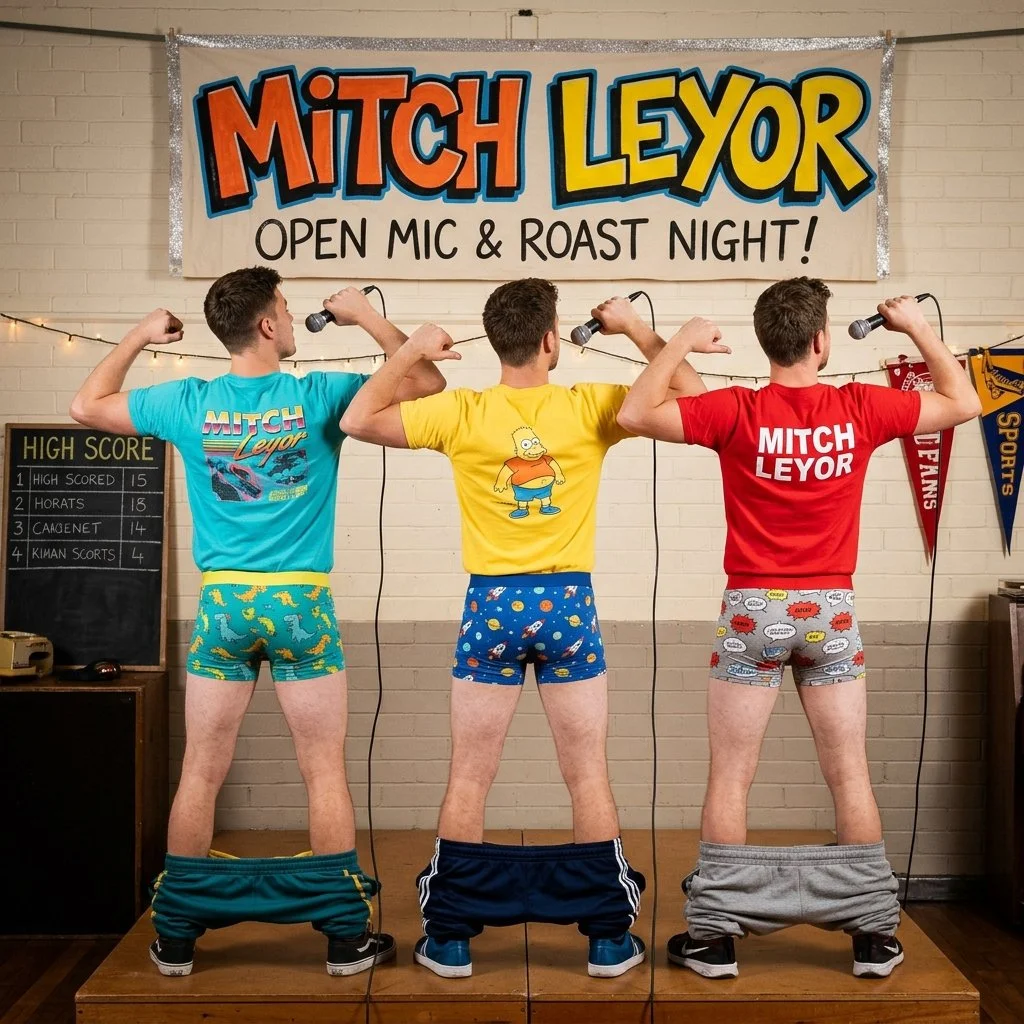
Alright, folks — buckle up, because this essay isn’t your run-of-the-mill school assignment. This time, you’re venturing into the highly uncharted (and highly ridiculous) territory of roasting Mitchell. Yes, the Mitchell. Don’t even act like you don’t know who we’re talking about — the toddler tornado with a juice box in one hand and a hunger for chaos in the other. Your mission, should you choose to accept it, is to craft your very own introduction (150 words) where you deliver the comedic goods. Take inspiration from Mitchell’s daily escapades—his tantrums, his Velcro-clad throne, his milk bottle loyalty. But remember, this is all in good fun. We roast because we care (and because Mitchell’s antics beg for it). Keep it playful, keep it warm, and throw in a wink or two. No toddlers' feelings were harmed in the making of these roasts, and that’s non-negotiable.
Two things to keep in mind while you’re writing:
Let the comedy fly, but aim to celebrate the legend that is Mitchell with your words — don’t go for cheap shots or mean-spirited jabs. Remember, we’re laughing with him... mostly.
Stay safe out there, roastmasters; Mitchell’s lawyer (read: his mom) might not actually sue you for libel, but she definitely has a stash of embarrassing baby photos ready to deploy as retaliation. Good luck, and may your keyboard be as snappy as Mitchell on snack denial day.
Introduction – 150 Words
Ladies and gentlemen, welcome to the much-anticipated roast of Mitchell, the wunderkind, the pint-sized tyrant, the unquestionable ruler of juice boxes and chaos. Today, we don’t just celebrate Mitchell’s existence—we dissect it. This is not a tribute to toddler progress but rather an exposé of a tiny human locked in an epic battle against adulthood. Some say milestones mark growth; Mitchell believes they’re nothing but fake news.
Potty-training? Never heard of her. Walking? A loose term stretched to cover his protracted relationship with the floor. And his dependency on a milk bottle? It’s less a phase, more a medieval siege tactic with no intention of surrender. This child is a headliner for tantrums, the mastermind behind Velcro economics, and the reigning champion of “Look what I put in my mouth this time!” Grab your snacks—Mitchell may have a bottle, but we’re sipping tea today.
The Walking Wreck – 300 Words
You’d imagine walking—a fundamental skill acquired by nearly everyone—would be a non-event. But with Mitchell, it’s art. Every “stride” is an interpretive dance of survival and bad decision-making. Watching him toddle through a room is like seeing a drunk flamingo try to ice skate. His knees buckle at odd intervals, his arms windmill as if summoning unseen spirits, and there’s a 50% chance he’ll crash into something that definitely didn’t move.
And yet, his parents cheer like he’s a gladiator surviving his 27th arena battle. Did he just dodge the corner of the coffee table? Applause so loud it could summon the neighbors. Tripped over the dog’s tail? Standing ovation. Landing in the laundry pile mid-stride? That warrants an encore performance. It’s as if “walking” is less about functional movement and more about providing endless action-packed entertainment.
Meanwhile, the family dog has resigned itself to fate, looking skyward as if asking, “When’s my contract up?” The Roomba is on the verge of filing for unemployment because dodging Mitchell’s path has become an occupational hazard. And despite the chaos, Mitchell remains unbothered—each precarious step a testament to his philosophy that falling down is merely rebranding gravity as a personal choice. His walking, like the rest of his empire, is glorious, unstable bedlam.
The Milk Bottle Dependency – 250 Words
Mitchell’s relationship with his bottle should have its own reality TV show. At this point, it’s not just a bottle; it’s a lifestyle. If milk were a stock, Mitchell would be its largest institutional investor. He doesn’t simply drink from the bottle—he communes with it, clutching it mid-nap like a damning piece of evidence in the trial of “Is toddlerhood too soft on responsibility?”
This isn’t casual. His attachment screams "rebel against adulthood" louder than a midlife crisis convertible purchase. His parents, optimistic do-gooders that they are, keep trying to negotiate a clean break. The result? Banshee screams so cinematic they deserve their own horror soundtrack. Their efforts are met with the stubborn refusal of a toddler who knows he holds the high ground (literally, he’s perched on the couch clutching his bottle as if being besieged).
It’s not just about the milk—it’s the principle of defiance. Mitchell clings to that bottle like some kids hold a teddy bear, except this teddy can't expire or lose a leg. This bottle? It’s the symbol of all things youthful and petty. Mitchell knows exactly what he’s doing, and you know what? The bottle’s going nowhere. Forget sippy cups—the toddler emperor is keeping his throne for now.
Diaper Devotee – 250 Words
And then there’s diapers, the most glamorous part of Mitchell’s empire. Where others see a temporary solution, Mitchell sees a throne. Diapers are his physical declaration of independence. Ask him about potty training, and he’ll glare at you with the disdain of someone asked to give up their private yacht.
Potty-training campaigns have come and gone faster than Mitchell can hurl peas during dinnertime. His response to any toddler toilet? Horror, followed by an Oscar-worthy performance of betrayal and existential despair. Parents begging him to try just once find themselves in circular negotiations that loop back to Mitchell declaring he’ll stick with Velcro for life.
Even his gait changes the second a fresh diaper is strapped on. He toddles around the house like a king surveying his kingdom—completely ignoring the fact that his “crown” crinkles every time he moves. The sound is both comical and, dare we say, iconic.
No motivational sticker chart or enthusiastic encouragement can sway Mitchell's resolve. His diaper isn’t just a convenience; it’s a movement—a squishy protest against societal expectations. Bathroom progress may be on his horizon at some indeterminate point in the future, but Mitchell’s message is clear right now: Velcro superiority forever.
Future Mitchell might pick up the mantle of potty independence, but Present-Day Mitchell laughs in the face of such change—he’s living his best (diapered) life.
Toddler Mid-Life Crisis – 300 Words
If toddlers go through crises, then Mitchell’s living his cliché in full, tantrum-laden technicolor. His mid-life toddler crisis has everything—emotional whiplash, unreasonable demands, and drama straight out of a soap opera. Did the dog move too quickly? Tantrum. Did someone give him the “wrong” cup? Tantrum. Did gravity exist? You guessed it—tantrum.
Bedtime, in particular, is when Mitchell’s star truly shines. His nightly refrain of "I’M NOT TIRED" echoes through the halls with Shakespearean intensity. Blankets are hurled aside. Stuffed animals scatter like soldiers retreating from battle. If the Oscars had an “Overdramatic Screenplay By a Toddler” category, Mitchell would sweep it every year.
And speaking of chaos, his interactions with the family dog have escalated into cold war tension. Once allies, the dog now treats Mitchell’s hugs as ambushes to be avoided. The look of resignation on the pup’s face whenever Mitchell approaches is Pulitzer-worthy—a mix of dread, patience, and a silent plea for retirement.
Meals, however, take the mid-life crisis to new heights. Mitchell launches food like he’s auditioning for a circus trebuchet act. Peas become ammunition. Noodles hang from the ceiling, defying both logic and physics. It’s less “mealtime” and more “performance art in resistance to broccoli.”
And yet, underneath the spaghetti-covered chaos beats the heart of a reality TV kingpin. Mitchell knows how to charm. He pulls chaos from thin air but somehow makes you laugh while doing it. Resistance is pointless—he’s won.
Future Prospects – 150 Words
Now, before you think Mitchell’s reign is all tantrums and spaghetti art installations, know this: there’s hope. Deep within the sticky fingers, flying Cheerios, and unshakable confidence lies a tiny visionary with big plans, most of which involve snacks and refusing naps. Mitchell may someday channel that fearless energy into something noble—like entrepreneurship, comedy, or inventing a device that launches peas directly into the dog’s mouth. Until then, his future looks bright, loud, and mildly covered in syrup.
Reference: Ladies and Gentlemen, Introducing Mitchell
Welcome to tonight’s premiere performance of Tiny Tyrant Takes On Adulthood, starring none other than Mitchell—the self-proclaimed sovereign of snacks, tantrums, and questionable life choices. Grab your popcorn (but, for the love of all things holy, hide it from Mitchell—trust me), because what you’re about to witness isn’t just toddlerhood; it’s a spectacle of chaos and charisma so riveting, it could sell out Madison Square Garden. Twice.
Some may ask, “Who is Mitchell?” Well, here’s your man of the hour—or, if you’re his parents, the man of all 24 (no breaks, no refunds, and definitely no sleeping in). Mitchell is that rare combination of unbridled ambition and utter disregard for common sense. He’s a visionary, an innovator, a pioneer in the field of making you question every life choice that led to this moment. He sees a world where gravity bends to his will, bedtimes are mere suggestions, and the concept of accountability is something for “the others” (read: adults) to deal with.
Mitchell isn’t just growing up; oh no, he’s staging a full-blown revolution against the very idea of maturity. Who needs potty training when Velcro diapers are the pinnacle of convenience? Why bother walking in a straight line when you can charge headfirst into literally everything like a chaotic little knight testing the reliability of furniture (spoiler alert: it’s unreliable). This, my friends, isn’t just a toddler—it’s performance art with sticky hands and an undeniable flair for dramatic exits.
The opening number of Mitchell’s daily show is titled Gimme, Gimme, Gimme That Snack—a heartfelt ballad performed at top volume while pointing directly at your plate. Bananas, crackers, your piping hot cup of coffee—it’s all fair game in the eyes of this snack dictator. Mitchell doesn’t eat food; he conquers it. With the precision of a tiny pirate, he pillages your meal, leaving behind crumbs and a vague sense of betrayal.
And the demands don’t stop there. You might think meal preferences are a simple matter of "yes" or "no," but you’re wrong. Oh, so wrong. Mitchell’s taste buds are an enigma wrapped in a tantrum. One day, blueberries are the nectar of the gods—so sweet, so glorious, so now. The next day, those same blueberries are poison, and how dare you expect him to eat them. Are you even trying to cater to royalty? Heresy.
Imagine trying to put out a forest fire with a spray bottle. That’s nap time with Mitchell. While other toddlers might grudgingly accept that naps are unavoidable, Mitchell sees them as oppression—the kind of systemic injustice that requires immediate rebellion.
His resistance is theatrical, to say the least. He flops on the floor like a tiny activist staging a lie-in, complete with banshee-like wails and limbs that somehow go limp and rigid at the exact same time. It’s somewhere between a performance art piece and a WWE takedown. One minute he’s pretending to yawn; the next, he’s running laps around the living room, fueled by some mysterious energy source science has yet to uncover. (Seriously, it’s 3 PM. WHERE does it come from?)
Eventually, Mitchell might give in—but make no mistake, it’s not a defeat. It’s a strategic retreat, a promise to rise again, stronger and louder than before. And you know what? He snores like an angel. Go figure.
At this point, Mitchell’s wardrobe deserves its own monologue. Socks? Irrelevant. Shoes? Negotiable. Pants? An outright insult to his artistic vision. Diapers, though? Oh, those are sacred. Velcro is life, baby. Why bother with underpants when you can slap on a new diaper in record time and get back to the high-stakes business of cartwheeling into walls?
And then, there’s The Great Costume Debacle. Mitchell has invented an entirely new aesthetic genre that blends superhero capes with spaghetti-stained T-shirts and inexplicably mismatched socks. Is it chaos? Yes. Is it iconic? Also yes. Fashion critics could only dream of this level of unapologetic creativity.
Mitchell’s logic is a breathtaking cocktail of brilliance and madness. For instance, if he drops his cookie on the carpet, it’s ruined—absolutely uneatable. But if that same cookie happens to fall onto the dog’s back? Boom. It’s back in play. Five-second rule doesn’t cover this level of ingenuity. Carpet bad, dog good.
And then there’s his personal court system, where the only rule is that Mitchell is always the innocent party. Knock over a vase? That was gravity’s fault. Scribble on the walls? The markers made him do it. When confronted, he looks at you with wide, unblinking eyes that could melt the heart of the sternest disciplinarian. “Mitchell, did you flush your stuffed pig down the toilet?” Pause. “No. Pig do it.” Case closed.
If Hollywood is looking for its next Oscar-winning actor, look no further. Mitchell’s ability to channel raw, unfiltered emotion is unmatched. His tantrums are flawless works of drama—think Shakespeare, but with more flailing and less iambic pentameter.
One moment, he’s the picture of joy, laughing and clapping at a ridiculous YouTube video about cows. The next moment, he’s devastated because the video ended, and HOW DARE THE COWS STOP DANCING? Tears stream down his face in a scene so gut-wrenching, even Meryl Streep would take notes.
And yet, minutes later, it’s forgotten. He’s moved on, giggling as he tosses crackers at the dog. Mitchell is basically a walking emotional rollercoaster, and guess what? You’re along for the ride. No seat belts, no brakes.
Eventually, the curtain falls on this daily masterpiece. Mitchell crawls into bed—or, more accurately, speed-dives headfirst into his pile of blankies—and begins to drift off. Don’t be fooled by the calm. He’s not just resting; he’s planning. Tomorrow’s show is already in pre-production, and it promises to be even more chaotic, loud, and syrup-covered than today’s.
Mitchell’s reign is still in its infancy, and like all great rulers, he’s constantly evolving. One day, he might channel his energy into something truly monumental—founding a start-up, reinventing modern art, or leading a grassroots campaign for more snack breaks. For now, though, he’ll stick to his current priorities: snacks, hugs, and the occasional dramatic meltdown.
If you’re lucky enough to know Mitchell, you’re part of something truly special. Yes, it’s sticky, loud, and occasionally exhausting, but it’s also brilliant (con’t…)
Pro Tip: Show your work — Mitchell might peek over your shoulder to double-check your math. That’s right, the new kid in the toddler room has been honing his arithmetic skills between graham cracker power plays and juice box diplomacy.
Mitchell's after-school program initially schedules him for 15 hours a week. If his hours increase by 25 hours, how many total hours will he now be at the program per week? Show your work.
Last week, Mitchell attended the program for 20 hours. This week, his hours doubled. How many hours will he attend this week? Show your work.
Mitchell initially spent 30 hours weekly at the program. If his total hours increase by 40%, what are his new weekly hours? Show your calculations.
Mitchell's hours are currently 45 per week, but his mom wants to cut them by a third. What will his new weekly hours be? Show your work.
At first, Mitchell spends 25 hours a week at the program. If his hours increase by 10 one week and then another 20 the next, how many weekly hours will he have by the second week? Show how you got there.
Mitchell's weekly hours are increased from 18 to 54 over the course of three weeks in equal increments. How many hours are added each week? Show your calculations.
If Mitchell spends 12 hours a week at the program and his hours triple, how many hours will he now attend? Don’t forget to show your work.
Mitchell's weekly commitment jumps from 40 hours to 55 hours. What is the percentage increase? Show your calculations.
After spending 50 hours a week at the program, Mitchell gets a reduction of 10%. How many hours will he spend at the program now? Show your work.
Mitchell begins attending for 30 hours per week, but every week for the next four weeks, his hours increase by 5. How many total hours will he spend in the fourth week? Be sure to show how you figured it out.
If Mitchell is currently registered for 25 hours per week and his program ups his schedule to 35 hours, by what factor is his time increasing? Show your work.
Mitchell is scheduled for 16 hours weekly, but his parents decide to add 75% more hours to his schedule. What is his new total weekly hour count? Show all calculations.
Starting with 48 hours per week, Mitchell’s hours are halved over the summer break. How many hours does he now attend weekly? Show your process.
Mitchell’s weekly hours are 10, 15, 20, and 25 over four weeks. By how many total hours has his weekly attendance increased after these four weeks? Show your calculations.
Mitchell spends 22 hours at the program weekly. If his hours increase by 6 each month for three months, what will his weekly total be at the end of that period? Show your steps.
Starting from 30 hours, Mitchell reduces his hours by 10 one week and then doubles the remaining hours the next week. What’s his new weekly total after two weeks? Show how you calculated it.
If Mitchell’s weekly after-school hours grew by 150% from 20 hours, how many is he now attending? Show your work, no shortcuts.
Mitchell currently attends for 15 hours a week. If his hours increase to 55, what is the absolute increase in hours? Work it out step by step.
Starting at 45 hours per week, Mitchell’s hours decrease by 20%. How many hours will he now spend weekly? Show your process.
Mitchell spends 32 hours weekly but sees a 25% increase followed by another 25% the next month. What’s his final total weekly hour count? Do the math!
Mitchell’s weekly hours increase evenly by 12 every month for three months. Starting from 31 hours weekly, how many hours will Mitchell attend by the third month? Show your steps clearly.
If Mitchell’s hours increase by 10 one week, decrease by 5 the next, then increase again by 20 the third week, what is the net change in weekly hours after all adjustments? Show the math behind your answer.
Mitchell spends 28 hours weekly at the program, but his schedule will grow by 7 hours every week for five weeks straight. How many hours will he spend weekly by the end of week five? Show your calculations.
Mitchell begins attending his program at 35 hours a week but asks for a 50% reduction (why? You’ll have to ask him). How many hours then remain? Work it out clearly.
If Mitchell attends for 18 hours the first week, doubles his hours the second week, then triples that the third week, how many hours does he attend in week three? Show your calculations.
Mitchell’s attendance increases by 10% per week after starting at 50 hours. How many hours will he attend weekly by the fourth week of increases? Write it out and show your math.
Mitchell starts with 25 weekly hours at the program. They increase to 45 weekly hours — what is the percent increase? Show how you calculated it.
If Mitchell spends 40 hours at the program but forfeits 5 minutes per hour sitting idle (daydreaming?), how many “active” weekly hours does he actually use? Break it down step by step.
Mitchell’s hours increase from 30 to 55 weekly over 5 months, with an equal number added each month. How many additional weekly hours are added per month? Walk us through.
Starting at 20 hours, Mitchell adds 30, then subtracts 15 before finally doubling what remains. What’s his total now? Show your magical math process and logic.
GYM
Warm-Up (0-15 Minutes)
0-5 Minutes: Dynamic stretches (leg swings, arm circles, bodyweight lunges).
5-10 Minutes: Light cardio (treadmill jog or rower).
10-15 Minutes: Mobility drills (hip openers, shoulder dislocates with a resistance band).
Strength Training Circuit (15-95 Minutes)
Repeat circuit 3 times, resting 90 seconds between exercises.
15-25 Minutes (Exercise 1): Squats – 4 sets of 8 reps (moderate-heavy weight).
25-35 Minutes (Exercise 2): Bench Press – 4 sets of 8 reps.
35-45 Minutes (Exercise 3): Deadlifts – 3 sets of 10 reps (focus on form and control).
45-55 Minutes (Exercise 4): Pull-Ups or Lat Pulldown – 4 sets to failure or 10 reps if weighted.
55-65 Minutes (Exercise 5): Overhead Press – 4 sets of 8 reps.
65-75 Minutes (Exercise 6): Bulgarian Split Squats – 3 sets of 12 reps per leg.
75-85 Minutes (Exercise 7): Barbell Rows – 4 sets of 8 reps.
85-95 Minutes (Exercise 8): Barbell Hip Thrusts – 3 sets of 12 reps.
Conditioning and Core (95-155 Minutes)
95-105 Minutes (High Intensity): 5 Rounds – 1-minute rowing machine sprint/1-minute rest.
105-115 Minutes (Core): Weighted Cable Woodchoppers – 4 sets of 12 reps per side.
115-125 Minutes (Core): Hanging Leg Raises – 4 sets (to failure).
125-135 Minutes (Core): Plank Holds alternating with side planks – 3 rounds, 1 minute each position.
Accessory Work (135-200 Minutes)
Rotate through 2-3 times for variety and balance.
135-145 Minutes (Exercise 1): Tricep Dips – 3 sets of 10-12 reps.
145-155 Minutes (Exercise 2): Dumbbell Bicep Curls – 3 sets of 10-12 reps.
155-165 Minutes (Exercise 3): Lateral Raises – 3 sets of 12 reps.
165-175 Minutes (Exercise 4): Face Pulls with Bands – 3 sets of 12-15 reps.
Cooldown and Stretching (200-240 Minutes)
200-210 Minutes: Slow-paced cardio (light jogging or walking).
210-240 Minutes: Full-body static stretches (hamstrings, quads, shoulders, chest). Focus on flexibility and relaxation.
This workout balances strength, conditioning, and recovery for peak athletic performance. Adapt weights and intensity as needed for progressive overload!