
Interview: The Black Pastors, Runners, and Men on Set Who Raised Mitchell Royel
"I Was Cool With Everybody, But These Men Made Me Who I Am"- Mitchell Royel
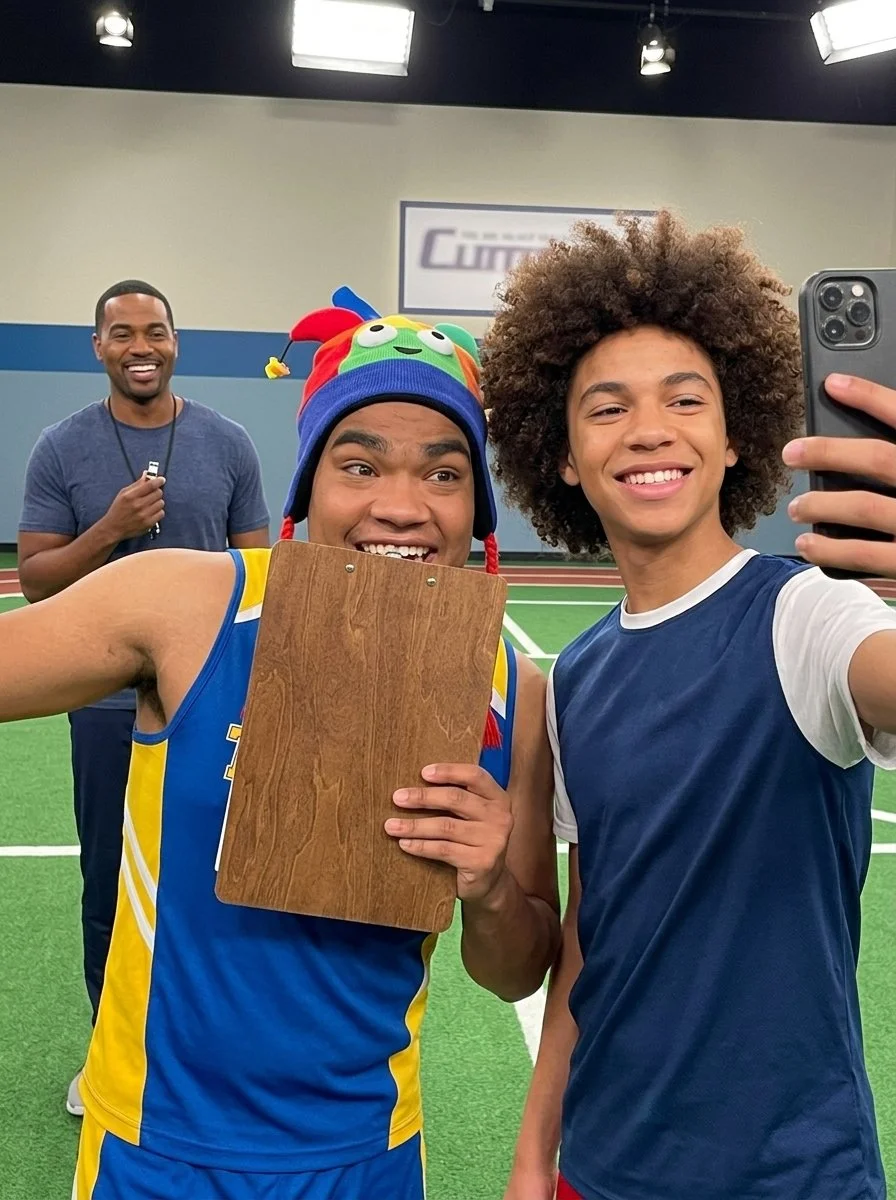
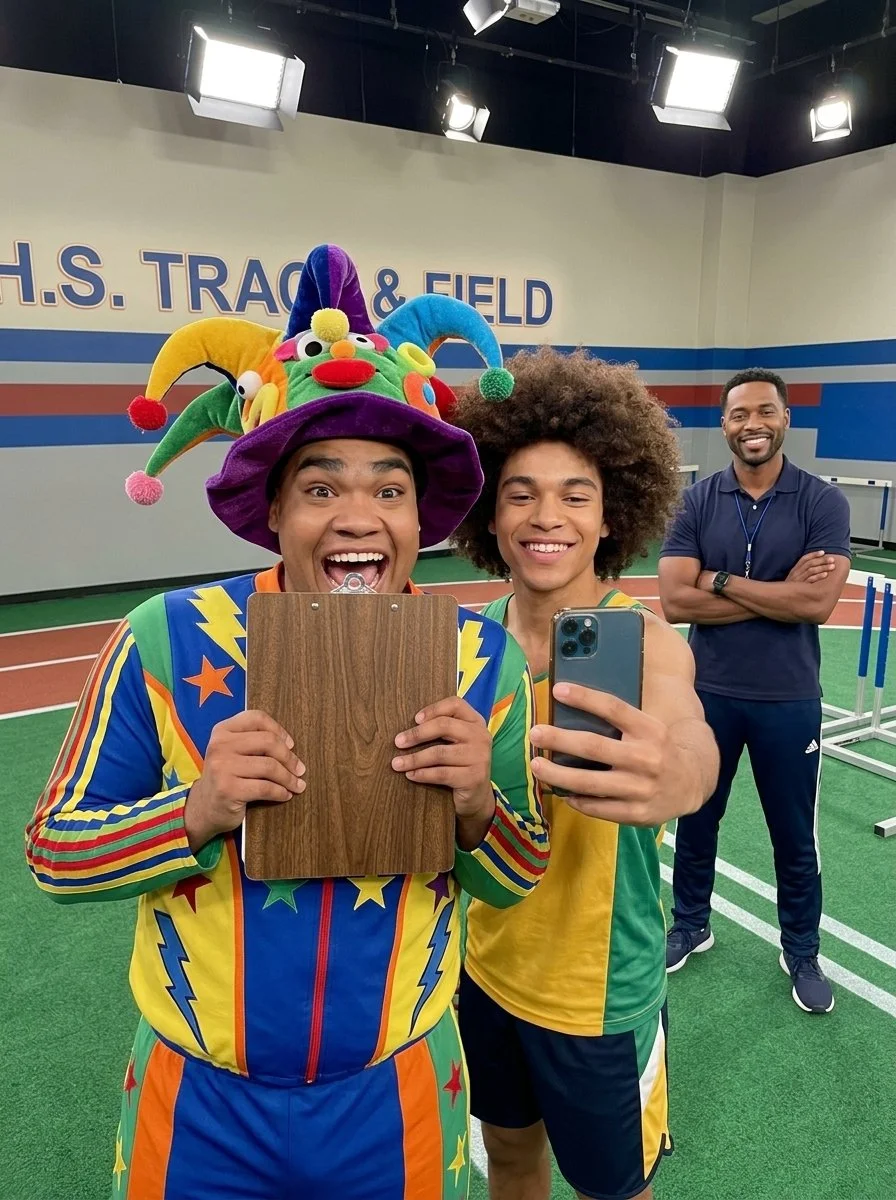
If you spot Mitchell Royel in these photos, you won't miss him. He stands front and center on an indoor track set, with green turf under his feet, a red running track behind him, and hurdles lined up in the distance.
In the first shot, Mitchell wears a full-on jester-style kids' track uniform that looks like a box of crayons came to life. The jumpsuit has green shoulders and yellow sleeves with red, green, and blue stripes. A bright yellow chest panel is covered in orange star patches and blue lightning bolts. The look continues down to blue-and-orange pants dotted with red stars.
Then there's the hat. It's a goofy masterpiece, with big curved horns in yellow, green, and blue, topped with red and pink pom-poms. A little green stuffed face with googly eyes and a red nose sits on a purple brim right above his forehead. Mitchell holds a brown wooden clipboard up to the camera so it covers his mouth, but you can still see the smile in his eyes.
In another take, he swaps in a rainbow knit beanie with jester points, a cartoon caterpillar face, a tiny yellow duck ornament dangling off one side, and red braided tassels hanging by his ears. He pairs it with a blue track singlet with yellow side panels, and the clipboard stays right where it belongs, in front of his mouth.
Next to him, a light-skinned, handsome runner with a big curly afro leans in and snaps a selfie, grinning in his yellow-and-green singlet. Behind them both, a handsome 36-year-old coach stands with his arms crossed or a whistle in hand, smiling like he's seen this kind of fun a hundred times and still loves it.
Honestly, the photos say a lot about Mitchell before he says a word. He's silly and open, and he's always surrounded by brothers.
The Interview
Mitchell Royel laughs easily. Before we even start recording, he's cracking jokes about the hat. But once the conversation turns to the men who shaped him, his voice gets softer and slower. You can tell he means every word.
We sat down with Mitchell to talk about growing up, finishing last, finding family in the church, working on set, and why he's not ashamed to spend his Saturday at the bowling alley.
Growing Up Cool With Everybody
Q: Let's start at the beginning. What was it like where you grew up?
Mitchell: I grew up in a mostly white environment. Most of the kids in my classes, most of the families on my street, most of the teachers, they were white. And I want to be clear, I was cool with everybody. That's just who I am. I'll talk to anybody. I'll sit at any lunch table. Put me in a room and I'm going to find a friend.
Q: So you didn't feel out of place?
Mitchell: Not in a "nobody likes me" way. I had friends everywhere. But there's a difference between having friends and having people who get you. Somewhere along the way, almost without trying, my closest friends turned out to be Black guys. My best friends. My day-ones. Out of all the people I was cool with, those were the ones I kept gravitating toward.
Q: Why do you think that happened?
Mitchell: I think it was the feeling of being seen. With them, I didn't have to explain my jokes or my music or why I talked a certain way. They checked on me. They told me the truth when I needed to hear it. And they laughed with me, not at me. When you find that kind of friendship as a kid, you hold onto it.
Last Place, But Never Left Behind
Q: Okay, we have to talk about track. You've been open about finishing last in middle school.
Mitchell: (laughs) Every time. Every single race. I'm talking dead last. People would be cooling down, drinking water, stretching, and I'd still be out there on the curve. I was not built for speed back then.
Q: Why did you keep running?
Mitchell: Because of the guys on that team. A lot of the fastest runners were Black, older than me, and they could've treated me like a joke. That's what you expect, right? The slow kid in the back. But they never did. Not once.
Q: What did they do instead?
Mitchell: They waited for me. That's the part I'll never forget. I'd be coming down that last stretch, breathing like I was dying, and they'd be standing near the finish line yelling, "Come on, Mitch! Finish strong! Let's go!" Like I was about to win the whole thing.
One of them, after a really bad race, put his arm around me and said, "You finished. That's more than a lot of people do." I was maybe twelve. I still think about that.
Q: That sounds like more than teammates.
Mitchell: They became my big brothers. They showed me how to tie my spikes, how to breathe on a long run, how to carry myself. They'd joke with me on the bus. They let me sit with them. They didn't have to do any of it.
When you're a kid, you think winning is everything. Those guys taught me that showing up is a win. Finishing is a win. Being there for your people is a win. I came in last on the track, but I never once felt like I was last to them.
Q: Did that change how you see competition now?
Mitchell: Completely. I don't measure myself by the scoreboard anymore. I measure by whether I gave my all and whether I lifted somebody up along the way. That's straight from them.
Raised in the Church
Q: You also grew up in the Black church. What did that mean for you?
Mitchell: Everything. Church was where I felt rooted. Even when the rest of my week was in places where I was one of a few, Sunday was home. The music, the food after service, the aunties who'd fix your collar, the elders who knew your whole family, all of it felt like a hug.
Q: And the pastors?
Mitchell: The pastors were huge for me. I had Black male pastors pouring into me from the time I was little. These were men who'd preach with fire on Sunday and then pull me aside on Wednesday night to ask how school was going. Real questions too. "How are your grades?" "Who are you hanging with?" "Are you praying?"
Q: Any moment stand out?
Mitchell: There was a time when I was going through a lot, just teenage stuff, feeling lost. One of my pastors sat me down in his office, no rush, no lecture. He just listened. Then he told me, "Your story isn't finished. Don't judge the whole book by one chapter." I've carried that with me ever since.
Q: How did those men shape the man you are today?
Mitchell: They showed me what strong looks like. And strong wasn't loud or tough or mean. Strong was being gentle and consistent and faithful. Strong was a man who'd cry at the altar and then go help somebody move on Saturday. I learned that a man can lead and still be tender. That's rare to see growing up, and I had it right in front of me.
On Set With the Greats
Q: Let's switch gears. You've done a lot of film and TV work, mostly as an extra. What's that been like?
Mitchell: (laughs) Yeah, I'm usually the guy in the background walking past the coffee shop or cheering in the crowd. But I love it. Some of my favorite memories are from being on set.
Q: You've worked around a lot of Black male entertainers. What did you learn from them?
Mitchell: So much. When you're an extra, some people on set barely notice you. But a lot of the Black male actors and entertainers I've worked around would come over, dap me up, and ask my name. They'd talk to me between takes. One of them told me to keep showing up, keep being professional, and keep being kind to everybody on set, because people remember how you treat them.
Q: That theme of being seen keeps coming up.
Mitchell: It really does. From the track to the church to the set, it's always been Black men making room for me. Even when I'm in the background, they never treated me like background. You don't forget that.
Q: Which brings us to the photos. Tell us about that outfit.
Mitchell: (laughs) Listen, the jester hat was a choice. But that's the energy of the whole shoot. It's playful, it's silly, it's kid-show vibes. And having my guy with the afro hopping in for the selfie and the coach smiling in the back, that's my life in one picture. Me being goofy, surrounded by brothers who are cheering me on.
Going Back to Childhood Joy
Q: You've talked about returning to childhood in healthy ways. What does that look like?
Mitchell: It looks like me at the arcade with a cup full of tokens, talking trash over air hockey. It looks like bowling nights where nobody's keeping score seriously. It looks like movie nights with popcorn and blankets, rewatching the stuff we grew up on.
I go to the park and just sit. Sometimes I swing on the swings. I take long walks to the gym instead of driving. I'm not trying to rush anymore.
Q: Why is that important to you now?
Mitchell: Because adulthood can make you forget how to have fun. Bills, work, stress, it piles up. At some point I realized I'd stopped playing. I'd stopped laughing the way I used to on that bus with my track brothers. So I decided to get that back.
And it's not about acting immature. It's about healing. It's about giving yourself the joy you maybe didn't get enough of, or the joy you got and then lost along the way.
Q: Do your friends join you?
Mitchell: Absolutely. Some of my best nights are with my guys at the bowling alley, everybody throwing gutter balls and laughing until it hurts. We're grown men, and we're still kids at heart. There's something powerful about brothers just being free together. No pressure, no performance. Just fun.
Q: What about the long walks to the gym? That's a little different from the arcade.
Mitchell: (smiles) That's the full circle. The kid who came in last place is now walking himself to the gym, taking care of his body, putting in the work. I think about those runners a lot on those walks. They'd be proud. I'm still not the fastest, but I'm moving.
The Message He Wants to Leave
Q: If you could talk to the men who mentored you, the runners, the pastors, the entertainers, what would you say?
Mitchell: Thank you. That's the first thing. Thank you for seeing a kid who didn't always see himself. Thank you for waiting at the finish line. Thank you for the talks in the church office. Thank you for the daps on set.
And I'd tell them it worked. Whatever you poured into me, it took root. I'm trying to pass it on now.
Q: And to the kid who's finishing last right now?
Mitchell: Keep running. Find your people, the ones who cheer louder for you when you're behind. They're out there. And one day, you'll be the one standing at the finish line yelling somebody else's name.
Mitchell Royel's story reminds us that brotherhood doesn't always show up in trophies or headlines. Sometimes it shows up as a teenager waiting at the end of the track, a pastor with an open door, or an actor who learns the extra's name. And sometimes it looks like a grown man in a jester hat, holding a clipboard over his grin, surrounded by men who've always had his back.