
(Reflection, Math, Fitness, Mindfulness) Night Shift Chronicles: Hosting, Babysitting, and Diaper-Wearing Horse Cartoons
Working as a host at an American casual dining restaurant, my nights are always busy and a bit chaotic—ushering families to their booths, managing waitlists, and tactfully handling the “How long until our table’s ready?” questions with a smile. But last night, the chaos followed me home in the form of babysitting my now magically two-year-old nephew, Mitchell. The shift may have ended, but my night was far from over.
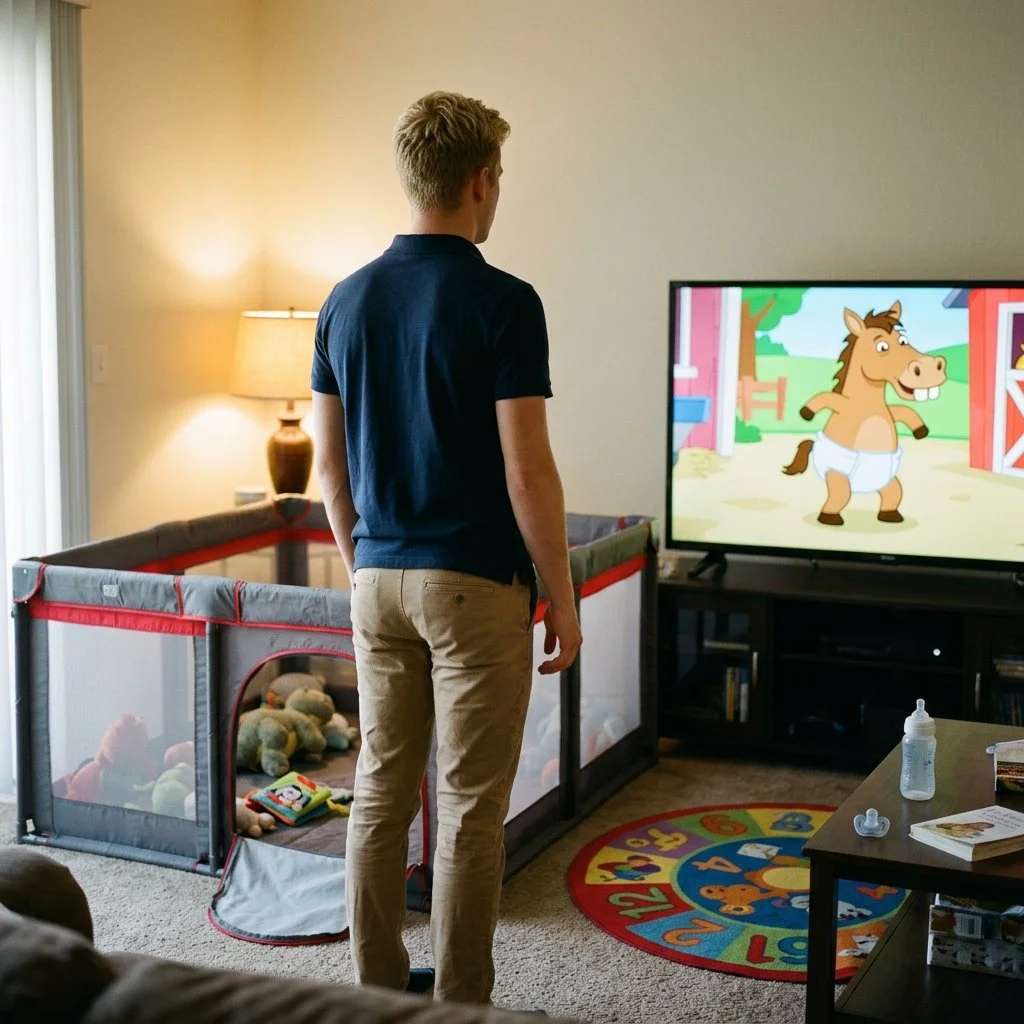
With Mitchell toddling around the living room like he owned the place, I needed the ultimate distraction—a cartoon. I flipped the TV to some show about a horse with big buck teeth and, for some reason, a giant diaper. Don’t ask me who thought this was a good premise, but it had Mitchell completely locked in for the full two-hour runtime. I took the opportunity to scarf down some leftovers from work and finally breathe after hosting all evening. By the time the show ended, Mitchell and I were sitting on the floor, surrounded by scattered juice boxes and goldfish crackers, having a deep (well, as deep as a talk with a two-year-old gets) discussion about the diaper-wearing horse.
Mitchell found it hilarious, pointing to his own diaper and laughing, while I tried to explain why, in the real world, horses don’t rock Huggies. But somewhere in our giggles and comparisons, I realized something. Life, like that odd cartoon, can be a little silly and unexpected. You have to roll with it—whether it's taming a packed restaurant lobby or entertaining a toddler with the wildest TV shows you’ve ever seen. The morale? Sometimes, joy and connection come from the weirdest, most unexplainable moments, and you just have to lean in and enjoy the ride.
Essay Prompt
Topic
Drawing from "The Night Shift Chronicles," develop an essay discussing what Mitchell, a two-year-old, might learn from the peculiar cartoon featuring a diaper-wearing horse with big buck teeth, and how this reflects broader ideas about learning, imagination, and resilience in childhood.
Essay Breakdown and Word Count Guidelines
Introduction (200 Words):
Briefly introduce the context of "The Night Shift Chronicles," focusing on the curious encounter with the horse cartoon.
Present your thesis statement, explaining what you believe Mitchell could learn from the cartoon and its relevance to his development.
Section 1 - The Power of Imagination (400 Words):
Explore how unconventional scenarios, like a diaper-wearing horse, can spark a child's creativity and stimulate their imagination.
Discuss the role of humor and absurdity in a toddler's cognitive development and emotional engagement.
Section 2 - Early Social and Emotional Understanding (400 Words):
Analyze how Mitchell's laughter and his comparison of the cartoon horse to his own diaper symbolize the development of self-awareness and social connections.
Explain how such moments can contribute to a child’s growing understanding of the world through relatable and humorous elements.
Section 3 - Lessons in Flexibility and Resilience (300 Words):
Address the broader analogy presented in the narrative about the unpredictability of life and learning to "roll with it."
Link this idea to how children absorb life lessons from unexpected sources, cultivating adaptability and resilience even at a young age.
Section 4 - The Role of Shared Experiences in Learning (200 Words):
Reflect on how shared activities, like watching the cartoon and laughing together, foster connections between Mitchell and his caregiver.
Explain how such shared moments serve as a foundation for emotional bonding and collaborative learning.
Conclusion (200 Words):
Recap the key points discussed and reassert the thesis.
Conclude with thoughts on the importance of finding joy and connection in life’s odd and teaching moments, emphasizing their impact on childhood development.
This essay should blend humor and analysis, mirroring the light-hearted yet reflective tone of "The Night Shift Chronicles," while presenting insightful ideas about childhood learning and development.
Reference: Understanding the fascination of my two-year-old nephew, Mitchell, with the horse wearing a diaper and sporting buck teeth brought up as many questions as it did laughs. If I were to ask Mitchell questions about the titular character in his new favorite cartoon, they’d likely be framed to match his level of understanding and humor while also teasing out his imaginative perspective. For instance, I might start with something simple like, “Mitchell, why do you think the horse wears a diaper?” or “Do you think the horse likes his teeth that big?” To Mitchell, these wouldn’t seem like questions meant to overanalyze; instead, they would inspire deeper giggles and fun answers like, “Because he doesn’t like the potty!” or “He has big teeth for the biggest apples!”
At just two years old, Mitchell’s answers wouldn’t carry deep reasoning, but they would reflect his growing understanding of the world. His answer about the horse wearing a diaper might even relate directly to his own experience—after all, he’s still wearing diapers himself. This parallel draws an obvious connection between the two of them. Both Mitchell and the cartoon horse are caught in transitions. Mitchell is on the brink of entering a stage where diapers will be replaced with potty training, while the horse, however absurd its premise, might be a symbol of the strange and ongoing transitions all of us experience, even if it is within the silly world of animation.
Comparing Mitchell to the horse is as funny as it is enlightening. Both Mitchell and that diaper-clad horse share a carefree, almost chaotic energy that comes with youthful freedom. They embody a spirit of living in the moment without concern for what might make sense to anyone else. Watching Mitchell point to his own diaper and laugh out loud while watching the horse strut around in its own nonsensical attire was a reminder of how much toddlers are learning to connect their experiences to the stimuli around them. For Mitchell, something in that odd cartoon resonated with his own little world, his own small adventures of diapers and absurd fun. To me, it illustrated Mitchell’s blossoming ability to see and explore connections with humor, no matter how bizarre the context.
If I had to predict how Mitchell would respond to my questions, I would imagine his answers would be rooted in simplicity mixed with sheer joy. I might hear something straightforward yet imaginative, like, “The horse is a baby like me!” or “The horse is silly and likes diapers!” Toddlers have a natural ability to interpret the world through a lens of their own playful imagination, and I expect Mitchell wouldn’t disappoint with his uniquely direct and creative takes. His responses would be glimpses into his mind as it learns to make sense of odd and contrasting ideas in ways only a two-year-old could fathom.
But where does this leave me as the adult in the room? What lessons could I impart on Mitchell based on that diaper-wearing, buck-toothed horse? First, I’d emphasize the importance of creativity and humor in life. Cartoons like the one Mitchell adored might seem ridiculous on the surface, yet they introduce us to the beauty of stepping outside the bounds of stiff logic. I’d explain to Mitchell that it’s okay to find joy in the silly and unexpected moments because they spark our imagination and help us think in different ways. Creativity, after all, fuels resilience, problem-solving, and adaptability—all critical skills for life.
Second, I’d highlight the value of kindness and acceptance, no matter how unusual someone—or some horse—might appear. The cartoon’s premise might be absurd, but it paints a picture of individuality without fear of being different. I’d tell Mitchell that everyone, like the horse, has unique quirks that make them special. I’d encourage him to approach the world with kindness and laughter, knowing that celebrating differences makes life richer and more colorful.
Lastly, I’d use this odd cartoon as a moment to teach Mitchell about the power of curiosity. I’d ask him to keep thinking about why things happen or how they work—not in a demanding way but as an invitation to keep exploring the world around him. If a horse can wear a diaper, what else is possible? I’d frame this lesson in a way that spurs him toward lifelong curiosity and fosters his growing love for asking questions.
Ultimately, while the night started as a whirlwind shift at the restaurant and transformed into a cozy living room filled with juice boxes, crackers, and random cartoons, it offered lessons in life’s little surprises. My discussion with Mitchell about that ridiculous horse revealed that there’s magic in the chaos, in the side-splitting giggles over pampers and buck teeth, and in making sense of it all alongside someone just beginning to decipher the world. Joy, curiosity, imagination, and kindness—those are the lessons I’d hope Mitchell walks away with, all thanks to one nonsensical yet oddly profound cartoon experience.
### 9th Grade Math Word Problems Test – Packing Mitchell's Diaper Bag
Instructions: Solve the following word problems involving 3-4 step equations. Each problem stems from the task of Mitchell's caretaker preparing his diaper bag. Be sure to carefully read each problem, set up an equation, and show your work. Do not skip steps, and provide clear reasoning for every part of your solution. Answers are not provided, so check your work carefully.
Mitchell's caretaker is packing bottles for a day. If he packs 5 bottles but decides he needs twice as many more, plus an extra 3 bottles just in case, how many bottles total will he have packed?
Diapers weigh 0.75 pounds each. If the diaper bag already contains 4 diapers and Mitchell’s caretaker adds 8 more, along with a wipes pack that weighs 2 pounds, what is the total weight of the diapers and wipes in the bag?
Mitchell uses 3 diapers per hour, but for every fourth hour, he uses an extra diaper. If the caretaker needs to pack diapers for 7 hours, how many diapers should be packed?
Mitchell's snacks for the day need to be split into 3 equal portions, with each portion weighing 0.5 pounds. If 2 extra snacks are later included, each weighing 0.75 pounds, what is the total weight of all the snacks?
Mitchell’s bag can hold a maximum weight of 15 pounds. If the weight of packed items totals 10.5 pounds and the caretaker adds 2 containers of formula that weigh 1.25 pounds each, what is the remaining weight capacity in the bag?
Mitchell's caretaker preps 8 clean bibs, each of which is folded to a thickness of 0.3 inches. If he then adds 5 more bibs that are thicker, at 0.5 inches each, what is the total thickness of all the bibs stacked together?
The bag includes 2 toys, each with a volume of 1.5 cubic feet, and 3 books, each with a volume of 0.8 cubic feet. If the bag can hold a maximum volume of 10 cubic feet, how much volume will remain in the bag after packing these items?
If Mitchell's favorite blanket needs to be folded into halves three times to fit in the bag and starts with an area of 32 square feet, what is the final area of the folded blanket in square feet?
Mitchell's caretaker needs to pack 6 ounces of fruit puree per feeding. If there are 5 scheduled feedings and each jar contains 3 ounces, how many jars of fruit puree will he need to pack?
The total count of items packed so far is 45. If Mitchell’s caretaker adds double this amount of items in the next round of packing, how many items would there be in total?
Each clothing item for Mitchell is rolled to a length of 4 inches and a diameter of 2 inches, resulting in a volume of (\pi r^2 h). Calculate the approximate volume for 6 rolled clothing items combined.
Mitchell's caretaker is packing pacifiers. Each pacifier weighs 0.2 pounds. If he decides to pack 2 pacifiers for each 2-hour interval of the trip, and the trip is 10 hours, what will the total pacifier weight be?
The bag has 3 compartments. The main compartment is reserved for diapers and formula, weighing a total of 9 pounds. If the second compartment weighs 3.5 pounds and the third weighs 2.25 pounds, calculate the overall weight of the packed bag.
Mitchell’s caretaker plans to organize the diaper bag such that 25% of the space is reserved for clothing, 40% for food items, and the remainder for miscellaneous items. If the bag has a total volume of 20 cubic feet, what is the space available for miscellaneous items?
The caretaker plans to fit a maximum of 20 items in each of the main two compartments. If the first compartment has 12 items and he adds 8 more, how many items will remain to be added to the second compartment to hit the bag’s capacity?
Mitchell's caretaker notices that for every 2 oz of formula, 1 oz of water needs to be added. If the bag contains 40 oz of water, how much formula can he pack using all the water?
A pack of 40 wipes costs $3.75. If the caretaker buys 3 packs and packs half into the diaper bag, what is the cost of the items packed into the bag?
For every 3 bibs packed, an extra 2 spare bibs are added. If Mitchell's caretaker decides to pack 15 bibs in total, how many of the bibs are spares?
To organize clothing, Mitchell’s caretaker selects 3 items of the same type and then mixes in items of 2 other types, in a ratio of 3:2. If there are 18 items in the bag, how many of each type are there?
Mitchell’s caretaker prepares 2 zippered pouches with snacks, where one pouch holds 1 lb more than the other. If the total weight is 8 lbs, what is the weight of each pouch?
The caretaker fills the bag with a mix of items weighing a total of 14 pounds. If the snacks make up half of the weight and diapers make up one-fourth, what is the combined weight of all other items?
For every hour of the trip, Mitchell’s caretaker packs 3 wipes per diaper change. If there are 3 diaper changes per hour and the trip is 6 hours long, how many wipes are packed?
Three identical water bottles are packed, each holding 24 fluid ounces. If Mitchell drinks 60% of the liquid by the end of the trip, how much liquid remains?
Mitchell’s caretaker decides to pack 10 sets of toys. If 3 sets weigh 4.8 pounds together, what is the average weight of each toy in a set?
Mitchell eats from 7 containers of baby food, with each container holding 2.5 ounces. If the leftover amount is 4 ounces, how much food did Mitchell eat?
A bottle warmer is added to the packing list at 3.2 pounds. If this increases the bag’s weight to 18 pounds, what was the original weight of the bag?
A travel play mat occupies 4 square feet in the bag. If it’s reduced to 60% of its size by folding, what is the mat’s new area?
The caretaker distributes items evenly into 4 sections of the bag. If there are 36 items in total, how many items will each section hold?
For every 5 diapers packed, Mitchell’s caretaker adds 1 pack of wipes. If there are 9 packs of wipes, how many diapers are packed?
Mitchell’s diaper bag costs $58.50, and all packed contents are worth 4 times the bag’s price. What is the total value of the bag and its contents?
Show your work for each problem!
# Four-Hour Heavy Cardio Gym Workout Routine
This workout routine is meticulously crafted to focus on extended periods of heavy cardio and dynamic exercises over a span of four hours. It is an excellent program to enhance cardiovascular health, build stamina, and burn calories effectively. You can follow these instructions or adjust the structure to suit your fitness level and preferences. Prioritize hydration and listen to your body, incorporating rest when necessary, to ensure safety throughout the session. The routine is divided into manageable time segments, optimizing both intensity and recovery for a well-rounded experience.
Warm-Up (20 Minutes)
Start your session with a thorough warm-up to prepare your body for the intense exercises ahead. This phase helps loosen up your muscles, increases blood flow, and reduces the risk of injury.
Dynamic stretches (5 minutes): Include exercises like arm circles, leg swings, and torso twists. Perform these at a controlled pace to activate major muscle groups.
Light jogging or brisk walking on the treadmill (15 minutes): Begin at a steady pace to ease into movement, gradually increasing intensity toward the last 5 minutes to raise your heart rate.
High-Intensity Cardio (50 Minutes)
This segment focuses on pushing your cardiovascular limits through sustained high-intensity exercises. Incorporating intervals allows you to challenge your body while promoting recovery during active rests.
Running on the treadmill or indoor track (30 minutes): Use interval training, alternating between 2 minutes of sprinting and 3 minutes of light jogging. Maintain proper posture and breathing for maximum efficiency.
Jump rope (10 minutes): Perform in 2-minute intervals, resting for 30 seconds between sets. Focus on quick, light jumps to minimize strain on your joints.
Stair climber (10 minutes): Find a comfortable yet challenging pace that maintains your heart rate. Use the handlebars for balance, but avoid leaning too heavily on them.
Mixed Cardio and Strength Intervals (60 Minutes)
This hour combines cardio and strength-based movements to build both endurance and overall body strength. Perform these exercises in circuit format to keep your heart rate elevated and engage various muscle groups.
Burpees (5 sets of 15 reps): Execute with explosive power, transitioning seamlessly between each phase of the movement.
Kettlebell swings (5 sets of 15 reps): Focus on controlled swings, engaging your core and hips. Start with a weight that challenges you without compromising form.
Mountain climbers (5 sets of 45 seconds each): Maintain a steady pace, keeping your back flat and core tight for precise movement.
Perform these exercises consecutively with 1 minute of rest between sets. Complete 3 rounds of the full circuit.
Endurance Cardio (40 Minutes)
The goal during this phase is to sustain moderate intensity over an extended period, reinforcing stamina while continuing to burn calories.
Rowing machine (20 minutes): Focus on fluid, rhythmic strokes to engage your entire body. Adjust the resistance to a moderate level that maintains a steady intensity.
Treadmill incline walk (20 minutes): Set the incline to a challenging level and keep a brisk walking pace. Engage your glutes and hamstrings to power through the workout.
Cool-Down and Stretching (30 Minutes)
End your workout with a dedicated cool-down period, allowing your body to lower its heart rate and preventing muscle tension.
Light jogging or walking (10 minutes): Gradually reduce your intensity, bringing your heart rate back to normal.
Static stretches (20 minutes): Target all major muscle groups, including hamstrings, quadriceps, calves, shoulders, and back. Hold each stretch for 20–30 seconds to promote flexibility and reduce soreness.
Final Notes
This comprehensive 240-minute workout prioritizes diversity in exercise selection to ensure your session remains engaging and effective. It is designed to challenge your endurance while incorporating recovery opportunities for sustainable performance. Adjust as needed to match your fitness level, and always prioritize your health and safety.
Mindfulness Exercise: Visualizing Your Perfect Fashion Statement
Objective: To explore personal expression through style while fostering group connection and creative thinking.
Step 1: Set the Scene
Gather the group in a circle and ensure everyone is relaxed and comfortable. Begin by asking everyone to close their eyes, take a few deep breaths, and clear their minds.
Step 2: Guided Visualization
Start painting a vivid mental picture for the group with this prompt:
"Imagine you’re walking into a room filled with flashing lights, cameras clicking, and eyes turning your way—the world premiere of You, The Icon. What are you wearing? Picture the fit, the texture, the color. Is it a sleek tailored suit? Maybe a bold streetwear combo that screams confidence? Are the shoes polished to perfection or an expression of edgy rebellion? Visualize every detail down to the accessories—your favorite watch, a statement necklace, or even a quirky pair of socks that’d make a grandma chuckle."
Pause for a moment to give the visualization time to settle.
Step 3: Group Share
Once everyone has envisioned their ultimate fashion statement, go around the circle and invite each person to share a short description of their outfit. Add a humorous twist—ask them to give their look a name, like "Gentleman Next Door with Gold Sneakers" or "Business Casual but Make It Loud."
Step 4: Reflection Journal
Hand out journals or a sheet of paper for reflection. Encourage the group to briefly respond to the following prompts:
How did your outfit reflect your personality or how you want to be perceived?
What surprised you about the exercise?
Can expressing yourself through fashion play a role in boosting confidence or making a memorable impression?
This fun and lighthearted exercise not only promotes mindfulness but also spurs creativity, laughter, and meaningful self-reflection. The insights gained might just inspire their next off-the-field fashion statement!