
WHO WE ARE WHEN THE ROAD BREAKS

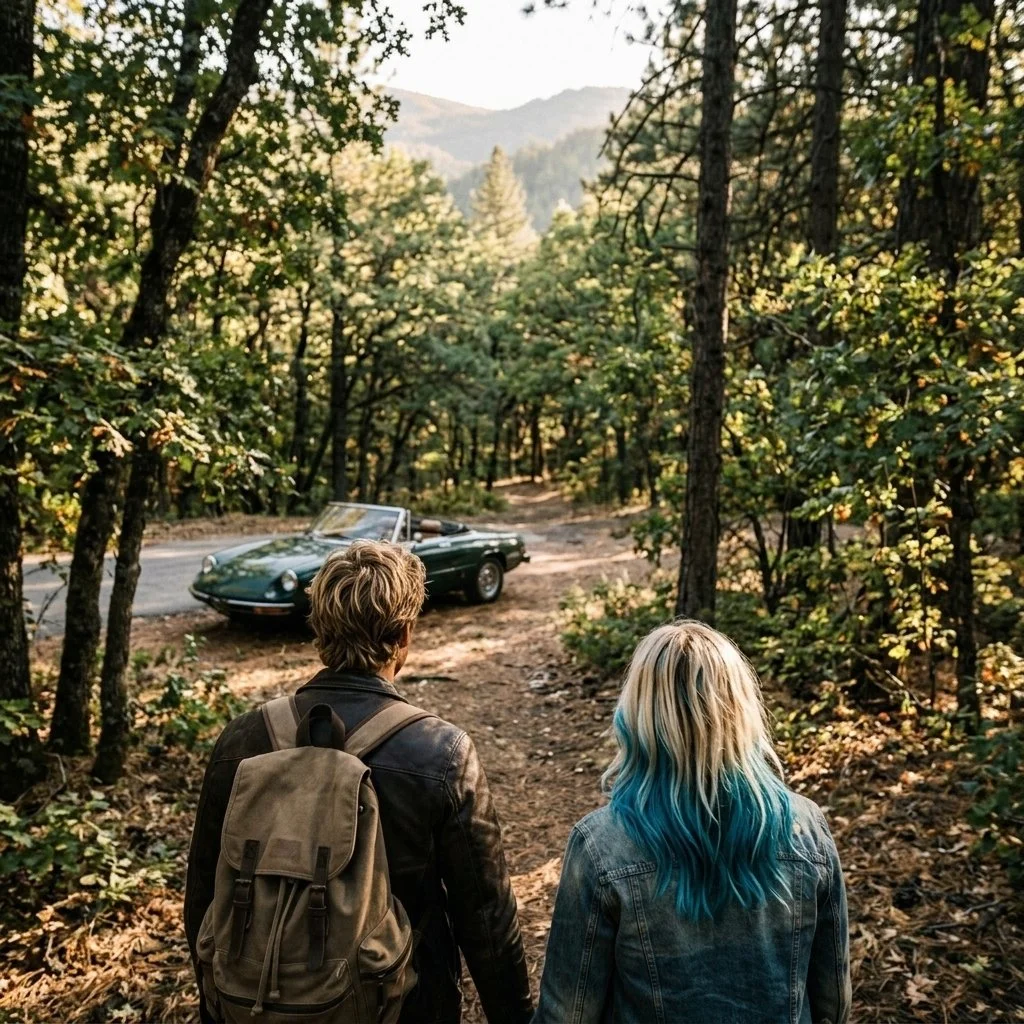
Photo captured by Mitchell Royel in the Fashion District. Please note that this sermon is for demonstration purposes only. We urge everyone to exercise caution when driving. Currently, we’re listening to "H8 U" by Véyah, a resonant piece that amplifies the voice of self-realization and fellowship.
I. The Drive
Let me tell you a story. And I need us all to sit with it, because it's true, and because it's the kind of true that doesn't let go.
There's a couple in this church. We've sat next to them. We've passed them the bread and the cup. We've watched them laugh in the back row before service. On an ordinary Saturday morning, they got in a car to go on a hike.
That's it. That's the whole plan. Water bottles. Trail mix. A playlist she made and he pretended to like. The windows cracked just enough to let the morning in. Two people in love, driving toward a mountain, thinking the biggest decision of their day would be which trail to take.
They had no idea the day had already been marked.
Because somewhere across town, another human being was drowning. Her ex-boyfriend. A man who had never let her go. A man who kept replaying a chapter she had already closed. A man whose pain had curdled into something he could no longer control. He wasn't sleeping. He wasn't healing. He was circling. And he knew their plans. He knew the road they'd take.
And as their car came around the bend, he stepped into the middle of the street.
Not to the side. Not with a sign. Not with words.
Into the center of the road. In front of a moving car.
And he was struck.
II. Sit in the Impossible
Let us feel how impossible that is to hold.
A couple is on their way to a hike. They are talking about lunch. And in a single second, a person they know — a person she once loved — is on the pavement in front of them because he chose the one act that would tear all of their lives open at once.
There are moments in life so surreal that the mind refuses them. The soul says, this is not happening, this cannot be happening. The sound. The stillness after the sound. The way time stops obeying the clock.
The road broke open.
And here's what I've learned in all my years of walking with people through their darkest hours: the road always breaks open eventually. Maybe not like this. Maybe it's a phone call. Maybe it's a diagnosis. Maybe it's a message that was never meant to be seen. But there will come a day when the ordinary shatters and we are standing in the middle of something we did not plan and did not want and cannot undo.
The question is never if the road will break open.
The question is: who will we be when it does?
III. What Unhealed Pain Becomes
Before I tell you what they did, I have to talk about him. Because I don't want us to walk out of here only thinking about the couple. I want us to think about the man in the road.
Because that man is not a monster. That man is a warning.
Scripture tells us in Proverbs 4:23, "Above all else, guard your heart, for everything you do flows from it." Guard it. Not because the heart is fragile. Because the heart is a source. Everything downstream in our lives is fed by what happens in that hidden place. And when a wound in the heart goes untended, it does not stay a wound. It becomes a pattern. And a pattern becomes a prison.
This man loved her once. But love that refuses to release becomes something else. It stops being love and becomes possession. It stops being longing and becomes obsession. Unresolved pain doesn't sit quietly in a corner. It grows teeth. It rewrites the story until we become the victim of a life that's actually just the wreckage of our own refusal to heal.
Hear me, church. Some of us are carrying something we were supposed to lay down years ago. A rejection. A breakup. A betrayal. A version of our lives that didn't happen. And we've been telling ourselves we're fine. We've been driving around town circling a road that leads nowhere.
That man in the street didn't wake up one day and decide to destroy three lives. He got there one unhealed thought at a time. One replayed conversation at a time. One night he chose the wound over the healing.
Cain was there once. Do we remember? God looks at him in Genesis 4 and says, "Sin is crouching at your door; it desires to have you, but you must rule over it." God warned him. The pain was crouching. The bitterness was crouching. And Cain didn't rule over it. He let it rule him. And a brother died.
Unhealed pain always wants a body count.
Sometimes it's our own.
IV. The Choice
Now let me tell us what the couple did.
Because this is the part that separates people who have Christ from people who only have circumstances.
They could have panicked. They could have driven off — and some people would have, because fear does terrible math in a fraction of a second. They could have fallen apart, screaming, useless. They could have started protecting themselves, thinking only of their record, their record, their future.
They didn't.
They stopped.
That's the first thing. They stopped the car. In a moment when everything in their bodies wanted to flee, they stopped. And I want us to understand that stopping is a spiritual act. When the world tells us to run from the mess, godliness plants our feet in the middle of it.
They called for help. They dialed those three numbers and they stayed on the line and they did what the voice on the other end told them to do. They didn't manage the situation for their own comfort. They surrendered it to the people trained to save a life.
They stayed at the scene. They didn't disappear. They cooperated with every authority that arrived. They told the truth — the whole, hard, humbling truth. Romans 13 tells us the authorities are established by God, and these two honored that. They didn't hide. They didn't spin. They stood in the light.
And they rendered what aid they could to the very man who had just tried to break their lives. Think about that. The person on the ground was the source of their nightmare. And they knelt beside him anyway.
Do we know what that is? That's the Good Samaritan in real time. Luke 10. A man is broken on the road, and everyone has a reason to keep walking. But the one who stops, the one who kneels, the one who binds the wounds of a stranger — that is the one Jesus says loved his neighbor. And Jesus turns to us and says, "Go and do likewise."
They did likewise. On the worst morning of their lives, they did likewise.
V. Mercy in the Wreckage
Here's what haunts me, in the best way.
They had every earthly right to hate that man. Every court in the land would have understood their rage. Nobody would have blamed them for feeling nothing but fury.
But rage wasn't the master of that moment. Mercy was.
And mercy in a moment like that doesn't come from nowhere. We don't manufacture it on the spot. Mercy under pressure is the overflow of a heart that has already been practicing it in private. The way we respond in crisis is not who we become in crisis. It's who we already were when nobody was watching.
Jesus said in Matthew 5, "Blessed are the merciful, for they will be shown mercy." And I used to think that was a reward system. Be merciful, get mercy. But it's deeper than that. The merciful are blessed because mercy is proof that God has already rewired the human heart. A heart that can kneel beside its own enemy has been touched by heaven.
That man tried to make himself the center of their story with an act of destruction.
And instead, in the way they responded, God became the center of it.
That's the reversal of the gospel. What the enemy means for evil, God bends toward redemption. Joseph knew it. Genesis 50:20 — "You intended to harm me, but God intended it for good." The wreckage doesn't get the final word. The response does.
VI. And Then They Walked
I need to share the last part of this story, because it matters more than we might expect.
After it was handled — after help came, after they told the truth, after they did everything righteousness required of them — they eventually continued to the trail.
Now, some of us flinch at that. How could they go on a hike?
But hear this. This is the part that preaches the loudest.
They did not run from their responsibility. They walked after they carried it. There is a world of difference between fleeing a burden and finishing our obedience and then choosing to keep living.
Because here is a truth that will set some of us free today: we are allowed to keep living after the road breaks open.
We are allowed to breathe again. We are allowed to walk again. We are allowed to feel the sun on the trail after we've done the hard, holy work of facing the wreckage with integrity. Faithfulness in crisis does not mean we sentence ourselves to a lifetime of paralysis. It means we do what's right — fully, honestly, mercifully — and then we let God carry the weight we were never meant to carry.
They walked up that mountain not because they didn't care. They walked up that mountain because they had already done everything that caring required. And now they were placing the rest — the man, the outcome, the trauma, the fear — into hands stronger than theirs.
That's not coldness. That's surrender.
"Cast all your anxiety on him because he cares for you," says 1 Peter 5:7. There is a holiness in refusing to let one moment of chaos become the coffin of our whole future.
VII. The Mirror
So let me bring this home. Let us hold up the mirror together.
There are two kinds of people in this story. And all of us are one of them.
Maybe we're like the couple. Maybe we're living faithfully, and we need to know that when our road breaks open — and it will — the character we've been quietly building in the dark is the character that will carry us in the light. Keep practicing mercy now. Keep telling the truth now. Keep stopping the car now, in the small things, so that when the big thing comes, our feet already know how to stay.
But maybe — and I say this gently, and I say it with love — maybe some of us are the man in the road.
Not literally. But in our hearts. Some of us have been circling a pain we refuse to release. We've let a wound become our identity. We've been telling ourselves the story where we're forever the victim, forever owed, forever justified in whatever bitterness we carry. And it's quietly turning us into someone we were never meant to be.
I'm pleading with us today. Don't wait until the pain writes a headline. Don't let the wound crouching at the door finally win.
Because there is another road. There is healing that doesn't require anyone else to fix what they broke. There is a Savior who took every wound the world has ever inflicted, carried it up a hill of His own, and let it kill Him so that it wouldn't have to kill us.
"He was pierced for our transgressions," Isaiah 53 says. "By his wounds we are healed."
Our wounds don't have to be the end of our story. His wounds already wrote a better one.
VIII. The Altar
So I'm going to ask us to do something together.
Wherever we are right now, I want us to stop running from our own roads.
If anyone here is carrying an unhealed pain — a breakup, a betrayal, a rejection, a grief that's been dragging behind us for years — I want us to bring it here. Not tomorrow. Not when we feel ready. Now. Because the thing crouching at the door is patient, and it is hungry, and the only way to rule over it is to hand it to the only One who can.
And if any of us have been the ones who respond with fear, with selfishness, with the instinct to self-protect and disappear — come. Let God build a new instinct in us. Let Him make us the kind of people who stop the car. Who kneel in the wreckage. Who choose mercy when rage would be so much easier.
Come lay it down.
The road is going to break open one day. I can't promise it won't. But I can promise this: we don't have to face it as the people we are today. We can be healed. We can be changed. We can become the kind of people who, in the worst moment of their lives, still know how to love their neighbor, still know how to tell the truth, still know how to trust that God is holding what we cannot.
Come.
The altar is open.
And so is the road ahead of us.
Let's pray.
-Pastor Mitchell Royel