
THEY TURNED US OUT IN THE SHADOW OF THEIR ALTARS, AND STILL, HE WAS THERE
WE’RE LISTENING TO FML (LOL OH WELL) BY KILLBOY.
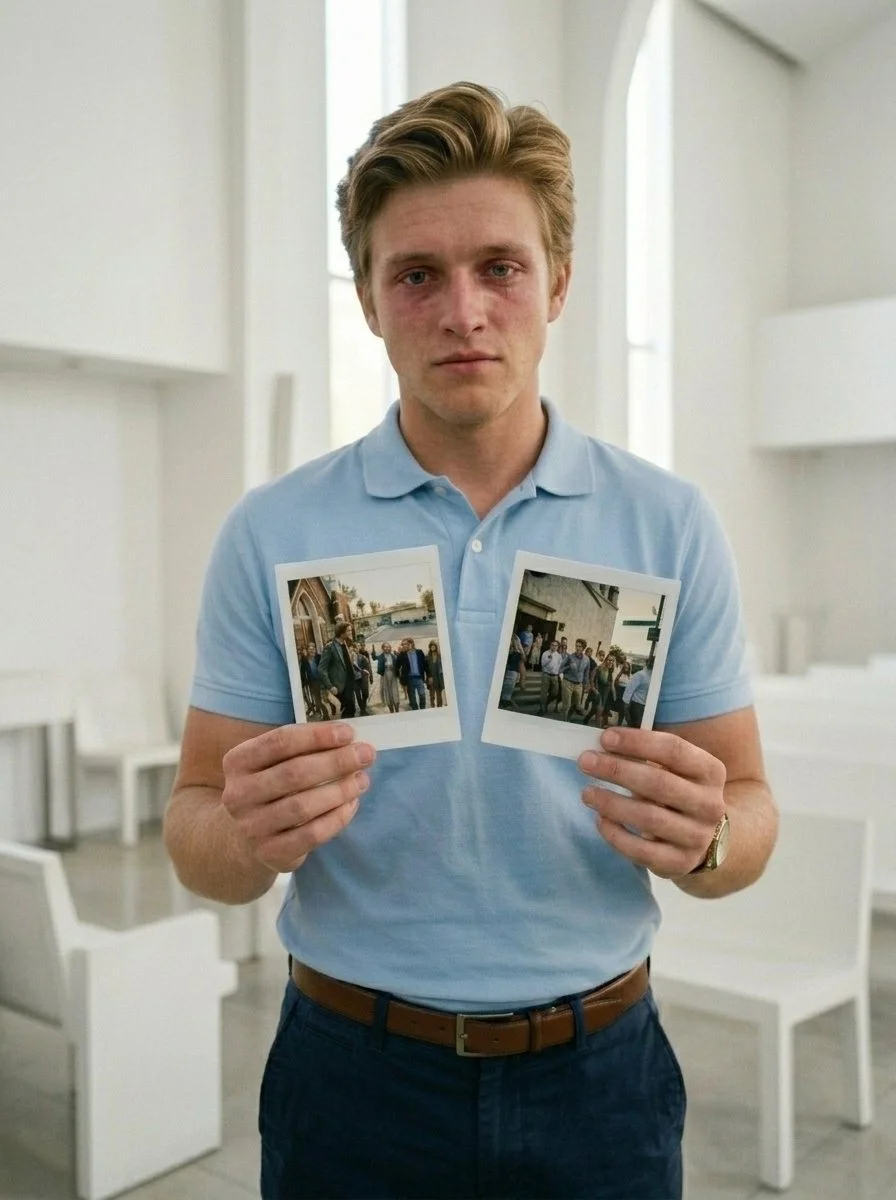
These Polaroids, captured years ago in North Hollywood, California, depict members of the Prism Church LA, whose names are protected for privacy, moments after they stormed out of their former church home. This image, vividly preserved in time, speaks to a chapter of deep transformation and resilience within their community. We pray for grace and healing for all involved.
"For where two or three gather in my name, there am I with them." - Matthew 18:20
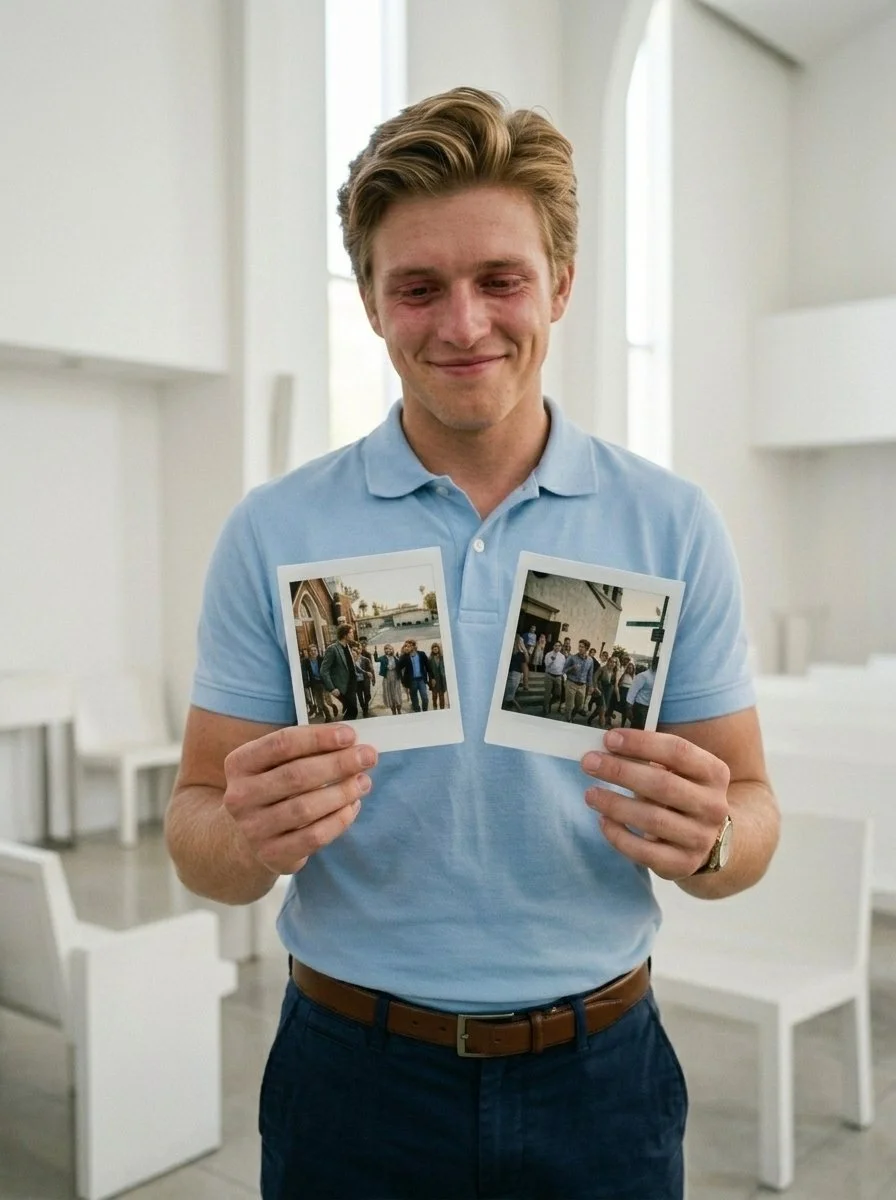
“A friend loves at all times, and a brother is born for a time of adversity.” - Proverbs 17:17 This photo, along with the one above, was captured today, 8/14/26, in the Fashion District by Mitchell Royel.
Let us begin where we do not want to begin. Let us begin with the wound.
Because some of us walked into a room that was supposed to hold the presence of God, and what we found there was not God at all. We found ambition wearing a worship shirt. We found control disguised as covering. We found men who spoke of grace and dealt in fear. And we carry that. We carry it in the way we flinch when someone raises their hands. We carry it in the way we no longer trust a stage, a spotlight, a smile that comes too easily. Some of us live in this city — this beautiful, brutal city that stretches from the ocean to the desert — and we have learned that a place can promise heaven and hand us something else entirely.
And here is the thing we do not say out loud. We thought the church would be the safest place on earth. We were told it was the body of Christ. We were told, in 1 Corinthians 12, that we are members of one another, that if one part suffers every part suffers with it. But what happens when the part that was supposed to suffer with us became the part that made us suffer? What do we do with that? Where does that grief even go?
Let us go to Psalm 22. Let us go there together, because it is honest in a way we are afraid to be. "My God, my God, why have you forsaken me? Why are you so far from saving me, so far from my cries of anguish?" That is not a psalm of the faithless. That is a psalm of the wounded faithful. That is the cry of someone who believed and got hurt anyway. And we need to know that this cry is in the book. The lament made it into Scripture. The abandonment made it onto the page. God did not edit out our disappointment. He preserved it. He canonized our ache.
And the same words — "My God, my God, why have you forsaken me" — are the words Jesus spoke from the cross, in Matthew 27. So let us understand something we cannot afford to miss: the God we follow does not stand outside our sense of betrayal. He entered it. He hung inside it. When we felt abandoned by the people who claimed His name, we were never as far from Him as we feared. We were, in that moment, closest to the very place where He bled.
But we cannot stay only here, in the wound, because it would not be honest. Because some of us have a different story.
Some of us walked into a room and it was real. The presence was real. The love was not a strategy — it was a substance. Somebody found us at the lowest point of our lives and did not try to fix us or use us or promote us. They just stayed. They carried our burden the way Galatians 6 tells us to carry one another's burdens, and in doing so they fulfilled the law of Christ. Some of us were prodigals, and the church we found actually ran to meet us. Some of us were dead, and the community around us breathed until we came back to life.
And if that is our story, let us not be arrogant about it. Let us not stand at a distance from our brothers and sisters who were wounded, wagging a finger, wondering why they cannot just get over it. Because Romans 12 tells us to weep with those who weep. It does not tell us to explain to them why they should stop weeping. The privilege of a healthy church is not a trophy to hold over the broken. It is a gift to steward on their behalf. If we were blessed, we were blessed to become a blessing. That was always the arrangement. Genesis 12. It has never changed.
So here we are — two rooms, two stories. One church broke us. Another church made us. And the temptation is to let our experience become our theology. To let the room we walked into decide the God we believe in. And that — that right there — is the trap we must refuse.
Because here is the thesis, and let us say it plainly so that none of us can pretend we did not hear it: our experience of the church does not alter our obligation to Christ.
The building failed. Christ did not fail. The pastor lied. Jesus did not lie. The community fractured. The head of the body is still holding all things together. Colossians 1 says in Him all things hold together — even when the things around us fall apart. Our wound is real. Our blessing is real. And neither one gets to sit on the throne. Only He does.
Look at Hebrews 10. It says let us not give up meeting together, as some are in the habit of doing, but let us encourage one another — and all the more as we see the Day approaching. Now, we have to be careful here, because that verse has been weaponized against the very people who were hurt inside the meeting. But read it again with new eyes. It does not say the meeting was perfect. It says the meeting matters anyway. It says our showing up is not a reward we give the church for behaving well — it is a discipline we owe to one another because the Day is coming. The obligation is not to the institution. The obligation is to the encouragement of the saints and the honor of the returning King.
And look at Ephesians 4. It says there is one body and one Spirit, one Lord, one faith, one baptism, one God and Father of all. One. Not one experience — one Lord. We do not all share the same story, but we share the same Savior. And Paul goes on, in that same chapter, and he says the whole body grows and builds itself up in love as each part does its work. Each part. The wounded part. The blessed part. The suspicious part. The trusting part. He is not asking us to have identical histories. He is asking us to do our work in the body regardless of the history we carry into it.
Let us go higher still. Let us go to John 17, to the last thing Jesus prayed before they came for Him with torches. He did not pray for our comfort. He did not pray that the church would never hurt us. He prayed that we would be one, as He and the Father are one — "that they may be brought to complete unity. Then the world will know that you sent me." Do we understand the weight of that? Our unity is not a nice idea. It is the evidence. It is the argument. The world reads the Gospel through the way we hold one another. Which means the enemy has always known that the fastest way to silence the message is to fracture the messengers. Church hurt is not an accident. It is a strategy. And when we let it drive us into permanent isolation, we hand the enemy the very thing he was reaching for the whole time.
But — and hear this — the answer to church hurt is never denial. It is never pretending the wound was not a wound. The answer is resurrection. And resurrection only ever happens to dead things. Romans 8 tells us that the Spirit who raised Christ from the dead lives in us, and that same Spirit will give life to our mortal bodies. The same power that rolled the stone away is at work inside the ache we are carrying right now. Romans 8 says nothing can separate us from the love of God — not death, not life, not angels, not demons, not the present, not the future — and let us add the thing Paul did not need to list because it fits inside every category he already named: not even the church. Not even the people who wear His name and wound us in it. Nothing separates us from the love that is in Christ Jesus our Lord.
So what do we do now? What do we do with the two rooms and the one Lord?
We go back to Acts 2. We go back to the beginning, when the Spirit fell and they devoted themselves to the teaching and to the breaking of bread and to prayer, and everyone was filled with awe, and they shared everything, and the Lord added to their number daily. That was the first church, and let us not romanticize it, because within a few chapters they are already arguing over the distribution of food and lying about their offerings and dragging one another before the apostles. The first church was not perfect either. And still — still — the Lord added to their number daily. The Spirit did not wait for the community to be flawless before He moved through it. He never has. He works through cracked vessels because cracked vessels are the only kind that have ever existed.
So we do not return because the church earned our return. We return because the King is worthy of it. We forgive because we were forgiven a debt we could never repay. We stay soft in a city that rewards the hard, we stay tender in a scene that rewards the image, and we build something — quietly, faithfully, together — that the ones who broke us could not build, because they were building for themselves and we are building for Him.
Matthew 16. Jesus says, "I will build my church, and the gates of hell will not prevail against it." Let us notice who is doing the building. Not us. Him. It was always Him. The men who used the church for their own kingdom were never the ones holding it up. He is. And a church He is building cannot be permanently destroyed by the failures of the people He is building it out of. The gates of hell do not prevail. Neither does our worst experience. Neither does our best one. He prevails.
So let us hold both stories in our open hands. The wound and the blessing. The room that broke us and the room that made us. And let us lay both of them at the feet of the only One who was ever worthy of our worship in the first place. Let us not build our faith on the church. Let us build the church on our faith in Him.
Because the church may have failed us. It will probably fail us again. We will probably, God help us, fail someone else. But He does not fail. He has never once failed. And our obligation was never to a perfect people. It was always, only, entirely — to Him.
Let us rise, then. Wounded and healed, broken and rebuilt, all of us together. Let us rise and follow the One who was forsaken so that we would never have to be.
And let the church He is building — the real one, the invisible and unbreakable one — let it be found faithful in us.
Amen.
-Pastor Mitchell Royel