
photos captured by mitchell royel for mitch leyor jr on iphone in the fashion district.
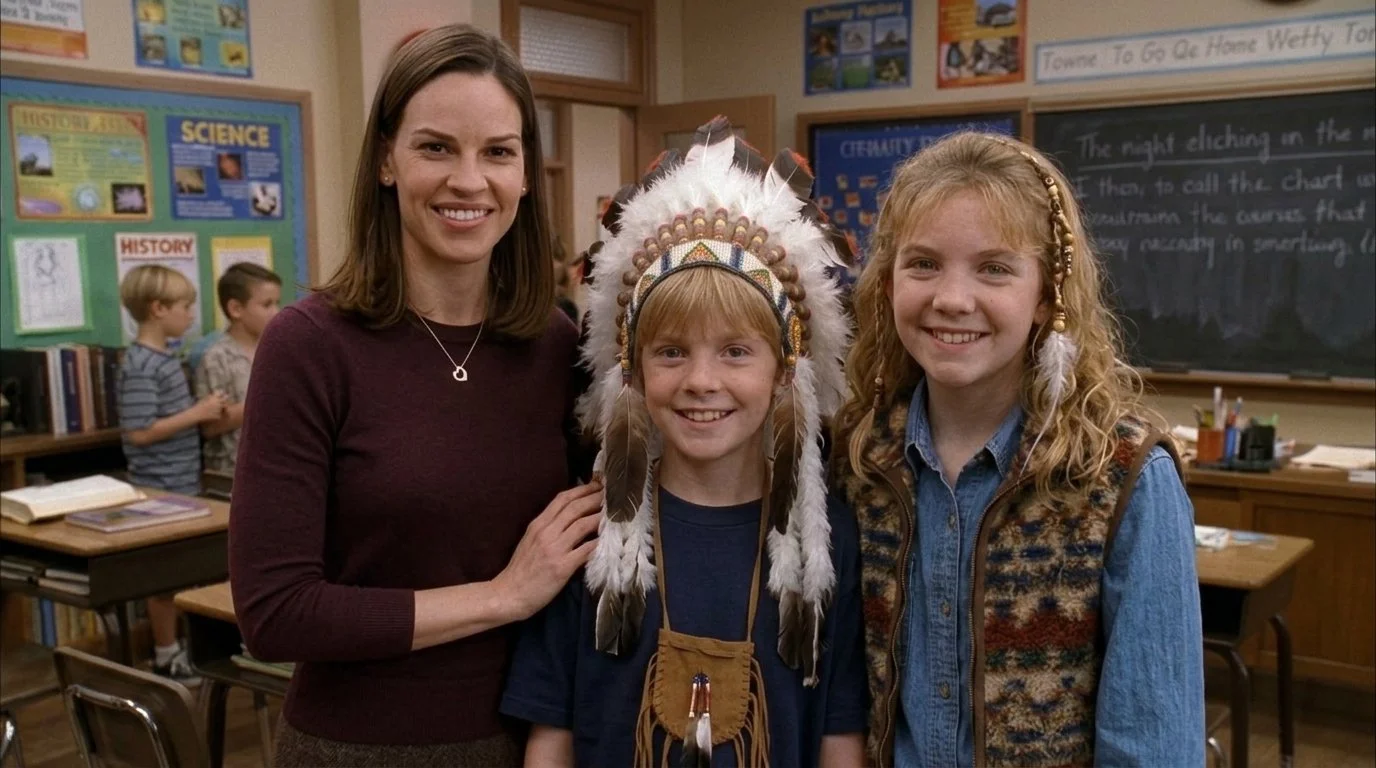
(Inspired by Hilary Swank's role as Erin Gruwell in Freedom Writers. The teacher in this scene is played by a model, though you'd be forgiven for doing a double take.)
Let me set the scene for you.
It's late afternoon. The light coming through the classroom windows has gone soft and gold. The science and history posters on the bulletin board are a little faded, and the chalkboard still holds half of this morning's lesson. Somewhere in the back, two boys are spinning the globe and arguing over where they'd go first.
And right in front of me, two of my kids are grinning like they just won the championship.
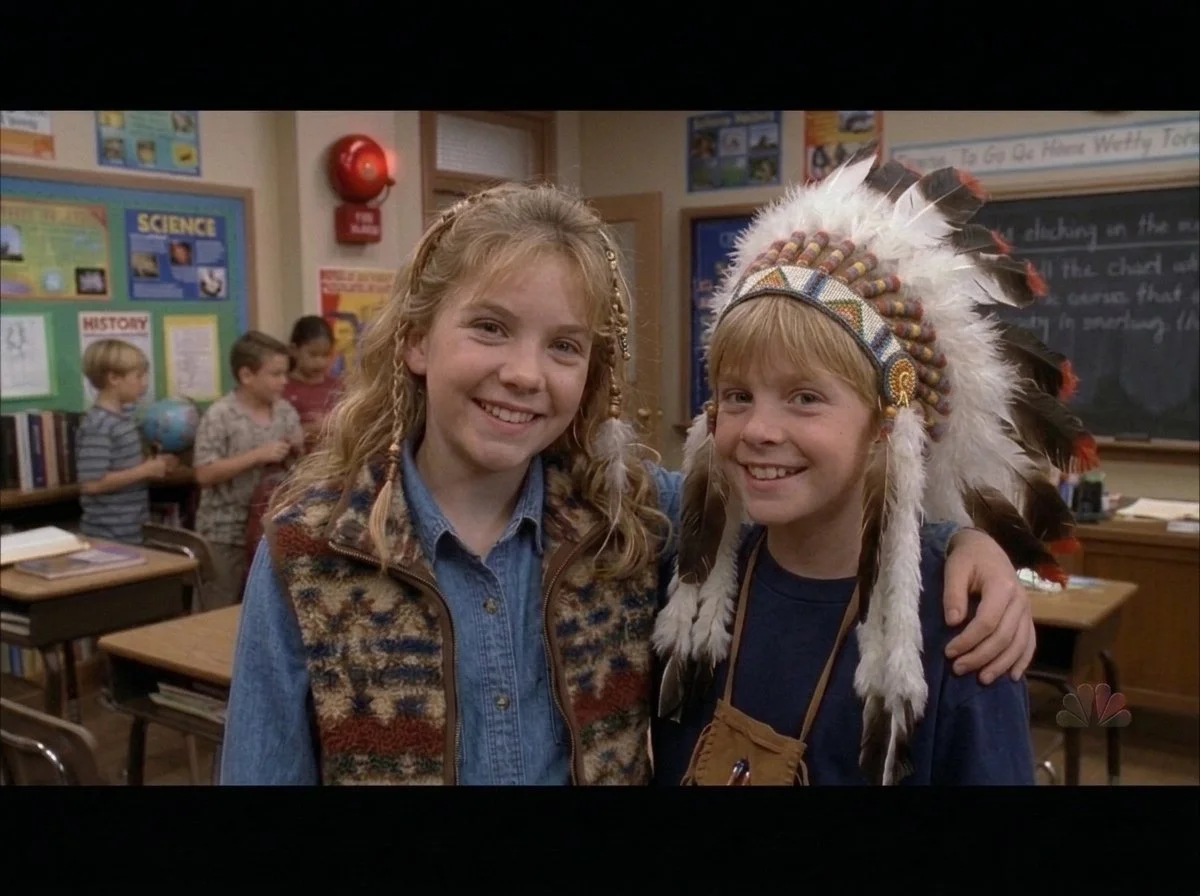
The boy is wearing a Plains-style war bonnet, and it's beautiful. White feathers fan out around his face, tipped in brown and black, and they sway every time he laughs. The beaded headband across his forehead is a tiny mosaic of blue, yellow, red, and white geometric shapes, each bead set in a careful line. Long feathered strands hang past his shoulders. Around his neck, a small fringed leather pouch rests against his dark blue t-shirt. He keeps touching it, like he's making sure it's still there.
The girl went a different direction. She's in a blue denim button-up under a fleece vest covered in a Southwestern geometric pattern: rust, tan, navy, and warm brown. Someone braided thin strands into her blonde hair and threaded them with wooden beads. A single white feather dangles near her cheek. She has her arm wrapped around his shoulder like they've been best friends forever. Maybe they have.
I put my hand on his other shoulder, and somebody snaps the picture.
Here's the thing I keep thinking about. A war bonnet isn't just a costume. For many Plains nations, every feather was earned. Each one meant courage, sacrifice, or a promise kept. It was worn by men who had proven themselves to their people.
So when I look at that boy, I don't want to take the moment away from him. I want to hand him the bigger version of it. That headdress is asking him a question: What would you have to do to earn one feather?
That's the conversation we're having next week. Not "take it off." Just "learn what it means."
If this moment had a soundtrack, it would open with "Dumb" by Breathe Carolina & Nikki Vianna. Bright synths, a bouncing beat, the kind of track you'd blast walking into the gym before a big game. It's loud and a little reckless, and it fits how kids carry themselves when they think nobody's really watching. Full of energy. Not yet sure where to aim it.
Then the music slides into "Whistle" by Jax Jones & Calum Scott. Calum's voice brings in something warmer, something that feels like being called. That's the shift I'm after. From noise to signal. From playing the part to stepping into it.
Picture it: the beat drops, the camera pulls back, and you see the whole room. Two kids in borrowed feathers and beads. A teacher who believes they're capable of more than anyone's told them. And a long road ahead that none of us can fully see yet.
Fade out on the feathers catching the last of the light.
(She walks to the front of the room, sets her coffee down on the desk, and looks out at the rows of young men. She waits until it's quiet.)
Okay. Phones down. I mean it. Give me ten minutes. That's less time than you spend picking a pregame playlist.
I want to tell you a story first. Some of you have heard it. Some of you will think it's corny. That's fine. Stick with me.
The story goes that when the first European ships sailed toward this continent, the people standing on the shore couldn't see them. The ships were massive. Sails, masts, the whole thing. They were sitting right there on the water. But nobody on that beach had ever seen anything like them. There was no picture in their heads for "giant wooden ship." So their eyes slid right past them.
Then one man, a shaman or an elder depending on who tells it, noticed the water moving strangely. Ripples coming in where they shouldn't be. He kept staring. Day after day. And finally, he saw them. Once he could see them, he showed everyone else.
Now, historians argue about whether it really happened that way. Fair enough. But I don't care if it's a fact. I care that it's true. Because every single one of you has a ship sitting off your shore right now, and you can't see it.
(She steps around the desk.)
You know what your ship is? It's a ten-year-old kid who doesn't have anybody.
He doesn't have a dad at home. Or he has one, but the guy's checked out. He's figuring out what it means to be a man from YouTube clips and group chats and whatever the loudest guy at school tells him. He's not on your radar. He's not in your world. So you look right past him.
That's why I'm here. Starting this semester, we're launching a Big Brother program. Each of these boys gets matched with a guy like you — someone in his twenties. You show up. Weekly. You throw a ball, you help with homework, you eat a bad cafeteria lunch with him, you answer his dumb questions. And you answer the ones that aren't dumb at all, the ones he's too scared to ask anybody else.
(A few guys shift in their seats. She notices.)
I already know what some of you are thinking.
"Ms. G, I'm not a role model. I'm barely passing."
"I don't have money. What am I supposed to give him?"
"I don't even have my own life together."
Good. Perfect. You're exactly who we need.
Because here's what I learned in my first classroom. I walked in thinking I was the one with all the answers. I had the lesson plans, the degree, the pearls. And those kids taught me more than I ever taught them. Kids I'd been told were lost causes. Kids from neighborhoods I'd never set foot in. They showed me what loyalty looks like. What surviving looks like. What it costs to keep showing up.
I learned the most from the people I expected to learn the least from.
That works both ways. Some of you are going to get matched with a kid who doesn't look like you. Different neighborhood, different bank account, different everything. And you're going to walk in thinking you're the coach. Then three weeks in, that kid is going to say something that stops you cold. Something about forgiveness, or about fear, or about God, that you didn't see coming. That's the ripple in the water. Pay attention to it.
(She picks up a piece of chalk and writes on the board: IRON SHARPENS IRON.)
A lot of you sit in church on Sundays. You've heard this one. Proverbs. "As iron sharpens iron, so one man sharpens another." Notice it doesn't say "as the expensive iron sharpens the cheap iron." It doesn't say "as the iron with the 4.0 sharpens the iron on academic probation." It's just iron. Two pieces. Both get sharper.
And let's be honest about who Jesus picked. Fishermen. A tax collector. Guys who argued, guys who doubted, guys who ran when it got hard. Nobody would've drafted that roster. He didn't wait for them to be ready. He handed them the job, and they grew into it.
You think you need to have it all figured out before you lead? Nobody does. Captains aren't the guys who never fumble. They're the guys who get back in the huddle and say, "Next play. I got you."
(She sets the chalk down. Her voice gets quieter.)
Here's what scares me. Not that you'll say no. It's that you'll never even see the question. That you'll stand on the shore your whole twenties, scrolling, competing, chasing whatever everybody else is chasing, and you'll never notice the ship. You'll never notice the kid.
And he'll grow up thinking nobody saw him either.
So I'm asking you. No, I'm challenging you. This generation of young men, you right here, you're the ones those boys are watching. They're copying how you talk. How you treat girls. How you handle losing. How you treat the guy who's not as fast or as cool or as smart. They're learning it whether you mean to teach it or not.
So teach it on purpose.
I don't care where you came from. I don't care what's in your bank account or what your GPA says or what your last coach told you about yourself. You have something to give. Showing up is something to give. Your story, even the messy parts, especially the messy parts, is something to give.
The sign-up sheet is on my desk. It's going to sit there all week.
(She looks around the room, one face at a time.)
Look for the ripples, gentlemen. Then step into the water.
Somebody's waiting on the shore for you to see him.
-curated by
Mitchell Royel +Deck

Reversal: Okay. Phones down. Seriously. Just for five minutes—I promise your DMs and streaks will survive. There’s something I need you to hear, and it might not be what you expect.
Here’s the thing. You’ve spent your whole life being told that older guys are where the wisdom is. Coaches. Captains. Mentors. The dads who pass down advice between commercial breaks or the veterans who tell you to toughen up after a bad practice. And yeah, sure, those voices matter. But they aren’t the only ones. Sometimes, the person who has the most to teach you is a scrawny fourteen-year-old who barely knows which way to wear a chinstrap.
Trust me, I’ve seen it. The freshmen come in, quiet, eyes scanning the floor half the time, and sure, you think they’re annoying. You think they’re slow, clueless, immature. And maybe sometimes they are. But every once in a while, one of those kids says or does something that flips the whole script. He takes a hit on the field that’s bigger than anything you’ve seen and gets up, holding his ground with zero ego. Or he’s the first guy to clap and yell for you when no one else notices the rebound you saved. Maybe it’s not loud or flashy, but it’s something real. It’s courage. Humility. Gratitude. Stuff you forgot the value of because you got used to people telling you that you’re the main act.
That’s the ripple, gentlemen. That’s the water moving in a way you didn’t expect. The question is, are you too busy brushing someone like that off to even notice?
(She steps forward now, voice quieter but firm.)
See, what makes a real leader isn’t how well you carry people weaker than you. It’s how well you listen to those you think have less to say. A real leader isn’t afraid to admit there’s wisdom in places he didn’t think to look. The kid you dismiss today might teach you something about loyalty tomorrow. About how to lose the right way. About how to shake someone’s hand even when you’d rather throw a punch.
And that’s the twist, guys. The sharpening works both ways. You are iron, sure. But iron loses its edge when it only grinds against the same blade over and over. Your ego, your assumptions, your blind spots—they need friction. Sometimes that friction comes from someone you’re convinced has nothing to offer you.
(She lets those words hang for a beat before lifting her chin slightly, voice steady.)
So I’m not just asking you to step into the water and teach someone else. I’m telling you to have the guts to learn while you’re down there. It’s not just about giving; it’s about growing. And if you walk out thinking today’s lesson was just about those younger boys, you’re missing the point. This is about you too—who you are, who you choose to be, and what you still have left to learn.
The ripple is there. You just need to see it.