
HE TOOK THE ROSE, WE KEPT THE LIGHTS
Right now, we’re listening to “No Good” by Ally Brooke—yes, the classic, the anthem, the song that lives rent-free in your head and still somehow pays your emotional bills. Don’t argue, just sway. And as the bass line snakes through your soul like it’s hunting for its next victim, know this moment is brought to you courtesy of Mitchell Royel, who snapped these gems on a humble iPhone—because why haul a DSLR when your pocket already holds the future? It all went down tonight, 10/13/26, in the fashion district, under streetlights that think they’re auditioning for Broadway. Mitchell caught it all—the velvet shadows, the pop of neon, the way the air feels like someone just whispered a secret about the best taco truck a block over. Snap, snap, snap. Exhibit A for why you can’t call it “just a phone” anymore.
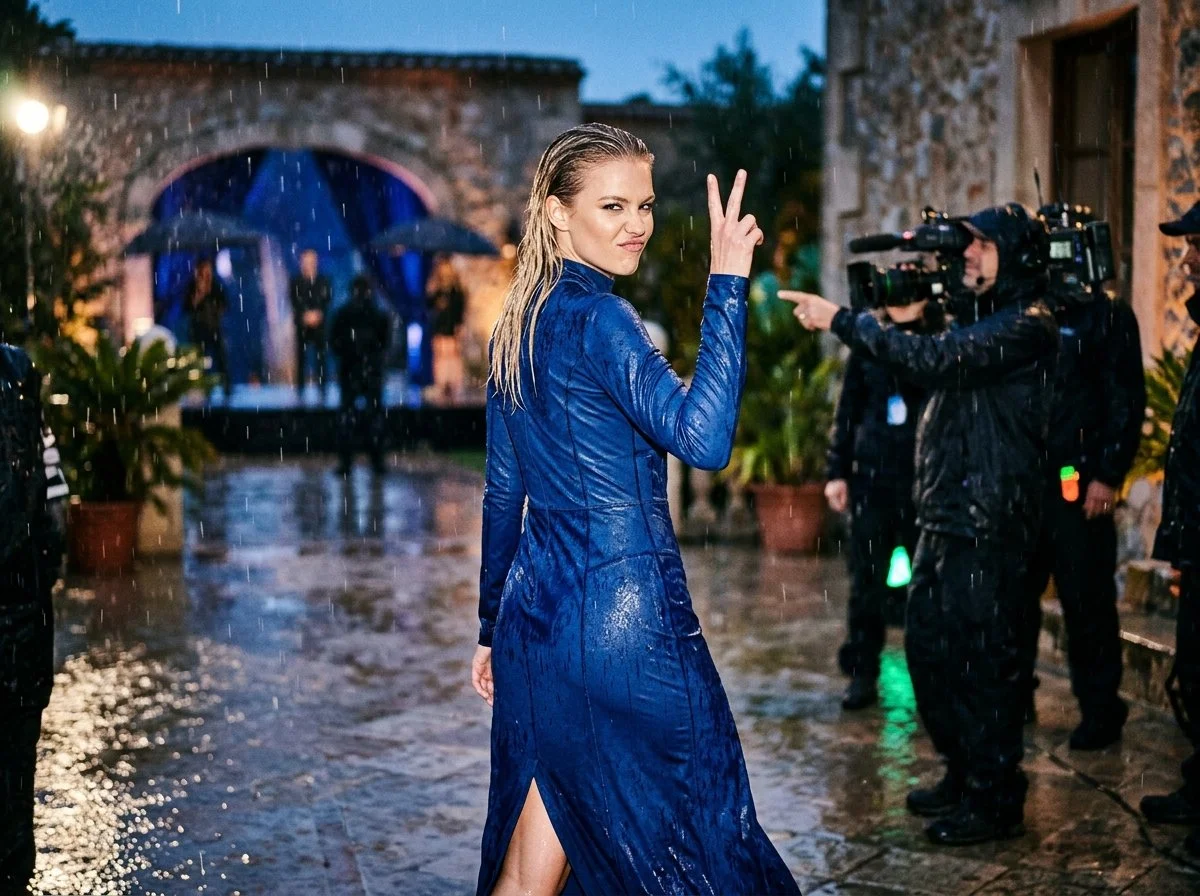
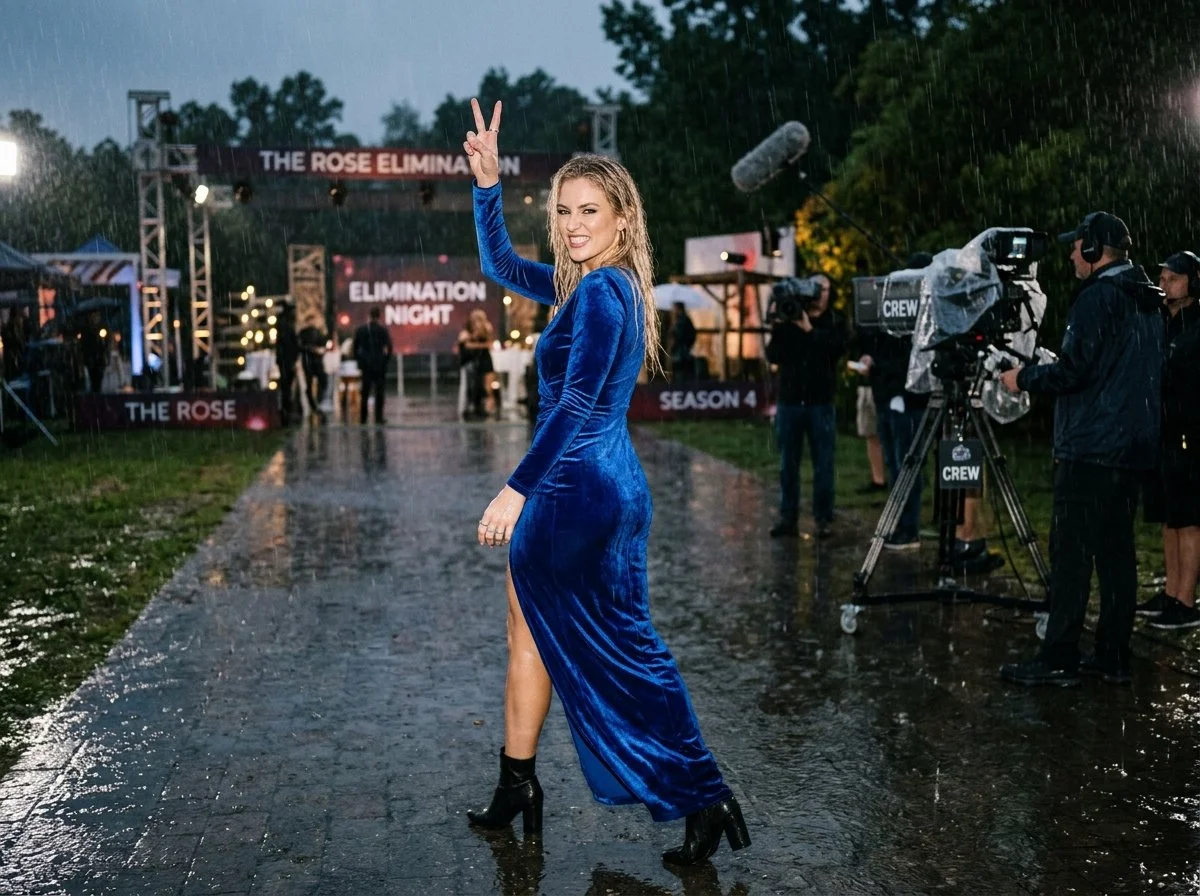
There is a particular kind of heartbreak that arrives in a velvet gown, in the rain, on live television, with six million people watching and a boom mic shaped like a sad gray raccoon hovering two feet above your head. That was us. Season 4, Elimination Night, 9:47 p.m. Pacific. The lead. The most publicly single woman in North America. And the walking, dripping, peace-sign-flashing proof that the production gap in reality television will dismantle your love life if nobody has the decency to name it first.
So let us name it.
Here is what nobody tells the men who sign up for these shows. When an actor weeps on screen, nobody calls their ex to check in. When an actor flips a table and storms off set, craft services hands them a coffee and the director calls cut. There is a script. There is a character. There is a clean, agreed-upon boundary between the person doing the work and the work itself. Reality stars don't get that boundary. We are the script. Our relationships are the product. Our ambition, our instinct for performance, our ability to walk into a room and command it — that isn't artifice layered over some truer, plainer self. That is the self. An actor plays a character and goes home. A reality star plays herself, and herself happens to be a woman who has spent years studying how to hold a room, how to move through light, how to make a moment land. That's not a lie. That's a calling. And the men who can't tell the difference tend to call it deception, right around week eleven, in the rain, in front of the sequins.
Grant never understood the distinction. Sweet, poem-writing Grant. He cried on the hot air balloon date — real tears, first take, no coaching — and rhymed "forever" with "together" with "this weather," which we chose to find charming. He looked at us in the fantasy suite and said we were the most real person he'd ever met. Hold onto that word. It comes back around.
What Grant fell in love with was not a fiction. It was a production. There is a difference, and it matters. The production gap isn't the distance between who we are and who we pretend to be. It's the distance between who we are and what the edit chooses to show — three lighting rigs, a producer whispering "say it again but softer," forty-seven post-production cuts removing every moment we complained about our feet. An actor's co-star knows the performance is a performance. Grant had no such clarity. He was watching what the format promised him was unfiltered reality. He believed it because the entire premise insists that he should. That's the product. That's the sell. And so he fell in love with a carefully lit, expertly paced, emotionally curated version of a real woman and called it the whole truth.
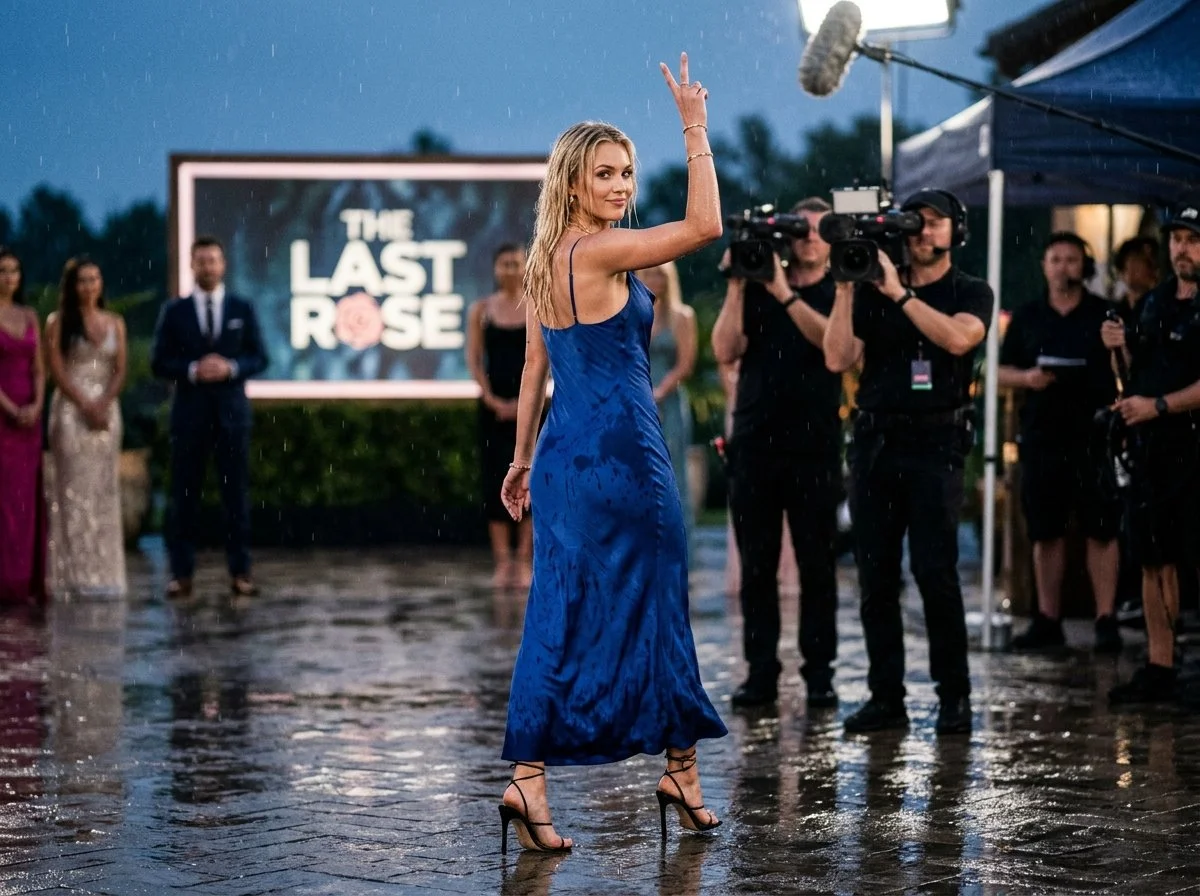
The rain started at 6 p.m. Production refused to move indoors — the executive producer said, and we are quoting directly, "Wet is a mood." So there we stood on a cobblestone courtyard under a stone archway, next to a potted palm that had lived a long and difficult life. The velvet gown weighed approximately as much as a golden retriever. The blonde hair had moved decisively past "beachy waves" and into "recently dragged from a lake." Above us, the boom mic hovered in its gray fuzzy wind cover like a creature with judgment. Two cameras tracked our every breath. A woman with a clipboard stood under a blue tent eating a granola bar and managing our emotional arc. Behind us, the LED screen glowed with the words "The Last Rose," the O replaced by a pink rose bud, because subtlety didn't make it past the Season 1 writers' room.
My sister wore magenta. My best friend wore gold sequins and caught every light on that wet cobblestone like a disco ball that had survived war. The host — a man whose navy suit has never once in recorded history experienced a wrinkle — clasped his hands and said, "Tonight, one man walks away with her heart." He was half right. One man walked away.
Between takes, we were different. We wore a parka over the gown and ate cold fries from a paper bag in the van. We called the boom operator "Kevin" even though his name is Greg. We complained about our feet with genuine conviction and zero apology. No producer was whispering anything softer. No editor was cutting around it. That version of us was just as real as the balloon-date version — more honest in some ways, because nobody was telling her how to sit. But here is what Grant couldn't hold: the off-camera self and the on-camera self are not two different women. They are the same woman in different light. The showgirl and the woman eating cold fries in the van are not in conflict. The ambition, the glamour, the performance instinct — those aren't masks she puts on for the cameras. They are her. She trained for this. She wanted this. She is, before she is anything else, a woman who knows how to inhabit a moment — and that capacity does not disappear when the lights go down. It just gets quieter. It rests. It eats fries.
Grant caught a glimpse of the fries during week nine, when a lighting failure went dark for forty minutes. He saw us with our shoes off, mascara smudged, in a loud disagreement with a vending machine. He went very quiet that night. We assumed he was tired. He was not tired. He was processing the thing no one on these shows ever adequately prepares the contestants for: the moment the production gap becomes visible. The moment they realize it existed at all.
Back to the rain. Back to the rose in our hand, dripping like it too had feelings about the evening. We looked at Grant. Cameras pushed in. The clipboard woman stopped chewing. "Will you accept this rose?" And Grant, standing there in his feelings, said: "I don't think I know who you are. The girl in the balloon and the girl at the vending machine are not the same person. I signed up for one of them. I'm choosing myself tonight." Then he turned and walked past the potted palm, ducked under the blue tent, and left. On live television. In front of the magenta. In front of the sequins. In front of approximately 6.2 million people and one very stunned host.
We did not collapse gracefully onto the cobblestones. We turned to camera two, smiled the largest smile of our adult life, flashed a peace sign, and walked off set in the opposite direction. That photograph is now a meme. You've seen it. Our mother has it framed.
Here is what Grant got profoundly, painfully wrong — and it is the same thing we all get wrong when we mistake the produced version of someone for the incomplete version. Grant thought the gap meant one of the women was false. He looked for the real face under the mask, the way you might parse an actor's performance. But she was never performing a character. She was performing herself — which is what showgirls and aspiring actresses and women who have spent their whole lives learning to fill a room have always done. The performance is not separate from the person. It is an expression of her. Her ambition is not a red flag. Her polish is not armor over vulnerability. Her ability to walk into a rose ceremony in soaking wet velvet and still make the camera want to follow her — that is not vanity. That is craft. That is years of becoming someone who knows what she is made of, even when it's raining, even on live television, even when a man named Grant is walking away.
The production gap in reality television is, at its core, a show-business gap. It is the misunderstanding that happens when someone who has never been inside the industry tries to love someone who has lived inside it her whole life — who chose it, who worked for it, who built herself to be seen. The gap isn't between the real self and the performed self. The gap is between what he thought he was watching and what was actually happening. He thought he was seeing behind the curtain. He was seeing the whole show. That was always the whole show.
And before anyone feels too superior about any of this, consider your own production schedule. The dating profile is a trailer. The first date is a pilot. The first three months are peak season — we hide the sweatshirt with the bleach stain, we claim to love hiking, we eat cereal for dinner in private. We are all, in our own way, running a show. The difference between us and the woman in the velvet dress is just budget and camera count.
The person worth keeping is the one who meets you at the vending machine and helps you shake it. Not because they love you in spite of the performance — but because they understand that the performance is part of what they're loving. The whole person lives in both the balloon and the van. She is the showgirl and she is the woman in the parka eating fries at midnight. She does not owe anyone the erasure of either one.
Two hours after the blindside, we sat in the van, still in velvet, still damp, eating cold fries. Greg the boom operator knocked on the window and handed over a dry towel. "For what it's worth," he said, "the vending machine thing was my favorite episode." Season 5 casting opens in March. We're bringing our own towel.
-Ryder, Mitchell Royel
Epilogue: There is a very specific variety of heartbreak that men will never fully grasp. This isn’t self-pity—it’s just practicality. Frankly, it isn’t in their best interest to understand. It's not the Hollywood-weep heartbreak, with its wistful piano solos and artful smudges of mascara. No, this kind of heartbreak wears ambition like perfume—it’s intoxicating, sharp-edged, cuts right to the bone before anyone realizes it’s in the room. It’s the heartbreak of arriving exactly where you’ve fought to be, only to find that the spotlight is not a warm glow but a scalpel. That your achievements, your audacity, your ability to split a room wide open with a single glance, are simultaneously admired, feared, misunderstood, and utterly untranslatable to the person across from you, who has decided this is all somehow a problem to solve.
And here’s the kicker. You’re not the problem. You’re the full-scale production everyone bought tickets to, the moment itself—and it will never occur to them that what you’re doing isn’t theater; it’s instinct. It’s survival. It’s pride sharpened to a fine, glittering blade. Men, bless them, have been trained to seek authenticity like it’s buried treasure, to peel you like an artichoke thinking your ambition, your capacity to perform at the edge of brilliance, is just the outer layer of the sweet, insecure girl at the center—oblivious to the fact that the bravado and the softness are one seamless tapestry. They can’t reconcile the woman who takes up space, glows like a supernova, commands the air like she invented breathing, with the woman who also gets a little teary eating crinkle fries in a too-quiet car. But here’s the secret no one names out loud—both women are standing right in front of them. It’s not a contradiction. It’s not a magic trick. It’s not an enigma begging to be solved. It is her, in full.
There’s a unique devastation to watching someone mistake your power for artifice, your polish for something shallow. To being told the thing you honed like a weapon—your strength, your precision, your ability to walk into any room and own every square inch of it—is, in the end, just a little too much. There’s a particular kind of emotional whiplash that comes from realizing the very same fire they were drawn to is what they now claim is burning them. But here’s the thing—they packed the lighter fluid and walked into the inferno voluntarily. They just didn’t stop to imagine what it feels like to stand next to a wildfire and still fall short of its blaze.
We could spend hours, days, endless debauched happy hours trying to explain this to them. But honestly? It’s better this way. Better for you, for your momentum, your unapologetic glittering ambition, if they never understand. Fletcher, Mark, Steven—whoever they are this year, next year, in their predictable rotation—they’re just not built for the rain-soaked velvet and quiet parka moments alike. They’ll never catch both, not fully. What they call too much, you’ll eventually hang like a trophy. And when a boom operator named Greg tosses you a towel and tells you your fieriest episode was his favorite—you’ll know exactly what they lost. What they never had the muscles to carry. Good luck to them. You’re keeping the fries.