
Soundtrack to this moment is “Like Me” by Girlicious and "Good In Goodbye" by Madison Beer.
Photos captured by Mitchell Royel on iPhone in the Fashion District
The following piece is purely a work of fiction. It features wholly imagined scenarios and characters portrayed by actors. Any resemblance to actual persons, living or deceased, or events is purely coincidental and unintentional.
Golden hour. A modern house in the hills, all warm cedar and clean white lines. A woman in a cream trench coat stands at the edge of a doorway. She's not crying. Not anymore.
Let me tell you how it started, 'cause nobody ever believes me when I say it was a part-time job.
Twenty hours a week. Folding sweaters on a front table under lights so bright they made everybody look a little more expensive than they were. I had a lanyard, a name tag, and a manager who told me to "smile with my eyes." I needed the money, and I liked the clothes. I liked how the cashmere felt when I ran my hand down a stack of it at close. That's it. That's the whole dream I walked in with.
I wasn't looking for nobody. I want that on the record.
Then he came through on a store walk. Quarterly visit, they called it. Everybody was moving like the building was on fire, straightening hangers, wiping glass that was already clean. And he stopped at my table. Picked up a knit, looked at the tag, looked at me, and asked what I'd change about the display.
And I told him. Honest. 'Cause I didn't know who he was yet.
He laughed. Not at me. With me. And baby, that's how they get you. They laugh with you first.
FRAME ONE: THE DRIVEWAY
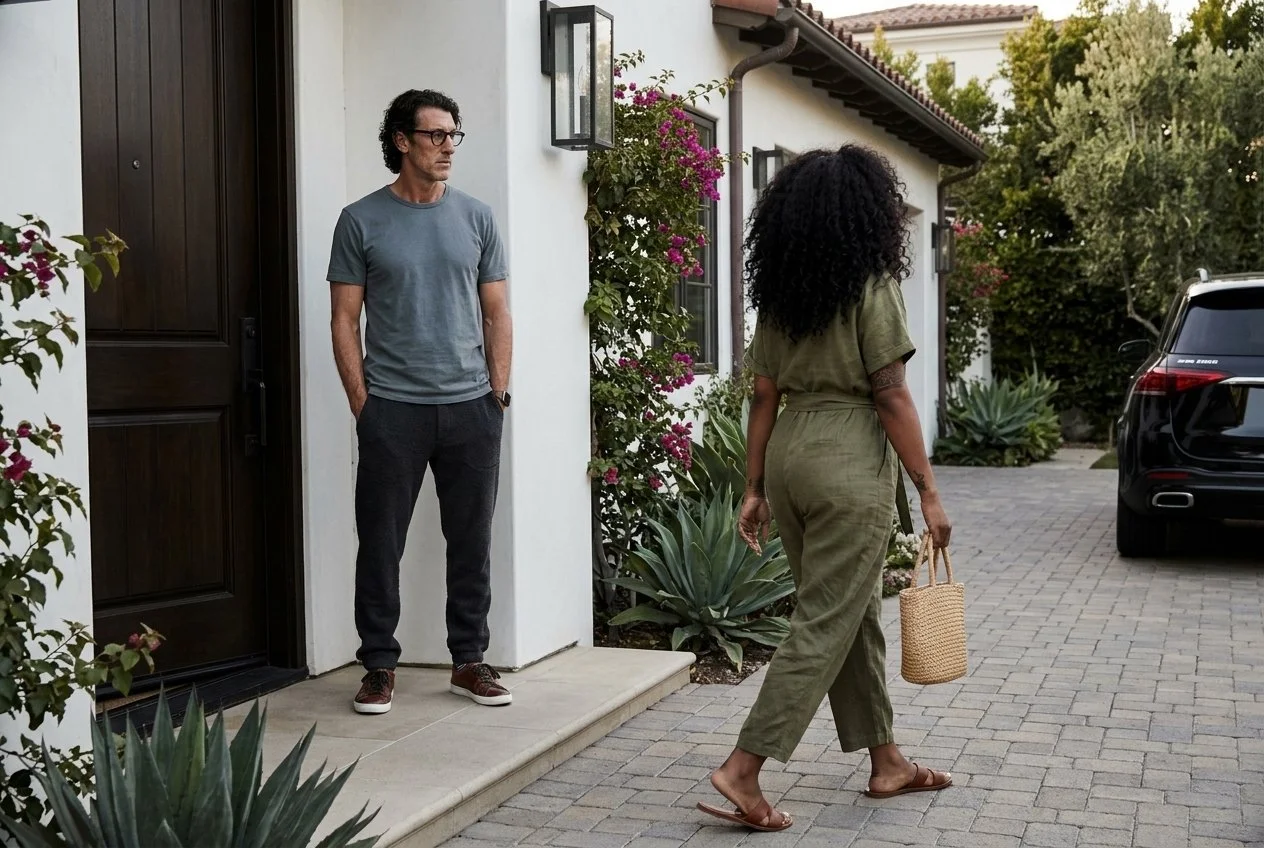
Soft white stucco. Terracotta roof tiles warmed by the sun. Magenta bougainvillea climbing the wall like it's got somewhere to be. She's in an olive green jumpsuit, cinched at the waist, brown leather slides, a woven straw bag swinging from her left hand. She's walking down a pale stone driveway toward a black SUV. He's on the step by the big wooden door, hands in his pockets, watching her go.
This is the early part. The easy part. When leaving still meant coming back.
He texted me two days later. Got my number off the schedule, which should've been my first clue that he don't know what a boundary is. But I was flattered. I was twenty-something and broke and he was asking me to dinner at a place where they don't put prices on the menu.
I remember sitting at that table, trying to figure out which fork to use. Trying to sit up straighter. Trying to say "yes" instead of "yeah." And I caught myself doing it. Right there. I watched myself start to shrink so I could fit.
Nobody tells you that code-switching don't always look like what you think it looks like. It ain't always about race. Sometimes it's about money. Sometimes it's about where you grew up, what your mama cooked, how loud your family laughs at the cookout. Sometimes it's about the way you talk when you're comfortable versus the way you talk when you want somebody to think you belong.
And I wanted to belong. God, I wanted to belong so bad.
So I started editing. A little at first.
I stopped wearing my hair out to his events 'cause one of his friends' wives asked if it was "always like that." I stopped bringing up my cousin's baby shower 'cause he got this look on his face like I was telling him about a different planet. I learned about wine. I learned about which neighborhood is "up and coming," which is just a nice way of saying where people like me used to live before people like him found it.
I learned to laugh at jokes I didn't think were funny.
I learned to keep my opinions about the store displays to myself, 'cause now that we were together, it was "awkward" if I said something at work.
And the crazy part? Everybody thought I was winning. My girls back home was like, "You dating the CEO? You made it." And I'd smile and post the pictures. The rooftop. The Sunday brunch. The weekend in Santa Barbara. I looked so good in every picture.
I just didn't look like me.
FRAME TWO: THE DOORWAY
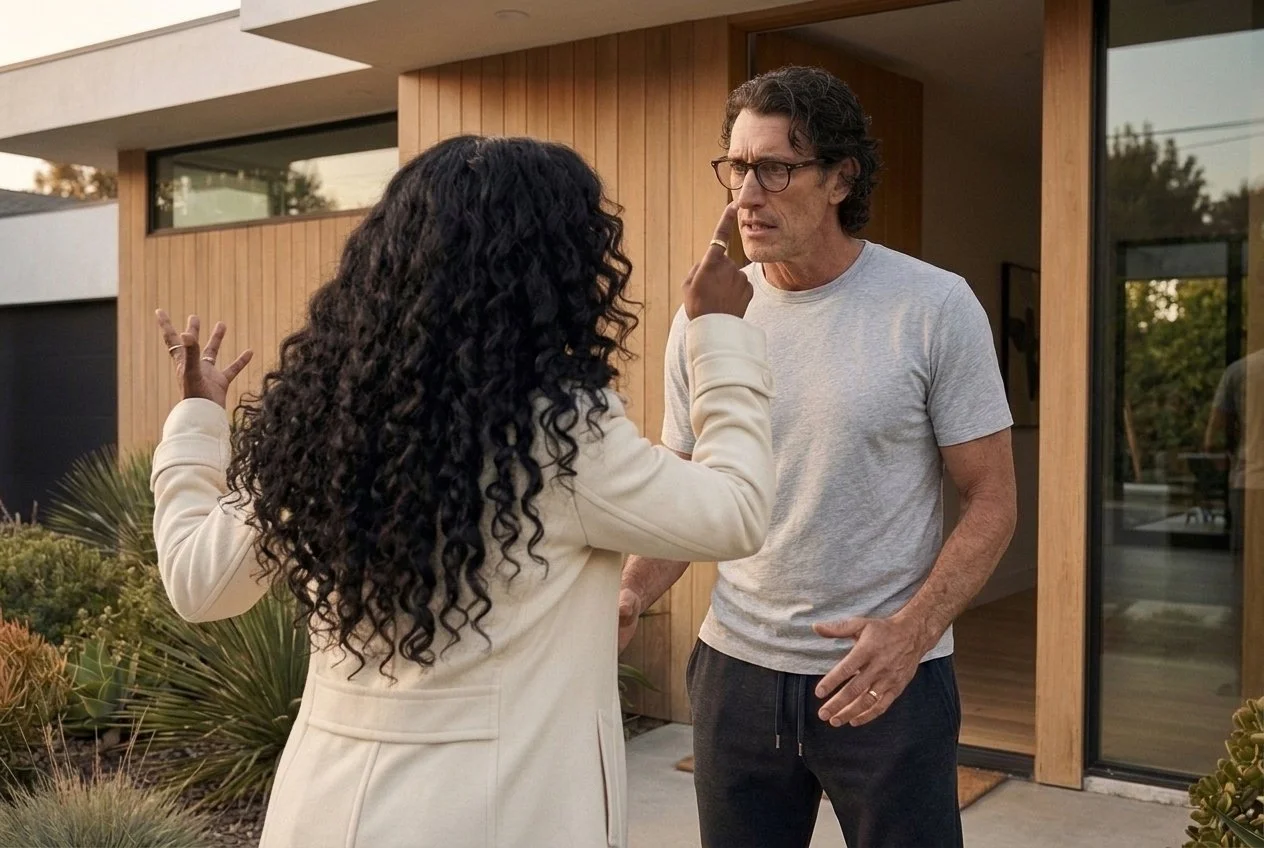
Late sun, low and gold, pouring across vertical wood siding. Floor-to-ceiling glass reflecting the trees. She's in the cream coat now, belted at the back, long curls falling past her shoulders. Her left hand is up, fingers spread wide, like she can't believe she has to explain this again. Her right hand points straight at his face. Right between those thick black frames.
He's in a gray tee and charcoal joggers, standing on the threshold. One palm turned down. Calm down, it says. Calm down.
She will not calm down.
Here's what upscaling yourself costs. I'ma give you the receipt.
It costs you your friends, first. Not 'cause they leave. 'Cause you stop calling. You don't know how to be both people in one conversation no more, and it's easier to just go quiet.
It costs you your voice. You get so used to translating yourself that you forget what you sound like in your own language. You start a sentence, hear it in your head the way they'd hear it, and you swallow it.
It costs you your job, sometimes. 'Cause when you're dating the man at the top, there's no such thing as just being an employee no more. Every promotion looks like a favor. Every write-up looks like a lovers' quarrel. I went from being the girl who knew how to style a table to being "his girlfriend who works in the store."
And it costs you the truth. 'Cause the whole time, you think if you just get the accent right, the clothes right, the dinner conversation right, they'll finally see you as an equal.
They won't. Not 'cause you ain't enough. 'Cause they fell in love with the version of you that was working so hard to impress them. The minute you get tired, the minute you let your real self slip out, it looks like you changed.
I didn't change. I just stopped performing.
The night it fell apart, it was over something small. It's always something small. I said something the way I'd say it at home. A little sharp. A little loud. A little me. And he looked at me like I had embarrassed him. In his own kitchen. With nobody else there.
"Why are you talking like that?"
Like what, baby? Like the woman you met at the sweater table? Like the woman who told you the truth before she knew your title?
That's when I knew. He never wanted me. He wanted the remix.
So I said everything. Every swallowed sentence from two years. I stood in that doorway and pointed my finger at him and let him have it, and he kept doing that thing with his hand, that little "calm down" motion, like I was a fire alarm going off in his nice clean house.
I wasn't the fire, though. I was the smoke detector. I was just telling him something had been burning for a long time.
FRAME THREE: THE STEPS
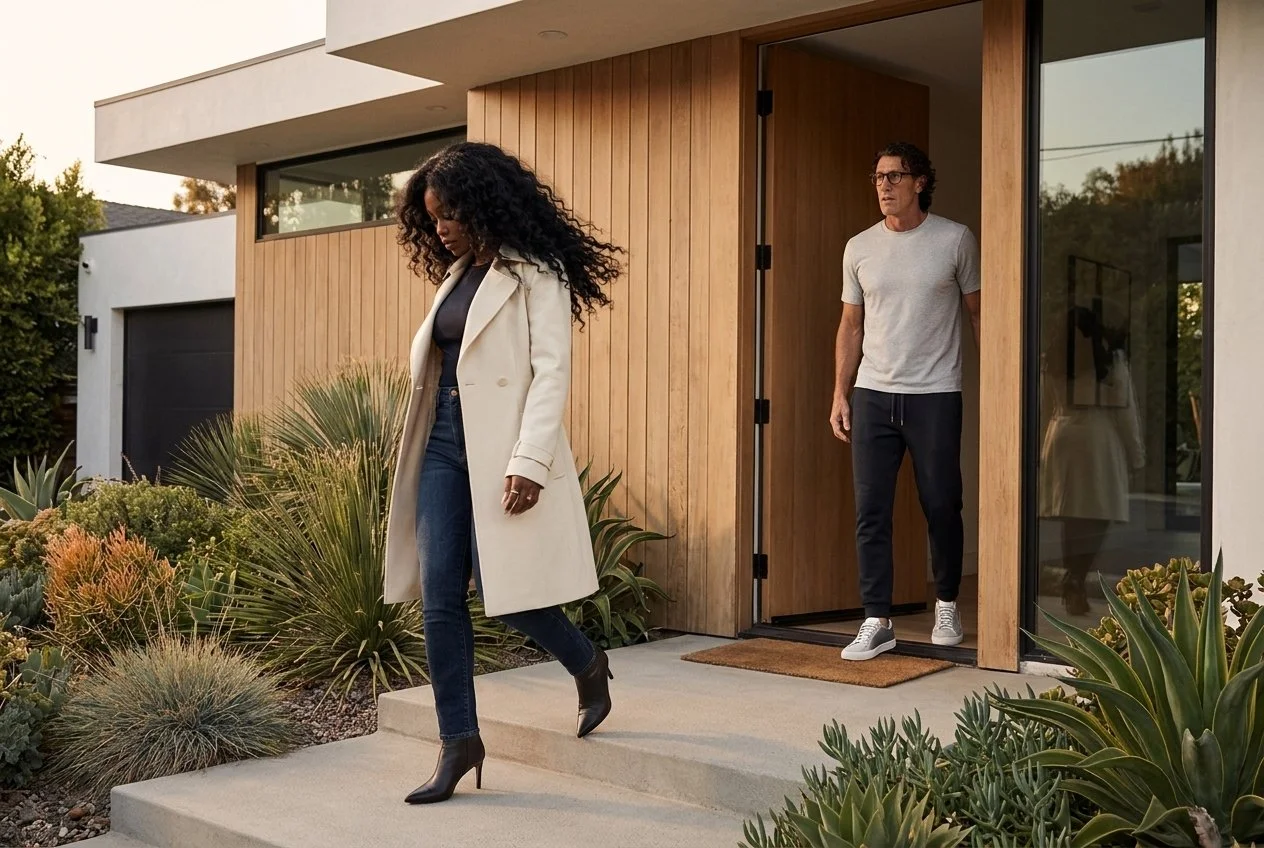
The pivot door stands wide open. Natural-fiber mat at the threshold. She's halfway down the concrete steps now, trench open, dark jeans, black pointed-toe boots catching the last of the light. Her head is tilted down. Not defeated. Just done looking back.
Agave in the foreground, sharp and green. Feathered grasses brushing the path. And in the glass beside the door, a faint reflection of her, walking away. Even the house knows she's leaving.
He stays in the doorway. Of course he does.
I'm not mad I fell in love. I want to be clear about that, too. Love ain't the mistake. The mistake was thinking I had to become somebody else to deserve it.
And I know some of y'all are in it right now. Maybe it's a man. Maybe it's a job. Maybe it's a friend group or a family or a whole city that only claps for you when you sound like them. And you're tired. You're so tired from the translating.
Here's what I learned walking down those steps.
You can level up without erasing yourself. Grow. Learn the fork. Learn the wine if you want to. But learn it as an addition, not a replacement. You don't have to delete your mama's kitchen to sit at somebody else's table.
If you have to shrink to fit, it don't fit. I don't care how pretty the house is. I don't care how warm the wood looks in the sunset. A beautiful room is still a cage if you can't breathe in it.
The people who loved you before the upgrade are still there. Call them. They'll pick up. Mine did. My girl answered on the first ring and said, "Finally," and I cried in the car for twenty minutes, and then we went and got wings.
The last time is the last time. Say it out loud. I'm saying it now. I will never again sand down my edges so a man can hold me without getting cut. If he can't handle the edges, he can't handle me.
I kept the coat, by the way. The cream one. I bought it myself, with my own employee discount, back before I knew his name. It was always mine.
So I'm walking out in it.
Golden hour. Hair out. Head down for a second, but only 'cause I'm watching my step.
I'm over it. And for the first time in a long time, I sound exactly like myself saying it.
-Ryder
Reversal: Golden hour. A modern house in the hills, all warm cedar and clean white lines. A woman in a cream trench coat stands at the edge of a doorway. Her eyes lift toward the horizon, her lips whispered in the shape of a smile. She’s not waiting. She’s arriving.
Let me tell you how it started, ‘cause I never thought I’d get to say that it worked. It was a part-time job. Twenty hours, maybe less. Folding sweaters under lights that made everybody look a little closer to how they wanted to feel. I needed the money, and I loved the clothes — the cut of wool trousers, the clean edge of a perfectly sewn hem. I loved the sound of the shop in the quiet mornings. That was it. That’s all I wanted.
Then he walked in. No fanfare. No entourage. Just him, pausing by a front table with that quiet kind of confidence like he owned the room — and later, I’d find out, the company. He picked up a knit, ran his fingers over the grain of it, looked at me and asked, “What would you do to make this look better?” I told him. That was the start. Not a laugh. Not a slick one-liner. Just a question, and a moment, and me not hiding who I was. And for once, that was enough.
FRAME ONE: THE FIRST NIGHT
Soft light spilling through tall windows. A leather jacket draped over a chair. A worn paperback on a coffee table, spine cracked and creased. She’s barefoot, sitting cross-legged on the couch in jeans and a cotton tee, her hair thrown up into something loose and unpracticed. He sits across from her, one hand resting on the edge of his chair, the other holding a drink he hasn’t touched. They’re leaning toward each other slightly, both unaware of the time.
That’s how it happened, slowly. We didn’t skip steps. He never asked me to explain the way I said something or apologize for the spaces I came from. I didn’t spend the whole dinner picking the right fork or smoothing over my curls to match some imagined ideal. And he never stopped asking questions — about what I thought, how I’d change things. He never stopped listening. And the magic in it wasn’t about a rooftop view or a suit that costs more than my first paycheck. It was about ease. It was about not having to edit.
FRAME TWO: THE FUTURE
A studio filled with sunlight, half-written notes tacked to a wall. A laptop open beside a plate someone forgot to clean. A long work table with paint splatters near the edges. She’s in joggers and an old graphic hoodie, earbuds tucked beneath her hair, a brush in hand. He leans against the doorframe with two mugs of coffee, a soft grin on his face.
Here’s the truth they never tell you about love when you’re in it for keeps — it expands you. Not to fit someone’s world, but to fill both of yours. You learn to keep what matters and build what’s next. You don’t shrink. You grow. There’s no scaling up, no adapting down. Just forward, together, step by step, toward whatever comes next.
FRAME THREE: THE HILLSIDE
The pivot door is half open. Light warming the threshold, the low hum of evening birds. She’s on the terrace now, cream coat still wrapped around her shoulders, hands cradling a glass of something glowing amber in the sun. Her head tilts back slightly, laughter caught mid-moment. Behind her, he sits on the edge of a low stone planter, one hand propped on his knee, eyes fixed on her in quiet delight. Nothing is performing here.
Not everything asks for sacrifice. Sometimes, you buy the coat. You walk in your skin. You don’t shift or adjust; you step in and find yourself more of everything. And sometimes, you find a love that lets you stay sharp without losing the warmth.