
BALDWIN HILLS MEETS MALIBU CHIC
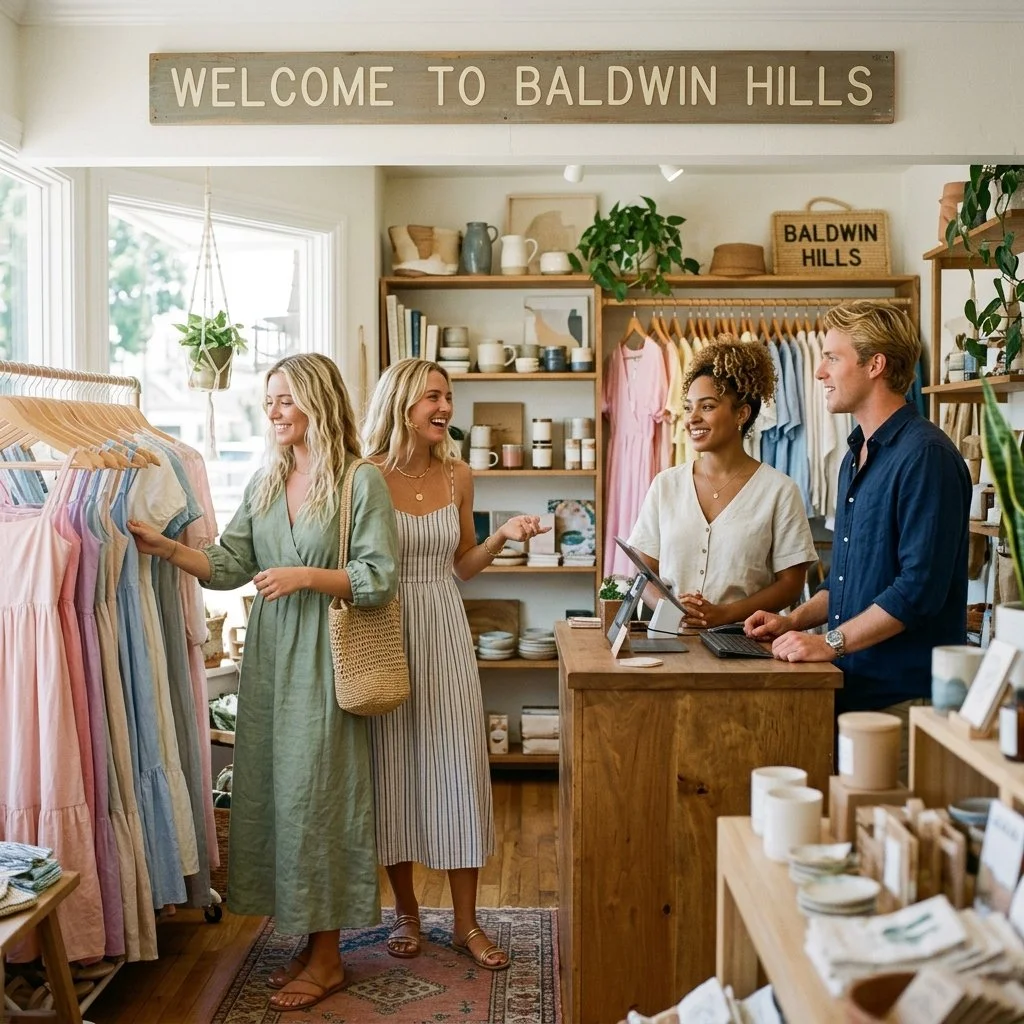
Captured by Mitchell Royel in the Fashion District, where everything felt a little golden, a little slow, and a little too good to leave behind. There was this soft kind of heat in the air, the kind that makes every glance feel loaded and every frame feel like a memory before the night is even over. And now playing, Hot & Sexy - Girls Trip by Zara Larsson and Tyla, because it fits the mood exactly—pretty, bold, effortless, and just the right amount of dangerous.
There are days when inspiration politely taps you on the shoulder, and there are days when it practically pulls you out the door.
This was one of the second kind.
I had been staring at fabric swatches for a new dress line for what felt like forever. Soft cottons, slippery silks, tiny floral prints, clean solids, buttons that were almost right but not quite. Everything was pretty, but nothing was saying anything. And if there’s one thing I’ve learned about designing dresses, it’s that “pretty” is only the beginning. A good dress should have a point of view. It should feel like somewhere you’ve been, someone you’ve met, or a version of yourself you’re just about ready to become.
So my girlfriend and I decided to leave our usual little world for the afternoon. We ventured out of my natural habitat with iced coffees, sunglasses, and a very open mind. Our destination was a dress shop in Baldwin Hills, partly because I had heard about it, and partly because the neighborhood had been lingering in my imagination after watching the show. There was something about the hills, the houses, the confidence, and the quiet glamour of it all that made me curious.
I wasn’t looking for anything too specific. Sometimes that is the best way to shop for inspiration. You go in without a checklist, and the day hands you exactly what you didn’t know you needed.
The dress shop was tucked into a sweet little stretch that felt lived-in and loved. Not overly polished. Not trying too hard. Just warm, colorful, and full of personality.
Inside, there were racks of dresses that immediately made me slow down. Cotton sundresses with easy movement. More structured pieces with sharp little waists. Prints that felt bright without being loud. A few pieces had that rare quality I always notice: they looked like they belonged to real women with real plans.
Brunch. A birthday dinner. A first date. A family party where you want to look effortless but secretly spent twenty minutes deciding on earrings.
Behind the register was a young woman in her twenties who looked like she had been styled by instinct. She had that calm, pretty confidence that doesn’t announce itself. Her hair was done, her makeup was soft, and she wore a dress from the shop in the most convincing way possible: like she wasn’t selling it, she was living in it.
A young man, also in his twenties, was moving around the store helping with things in that half-owner, half-boyfriend way. He adjusted a hanger, checked on a customer, answered a question, then drifted back toward the register to talk to her. There was a rhythm between them that made it feel like the shop was more than a business. It felt like a love story with inventory.
At one point, my girlfriend leaned in and whispered, “Do you think he bought it for her?”
I smiled because I had been wondering the same thing.
Maybe he bought it. Maybe he ran it for her. Maybe they built it together. Whatever the real answer was, there was something very sweet about watching two young people create a little world of their own and invite strangers into it.
We were holding two dresses each by then, pretending to be casual but very much invested, when the young man started talking about the neighborhood. He mentioned, almost in passing, that they lived in the three-story houses up the hill.
My girlfriend and I both paused.
Not dramatically. Not in a movie-scene way. More like two people who had just heard one sentence and suddenly had a million questions.
The three-story houses up the hill.
It was such a simple detail, but it opened a whole window in my mind. I wanted to ask about everything. What was it like growing up there? Did they always know they would stay? Did the shop come first or the house? Were they building something for themselves, for their families, for the neighborhood? Did people underestimate them? Did they enjoy proving people wrong, or was that exhausting?
Of course, I did not ask all of those questions, because curiosity still needs manners.
But I felt them.
There is a specific kind of pause that happens when you realize your assumptions have been walking a few steps ahead of you. You may not have invited them, but there they are, making themselves comfortable.
And that was the tiny lesson tucked inside the afternoon.
I have been thinking a lot about prejudice lately. Not in the loud, obvious way it usually gets discussed, but in the quiet way it can live underneath a thought before you even notice it.
Most people know how to control overt racism, or at least how to hide it. We know the right things to say in public. We know what sounds ugly. We know what crosses a line.
But prejudice is sneakier than that.
It can show up as surprise. It can sound like, “Oh, I didn’t expect that.” It can look like a pause after someone tells you where they live, what they own, who they love, or what they have built. It can sit quietly inside admiration, dressed up as curiosity.
That is the part that feels important to pay attention to.
Because if we are not careful, prejudice catches up to us in the small moments. Not always as cruelty. Sometimes as limitation. Sometimes as a story we wrote about someone before they had the chance to tell us the truth.
Standing in that dress shop, surrounded by pretty fabrics and afternoon light, I realized how easy it is to move through the world thinking you are open-minded while still carrying little folded-up assumptions in your pocket.
The goal is not to shame ourselves every time we notice one. The goal is to notice. To unfold it. To ask where it came from. To decide not to keep carrying it.
That afternoon reminded me that graciousness is not just how we speak to other people. It is also how honestly we examine ourselves.
I left the shop with two dresses I loved and one I probably did not need but absolutely could not leave behind.
One was soft and feminine, with a shape I kept thinking about for my own line. Another had a color combination I would not have chosen on a mood board, but in person it felt fresh and alive. The third had a neckline that made me rethink a sketch I had nearly abandoned earlier that week.
That is the beautiful thing about stepping outside your usual places. You stop designing from memory and start designing from experience.
I came home with notes in my phone, photos of details I wanted to remember, and that happy little feeling that comes after finding inspiration in an unexpected corner of the day. But more than that, I came home with a reminder that style is never just about clothes.
It is about who gets seen.
It is about who gets underestimated.
It is about the stories we tell ourselves before we know better, and the grace we give ourselves when we finally do.
My girlfriend and I talked about it on the drive home. The dresses. The couple. The houses up the hill. The way the shop felt like ambition and affection stitched together. We both agreed that the afternoon had given us much more than shopping bags.
It gave us a small but lasting shift in perspective.
And honestly, those are the best kinds of outings. The ones that begin with a search for fabric and end with a better understanding of people.
So yes, I found inspiration for the dress line. I found new shapes, new colors, and a new sense of ease I want to bring into the collection. But I also found a reminder to keep looking closer, listening longer, and letting the world surprise me without turning that surprise into a judgment.
We left with new dresses, lots of inspiration, and a subtle but profound lesson.
See you soon, Baldwin Hills.
—Ryder, Mitchell Royel