
COLD SWEAT - SHORT FILM
We're sitting here, lights low, drowning in the half-dark while We Said No Feelings by Zayven Solaire plays like a wound that never quite closes.
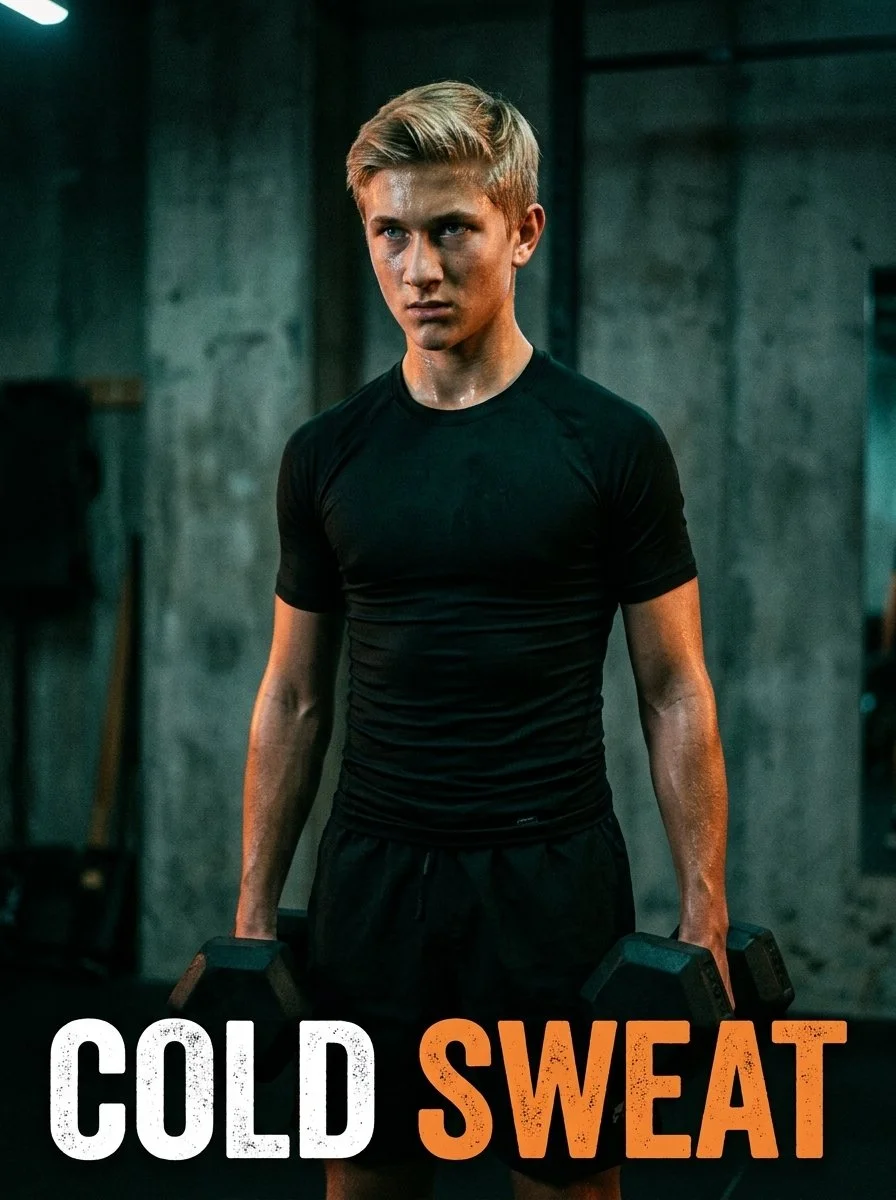
by Mitchell Royel: Tyler has it all figured out. He's a standout college athlete with a packed schedule, easy confidence, and a growing online connection to Emily, a witty girl who seems to understand him better than anyone.
That's the version of the story he'd tell you if you'd asked him three weeks ago. He'd have grinned that easy grin, the one that got him through morning practices and afternoon exams and every conversation he'd ever wanted to win. Back then, he believed the world bent toward him. That's the thing about people who've never been broken. They think they're unbreakable.
I know how that story ends now.
So does he.
The messages started in October, when the leaves were turning and the campus smelled like wet stone and coffee. Emily found him first — a comment on a photo, then a joke, then a conversation that spilled past midnight and kept going. She was quick. Quicker than him, and that surprised him, because Tyler wasn't used to being second in anything.
"You always this slow to respond?" she typed once, after he'd taken twenty minutes.
"Was at practice."
"Sure you were. Bet you were rehearsing something clever."
He was. He deleted three drafts before sending one. That was new too — caring what someone thought.
She never sent photos of where she lived. She talked about a campus nearby, a roommate she hated, a philosophy class that bored her. She asked questions that landed too close, like she'd studied him. He mistook that for connection. He was twenty years old and drunk on the feeling of being understood, and he didn't stop to wonder why the understanding only flowed one direction.
Their first real date was coffee. She was exactly as sharp in person, maybe sharper. Dark hair, a laugh that arrived a half-second before his jokes finished landing. She touched his arm when she made a point. She left him wanting the next time before the current one ended.
That's a skill, I understand now. Leaving someone hungry. It's the oldest trick there is.
By the third week he'd stopped noticing the gaps in what she told him. He noticed her instead — the way she leaned in, the way she seemed to already know his rhythms, when to push and when to pull back. He thought it was chemistry.
It was a map. She'd been drawing him.
"You should come to my studio," she said one afternoon, curled on a bench outside the library. The cold had teeth by then, and she wore a coat too thin for it, like she didn't feel it.
"What studio?"
"Hot yoga. Down on Fifth. It's my reset button." She tilted her head. "You're all locked up, you know that? Shoulders up by your ears. You need to sweat it out."
"I sweat plenty. I'm an athlete."
"Sweating for a coach isn't the same as sweating for yourself." She smiled. "Come Thursday. Trust me."
Trust me. Two words. He said yes before he'd finished thinking about it, because saying yes to Emily felt like winning, and Tyler was built to chase the win.
I want to reach back through time and grab him by the collar. I want to say: the ones who tell you to trust them are the ones counting on you to. But he wouldn't have listened. Nobody who has it all figured out ever does.
The studio sat between a shuttered bakery and a nail salon, glass front fogged from the inside. A neon sign hummed above the door — a single word, EMBER, in orange script. Inside, the heat hit him like a wall. Wet, thick, close. It got into his lungs on the first breath.
Emily was already there, waiting in the lounge, glowing like she belonged. And around her, loose against the walls, were the guys.
Four of them, maybe five. Early twenties. They wore workout clothes but no sweat, no flush, none of the exhausted looseness of people who'd actually moved. They lounged like they owned the place, drinks in hand, watching the door. Watching him.
One of them lifted his chin at Emily. She lifted hers back. A small thing. A signal Tyler's eyes slid right over.
"That's Cole," she said, following his gaze. "He kind of runs the social side of this place. Come on, class is starting."
He should have felt it. The wrongness was there, humming under the heat like the neon sign. The guys who never took the mats. The locked door at the back of the lounge. The way the woman at the front desk didn't smile, didn't check him in, just looked at him like a name on a list already crossed off.
But Tyler was watching Emily walk ahead of him, and the heat was making him dizzy, and he was twenty and certain, and certainty is the loudest sound in a young man's head. It drowns everything else out.
The class was brutal. Ninety minutes of poses in a room hot enough to bake bread. Halfway through, his vision swam. Emily flowed beside him, effortless, whispering you've got this in a voice that felt like a hand on his back. He pushed through because she was watching. He'd have walked into a fire for the same reason.
Turns out that's more or less what he did.
Afterward, he was hollowed out. Legs like wet rope, head ringing. Emily handed him a water bottle in the lounge.
"Drink," she said. "All of it."
He drank. It tasted faintly of nothing, of plastic and the ghost of something sweet. He drank it because she told him to, and by then telling him to do things was all it took.
The room went soft at the edges. The neon smeared into a long orange line. Cole was standing over him and Tyler couldn't remember him crossing the room. Emily was saying something, but the words came apart before they reached him.
The last clear thing he saw was her face. Not cruel. Not sorry. Just finished, the way you look at a task once it's done.
Then the floor came up to meet him, and the world went out like a snuffed candle.
He woke to concrete and the smell of bleach.
Cold — that was the first thing, the shocking cold after all that heat, like being dropped through ice. His wrists were bound behind him. His shirt was gone. The room had no windows, one bulb, a drain in the center of the floor. Somewhere water dripped, slow and patient, counting seconds he couldn't count himself.
Panic is a wave. It doesn't build. It arrives all at once and takes everything. His breath came in ragged tears. He pulled at his wrists until the plastic bit through skin. He screamed — for Emily, for anyone — and the sound bounced back at him off bare walls, mocking, alone.
The door opened.
They came in slow. Cole first, then the others, and they were smiling, and that smile was worse than any weapon. Because a weapon has a reason. That smile didn't. It was the smile of boys who had found a way to feel enormous, and had discovered that hurting someone was the cheapest way to get there.
"Look at him," Cole said. "Big athlete. Look at him now."
"Where's Emily," Tyler said. His voice cracked in half.
That made them laugh. Really laugh, doubled over, delighted.
"There's no Emily," one of them said. "There's never an Emily."
I've thought about that sentence more than any other. There's never an Emily. She was a costume the whole time. A face they put on a screen to pull boys like Tyler out of the light and into that room. He wasn't the first. He understood that later — the practiced boredom of it, the routine.
What came next I won't lay out piece by piece. Some things you survive by not describing them. But I'll tell you what mattered.
They didn't want anything. That was the horror of it. Tyler kept waiting for a demand, a purpose, a way to bargain — because his whole life had run on the logic of effort and reward, push and win. He kept trying to find the game so he could play it.
There was no game. They hurt him for the pleasure of watching him break. They filmed some of it, laughing, replaying it for each other like a highlight reel. Every time he begged, it fed them. Every time he went silent, they found a way to make him beg again. Time stopped meaning anything. Hours or days — he lost the shape of them. Hunger came and went. The bulb never turned off.
The confident kid who had it all figured out died somewhere in that room. What replaced him didn't have a name yet.
Maya noticed the small things because small things were all she'd ever been allowed.
She came to Ember three times a week, always the early class, always the mat in the far corner where nobody looked. She'd been coming for a year. Long enough to become furniture. Long enough that people stopped seeing her — which is exactly what she preferred, and exactly what let her see everything else.
She'd noticed the guys who never took class. She'd noticed how they clocked every new face that came through with Emily, and how those faces came in bright and never came back. She'd noticed the door behind the lounge, always locked, and the low sound that came from behind it one evening when the studio was supposed to be empty — a sound she told herself was the pipes, and knew was not.
She'd noticed Tyler. Watched him walk in behind Emily with his chest out and his guard down, a lamb who didn't know he'd been led. She'd wanted to warn him. She'd said nothing, because saying something meant being seen, and being seen was the one thing she'd spent her whole quiet life avoiding.
She didn't sleep that night. Or the next.
On the third night she came back after close. She'd taken a key months ago — copied it from the hook behind the desk on a slow afternoon, not for any reason, just because knowing you could open a door felt like power when you had none. She'd never used it.
She used it now.
The studio was dark and still ticking with residual heat. She moved through it on instinct, past the empty mats, into the lounge, to the door that was always locked. Her hand shook so hard she dropped the key twice. Behind the door, stairs. Below, that smell — bleach, and under it something animal and wrong.
She found him in the room with the single bulb.
He was barely conscious, wrists raw, curled around himself on the concrete. When the light from the doorway hit him he flinched like it was a blow. He didn't beg anymore. He'd learned that begging only invited more. He just made himself smaller, and the smallness of him — this big athlete folded down to nothing — was the thing that broke something in Maya that never fully healed.
"I'm not one of them," she whispered, dropping beside him, working at the plastic on his wrists with a key edge. "I'm getting you out. Can you walk?"
He looked at her like she might be another trick. Everything had been a trick. Why not this.
"Please," she said. "We have to go now."
Something in the word we reached him. He nodded.
Getting him up the stairs took everything they both had. He leaned on her, all his weight, his legs remembering how to work in fits and starts. Every creak froze them. Every shadow was Cole. They moved through the dark studio, past the mats where people would stretch tomorrow morning without knowing, out the front door into the shocking clean cold of the night.
He gulped the air like a drowning man breaking the surface. Then his knees went and Maya caught him, and the two of them sank to the sidewalk under the humming neon that spelled EMBER, and Tyler wept — great, silent, tearing sobs, the sound of a person putting himself back together with the wrong pieces.
"You're okay," Maya kept saying, though she knew he wasn't, would never be exactly. "You're out. You're out."
He wasn't out. Not really. You don't leave a room like that behind. You carry it.
The police station was too bright and too warm and smelled of burnt coffee. Tyler sat in a plastic chair with a blanket over his shoulders and told them everything. His voice was flat by then, wrung dry, and maybe that was the first mistake — because people expect a victim to shake, and Tyler had done all his shaking on the sidewalk. What was left looked, to the officer across the desk, a lot like calm.
"So you met this girl online," the officer said, not writing anything down.
"Yes."
"And you went with her. Voluntarily."
"To a yoga class. Yes."
"And you had something to drink there."
"They drugged me."
The officer's pen didn't move. "You said you drank it."
"Because she told me to. I didn't know—"
"Right." A long pause. The kind that says I've already decided. "Look. You were drinking. You went off with a girl you met on the internet. You're upset she wasn't who she said." He leaned back. "It happens more than you'd think. These online things go sideways. My advice? Be more careful who you meet."
"I was held in a basement," Tyler said. "For days. Look at my wrists. Look—"
"You've got some marks. Could be from a lot of things." The officer stood, the conversation over. "We'll file a report. But I gotta be honest with you, son. No witnesses, no clear ID, a story that starts with you getting drunk and going home with a stranger — there's not a lot here."
There was Maya. She was witness. She'd been in the room. But when Tyler turned, the chair beside him was empty. She'd slipped out sometime during the questioning — because being a witness meant being seen, meant her name in a file, meant being asked how she happened to have a key to a locked door. She'd saved him and then she'd vanished, and Tyler couldn't even blame her, because he understood now what it cost to be visible in a world that punished you for it.
They filed the report. Nothing came of it. No charges. No follow-up. A phone number he called that rang into a voicemail no one checked. The studio opened the next morning, and the morning after that, mats laid out, neon humming, Emily's face — or whoever's face it really was — smiling out from the screen to pull the next one in.
The system Tyler had trusted his whole life, the one that had always caught him, opened its hands and let him fall straight through.
And when he hit bottom, something down there was waiting for him. It had been waiting a long time.
Fury.
Fear had a shape you could survive.
Fury had a purpose.
The change came over him in the following weeks like a tide going out — everything soft draining away, leaving something hard and bare underneath. He stopped going to practice. Stopped answering his teammates, his coach, the friends who circled with concern they didn't know how to spend. He stopped being the boy who had it all figured out, because that boy had been a fool, and fools got dropped into basements.
He got quiet instead. Watchful. He started to notice things the way Maya noticed them — the angles, the patterns, the gaps where a system was weakest. He'd spent his life inside the lines. Now he could see the lines for what they were: suggestions, drawn by people, and people could be beaten.
He started with the studio's paper.
Ember was a business, and businesses leave trails. Filings, licenses, a registered owner whose name appeared on nothing else, a corporate shell with a rented address. He sat up till dawn with a laptop and a legal pad, teaching himself the language of ownership and money, and the more he read, the more the picture bent. The studio barely made money on classes. The classes weren't the point. The money moved in strange amounts through accounts that didn't match the size of a little storefront between a bakery and a nail salon.
The hazing wasn't the whole thing. The hazing was a symptom. Something bigger sat behind that locked door, and the boys with the empty smiles were a small violent part of it, given a room and a supply of victims and told to entertain themselves.
I want to say Tyler wanted justice. In the beginning maybe he did. Justice and revenge sit close together, close enough that from the inside you can't always tell which one you're holding. But justice waits. Justice asks. Revenge doesn't have the patience.
Tyler stopped waiting.
He found Maya again, or she found him — he was never sure which. She was at a diner near campus, alone in a corner booth, and when he sat down across from her she didn't look surprised. She'd been keeping half an eye out, he'd learn. Watching him the way she watched everything, from a distance, waiting to see which way he'd break.
"You disappeared," he said.
"I had to." She wrapped both hands around a coffee mug. "You know why."
He did. "They didn't do anything. The police. They said I was drunk. They said I made a bad choice."
Something flickered across her face — not surprise, just confirmation of a thing she'd already known. "They never do anything," she said quietly. "That's why they can keep doing it. Nobody makes them stop."
"I'm going to make them stop."
She looked at him for a long moment. Really looked, the way she looked at the little things nobody else saw. And whatever she found in his face made her set the mug down.
"How," she said. Not a question. A test.
He told her. The filings, the money, the shell company, the plan taking shape. A journalist he'd found who covered corruption for the local paper, hungry for something bigger. Documents he could get if he got close enough. A case — the case the police refused to build — assembled from the outside, brick by brick, until it was too big to ignore.
Maya listened. And a small worry started up behind her eyes, and it never left again.
"That's careful," she said when he finished. "That's smart. Journalist, paper trail, let the light do the work." A pause. "So why do you look like you want to burn the place down?"
He didn't answer. Because the honest answer was: because I do.
The first leak was clean. Almost noble.
He got the financial documents to the journalist — a tired woman named Reyes who'd been chasing the same shell companies for a year without knowing what sat at the center. Tyler handed her the center. She ran a story: a small yoga studio moving money it had no business moving, questions the owner wouldn't answer, a reporter's calls unreturned.
It landed. Not huge, but real. A city councilman asked a question at a meeting. An inspector showed up at Ember and left with a notebook. For one clean week, Tyler felt the thing he'd been starving for — the sense that a door was finally opening, that the world could still be made to answer.
Then Ember hired a lawyer, issued a statement, and closed ranks. And the door swung shut again.
That was the fork. Right there. He could have kept pushing the slow legal way, kept feeding Reyes, let the pressure build over months. That was the survivor's path. Patient. Steady. Alive.
He didn't take it.
Because slow wasn't enough anymore. Slow let them keep the lights on. Slow meant the screen still glowed, still smiled, still pulled boys into that room while lawyers filed motions. Every day the studio breathed was a day it could take another Tyler, and Tyler couldn't stand inside that math. It ate him.
So his methods got darker.
He staked out the studio at night, learned its rhythms the way it had learned his. He knew when the last class emptied, when the desk girl left, when Cole's crew rolled in through the back with their drinks and their empty smiles. He photographed license plates. He followed cars. He built a file of faces and names, a ledger of the people who'd hurt him and the people who paid them.
He got into their online lives. It wasn't hard — they were arrogant, careless, boys who'd never been caught because they'd never had to be careful. He found the video they'd made of him, sitting in a shared folder like a trophy. He found others. Other boys, other basements, other faces gone from bright to broken. His hands shook so hard he couldn't type. Then they stopped shaking, and that was worse.
He copied everything. He should have taken it straight to Reyes. To the state police, above the local ones who'd failed him. That was the clean move, the one that would have burned Ember to ash within the law.
Instead he sat with the files for three days, and something turned in him.
He started using them.
He sent Cole a single frame from Cole's own trophy folder — Cole's face, mid-laugh, standing over a boy on a concrete floor. No message. Just the image. I see you. I have all of it. I'm coming.
Terror, it turns out, works both ways.
He watched from across the street as Cole's careless swagger curdled into something jumpy. He watched the crew stop lounging in the lounge, start checking over their shoulders, start turning on each other. He fed the fear a piece at a time — an image, a name, a screenshot of an account they thought was private. He'd learned in that basement exactly how to break a person down slow, keep them off balance, never let them find the ground. He'd learned from the best. And now he taught it back.
It felt, for a while, like justice.
It wasn't. Justice doesn't smile at another person's fear. But Tyler smiled now, alone in his car, watching Cole flinch at shadows, and if you'd shown him that smile a month before it would have frightened him. He didn't recognize it. He'd become someone he wouldn't have wanted to meet.
Maya saw it happen.
She stayed close, though she told herself she shouldn't. She met him in diners and parking lots and heard the plan get sharper and colder each time. At first she'd rooted for it — some deep bruised part of her loved seeing the ones who'd hurt him squirm. She'd spent her whole life unseen and unable to fight back, and here was a person fighting back with everything, refusing to be small, refusing to disappear the way she always had.
But the light in his eyes when he described their fear started to look like the wrong light. It looked like Cole's, in that room. The pleasure of watching someone break.
"You have the files," she said one night. They were in his car outside Ember, the neon painting them both orange. "You have the videos. There are other victims on there. Give it to Reyes. Give it to the state. It's enough now, Tyler. It's more than enough. You could end them tomorrow."
"Tomorrow's not enough." His eyes didn't leave the studio. "I want them to feel it first. I want them to know what it's like to lie awake wondering when it's coming. The way I do. Every single night."
"That won't fix your nights."
"No." He almost smiled. "But it'll ruin theirs."
She was quiet a long time. Watching him watch the door. And the worry that had started in the diner grew until it filled the whole car.
"When you were in there," she said carefully, "what scared you most? Was it the pain?"
He thought about it. "No."
"What, then?"
"That they were enjoying it. That hurting me made them feel like more." He said it flat, staring straight ahead. "That's what I couldn't stand. That my pain was making somebody bigger."
Maya turned to him then, and her voice was gentle and terrible.
"Then look in the mirror, Tyler."
He didn't answer. His jaw worked. His hands tightened on the wheel. And for one second — just one — she saw the boy who'd wept on the sidewalk, the one who'd let her save him, flicker up behind the hard new mask. Then it sank back down under all that fury, and she wasn't sure it would ever come up for air again.
The end, when it came, came fast — the way everything with Tyler came fast now.
He'd made a plan that crossed the last line. He was going to break into Ember, the same way Maya had broken in for him, and plant the evidence in a way that couldn't be argued away — force the inspection, force the story, but do it by trespass and threat, do it with his own hands in the dark. He'd tipped Cole that he was coming. He wanted Cole there. He wanted, some part of him, the confrontation. Wanted to stand over one of them the way they'd stood over him and see who felt bigger then.
That's the part that scared Maya most. Not the plan. The want.
She got there first.
She used her key one more time, moved through the dark studio, and waited in the lounge with the file — the real file, the clean copy, the one that could end them the right way — held against her chest. When Tyler came through the front door at 2 a.m., all hard angles and purpose, she was sitting in the dark.
He froze. "What are you doing here."
"Stopping you."
"Get out of the way, Maya."
"Cole's not coming." She stood. "I sent it. All of it. To Reyes, to the state police, to three papers, an hour ago. The videos. The other boys. The money. Everything. By morning it's everywhere and it can't be buried and every one of them is finished." Her voice shook but she didn't stop. "It's done. You won. The right way. You don't have to do this."
For a long moment he just stared at her, and she couldn't read which way he'd break.
"That was mine," he said finally, and his voice cracked — the first crack in weeks. "That was mine to do."
"I know." She stepped closer, into the orange light from the window. "And I took it from you. Because the version of you that walks in here tonight with your own hands — I couldn't save that one. I could only save this one." She held his gaze. "You spent all this time proving you're nothing like them. Don't undo it in the last five minutes."
The silence stretched. Outside, the neon hummed. EMBER, EMBER, EMBER.
Then Tyler's shoulders dropped. All of it — the plan, the fury, the terrible momentum — went out of him at once, and he sank to the floor of the lounge where he'd once handed his trust to a girl who never existed, and he put his face in his ruined hands.
Maya sat down beside him. She didn't touch him. She just stayed, the way she'd stayed on the sidewalk, being the one person in his life who kept choosing to be seen for his sake.
"I don't know who I am anymore," he said into his hands.
"You're the guy who stopped," she said. "That's who. Right now. That's enough for tonight."
The story broke that morning, and it broke wide.
Ember closed within the day, its doors chained, its neon dark for good. The boys with the empty smiles were arrested one by one over the following weeks, the videos too damning to explain away, the pattern too clear to bury. Cole ran and got caught at an airport. The shell company unraveled, and the something-bigger behind the locked door turned out to be exactly as ugly as Tyler had guessed — a network that had used that studio as a mouth to feed itself for years. Reyes won an award. Other victims came forward once they saw they weren't alone. The system that had failed Tyler moved, finally, but only because two people it had failed forced its hand.
The police who'd sent him home never apologized. That kind never does.
Emily — whoever she'd been — was never found. Just a face, deleted from a screen, gone the way she'd always been going. Some nights that's the thing that haunts him most. That someone can be that close to you, learn your every rhythm, hold your whole trusting heart in their hand — and be no one at all.
Tyler didn't go back to being the boy who had it all figured out. That boy was gone, and he stopped mourning him. What grew in his place was quieter, warier, harder — but not cruel. Not in the end. He'd walked all the way up to the edge of becoming what they were, close enough to feel the pull of it, and he'd been dragged back by the one person who understood that surviving isn't the same as staying yourself.
He and Maya don't talk about that night much. But sometimes, when the dark gets loud, he calls her, and she picks up, and they don't even need to say anything. Two people who learned the same hard truth: that the world won't always catch you when you fall.
Sometimes the only thing between you and the bottom is someone who refuses to look away.
He'd been that person once, before the basement. He's learning how to be that person again.
It's slow. But he's done running from slow.
Some nights, that's enough.