
BLURRED STATIC - SHORT FILM
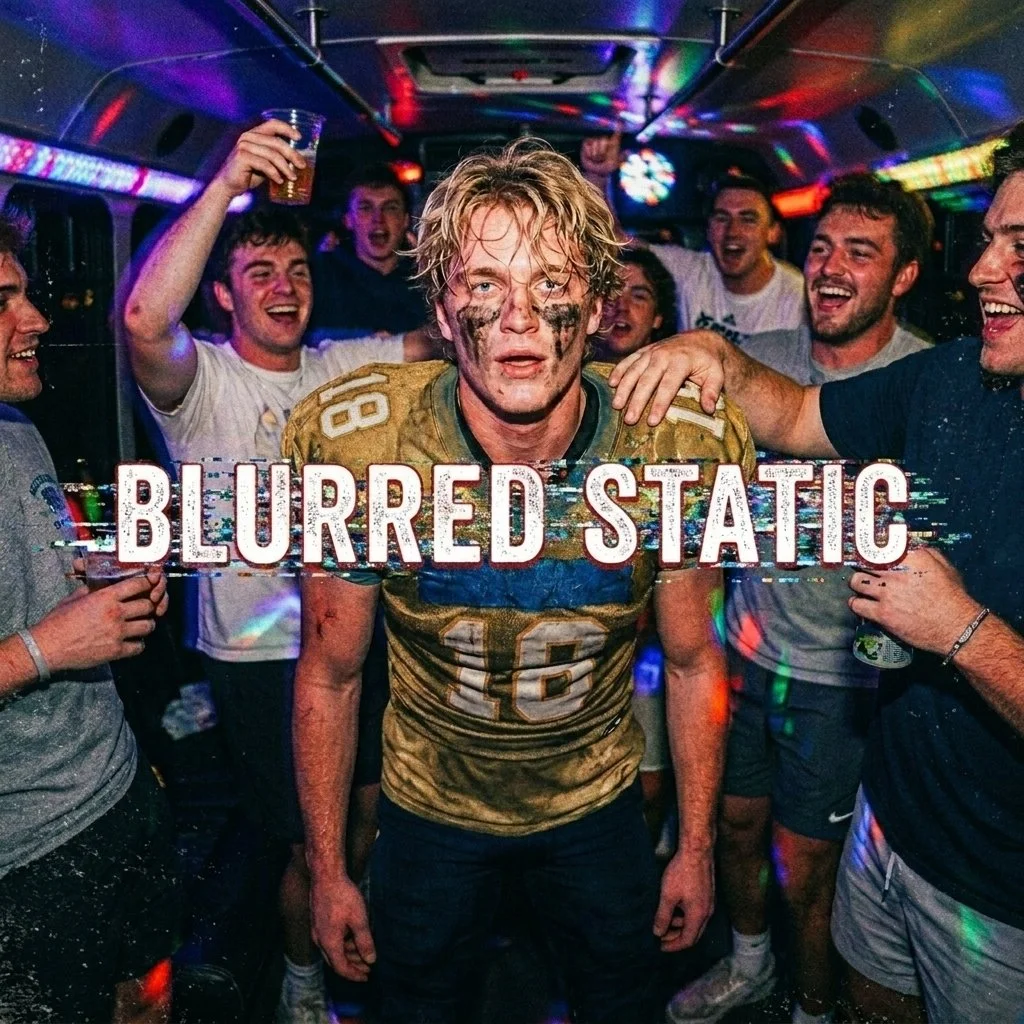
This one isn’t a story about anyone named Chris, but it could be.
It’s a slammed door,
An echo that lingers.
Words caught in a throat,
Sharp as splinters.
It’s the heavy air,
Thick with regret.
A memory clawing,
A night you can’t forget.
Garrett’s lost in his head,
A maze of should-have-said.
Weston stares through the cracks,
Big Travis carries what Garrett lacks.
It’s messy, raw, and real,
The kind of wound time doesn’t heal.
It just lingers, faint yet vast—
A scar that whispers,
Of a wild, untamed past.
by Mitchell Royel, now playing Back to You by Billi Royce
“Blurred Static” follows Garrett, a high school football player from the working-class town of Cedar Falls, Oregon, as his seemingly solid life unravels. The story begins with the camaraderie of his team, celebratory chaos masking underlying fractures. Garrett is dating Laurel, his long-time girlfriend, and balancing the pressures of being a star athlete. Everything changes when Bryce, a mysterious and manipulative student from the elite Wakefield Academy, quietly enters Garrett’s life. Bryce, with his calculated presence, plants doubt and introduces chaos, targeting Garrett's relationship with Laurel.
What starts as subtle interference escalates into betrayal, as Garrett learns Laurel has been hiding interactions with Bryce. The revelation throws Garrett off his game—literally. His internal torment impacts his performance, culminating in a critical playoff loss. Struggling with heartbreak and the weight of betrayal, Garrett becomes haunted by Laurel's actions and Bryce's influence. Yet, despite the hurt, Garrett wrestles with the pull of his lingering feelings for Laurel and the ambiguous closure Bryce leaves behind.
Against the backdrop of rainy Oregon, the story explores the complexities of love, loyalty, and identity in the face of manipulation. From Garrett's shattered trust to Laurel’s remorse and unresolved connection with Bryce, the narrative stays raw and deeply human. Even as Garrett and Laurel attempt reconciliation, seeds of doubt remain, showing how fractures in relationships—and within oneself—can linger like static, unresolved and echoing. The story is one of unfinished healing, a tenuous balance between warmth and wounds, and the quiet forces that both build and break us.
Prologue: The Bus
The party bus smelled like pine air freshener and spilled beer and the kind of desperation that passes for celebration when nobody wants to talk about what actually happened.
Garrett sat in the middle of it all — number sixteen, still in his game jersey, eye-black smeared down his face like war paint from a war he'd already lost. The lights inside the bus were red and purple, cheap disco colors, and his teammates were loud around him, cups raised, somebody's playlist thumping through the speakers. Cole had his arm around Garrett's shoulders. Big Travis was standing in the aisle doing some kind of dance that had no name. Weston was pouring something into plastic cups and handing them out like communion.
This was the bro night. All-expenses-paid, Coach's credit card behind the whole thing, because Laurel had cheated on Garrett and the team had found out, and this was what they knew how to do. They couldn't fix it. They couldn't make it make sense. But they could rent a bus and turn the music up loud enough that Garrett couldn't hear himself think.
He appreciated it. He did. But the music couldn't reach where the hurt was. Nothing that loud ever could.
He looked out the rain-streaked window at the passing dark — the valley, the pines, the hill rising up to his right with its single cluster of lights burning behind iron gates and Douglas firs. Wakefield Academy. The rich school. He thought, not for the first time, about Bryce. About how a kid from up there had drifted down into his life like smoke under a door, so slowly you didn't notice until the room was already full of it.
Cole leaned in close. "You good?"
"I'm good," Garrett said. He drank. The music swelled. Out the window, the lights of Wakefield held steady against the dark, patient and cold, like they'd been there a thousand years and would be there a thousand more.
He turned away from the window. He smiled when someone looked at him. He played the part of a boy being rescued.
But the phone in his pocket was warm, and he'd read her last text so many times the words had burned into the back of his eyes, and he was already, somewhere deep where nobody could see, deciding to go back.
That's where this story ends. Let's start at the beginning.
Chapter One: The Hill
In Cedar Falls, Oregon, you always knew where you stood by which side of the hill you lived on.
The town sat in a valley that filled with mist most mornings, the kind that hung low in the pines and didn't burn off until almost noon. Down here, where the air smelled like wet bark and diesel, were the public school kids. Cedar Falls High. Friday night lights. Letterman jackets going gray at the cuffs. Garrett was one of them.
Up the hill, behind a wrought-iron gate and a stand of old-growth Douglas firs, sat Wakefield Academy. The rich kids went there. They wore navy blazers and drove cars that never seemed to get muddy, and they looked at the valley below them the way you look at a map of somewhere you've already been — familiar, and a little beneath notice.
Garrett never thought much about the hill. He had no reason to. His world was full and small and exactly the right size: the locker room that smelled like sweat and menthol rub, the gravel lot behind the stadium where everyone gathered after practice, the low sound of the Calapooia River on the far side of the tree line. And Laurel.
Laurel had been his girlfriend since sophomore year. Now they were both seventeen, juniors, and she fit into his life the way the river fit into the valley — like she'd always been there and always would be.
He was the starting wide receiver. Number sixteen. On Friday nights, when the stadium lights blazed on against the black Oregon sky, the whole town seemed to pour into the bleachers, and Garrett felt, for those three hours, like the most important person alive. The crowd chanted his name. His teammates hammered their helmets against his. And somewhere up in the stands, Laurel watched, her breath fogging in the cold, her face easy and proud.
That was the year everything was good. He didn't know yet that good things have a sound when they break. He didn't know that the sound is very quiet, and that you only hear it after.
It started with a kid on a skateboard.
Garrett first saw Bryce on a Tuesday in October, outside the Gas-N-Go on Route 9. He'd stopped after practice for a Gatorade. The fluorescent lights inside buzzed their usual buzz, and the rain was coming down in that soft, directionless way it did in autumn — more like a rumor of rain than an actual storm.
There was a kid sitting on the curb under the awning. Older-looking, maybe eighteen, with dark hair pushed back off his forehead and a skateboard resting across his knee. He wore a Wakefield hoodie, the heather-gray one with the small embroidered school crest. A private school kid, down off the hill.
The kid looked up when Garrett walked past. He didn't say anything right away. He just watched, with a small, unhurried smile, like he already knew something Garrett didn't.
"Cold out," the kid said.
"Yeah," Garrett said, because what else do you say.
"You play for Cedar?" He nodded at Garrett's letterman jacket.
"Yeah."
"Cool." The kid stood, kicked his board up into his hand with practiced ease. "I'm Bryce."
"Garrett."
"I know," Bryce said.
And he rolled off into the rain. That was the whole conversation. Garrett bought his Gatorade, drove home with the wipers going and the radio low, and didn't think about the kid from up the hill again. He had no reason to. He didn't notice that something had just walked into his life and sat down and made itself comfortable.
Chapter Two: Static
The thing about sabotage — the real kind, the slow kind — is that it doesn't look like anything when it's happening. It looks like ordinary days.
Bryce started appearing at the edges. Garrett would notice him in the small places, the half-seen periphery of his days: leaning against the wall outside the diner on Fifth, sitting on the low concrete barrier in the gravel lot near the stadium, rolling lazy circles in the empty church parking lot two blocks from school. He never came close. He never pushed his way in. He was just there, and then there again, and after a while his presence became so routine it stopped registering as strange.
They'd nod to each other. Bryce would lift two fingers. Garrett would lift his chin. That was all.
But Laurel started getting quiet.
It happened so slowly Garrett couldn't fix a date to when it started. She still came to his games. She still kissed him in the hallway by the trophy case, a quick warm press that used to feel automatic and now felt careful. But there were gaps now, small silences where there used to be easy talk, and sometimes when she was looking at her phone her face would do something he'd never seen before — soften and then close up, like a door swinging open and then quickly, quietly pulled shut.
"Who's that?" he asked once, in his truck outside her house. The rain ticked on the roof. The engine was still running.
"Just my friends," she said, and slipped the phone into her bag, and smiled at him with a smile that was real, mostly, the way a cover song is real. It sounds like the thing. It just isn't.
He believed her. Why wouldn't he? When you've stood on solid ground your whole life, you don't spend time worrying about what's underneath it.
At practice that week, Coach Merritt rode him hard.
"You're a half-step slow, sixteen!" His voice cut across the wet field like the rain didn't exist. "Where's your head at?"
Garrett didn't have an answer that made sense. His head was on the route, on the ball, on the cold. But underneath everything there was a low-frequency hum now, a kind of interference, like a radio caught between stations. He couldn't tune it out. He couldn't tune it in.
He dropped a pass he could've caught in his sleep. The ball hit the grass and slid, and his teammates groaned, and Garrett stood there in the rain with his hands open and useless and the sensation of being a stranger inside his own body.
In the gravel lot after, Cole found him. Cole was the quarterback, Garrett's best friend since they were eight years old throwing spirals over the chain-link fence behind the elementary school.
"Hey. You good?"
"Yeah."
"You sure? Because you're not. You've been off for a week."
Garrett looked past the lot, past the fence, to where the hill rose dark and wet against the sky. One light burned up there in the Wakefield buildings, gold behind the firs, the only warm thing in a gray world.
"I'm fine," Garrett said.
Cole looked where he was looking and saw nothing. There was nothing to see. That was always the trick of it.
Chapter Three: Friday Lights
Friday nights in Cedar Falls in late October were their own kind of religion.
The lights came on while it was still technically light out — pale and unnecessary at first, and then the sky went purple, then black, and suddenly the lights were everything: a blazing white island floating in the dark, ringed by pines dripping rain, with the breath of two hundred people rising in the cold like incense smoke. The marching band. The smell of popcorn. The low electric thrum of three hundred conversations going at once.
Garrett loved it. It was the one place the hum in his head went quiet. Out there, under the lights, everything simplified down to what it had always been: the snap, the cut, the ball turning over in the black sky, the reach and catch. Simple. Clean. His.
He caught two touchdowns against Mill Creek that night. The crowd came apart. His teammates buried him under a laughing pile, and he came up with his helmet sideways and his chest full of something close to joy, and he looked for Laurel in the stands.
She was there. She was clapping.
But she was looking at her phone.
Just for a second. Just a half-glance, the bright rectangle lighting up her face from below. He almost missed it. He almost let himself miss it. But the hum crept back in under the lights for the first time ever, low and steady, and he carried it off the field.
After the game, everyone went to the Gas-N-Go. That was the ritual: twenty kids in letterman jackets taking over the parking lot, gas station nachos, fogged-up truck windows, the particular freedom of a won Friday night spreading out in all directions.
Bryce was across the road.
He was on the curb in front of the closed laundromat, his board beside him, a hood up against the fine mist that had started. He wasn't just watching the celebration — he was studying it. There's a difference: a watching-from-inside versus a watching-from-outside. Bryce was outside, the way he was always outside, and yet there was something in his posture that made it seem like he owned the distance.
Their eyes met across the road. Bryce lifted two fingers. Garrett, after a beat, lifted his chin.
Then he found Laurel. She was standing apart from the group, by the ice machine, thumb moving on her phone, face doing that soft-closed thing.
He walked over. She locked the screen before he reached her.
"Two touchdowns," he said.
"I saw." She smiled. "You were amazing."
"Were you watching? Or were those two touchdowns you heard about?"
Something moved through her face, quick as weather. "Of course I was watching."
He wanted to believe her. He almost got there. He put his arm around her and she leaned in, and across the road Bryce stood slowly, kicked his board up, and rolled off into the dark without a sound. Garrett didn't see him go.
Chapter Four: The Distance
November settled into the valley like a lid coming down.
The autumn rain gave way to the real rain — the weeks-long, river-rising, mud-making Oregon rain that doesn't apologize for itself. The pines dripped constantly. The hill disappeared into low cloud for days at a stretch, Wakefield gone like it had simply opted out of the world.
Laurel went further away.
There was nothing to point at. She said the right things. She held his hand in the hallway. But Garrett had spent two years learning her the way you learn a house you've lived in long enough to navigate in the dark, and the house had changed. There was a cool draft coming from somewhere, a drop in temperature he couldn't locate.
"Lake Saturday?" he asked at lunch.
"I can't. Helping my mom."
"Sunday."
"Maybe." She was looking past him, out the cafeteria window, up toward the hill. "Maybe Sunday."
He turned and looked. Cloud. Just cloud.
That night he couldn't sleep. He drove at two in the morning, no destination, wipers going, heater roaring. Past the dark stadium. Past the school. Out Route 9 and back again.
On his way home, going slow past the road that switchbacked up to Wakefield, he saw a car idling at the bottom. No headlights. Clean body, not a valley car. Through the rain on his window he could see two shapes inside, close together, one behind the wheel.
He told himself it was nothing.
He drove home with his hands white on the wheel and the hum loud as a freeway, and the shape of those two figures sat behind his eyes until morning.
Chapter Five: Gas-N-Go
Garrett started going to the Gas-N-Go more. He told himself it was for the Gatorade.
It wasn't. He went because Bryce was always there, and Bryce had become a strange fixed point in a world that had lost its footing. Bryce didn't go to his school. Bryce didn't play football. Bryce had nothing to do with any of it, with the hum, with Laurel, with the cool draft blowing through Garrett's life. Bryce was just a guy on a skateboard from up the hill who said hey and didn't seem to want anything.
That's what Garrett thought, anyway.
"Big game Friday," Bryce said one evening. Rain pooling in the lot. Hood up, board across his knees.
"Playoffs."
"You nervous?"
"No." And then, after a second: "A little."
Bryce nodded like this was the wisest thing he'd ever heard. "Everybody's depending on you."
"I guess."
"That's a lot to carry." He pulled a pack of gum from his pocket, offered it. Garrett took a piece. "Carrying everybody. Doesn't anybody ever ask if you're tired?"
Nobody ever had. Not Coach, not his dad, not Cole. They all just wanted him to win. And here was this kid he barely knew, this clean-shoe kid from the school up the hill, saying the one thing nobody had ever thought to say.
"You ever just want to drop all of it?" Bryce asked, soft as the rain. "Just set it down for a minute?"
"No," Garrett said. The word came out slower than he meant it to.
Bryce smiled like he heard the slowness more than the word. "Yeah," he said. "Me neither."
He stood, kicked the board up, and rolled off into the dark.
Here is what Garrett never knew:
The texts Laurel kept hiding came from a number saved under a girl's name. The car at the bottom of the Wakefield road had been Bryce's — his father's car, clean and expensive and never muddy. When Bryce said you ever just want to drop it, he wasn't making conversation. He was placing something, precise and patient, into the soft ground of a boy already starting to give.
Bryce never showed his hand. He never raised his voice or sent anything in his own name or left a single thing you could hold up as evidence. He just appeared, with the right words at the right time, working a thin wedge into a crack that already existed. He was the draft. He was the cool spot. The static in Garrett's head had a source, and the source was Bryce, and Garrett would have laughed at you for saying so. That's what made it work.
Some people pull others toward them without ever appearing to reach. It's a gift of a kind. The worst kind.
Chapter Six: Playoff
The playoff game was the biggest night Cedar Falls had seen in three years.
Cars parked in the mud all the way to the road. The bleachers groaned. The marching band played in the rain and didn't stop. Steam rose off the players and the lights turned it gold, and you could feel the whole town leaning forward on its collective breath.
Garrett couldn't catch anything.
First quarter: a simple slant, ball right in his hands, falls through. Second quarter: deep route, open by five yards, ball sails through his fingers. Between plays, Cole jogged over.
"Hey. Look at me. You're fine. Shake it off."
He couldn't shake it off. The static was a full roar now. Every time he got to the line he heard Bryce's voice — you ever just want to drop it — and his hands felt borrowed. He scanned the stands between plays, couldn't find Laurel, found her in the third quarter, and she had her phone out. In the playoff game. The biggest night of his life.
On the very next play, Garrett ran the route, turned, took the ball square in the chest, and dropped it. Mill Creek picked it off the bounce and ran it back sixty yards for a touchdown, and the visiting stands went up like a fire, and Garrett stood at the thirty-yard line in the rain with the sound of his own name dying in the Cedar Falls bleachers.
They lost. The season ended. The last ball Garrett touched in pads that year was the one he dropped.
In the gravel lot after, no one knew what to say. He sat on his tailgate in his uniform, eye-black running down his face in the rain, a turf scrape on his forearm bleeding through the jersey. Cole sat with him until his mom called. Then he was alone.
Laurel came over. Arms crossed against the cold.
"It's just a game," she said. She meant it kindly. That was the worst part.
It's just a game. Two years together and she still thought it was a game.
"You weren't watching," he said.
"I was—"
"In the third. You had your phone out. I saw you."
Guilt crossed her face, quick and bright, gone before it had fully arrived. "Garrett, I was just—"
"Who is it?"
"Who is what?"
"Who's on your phone. Every game. Every night. Who is it?"
"It's nobody," she said. "You're being insane." But her voice shook on the last word, just slightly, and they both heard it, and they both chose not to say so.
She drove home with her mother. Garrett sat on the tailgate until the lights clicked off row by row and the lot was black and empty around him, and up on the hill behind the trees, a single gold light burned in a Wakefield window, and then it too went dark.
Chapter Seven: What the Rain Knew
Without football, the days went shapeless.
Garrett moved through them like a sleepwalker: school, home, dark room, rain on the roof. The static never left. It had taken up residence. He lay in bed and listened to it hum under his mother's voice, under the gray light that came through his window, under the long silences that had grown between him and Laurel until the silence was the whole conversation.
They were ending. He could feel it the way you feel a cold front coming — the pressure change, the ache in the joints. He just didn't know how. He didn't know who.
The who came on a Thursday at the Gas-N-Go.
He'd stopped pretending it was for the Gatorade. He came because Bryce was there, and Bryce didn't look at him like a broken thing, and sometimes that's the only thing you need — one person who doesn't see you as what you used to be.
Except this Thursday, Bryce wasn't alone.
Garrett saw the car first — the clean one, the no-mud one from the bottom of the Wakefield road. It sat at the far pump. And leaning against the passenger door, head tipped back in a laugh, her hair dark and wet with rain, was Laurel.
She hadn't seen him. Neither had Bryce. Garrett stood half-hidden by his truck and watched. He watched Bryce say something and Laurel's laugh break open, the real laugh, the back-of-the-throat one she hadn't given Garrett in weeks. He watched Bryce reach out and slow-drag a strand of wet hair away from her face, easy and unhurried, like a thing practiced.
He knew it was practiced.
Standing there in the rain, he understood everything all at once, the way you finish reading a sentence and suddenly understand the one before it too. The phone. The locked screen. The car in the dark. The cool draft, the static, the planted questions on the Gas-N-Go curb. It all resolved into a single clear image: Bryce, from up the hill, who had sat with Garrett on that same curb talking about how tired he must be. Who had never once seemed to want anything. Who had wanted everything.
Garrett got in his truck. He didn't yell. He didn't go over. He just drove, and the worst thing was that he wasn't even angry — not the way anger comes fast and hot. He just felt the static finally resolve into a single sustained note, high and thin, the sound of something completely understood.
That's how the quiet ones work. They never leave anything with their name on it. Just a cold space where a warm thing used to be, and no proof, and no one to hold responsible, and the feeling that you walked into it yourself.
Chapter Eight: The Breaking
They broke up in his truck, in the gravel lot behind the stadium, in the rain, the same truck and the same lot and the same rain it had always been.
He didn't tell her what he'd seen. The words — Bryce, the Gas-N-Go, his hand in your hair — sat in his chest like stones he couldn't lift. So he just said: "I think we need to stop."
She started crying immediately, which told him everything he'd needed to know. Someone with nothing to hide argues. Someone with nothing to hide gets confused. She just put her face in her hands, and the crying was a confession, and they both understood that.
"I'm so sorry," she said. "Garrett, it just — it wasn't — I don't—"
"Don't," he said. "Don't tell me how."
They sat in the fogged-up truck for a long time, not touching, while the rain came down. Two people who had loved each other, inside a wreckage that still smelled like what it used to be. When she finally got out, the cold came in through the open door, and he watched her run through the rain to her car, and he didn't go after her, and the not-going-after felt like tearing something out by the root.
He drove home. His mother asked. He said fine. He went to his room and lay in the dark and cried until he couldn't breathe, and he hadn't done that since he was a little kid, and the fact that he still knew how felt like the saddest thing in the world.
Bryce disappeared.
Not from Wakefield — he was still up there behind his iron gate, in his blazer, in his other life. But he disappeared from the edges of Garrett's world. The curb at the Gas-N-Go stayed empty. The church lot stayed empty. No gray hoodie, no easy wave, no two-finger salute. He'd done what he came down the hill to do, and now he was gone, and there was nothing with his name on it. Just the cold he'd left behind, and the shape of a life with something missing from the middle.
Garrett understood, in the months that followed, that Bryce had never wanted Laurel, not really. He'd wanted the act of taking. He'd wanted to be the draft moving through a warm house, just to feel the heat go cold. And once the house emptied, there was nothing left to cool, and so he left, and that was the whole of it.
Chapter Nine: Winter
The winter was the longest of Garrett's life.
The valley sealed up under cloud and didn't reopen for weeks. The Calapooia ran brown and high. Garrett went to school and came home and moved through the gray hours like a man doing a job he'd stopped believing in.
He missed Laurel the way you miss a limb — not a grand, cinematic ache but a constant, stupid, physical absence. He'd reach for his phone to text her and catch himself. He'd see her in the hall and they'd both look away, and the looking-away was its own small daily grief.
He tried to hate her. He couldn't get there. That was the thing nobody warned you about betrayal — that it doesn't kill the love, just wounds it, and a wounded thing makes so much more noise than a dead one. He'd lie awake remembering the good parts, which were most of the parts: the lake in August, her laugh on long drives, the way she tucked her feet under her on the couch. The cheating sat in the center of all of it like a stone in a field. The field was still beautiful. The stone was still there. And he walked the field over and over anyway, at two in the morning, with nowhere else to go.
In February, the rain went thin and almost-snow. Garrett started driving at night again. One night he wound up in the Gas-N-Go lot and sat there with the engine off, looking at the empty curb. He half wanted Bryce to be there — not to confront him, just to ask why. But there was no answer even in the fantasy, because people like Bryce don't operate in reasons. They operate in hungers. And once the hunger's fed, they move on, and there's nothing left to say.
The old man at the register said, "Season's over, huh."
"Yeah," Garrett said.
"There's always next year."
Garrett drove home without answering. But somewhere on the drive, without deciding to, he stopped thinking about Bryce, stopped thinking about the stone in the field, and started just thinking about Laurel. Her laugh. The lake. The field.
The field.
Chapter Ten: The Pull
Spring lifted the valley out of gray slowly and without ceremony, the way it always did.
The rain eased. Cherry trees bloomed pink along the school fence. The hill came back into view, the firs green against a sky that was, sometimes, actually blue. Garrett started running again. Logging roads, alone, just his breath and the cedar smell and the sound of the river below. He started laughing at things again, which surprised him every time.
And then, in April, Laurel texted him.
Can we talk?
He stared at it for an hour. He knew the smart answer. The smart answer was no, or silence, or letting the field with the stone in it go fallow and wild and become something he didn't have to walk through anymore.
But nobody tells you that the heart has its own physics, its own gravity that operates completely independent of what you know. You can be drawn back to the exact thing that wrecked you, fully conscious, understanding what you're doing, and go anyway. Love and damage aren't opposites. They're the same shape, sometimes. And you reach for the warmth knowing the wound is part of it, because the alternative is a life that's safe and cold and entirely yours, and you find that's not enough.
He typed back: Okay.
Chapter Eleven: The Lake
They met at their place — the gravel pull-off where the road ran close to the water, the flat rock where they'd spent half their summers. The lake was still high with snowmelt, the color of pewter. Pines came down to the shore. A few patches of late rain drifted across the surface.
She was already on the rock when he pulled in. She turned when she heard his truck, and they looked at each other across the lot, and the whole winter was between them, and neither of them moved for a moment.
He walked over. Sat down. Left a foot of cold rock between them.
The silence ran long. A loon called out on the water — that low, haunted, questioning sound.
"I'm sorry," she finally said. No tears this time. She'd used them all. Her voice was flat and honest and tired. "I know sorry doesn't fix it. I know it doesn't go back. But I am, every day."
"I know," he said. He could hear that she was.
"I don't understand how it happened. I keep trying and I can't get there. It was like being pulled somewhere and not being able to stop." She shook her head. "I ruined the best thing I had. I can't even tell you why."
Garrett understood that more than she knew. He was sitting on the rock pulling himself back toward the thing that had ruined him, and he couldn't explain that either. They were both caught in the same gravity. Maybe that was what they had in common now, and maybe it was enough, and maybe it was a disaster, and there was no way to know which.
"I missed you," he said.
"I missed you so much," she said, and her voice broke on the last word.
He reached across the foot of cold rock and took her hand. The same hand. He knew every part of it. Taking it was like coming home to a house that had burned — the walls still standing, the rooms still familiar, but the smell of smoke in everything, permanent, always there.
They got back together. Of course they did.
Here is what Garrett didn't know yet:
Bryce hadn't disappeared. Not completely. He'd just moved to a longer distance, worked a slower timeline. He was patient the way water is patient — always finding the crack, always moving through it, never in a hurry. While Garrett ran his logging roads and grieved and slowly decided to go back, Bryce had been at the edge of it, invisible as atmosphere, sending the occasional message through the channel that was still open, the number Laurel still had saved under a girl's name, and Laurel, who was weak in the particular way we are all weak when someone tells us exactly what we want to hear, had not closed the channel.
She loved Garrett. She did. But she also still answered. And those two things lived in her at the same time, and she told herself they didn't have to be a contradiction, and they were.
Garrett had no way to know. He held her hand on the rock and looked out at the gray lake and felt the warmth return, cautious and tentative as the spring, and he thought it was a beginning.
It was, in a way. Just not the kind he meant.
Chapter Twelve: Static
Being back together was not the same as being okay.
They both knew it and neither said it. There was a kind of fragile ceremony to it — the careful way they held conversations, the things they didn't ask, the pauses that lived where certainty used to be. The stone in the field. They walked around it every day without looking at it directly, because if you looked at it directly, you had to decide what to do about it, and neither of them was ready for that.
Some weeks were almost good. Garrett would look at Laurel across the seat of his truck with the windows down and the air smelling like summer and think: maybe this is it. Maybe we got through it. And she'd smile at him, the real smile, and his heart would do the lift-and-ache thing, and he'd let himself believe.
Then she'd get quiet. Her phone would go face-down on the table. She'd take calls in the other room. The draft would come back through the house.
He noticed. He chose not to say anything. He told himself he was being paranoid. He reached for the warmth and held onto it and kept his eyes forward and tried not to feel the stone under his feet.
This is what love looks like sometimes, when it's been broken and mended: a willingness to not know. A choice to stay in the warmth even though you can feel the cold underneath it. Garrett made that choice every morning. It cost him something each time. He paid it anyway.
The team had been watching.
They hadn't said anything — to Garrett, to each other, not out loud — but athletes are observant people, and they'd all seen Laurel on her phone during the playoff game, and they'd all watched Garrett fall apart and lose them their season, and they'd all put a name to the cause without Garrett needing to say it. The bro night had been their answer — their way of saying we've got you, we're on your side, you're one of us and she isn't worth it. They thought he'd understood.
He hadn't. Or he had, and he'd gone back anyway, and they were about to find out.
Chapter Thirteen: The Locker Room
It was a Thursday in June, after summer conditioning. The team had run drills in ninety-degree heat and everyone came into the locker room loud and tired and dripping, the way they always did after a hard session in the sun — the specific good tiredness that comes from using your body the way it was built to be used.
Garrett was on the bench in front of his locker, still in his gear, phone in his hand, head down.
Cole saw it first. He saw the way Garrett's thumb moved, and the small careful smile Garrett didn't know was on his face, and something went tight in Cole's chest. He looked at Weston. Weston had seen it too. Big Travis was pulling his pads off and he looked over and his face went flat.
Nobody said anything for a minute. The locker room went the way locker rooms go when something unsaid is taking up all the air.
Then Cole said, quiet: "Garrett."
Garrett looked up.
Cole's face was even. Not angry, not hurt — something worse than both. The look of someone who already knew the answer and was asking only to make it real. "Who are you texting?"
Garrett's thumb
…froze over the screen and hovered there for a moment too long. The silence in the locker room grew louder, wrapping around them like a thick fog. Cole took a step forward, his eyes locked on Garrett's, and the weight of his gaze felt heavier than anything Garrett had lifted on the field.
"Who are you texting?" Cole asked again, quieter this time, but sharper. The kind of quiet that cuts to the quick, that lets you know you're not getting out of this, no matter how clever you think you are.
Garrett cleared his throat, his grip tightening on the phone. His mind scrambled for an answer, a lie that would sound right. But his hesitation spoke louder than any words could.
"It's just... nobody," he mumbled finally, his voice cracking in the middle. Not convincing. Not close.
Big Travis snorted from across the locker room, tossing his gear into his bag like it didn’t matter anymore. "Ain’t nobody texting ‘nobody’ like that," he muttered, but it carried, and everyone heard it.
A shift rippled through the room—small movements, murmurs that fizzled out almost immediately. Everyone was waiting to see what Cole would do. Garrett’s mouth opened, but no more excuses came out. His shoulders hunched like he was bracing for something he knew he wouldn’t dodge.
Cole just kept looking at him. That even, flat expression—like the sea before the storm—made Garrett want to crawl straight into the tile floor. "Garrett," he said again, his voice so steady it sounded almost detached. Like this wasn’t his teammate, his friend, a guy he shared the last three years of sweat, bruises, and wins with. "Who?"
Finally, Garrett cracked. His words tumbled out fast and too quiet, almost a whisper. "Heather," he said, and it didn’t even sound like a name when he said it. It sounded like guilt, thick enough to choke on. "It’s Heather."
There it was. The sound of it hung in the air, heavy as a thundercloud. Weston looked over at Cole, biting his lip like he wanted to say something but didn’t dare. Big Travis stood still now, his bag half-zipped, watching the whole thing unfold. And Cole—he just stood there.
"You’re texting Heather," he repeated, slow, like maybe if he said it again, it wouldn’t sound so wrong. Like maybe there was some part of this that made sense. Heather. His Heather.
Garrett’s head ducked down. "It’s not like that, man," he tried, but his voice cracked, and nobody believed him. He didn’t even believe it himself. "She reached out to me first, I swear. I didn’t—"
"Didn’t what?" Cole interrupted, his voice finally rising, the first crack in his calm. His jaw clenched, and for the first time Garrett could see the hurt buried deep under all that anger. For a second, just a second, he didn’t look like stone anymore. He looked like someone who had trusted the people closest to him and was just now realizing he shouldn’t have.
"I didn’t mean for it to happen!" Garrett blurted out. "I didn’t want to hurt you, man, I swear. It just…"
"Just what?" Cole stepped closer, every word like a hammer falling. "Just happened? Just slipped out of your hands, right? Like the ball last Friday. You fumbled this too, didn’t you, Garrett?"
"That’s not fair," Garrett whispered, but his voice didn’t hold up against Cole's. Nothing could stand up to that.
"Fair?" Cole echoed, his laugh sharp and bitter. "Fair was you keeping your hands off the one person you weren’t supposed to touch. Fair was you telling me if there was even a chance something was going on. But nah, Garrett, you killed fair. You buried it."
Nobody in the locker room moved. Each breath felt heavier than the last. Even Weston stopped fidgeting and stared, like everyone else, like watching a car crash you couldn’t look away from.
Garrett stood there, looking like he wanted to say something else—to take it back, fix it, do anything but stand there in the wreckage he’d made. But there was nothing else. He knew it. Cole knew it. Heather wasn’t here to explain herself, but it didn’t matter. This wasn’t about her anymore.
After what felt like hours, Cole finally shook his head. "I can’t look at you right now," he said quietly, and it landed harder than if he'd shouted. Garrett flinched like he’d been hit.
Cole grabbed his bag and walked out, past Weston, past Big Travis, past everyone. Nobody said a word. The door slammed shut behind him, and for a moment, all that was left in the room was silence.
"Man," Big Travis muttered under his breath, mostly to himself.
Garrett just sat down, his phone still in his hand, the message thread open like an accusation he couldn’t escape. Weston finally turned to pull on his hoodie, avoiding eye contact as if looking at Garrett would make it worse somehow. They all knew things wouldn’t be the same after this.
Some wounds don’t heal clean. Some just leave scars.