
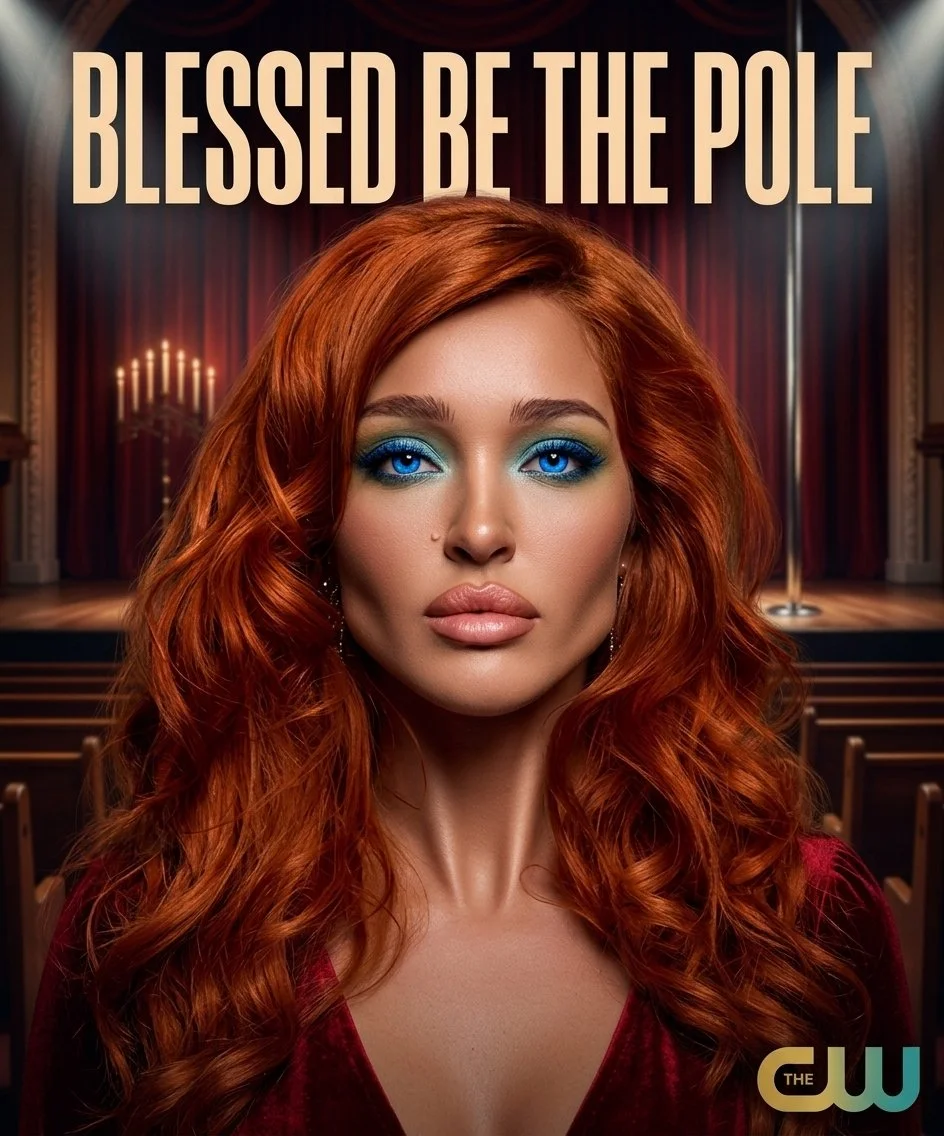
We're vibing to "Middle of the Night" by Elley Duhé and "Gold" by Kiiara, their hauntingly electric beats setting the perfect mood of empowerment and mystique. Blessed Be The Pole draws its inspiration from none other than Tyra Banks, the unapologetic queen of reinvention and limitless ambition. Tyra taught us how to own every stage, runway, and spotlight—not just with beauty but with boldness, resilience, and authenticity. This series embodies her legacy of turning struggle into strength and confidence into art, creating a narrative that elevates empowerment and self-expression to new heights.
Television Treatment — Season One
LOGLINE
When a single mother and former exotic dancer walks through the golden doors of the most exclusive house of worship in the 90210, she doesn't just find salvation — she sets off a chain of scandals, revelations, and unlikely redemptions that will crack the pristine facade of Beverly Hills' holiest address wide open.
SERIES OVERVIEW
Behind the palm trees and valet parking of Rodeo Drive sits a church where the sermons are loud, the tans are permanent, and the sins are exquisitely tailored. This is a world where faith comes with a dress code, forgiveness has a suggested donation, and the parking lot holds more secrets than the confession booth. Into this gleaming, gossip-soaked sanctuary walks Candy — a woman with a past she's desperate to outrun and a son she's determined to raise right.
What follows is a season-long collision of the sacred and the scandalous. It's a story about hypocrisy and heart, about the people who wear religion like a costume and the ones who accidentally stumble into its real meaning. Every episode peels back another layer of the church's glossy skin to reveal the raw nerve underneath: the loneliness of the rich, the desperation behind the Botox, the terror of a woman who has been told her whole life she's worthless — and the sunny disruptor who refuses to believe it.
Underneath the satire beats something surprisingly sincere. This is a story of second chances, chosen family, and the strange grace of belonging somewhere you were never supposed to fit. It moves fast. It hits hard. It's wickedly funny. And every once in a while — when you least expect it — it will break your heart.
Glossy. Ruthless. Redemptive. Amen.
PRINCIPAL CAST
CANDY "CINNAMON SWIRL" — Our heart and our anchor. Platinum blonde, glitter-dusted, fiercely protective. A single mom clawing her way toward a better life for her boy. She's smarter than anyone gives her credit for and kinder than anyone in this zip code deserves. She has spent years being looked at and never once being seen — and the slow, terrifying process of letting people see her is the emotional spine of the series. Her arc: a woman learning she was never the sinner in the room.
BRAYDEN "THE BRO" McCHAD — Pastel polos, ripped biceps, a heart the size of the San Fernando Valley. He greets strangers with fist bumps and scripture in the same breath. He seems too sunny to be real — but there's a quiet ache beneath the surf-speak, and a moral compass that points truer than anyone else's in the building. His secret: the cheerfulness is a choice, made new every single morning, over something he never talks about.
PASTOR RICHARD "DICK" GOLDENSTEIN — The impossibly tanned, improbably coiffed king of this castle. A televangelist who preaches against temptation on Sunday and indulges it the other six days. Charm on the outside, calculation underneath, panic beneath that. Our season's engine of chaos — a man who built an empire on appearances and will burn it down rather than be seen without his mask.
CHASTITY GOLDENSTEIN — Dick's wife. Manicured, betrayed, and done being quiet about it. She starts the season as a suspicious spouse and ends it as something far more dangerous: a woman with receipts, a private investigator on retainer, and nothing left to lose. Her rage is righteous. Her aim is perfect.
MUFFY VAN DER BOTOX — Queen bee of the church social set. Pearls permanently clutched, forehead permanently frozen. She weaponizes politeness and can spot a fake Rolex from three pews away. Comic relief with claws — but even Muffy has a hollow spot she fills with gossip and Chanel.
ELDER BARTHOLOMEW RICHINGTON III — Old money, older opinions, and a monocle he doesn't strictly need. Guardian of tradition. Horrified by everything after 1962. Beneath the bluster, a man terrified of being irrelevant.
ELDER PRUDENCE TIGHTPURSE — Blue-rinsed schemer with a soft center she'd rather die than reveal. The first of the old guard to secretly enjoy the new order, and the first to be ashamed of enjoying it.
PRUDENCE SOURGRAPE — The choir director. Severe, exacting, allergic to fun. Music is the only place she's ever been alive, and she's forgotten why. Her thawing is one of the season's quiet miracles.
BROTHER THADDEUS — Devout, easily scandalized, secretly thrilled by every scandal. The congregation's living reaction shot, and its unexpected conscience.
JAYDEN "TIMMY" — Candy's young son. Innocent, earnest, and prone to the kind of simple wisdom that stops a room cold. The reason Candy fights. The one person in the whole series who says exactly what he means.
SEASON ONE — EPISODE GUIDE
Episode 1 — "The Threshold"
We open on Beverly Hills at its most obscene and beautiful: valet lines, palm shadows, a gold cross catching the sun like a dare. The Beverly Hills Holy Church gleams white and merciless. Into frame comes Candy, on foot — no valet for her — in a borrowed floral sundress that doesn't quite hide the shimmer of body glitter she scrubbed at for twenty minutes that morning and couldn't get off. She stops at the threshold. She almost turns around. This is the whole show in a single image: a woman deciding whether she's allowed inside.
Her motivation is laid bare fast and without apology. Last night was a bad night at the club. This morning she looked at her sleeping son and made a promise. She doesn't fully believe in God. She believes in change, and this is the most respectable-looking building she could think of. She's here on a bet with herself that she can become someone new.
At the door she collides with Brayden "The Bro" McChad, self-appointed welcome committee, human golden retriever, dispenser of fist bumps and scripture in the same sunny breath. He clocks the rhinestone at her collar, the glitter on her collarbone — and instead of the flinch she's braced for her entire life, she gets a fist bump and a "Sup, newcomer." The relief nearly buckles her knees. We plant the central relationship in this beat: Brayden is the first person to look at Candy and not do the math. He seats her front and center, calls it "the best seats in the house," and never once treats her like a problem to be managed.
Inside, the congregation performs its favorite hymn: judgment. Pearls clutch. Husbands find the ceiling architecture suddenly fascinating. Whispers ripple like a stadium wave — is that... no, it couldn't be... I saw her at my husband's, I mean, at the supermarket. Candy sits with her spine straight and her stomach in knots, and we feel every eye as a small wound.
Then Pastor Richard "Dick" Goldenstein takes the pulpit — impossibly tan, impossibly white teeth, hair that defies both gravity and probability. And Candy gets the season's first cold-water jolt: she knows that face. Not from church. From somewhere darker, somewhere with a two-drink minimum. The recognition flickers and she buries it, but we don't let the audience forget it. His sermon is fire and brimstone against the sins of the flesh, delivered with the sweaty conviction of a man describing his own weekends, and the tithing pitch that follows is pure grift dressed as grace.
The emotional turning point comes after the service. Brayden asks Candy, gently, what brought her here. She decides the one place she shouldn't lie is a church, and she tells him the truth: she's a dancer, an exotic dancer, and she wants to be better for her son. She braces for the door to close. Instead Brayden calls it "heavy, bro-ette" and tells her Jesus hung out with all sorts, and he'd be stoked to have her. It's the kindest thing anyone has said to her in years, and she holds it like something breakable.
We close on the season's thesis and its threat side by side. Candy walks out into the sunlight with something dangerous and unfamiliar: hope. And across the sanctuary, Dick watches her go, his eyes narrowing, doing his own private math — recognizing her too, and calculating exactly what her presence could cost him. The seeds of chaos are planted in the immaculate garden. Only time will tell what strange fruit they bear.
Episode 2 — "Second Sunday"
The hardest thing Candy does all week is come back. We open on her in her cramped apartment, Timmy eating cereal, the borrowed dress hanging on the door like a question. She almost doesn't go. The genius of this episode is that the drama isn't external yet — it's the sheer act of a scorned woman voluntarily walking back into the room that scorned her. She goes.
Brayden waves her over like she's a returning war hero — his pastel polo somehow more pastel, his hair styled by what looks like a committee of tasteful angels. But the warmth is immediately besieged. The church ladies, sensing new blood, close ranks under the command of Muffy Van Der Botox, whose frozen smile could stop a clock. Muffy launches a velvet interrogation into Candy's "line of work," each question a manicured knife. Candy, cornered, offers "the entertainment industry," and the ladies coo about a nephew who produces Christian films — "Abs for Jesus," perhaps you've heard of him — while circling closer. We play this for comedy and dread at once: the smiling cruelty of people who have never once been afraid.
Dick's sermon this week is on temptation, and his gaze keeps landing on Candy long past the point of pastoral concern. We tighten the screw on his subplot: this is not admiration, it's fear and appetite braided together. When the collection plate comes round, Candy panics — her purse holds wadded dollar bills that smell of the club, a crumpled twenty, loose glitter. She puts in the twenty and a prayer. Brayden leans in with the episode's soul: "God's not about the Benjamins. He's more of a good-vibes kinda dude." Meanwhile Dick watches the plate move like a hawk tracking prey, and we understand exactly which god he worships.
Brayden rescues Candy from the socialites with an invented youth-group emergency, and here we deepen him: he's not oblivious to the ladies' cruelty, he's choosing not to feed it. In the parking lot, the episode's real engine finally roars. Candy and Brayden overhear Chastity Goldenstein — perfectly manicured, quietly volcanic — jabbing a finger at her husband's chest, warning him off "that new girl," threatening to take him for everything if she catches him "counseling" anyone again. Dick's protests of innocence are so smooth they indict him. We establish Chastity not as a shrew but as a woman who has caught her husband a dozen times and is out of patience — a sympathetic time bomb.
The emotional turning point is quiet and comes at Brayden's truck ("Bro'd in Christ" emblazoned on the side, the Protein Palace beckoning). Candy asks the question that will haunt the whole season: does he ever feel like this church isn't quite what it seems? For one unguarded second Brayden's cheerful mask slips, and we glimpse the doubt he works so hard to bury. Then it snaps back and he's talking about a smoothie called The Resurrection Body. But the doubt has landed in both of them. We close on Dick watching from his office window, unreadable, as the real tribulations begin to stir. It will take more than tithes to weather the storm.
Episode 3 — "Movement in Worship"
We open in the rehearsal room, where the church choir is committing audible crimes against "Amazing Grace" under the merciless baton of Prudence Sourgrape — a woman for whom music is the last unspoiled thing in a life that has otherwise disappointed her. Into this misery bursts Brayden in a "Sun's Out, Guns Out for Jesus" tank, radiating enough enthusiasm to power a small grid, with a "rad idea" and a secret weapon: Candy, who lingers in the doorway clutching a gym bag and visibly wishing for the sweet release of the earth swallowing her.
The conflict is immediate. Sourgrape reminds Brayden his last contribution — a rap break during "How Great Thou Art" — was "not well received." Muffy, present and lethal, sneers the quiet part loud: isn't she the one who dances, for money? Candy's cheeks burn. And here Brayden becomes something more than comic relief. He plants himself between Candy and the room and delivers his gospel: judge not; we've all got a past; if David danced before the Lord, so can we. Sourgrape, allergic to fun but starved for something real, reluctantly relents.
The heart of the episode is the rehearsal itself, and it's where we let Candy be good at something for the first time on camera. She teaches a simple step-touch with the patience of a woman who has coached terrified new girls through worse rooms than this. Brayden throws himself in with catastrophic, joyful flailing. And slowly — this is the emotional core — the choir loosens. The stiffness of respectability cracks. Even Sourgrape catches her own foot tapping and looks down at it like a betrayal she secretly welcomes. By the end they've assembled a genuinely decent routine to "Lord of the Dance," and Sourgrape admits, grudgingly, that this was "not entirely terrible" — the largest compliment in her vocabulary. The thematic undercurrent lands hard: Candy, who came here with only shame, discovers she has something to give. For one episode she is not a problem in the room. She is the reason the room is better.
Then the warmth curdles. Dick appears in the doorway, having watched the tail end, and asks Candy for a "private word" about her "integration into the church family" — the oiliness of it unmistakable. The threat is finally in the open. Brayden intercepts smoothly, inventing a smoothie run, and Candy tells him plainly: Dick makes her deeply, physically uneasy. She can't say why yet. We can.
We close on the subplot that will detonate the whole season. Chastity, in the shadows of the church office, watches her husband watch Candy walk away — and the suspicion that has simmered for two episodes finally hardens into cold, deliberate resolve. She's done warning. She's going to catch him. The gears of the divine comedy click into place.
Episode 4 — "Candid Cheater"
The detonation. We open on a packed sanctuary, the air thick with designer perfume and the faint scent of hypocrisy, and Dick at the pulpit sweating through a sermon on — of all things — fidelity. He preaches faithfulness, standing firm against temptation, resisting the siren call of sin, and we savor every oblivious syllable, because the audience knows what's coming and he doesn't. Dramatic irony as a loaded gun.
The doors bang open like the trumpet of judgment. Chastity storms the aisle, a mask of righteous fury and a stack of papers in her fist, and does the unthinkable: she uses his first name in vain, mid-sermon, in front of everyone. The congregation gasps as one organism. She lays it all out with the precision of a woman who has been building this case for months — hotel receipts, mysterious charges to the church credit card, and the detail that undoes him: glitter, found in his car. She hired a private investigator. And then she hits play.
The church's giant screens — usually reserved for hymn lyrics and inspirational memes — light up with footage no congregant will ever un-see: Pastor Dick, spray-tanned and shameless, receiving a very enthusiastic private performance from a woman who was decidedly not teaching Sunday school. We stage the reaction as glorious chaos. Muffy Van Der Botox faints dead away, pearls flying. Brother Thaddeus covers his eyes with fingers suspiciously parted. And somewhere in the back, a voice that sounds a lot like Brayden's shouts, "Dude, sweet moves!" The tonal whiplash — genuine scandal, genuine comedy — is the whole show in one scene.
Dick's empire collapses in real time. He makes the flailing defense of a drowning man — research, for a sermon on the evils of the flesh — but the mask is gone and everyone has seen the face beneath it. The congregation curdles into a mob faster than you can say holy roller. Muffy, miraculously revived, brandishes her handbag like a weapon of mass destruction and cries "Get him!" Dick does the only thing left: he runs, vaulting from the pulpit with an agility that suggests his fitness was honed somewhere other than the gym, and flees into the parking lot with a hymnal-wielding, collection-plate-swinging mob at his heels. His perfect hair comes undone. His empire runs out the door with him.
The emotional turning point is the silence after. The pulpit stands empty. The screens are frozen on an image that will haunt dreams. And Brayden — who has drifted to the front almost by accident — picks up the Bible Dick dropped in his flight. He steps up. He doesn't plan to. He shrugs at the shell-shocked room and delivers the sermon of his life without meaning to: this is what happens when you try to serve two masters, and one of them's got a killer routine. But the Good Book says judge not — so how about we all take a chill pill. In the wreckage of the old order, a new one is accidentally born. Candy watches from the back, and something breaks open in her chest — hope, again, but bigger this time. The undercurrent: the church has finally lost the man who made it a fortress. Now it's up for grabs.
Episode 5 — "Operation Holy Roller"
The aftermath. We open on a church in civil war. Half the congregation is scandalized into paralysis; the other half is electrified, gossiping in the narthex like they've been let out of a cage. Brayden is the accidental interim pastor, and nobody appointed him — the vacuum simply filled itself with the nearest source of light. We use this episode to widen the world and raise the stakes: this is a power struggle now, and Brayden and Candy don't yet know they're in one.
The antagonists sharpen. In the church office, the elders convene — a coven of the well-heeled and the horrified. Elder Bartholomew Richington III, monocle quivering, rages that they cannot have a "surfer boy" leading the flock; what's next, skateboarding down the aisle, energy drinks for communion? But Elder Prudence Tightpurse plays the longer game: let the boy have his moment, let him dazzle the young crowd, then swoop in and restore order. We give the old guard real teeth here — they control the money, the deed, the machinery — so the audience understands Brayden's charm alone won't save him. The threat is institutional.
Beneath them, literally, in the church basement — surrounded by dusty hymnals and a suspicious leftover punch bowl — Brayden and Candy hatch a counterattack. Brayden can feel the elders plotting "in his perfectly sculpted abs." Candy, strategist that she secretly is, names the mission: prove that change can be good, that faith can be fun, before the old guard strangles it. They cover a whiteboard in diagrams that look less like a church plan than a football play designed by a sugar-high toddler. Operation Holy Roller is born, and its weapon is Xtreme Faith Fest.
The centerpiece is pure spectacle and we let it run. The flower garden becomes a skate ramp reading "Ollie for the Holy." The dunk tank is filled with holy water — "Baptism: Xtreme Edition." Children scream with joy down the "Slide of Salvation" into foam cubes. Teens line up for the "Ring of Fire Jump," which Brayden swears is "totally safe, probably." And the pièce de résistance, Praise Karaoke, delivers the season's instant legend: Brother Thaddeus performing "Amazing Grace" to the tune of "Ice Ice Baby," transformed from timid reaction shot into a man discovering he has range. We track the elders through the chaos, watching their armor crack: Prudence Tightpurse caught red-handed at the "Holy Guacamole" stand, guacamole on her chin, having the time of her repressed life.
Chaos, foam, and minor injuries ensue — Brayden's tank top gets singed by the Ring of Fire, ice packs are dispensed by the lemonade stand, Bartholomew nurses a bruised dignity. But so does something none of these people expected: joy. The emotional turning point is Brayden's impromptu closing address, disheveled and slightly on fire, telling the crowd that church isn't pews and solemn faces — it's community, it's love, it's lifting each other up, sometimes literally, in the case of the Human Pyramid of Prayer. The crowd roars. And the elders, ice packs in hand, admit through gritted teeth that the boy gets results. Candy watches from the wings and realizes what she's witnessing: this ridiculous, wonderful man has done in one afternoon what a thousand fire-and-brimstone sermons never could. He's made these people a family. The undercurrent: the tide has turned, and the old guard just lost the congregation's heart.
Episode 6 — "Where Your Treasure Is"
The whole zip code shows up for Brayden's first official sermon — the botoxed, the bedazzled, the bewildered, packed to the rafters. He takes the pulpit in a suit that appears to have been spray-painted onto his frame and a "What Would Jesus Deadlift" bracelet, and he does the one thing guaranteed to horrify a room full of people who have all their money and none of their peace: he preaches about cash. Muffy clutches her pearls hard enough to make diamonds. The room braces for a grift — they've seen this move before, from a tanner man.
Then the twist, and it's the moral pivot of the season. Brayden isn't shaking them down. He wants to take the church's mountain of money — the tithes Dick hoarded, the renovation fund that never renovated anything — and turn it into a mountain of love. Real outreach. Scholarships for kids who can't afford college. Events for underprivileged children. A church that doesn't just talk about helping people but actually does it. We watch the congregation's skepticism melt in real time, face by face, as a room full of people who have only ever been sold to realizes they're being invited into something. Even Prudence Tightpurse leans forward, her pinched expression softening into cautious hope. Wallets appear as if by magic. Designer purses fly open. The collection plates overflow — but now the money means something.
The emotional detonation is small and comes from the smallest person present. Timmy, Candy's son, who's been quietly coloring in the front row the whole sermon, pipes up into a sudden hush: if the church has all this money, can they buy a giant swimming pool and fill it with pudding, because surely Jesus would want everyone to have pudding? The room freezes. And Brayden — instead of laughing him off — kneels to the boy's level and declares it, with total sincerity, the most righteous idea he's ever heard. Because that's the whole point: generosity without a catch, joy without a price tag, a faith a child could understand. The church finds its new mission in that moment — charity, community, and the occasional pudding pool.
We hold on Candy at the back, watching her son inspire an entire congregation of people who once whispered about his mother, and letting her cry the good kind of tears. Their eyes meet across the room; she mouths thank you; he answers with finger-guns and "that's what family's for." The undercurrent runs deep here — this is the episode where Candy stops being a woman seeking a place and becomes a woman who has one. We close on Brayden alone in the empty sanctuary, looking up at the ceiling, half-praying, half-bargaining: "I hope you're cool with all this, Big Guy — 'cause something tells me we're just getting started."
Episode 7 — "The Radical Rebirth Reef"
The finale, and we go big. Brayden is officially instated as pastor, dressed in his idea of formal wear — Hawaiian shirt with subtle crosses hidden among the palm trees, khaki shorts, flip-flops that flout every dress code the church has ever enforced. The sanctuary overflows onto the manicured lawn. He opens with a promise of a new chapter — radical love, extreme faith, and yes, a few sick ollies for the Lord — and then addresses the fear in the room head-on: what's more churchy than loving your neighbor, helping the less fortunate, and spreading joy?
He unveils the new Beverly Hills Holy Church one outrageous program at a time, and we let each land as its own comic set-piece with a sincere aftertaste. "Skate or Donate" — shred the local park, raise money for charity, and remember that falling is just another way to get closer to the ground you'll pray on. "Surf's Up Bible Study" — scripture and pop-ups on God's gnarly waves, Muffy already resigned to finally using her Chanel wetsuit. And the one that steals the room's breath: Pole Fitness for Jesus, led by Candy herself, reframed by Brayden with a completely straight face as "vertical dancing with a really sturdy partner." The gasp is enormous. Every eye turns to Candy, and we hold on her face — the woman who walked in ashamed of exactly this skill now standing at the front, offered a pulpit for the very thing she was told made her worthless.
The emotional turning point is the redemption of the room itself. Brayden invokes King David dancing before the Lord with all his might; he calls the body a temple worth strengthening. And it's Elder Prudence Tightpurse — of all people, the old guard, the schemer — who breaks the silence by volunteering first, muttering about her doctor's orders and her core strength. The tide breaks completely. The sign-up line forms. Even Mrs. Abernathy, a sprightly octogenarian, asks if she's too old, and Candy tells her, warm and sure, that age is just a number and the pole doesn't judge. The thematic payoff is total: the congregation that once weaponized shame is now lining up to learn from the woman they shamed. Grace, it turns out, wears body glitter.
Then the grand finale, pulled back like a curtain on the Second Coming: the Radical Rebirth Reef — a full wave pool in the church courtyard, surfboards painted with crosses and Bible verses, for surfboard baptisms. Super Soakers of holy water fly. New converts wipe out gloriously and get up laughing. Brayden blesses volunteers as they wobble upright, hanging ten for the Holy Spirit, and the whole thing is chaotic and ridiculous and — somehow, impossibly — moving. As the sun sets over the 90210 and the stars come out, Brayden gathers everyone for a final prayer, thanking God for new beginnings, radical ideas, and a congregation willing to hang loose and trust the plan, reminding them His love is more extreme than any sport, more refreshing than any wave, more uplifting than the sturdiest of poles.
We close on Candy and Brayden at the water's edge. She tells him he's transformed this place. He corrects her — we did it, together, bro-ette, and this is only the beginning of the righteous ride. Season One ends on a church reborn, a woman who finally found her worth, a boy with a future, and the unmistakable promise of more scandal, more heart, and more chaos to come. Sun's out. Guns out. Amen.
SEASON ARCS AT A GLANCE
Candy travels from ashamed outsider to indispensable community leader — a woman who arrives seeking forgiveness and discovers, over seven episodes, that she had nothing to apologize for. Every episode strips away another layer of the shame she was handed by other people, until the very skill she was told made her worthless becomes the thing she teaches an entire congregation. Her son is her north star; her friendship with Brayden is the first relationship of her adult life built on nothing but respect.
Brayden rises from goofy greeter to accidental prophet, and the season's quiet revelation is that his sunny simplicity was never stupidity — it was the purest and hardest-won faith in the building. He is the only character who was already whole when the season began, and his arc is watching the world slowly rise to meet him.
Pastor Dick falls from gilded idol to hunted fugitive in a single spectacular collapse — his downfall the hinge on which the whole season swings. He is the embodiment of everything the church was, and his flight out the door is the moment it becomes possible for it to be something else.
Chastity transforms from suspicious wife to avenging force, ending the season having reclaimed a power she never held inside her marriage. She is the one who lights the match; the new church rises from the fire she set.
The old guard — Muffy, Bartholomew, both Prudences, Thaddeus — begin as obstacles and thaw, one reluctant foot-tap and one guilty guacamole chip at a time, into converts to a warmer kind of faith. Their softening is the season's slow miracle, proof that even the frozen can be reached.
Beneath the satin and the satire, Season One asks a real question: what is a church actually for? And it answers, again and again, that grace shows up in the least respectable places — and sometimes wears body glitter.
Sun's out. Guns out. Amen, dudes.