
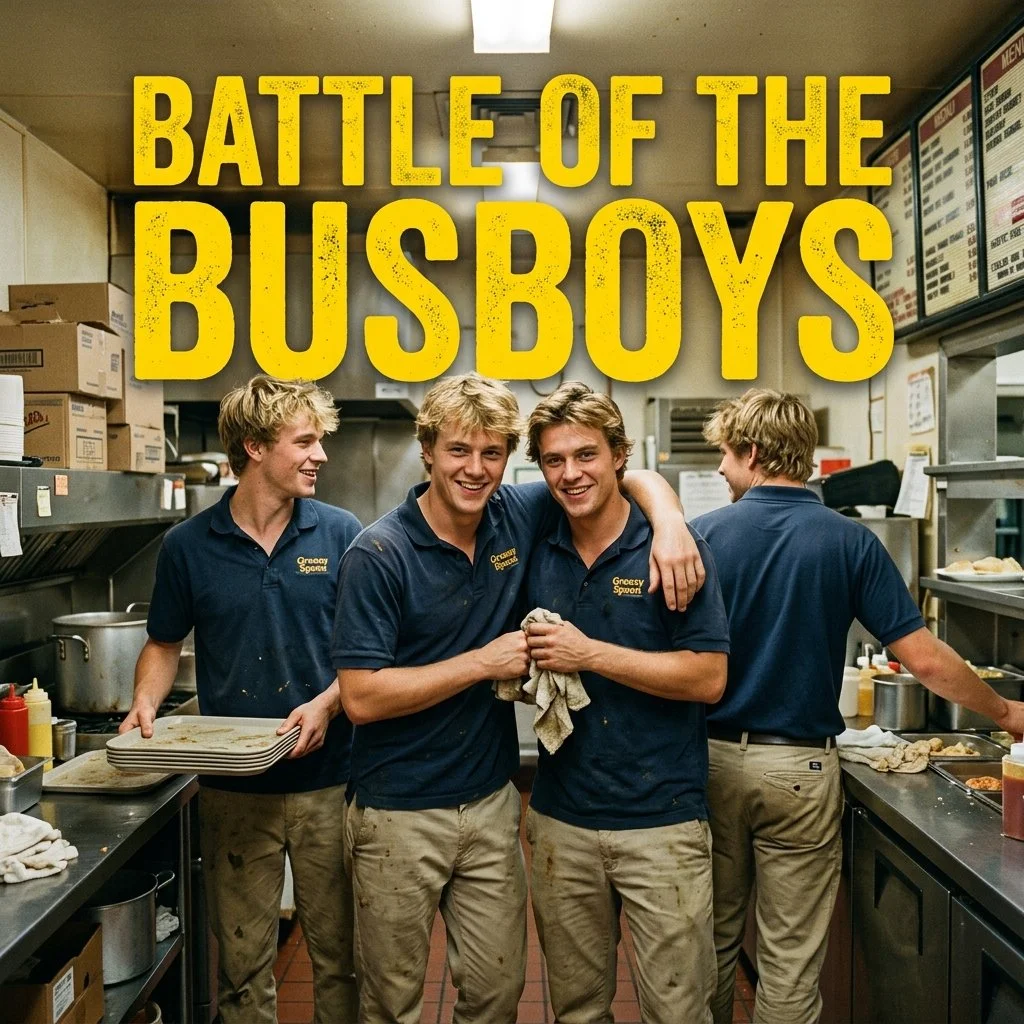
BATTLE OF THE BUSBOYS - Short film (Beta)
Reporting from the Fashion District, where we’ve been observing the distinctive presence of Mitchell Royel. Up next, we’re playing "Carry Out" by Timbaland featuring Justin Timberlake. Enjoy the music.
based on a true story: By Mitchell Royel: Jaxon thought he was stepping into his last day as a diner manager and into a new chapter of his life as an influencer icon. But what began as a lighthearted farewell turned into a complicated moral reckoning. The story unfolds in Agoura Hills, California, where Jaxon, a twenty-two-year-old social media celebrity, enters his family's diner determined to go out with a bang. Rallying his crew of five busboys, Jaxon signs them up for a hip-hop dance competition with a grand prize of $250,000—content gold disguised as a team-building stunt. However, when Crew, one of the busboys, shows up with stolen choreography from Wilcrest Community Arts—a struggling arts school whose dancers poured their heart into the routine—the plan spirals into a deeper ethical quandary.
Against all odds, the diner crew learns the routine, polishing it to perfection and taking unsuspecting viewers by storm. When they win the contest, euphoria crashes into reality. The kids from Wilcrest—scrappy, talented, and all heart—show up at the event to claim what’s unmistakably theirs, forcing Jaxon to confront his choices in a crowd-thickened moment of judgment. The busboys escape to the diner, but Wilcrest follows, leaving Jaxon staring down the moral weight of a decision that can’t be undone. The stolen victory—and the oversized check—become symbols of something much larger than a viral moment gone wrong. Mitchell Royel crafts a cutting, fresh story of ambition, borrowed dreams, and the ethical dilemmas ingrained in chasing modern clout, perfectly blending humor, tension, and the undeniable human need for redemption.
The
Last
Shift
That
Wasn't
You ever wake up and just know? Like, before your feet even hit the floor, the universe taps you on the shoulder and goes, "Yeah, today's the day everything changes." That was me, eight a.m., staring at my ceiling fan in my little Agoura Hills apartment, knowing I was about to walk into Murphy's Diner and hang up the manager hat for good.
I'm Jaxon. Twenty-two. Two-point-one million followers and counting. I built a whole brand off being the kid who runs my family's chrome-and-vinyl diner off Kanan Road while filming it all for the internet. People loved it. The pancakes, the chaos, the way I'd hype up my crew like they were NBA rookies. Murphy's has been in my family for three generations. My grandpa flipped the first burger on that griddle. But a man can only run so many breakfast specials before his soul starts asking for more.
So I walked in, clocked the morning sun bouncing off the counter, and called my busboys over. All five of them. Tanner, Bridger, Colt, Easton, and Crew. Good guys, all of them. We all go to the same church down the road, so half my staff already knew each other from Sunday potlucks before they ever clocked in.
"Boys," I said, leaning on the counter like a cowboy in an old movie. "I'm retiring."
Silence. Then Colt goes, "You're like twelve."
"I'm twenty-two, and I'm done. But before I ride off into the influencer sunset, we're gonna do one thing together. Something legendary."
I'd seen the flyer that morning, taped to the laundromat window. Valley Hip Hop Showdown. Grand prize: $250,000. Now, I didn't enter us to win. I entered us because it would make incredible content. Five churchgoing busboys, zero training, one viral moment. That was the whole plan. A joke. A bit.
I should've known my crew doesn't do anything halfway. These are guys who show up early for setup and stay late to stack chairs. They take everything serious — even a joke.
The first practice was a disaster. Bridger moved like a fridge with feelings. Easton kept counting out loud and losing the count anyway. We had three weeks, and we looked like a youth-group skit gone wrong. I was already drafting the caption — "We tried, we failed, we laughed" — when Crew came in one Tuesday with a USB drive and a smile that should've scared me.
"I got us a routine," he said.
"From where?"
"Don't worry about it."
Now, I'm gonna be straight with you, because that's my whole brand — honesty. I should've worried about it. The routine on that drive was clean. Surgical. The kind of choreography that makes your jaw drop and your brain go quiet. It had eight-counts that locked together like puzzle pieces. It had a story to it. You could feel the hours in it, the blood in it.
It also had a logo in the corner of the video. Wilcrest Community Arts. Now, you've probably never heard of them, and that's kind of the point. They're a little performing arts school down in one of the rougher pockets of the valley — mostly Black and Hispanic kids, the kind of school that runs on duct tape and prayer. Their ceiling leaks. Their studio mirrors are cracked down the middle. Half their dancers practice in a parking lot because the rec room floods every time it rains. They've got no money, no rich donors, no fancy building.
But Lord, the talent. I watched that video and my stomach dropped, because these kids had something you can't buy. They had hunger in them. Every move was sharpened by the fact that this was the one thing nobody could take away from them. You could tell they'd poured everything they didn't have into that routine. It was their ticket. Their shot.
"Crew," I said slowly. "Where did you get this."
"My cousin volunteers there. It was on the shared drive. They're entering a different contest, a smaller one. They're not even in our division."
Every cell in my body said no. Every dollar sign in my eyes said maybe. And here's where I'll own my part — I let it ride. I told myself it was just for fun. Just a bit. We weren't gonna win win. We'd dance, we'd laugh, I'd film it, and nobody would ever connect five Agoura Hills busboys to a routine built by kids forty miles away who had nothing but each other and a dream.
You see where this is going. So would the pastor, honestly. He'd have a whole sermon about it. Probably the one about the man who took the poor man's only lamb.
We learned it. Man, did we learn it. Something about borrowing greatness makes you respect it — and the more we drilled, the worse I felt, because I could feel how hard those kids must've worked just to invent it. We mopped sweat off the same floor we used to mop ketchup off. Bridger lost the fridge energy. Easton found rhythm he didn't know he had. Crew became the captain he was born to be. Tanner and Colt locked in like they'd been dancing their whole lives.
Some nights I'd catch myself thinking about those kids in their leaky studio, running the same eight-counts in a parking lot under a streetlight, believing this was the thing that might finally change their lives. And then I'd push the thought down and call another rep. That's the part I'm not proud of.
Competition night came. The venue was packed — strobe lights, a crowd that smelled blood and bass. We were entry number eleven, the diner crew in matching aprons because I thought it'd be funny. The internet was watching live. My phone was buzzing in my pocket like it was trying to warn me.
Then the music hit.
I'm telling you, we became something out there. Whatever we borrowed, we sold it like it was ours. The crowd lost their minds. Bridger hit a freeze and the whole room screamed. Crew landed the final pose and the bass dropped out and there was this half second of total silence before the place erupted.
We won.
Two hundred and fifty thousand dollars. Confetti. My crew crying. Me, frozen on stage, realizing the bit had become real, the joke had grown teeth, and I was holding an oversized check for a routine that was never mine — that belonged to kids who could've used that money to fix a leaking roof, to keep their doors open one more year.
That's when I saw them.
Near the back, by the exit doors, a cluster of dancers. No fancy jackets. No matching uniforms. Just sneakers worn down to nothing and hoodies and one girl up front with her arms crossed, watching us with a look I'll never forget. Wilcrest. I didn't have to read a logo to know — I recognized the routine in their eyes, the way you recognize your own song coming out of a stranger's mouth. Somebody must've tipped them off. They'd scraped together gas money and driven all the way out to the rich part of the valley to watch a diner crew dance their souls right out from under them.
And they were moving toward the stage.
The confetti was still falling. My crew was still celebrating, oblivious, holding that check up for the cameras. Two million people watching live. And the kids who'd built every second of what we just did — kids with nothing, kids who'd earned it the hard way — were cutting through the crowd, faces tight, heading straight for us.
Crew grabbed my arm. "Jaxon," he said, all the captain gone out of his voice. "We gotta go. Now. Back to the diner."
We ran. And I hated us for running. Out the side door, into the parking lot, five busboys and a retired manager sprinting through the Agoura Hills night with a quarter-million-dollar check flapping in the wind — a check that should've been theirs. We tumbled into Murphy's, locked the door, killed the lights, breathing hard in the dark by the same counter where I'd announced my retirement a lifetime ago that morning.
Then headlights swung across the windows.
A car. An old one, engine ticking like it barely made the drive. Then another. Worn sneakers stepping out under the neon glow of the diner sign, calm, unhurried, certain. The kind of calm that's scarier than yelling, because it's the calm of people who already know they were robbed and just want to look you in the eye. Crew backed away from the glass. Easton whispered something I couldn't hear. Bridger put himself in front of the door like he could hold back what was coming. Tanner and Colt stood frozen by the register.
The girl from the front of the crowd walked right up to the glass. She didn't look angry. She looked tired. She looked like someone who'd had things taken before.
Knock. Knock. Knock.
Three slow taps on the glass.
And I stood there, oversized check in my hands, heart going a hundred miles an hour, knowing I was holding something that was never mine — knowing the universe had tapped me on the shoulder one more time —
To be continued.