
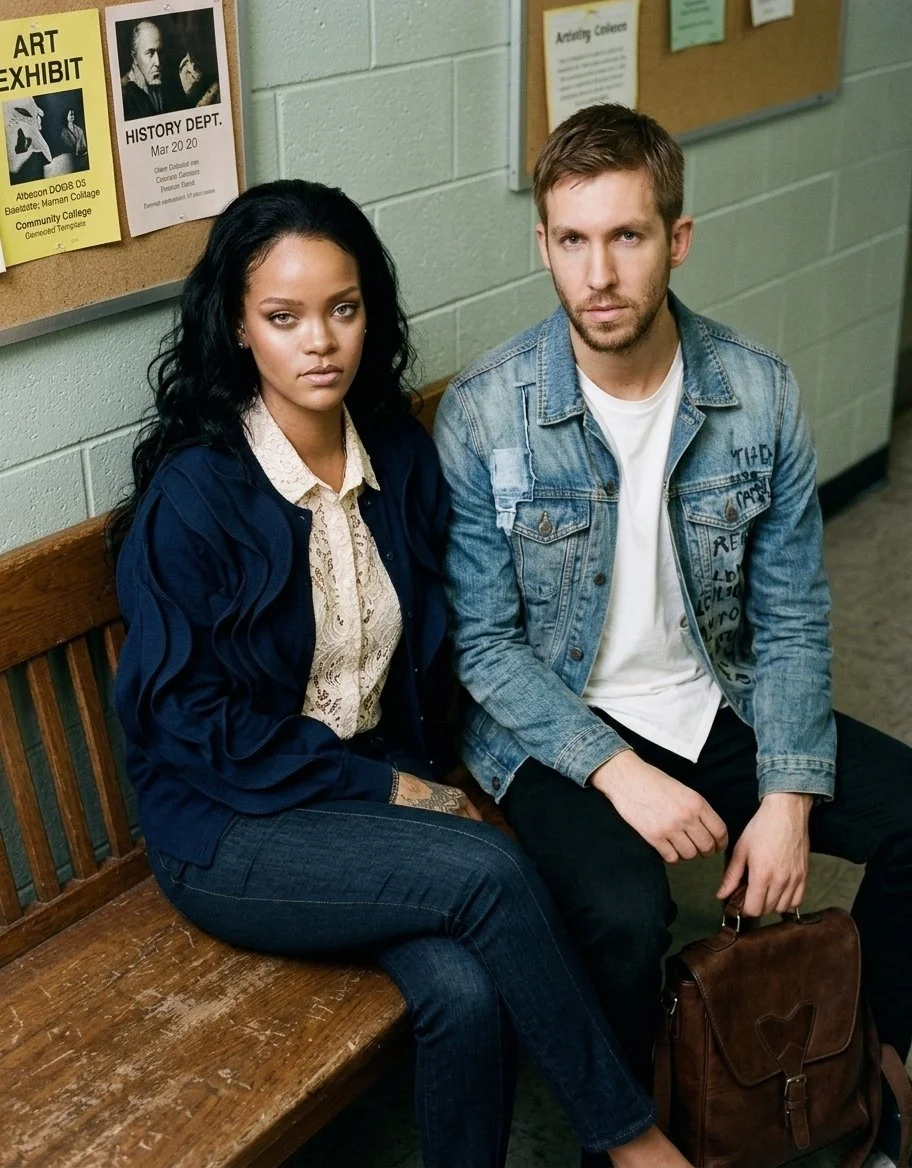
Photos of Rihanna and Calvin Harris, captured in the Fashion District by Mitchell Royel, effortlessly frame the mood. Meanwhile, the rhythmic pulse of "We Found Love" by Rihanna featuring Calvin Harris loops in the background, setting the tone.
Disclaimer: All photos of Rihanna and Calvin Harris mentioned here are owned by Mitchell Royel. Unauthorized use, reproduction, or distribution of these images is strictly prohibited.
Rihanna,
I will start with the facts, because the facts are necessary this time.
I graduated from Calabasas High School in June of 2025. I will not pretend I did not know what Calabasas was, or what it was not. I knew. I had known for four years. It was manicured and expensive and overwhelmingly, exhaustingly white. Not maliciously. Not always consciously. But completely. I moved through those halls and those classrooms and those parking lots and I learned, without anyone ever saying so directly, to calibrate my sense of the world to a very narrow frequency. I did not know what I did not know. That is the most honest thing I can say about it.
By August of that same year, I no longer spoke to a single person I had graduated with. The group chat went quiet. There was a party I learned about from a photograph. There was a final conversation in a parking lot where someone told me, calmly, that they had all outgrown me. I was not dumped by a person. I was released by a class. Two hundred and eleven people. And then, without ceremony, nothing.
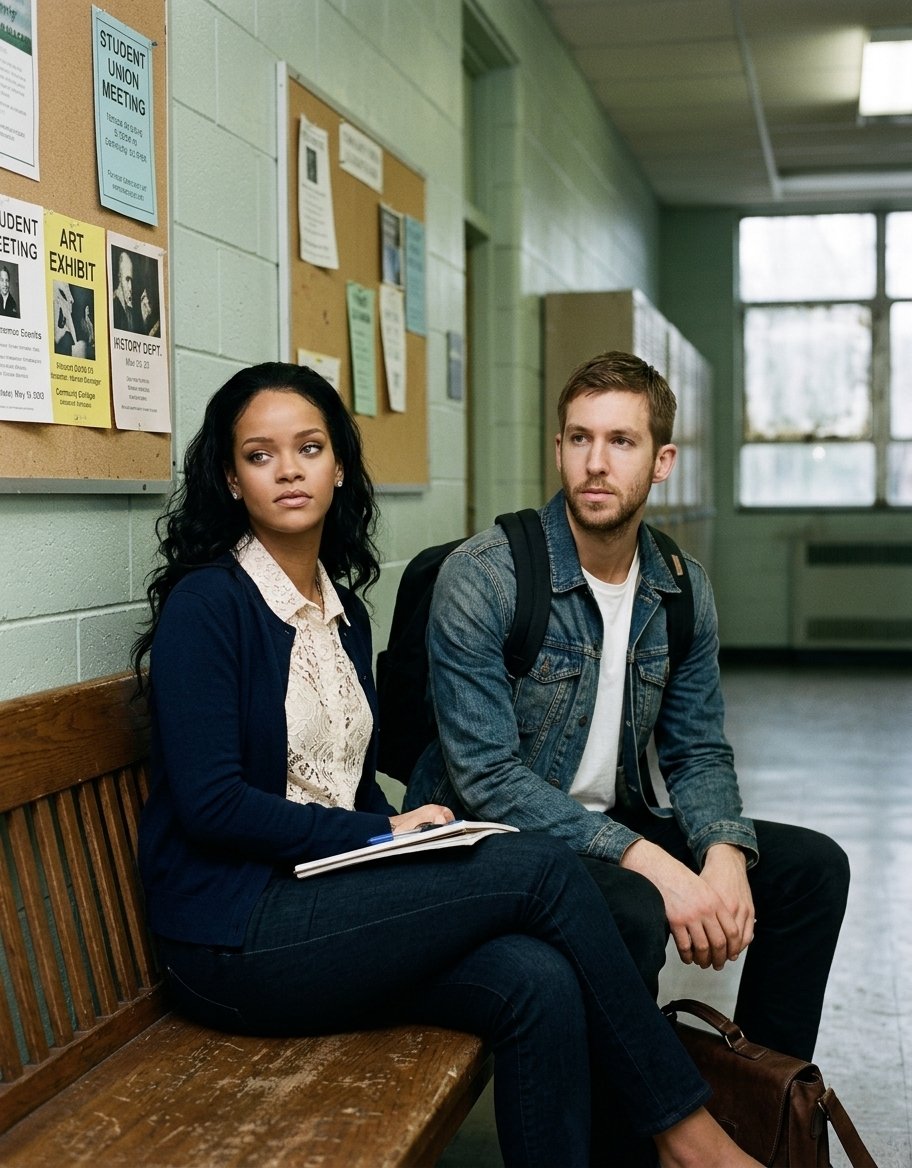
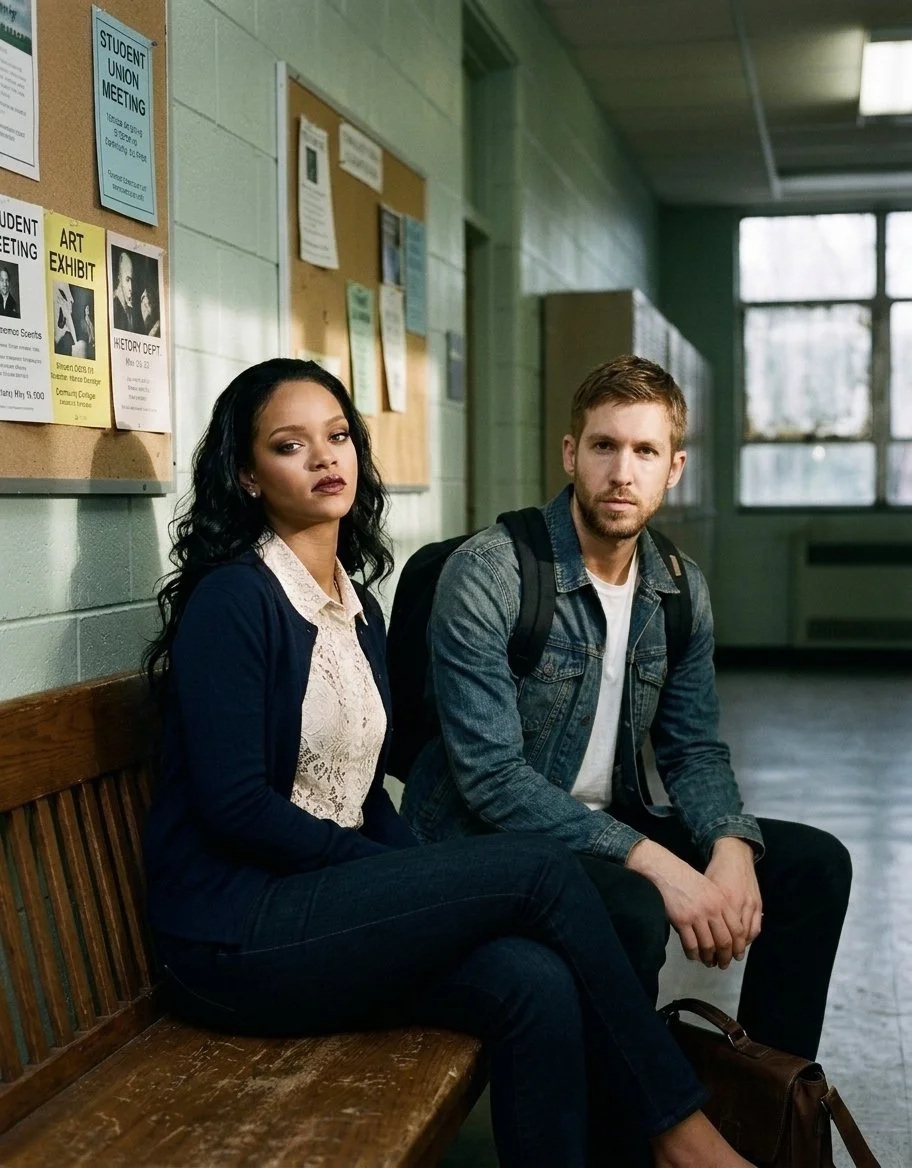
I enrolled that fall at a community college twenty minutes from my mother's house. I chose it because it was close and affordable and because no one there knew me. I sat on a wooden bench outside the humanities building between classes. Mint-green cinderblock walls. A bulletin board advertising events I was too withdrawn to attend. That bench was my office, my cafeteria, and my waiting room.
That is where I met you. Not you, Rihanna. All of you.
I do not know how to say this without sounding like I am describing a discovery, which would be embarrassing, because you were never lost. You have always been here. I was the one who had been somewhere else, looking at a version of the world that had been carefully, quietly edited to exclude you. And then I sat down on a bench at a community college, and the editing stopped, and there you were. Black women. Everywhere. In every form. Returning mothers with textbooks and car keys and a specific kind of patience I had never encountered. Young women with locs and press-on nails and a sharpness of mind that made every conversation feel like something I needed to write down. Women my grandmother's age sitting in computer literacy classes with a dignity that made the fluorescent lighting seem irrelevant. Women who laughed loudly in hallways and apologized to no one for it. Women who were exhausted and still showed up, every Tuesday, every Thursday, every early Monday morning.
I want to be precise about what it means to have missed this. It is not a small thing. It is not a gap in my social calendar. It is a missing education. A missing grammar. I had spent four years learning a version of beauty, of intelligence, of womanhood, that was drawn from an extraordinarily limited palette. I did not know the palette was limited. I thought it was universal. Community college taught me, without announcing that it was doing so, that I had been looking at a thumbnail and calling it a mural.
I played "We Found Love" on that bench more times than I am willing to count in print.
You released it in 2011. I was a child. But I came back to it that fall, not for the obvious reasons, not for the beat, but for the logic of it. The song never pretended things were fine. It named a hopeless place and then refused to accept that nothing good could be found there. That insistence, that stubborn refusal to wait for better conditions before allowing something real to begin, was the only instruction I was capable of receiving at the time.
I had been waiting to leave before I allowed myself to begin. Waiting for a better school, a better setting, a better version of my life in which I would finally be in the right room. The song said the beginning happens where you already are. So I stopped waiting. I introduced myself. I listened. I sat across from women who were working harder than I had ever worked at anything, who were building lives from scratch while also passing statistics exams, and I paid attention for perhaps the first time.
The woman in my morning class was forty-three. She was returning after a divorce. She wore perfume that smelled expensive and she took notes by hand in a handwriting so precise it looked typeset. She told me once, briefly, about the years she had lost, and then she closed the subject and went back to the problem set, and I have thought about that efficiency, that refusal to perform her pain for anyone, nearly every day since.
The woman who sat beside me in English Composition wore her hair different every week, and every week I wanted to ask about it and did not, because I did not yet know how, because Calabasas had not taught me how. By April, I had learned to ask. She told me about her stylist, about the hours, about the particular history encoded in certain styles, and it was a small conversation that felt, to me, like a door I had been standing outside of for years finally opening from the inside.
There were others. There are always others, and that is the point. There were women in the library and women in the tutoring center and women eating lunch alone outside the science building and women who held the elevator and said nothing and women who said everything in a single glance. There was an abundance that I had been, through no single person's fault and through the accumulated fault of every structural decision that placed me in Calabasas for four years, entirely unprepared for.
I am writing this in October of 2026 because your song turned fifteen this year, and because I believe in anniversaries as occasions for accounting. I owe one.
I am also writing it because this country is having a loud and painful argument right now about who belongs to whom, and I think the most honest thing I can contribute to that argument is a personal testimony about what it costs to live inside a bubble and what it gives you when the bubble breaks. I came out of Calabasas thinking I understood people. I did not. I understood a subset. A small, specific, heavily resourced subset that had been framed to me as the default. Community college corrected that framing without asking my permission or consulting my comfort.
Black women corrected it specifically, because Black women were there, and present, and fully themselves, and because full presence in a room has a way of reorganizing everything you thought you knew about the room.
I am not writing to assign credit or to perform a conversion narrative. I am writing because I was handed something I had not earned and did not know to ask for, and the appropriate response to that is acknowledgment.
To every Black woman I encountered in that first year: the ones who spoke to me and the ones who did not, the ones who were patient with my ignorance and the ones who correctly declined to be, the ones who made me laugh in the ten minutes before class started and the ones who walked past the bench without looking up, you reorganized me. You showed me a grammar I had not been taught and did not know I was missing. You were not there for my education. But I was educated. I am trying to be accountable to that.
Rihanna, you told me that something worth having could be found in a hopeless place. I went looking. I found it in the form of women who had been there all along, doing the work, holding the room, carrying more than they should have to carry, and doing it with a grace that the world has consistently failed to adequately name.
I am naming it now.
Inadequately, as all naming is.
But I am naming it.
-Mitchell Royel