
Two Portraits, One Quiet Shoreline
Some paintings ask you to look at them. Others ask you to look at yourself. I stood in front of these two portraits of JJ Wilson, rendered by Mitchell Royel, and felt both requests at once.
I'll tell you what I saw. Then I'll tell you what I felt, because with art like this, the two are hard to pull apart.
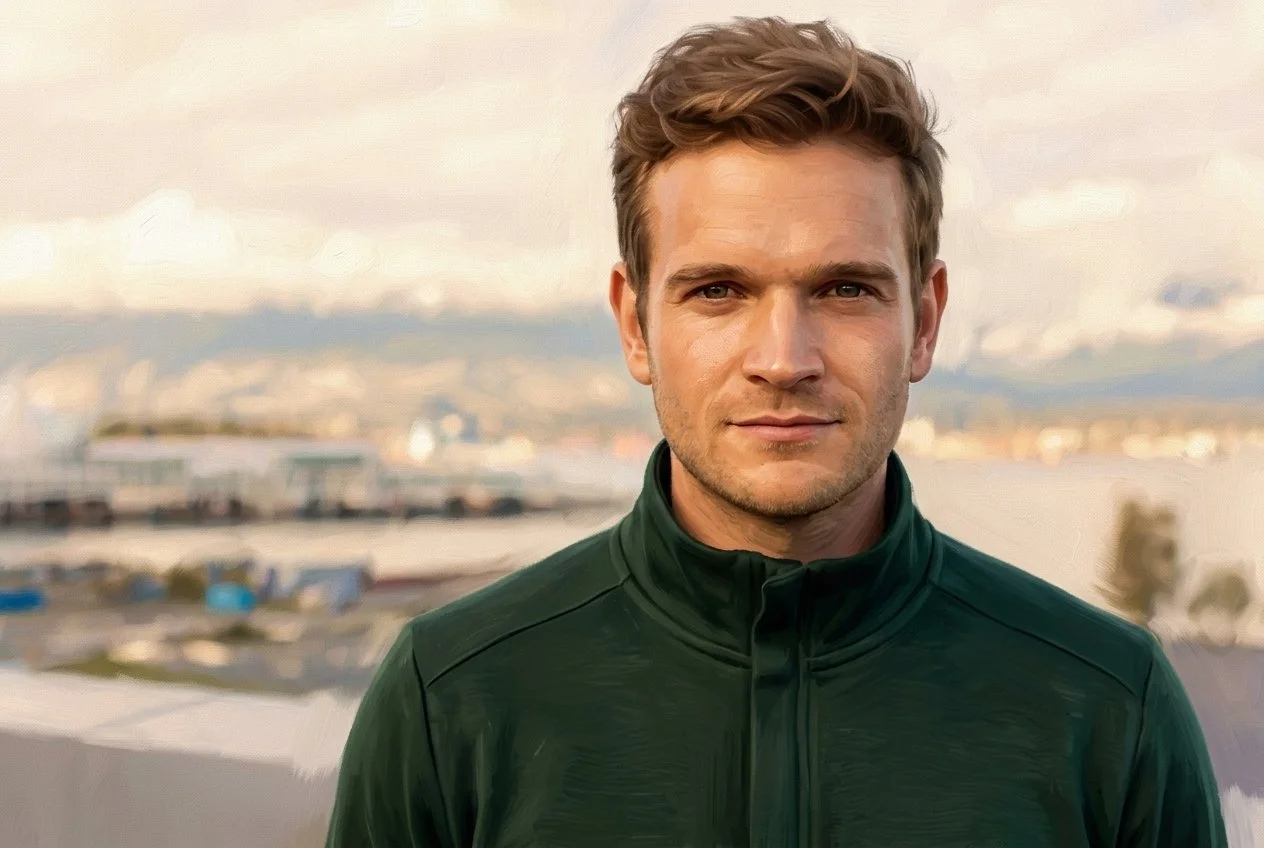
The First Painting: The Man Who Meets Your Eyes
He looks straight at you.
That was the first thing. Not past you, not through you. At you. Calm, steady, and somehow unhurried, as if he has nowhere else he would rather be than right here in this moment, with you.
He's framed from the upper chest up, centered on the canvas like a held breath. His jacket is a deep forest green, the color of cedar boughs after rain. It zips high at the collar and hugs close to the neck, the way you might pull something around yourself on a cool morning by the water. Faint seams run down and across the chest and shoulders. Royel paints them with soft, visible strokes, so the fabric feels both technical and tender. It's built for movement, yet it rests so still.
His light brown hair lifts and tousles upward, a little wild at the edges, as though the wind off the harbor has just passed through. A light shadow of stubble traces his jaw. His eyes are warm and brown. And there, at the corners of his mouth, sits the faintest hint of a smile. It isn't performed. It's simply there, the way contentment is there when you stop chasing it.
Behind him, the world softens into brushwork. A harbor spreads across his shoulders, catching the light of the sky. On the left, the shoreline gathers into docks and small buildings, dabbed in blues, whites, and grays. Far off, hazy blue-gray mountains rest along the horizon. And the sky, oh, the sky. Pale yellow and cream, like the first light of morning or the hush just before evening.
Here's what moved me. Every part of the background blurs and blends, but he stays clear. The world swirls into impressions, and he remains present. Isn't that what so many of us are reaching for? To stay rooted while everything around us moves?
This painting feels like arrival. Like someone who has done some inner work, made some peace, and is now simply here. Grounded. Open. Ready to be seen.
The Second Painting: The Man Between Moments
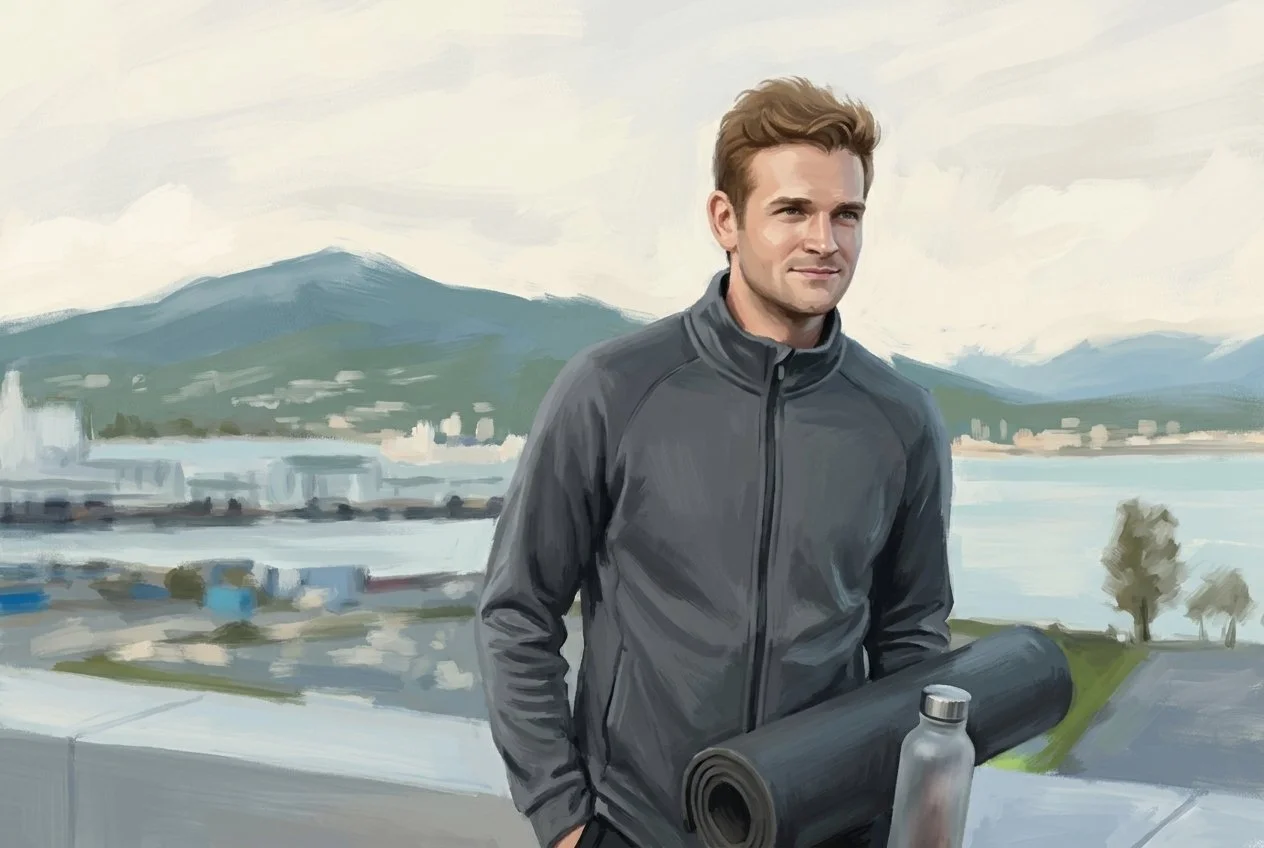
In the second portrait, he turns away.
His gaze drifts off to the right, past the edge of the canvas, toward something we can't see. A subtle smile rests on his face again, but this time it belongs to a private thought. I found myself wondering where he was going. Or where he had just been.
He wears a dark grey zip-up athletic jacket now, with a high collar and raglan sleeves. Those sleeves sweep in one clean line from collar to wrist, with no hard shoulder seam to break the shape. It's a small detail, but it gives his whole upper body an easy, flowing look, like water finding its own path.
Under his arm, he carries a rolled black yoga mat, tucked close against his side. His other hand slips partly into his pocket. The posture is relaxed, casual, and utterly unguarded. He isn't posing. He's in transit, caught between practice and the rest of his day.
And in the lower right corner sits a clear water bottle with a metallic cap, overlapping the edge of the mat. Such an ordinary object. Yet I couldn't stop looking at it. It felt like a quiet promise of care: I will take care of this body. I will keep filling myself up.
He stands behind a light grey concrete ledge that runs across the lower third of the frame, as if he's paused at an overlook. Behind him, the same harbor opens up, with faint blue containers and structures along the docks. To the right, a patch of green grass holds two small, stylized trees. And beyond the water rises a mountain range, fuller and greener here, brushed in layers of green and blue beneath a soft, overcast sky.
Where the first painting feels like arrival, this one feels like rhythm. The breath after the stretch. The walk home after the flow. The mat under his arm says I showed up today, and the faraway look says and something in me shifted.
Dear friend,
I drove across California to find myself, and instead I found a story.
Miles of highway, a thermos of cold coffee, the kind of drive where the sky gets bigger the farther south you go. I was heading to San Diego to visit my friend Mike. He had work to do when I arrived, so I did what any reasonable person with a notebook and a restless mind does: I found a laundromat, claimed a plastic chair next to the dryers, and I wrote.
That's actually where the idea for Bennett and Monroe first came to me — sitting in that plastic chair, socks spinning, light pouring in, notebook open. But that's a story for another open letter.
But I'm getting ahead of myself. Let me back up. Let me tell you how I got to Mike.
Before the drive, before the laundromat, there was a workshop. The kind of room with chairs in a circle and a candle that smelled like cedar and second chances. We breathed. We wrote. We let old stories go, the heavy ones, the "not enough" ones, the ones we'd been carrying so long we forgot they weren't ours. By lunch, I felt lighter. By afternoon, I felt brave.
Mike was at that workshop too. That's how we know each other, forged in the fire of honest conversation and chamomile tea. Mike has the kind of calm that makes you lean in. Easy smile. Steady eyes. A voice that didn't rush. We talked about why we'd come and what we hoped to leave behind, and somewhere between the honey and the second cup, he said it. Casually. Lightly. Like mentioning the weather.
"I know Chip Wilson."
Chip Wilson. The man who built Lululemon. The man who looked at a yoga mat and saw a movement.
Now, I could have asked about Chip. Most people would. But something in me, that quiet inner nudge we'd spent all morning learning to trust, tugged in a different direction.
"What about JJ?" I asked. "His son. What's he like?"
And Mike set down his tea.
The Legend, as Mike Told It
"Ah," he said. "JJ."
And then he began, and friend, I wish you could have heard it.
He said JJ grew up in the hum of a company that was growing up too. While other kids learned to ride bikes, JJ was learning how a stitch becomes a seam, how a seam becomes a shirt, how a shirt becomes a story people want to wear. He watched fabric get tested and stretched and tested again. He watched stores open in cities he'd never seen. He soaked it up the way dry ground drinks rain.
He didn't just stand near Lululemon. He worked inside it, Mike said. He learned the floor. He learned the build. He learned the long, slow art of making something good and then making it better. He learned what it takes to turn a small shop into a name the whole world knows. And he learned the most important lesson of all: that a brand is a feeling you can hold in your hands.
"But here's the thing about builders," Mike said, leaning in. "They don't want to live in the house. They want to raise a new one."
So in February of 2014, JJ and Shannon Wilson, his stepmother, a designer with a gift for fabric that moves like water, sat down and dreamed up something new.
They called it Kit and Ace.
And oh, the idea was bold. The idea was bright. The idea was cashmere that could take a fight. Not the fussy kind you hand-wash and fear. A technical cashmere, soft as a whisper, tough as a year. You could wear it to work. You could wear it to dine. You could spill your coffee and still look fine.
Lululemon had changed how people sweat. Kit and Ace wanted to change how people lived: the long days, the late nights, the in-between hours when you need to look sharp but feel free.
"It was everyday wear, lifted up," Mike said. "The Lululemon of the world beyond the gym."
And it grew. My goodness, it grew. Shops popped up in Vancouver, then cities near, then cities far, then cities across oceans. Long tables in the stores for shared suppers. Doors open to the neighborhood. A brand that felt less like a store and more like a gathering. Up and up and out and out, faster than anyone could shout.
Mike said JJ carried it the way his father had carried Lululemon in the early days: with fire in his chest and a vision bigger than the room.
Then Mike paused. Not for drama. Just for truth.
"Not every building stands forever the way you first drew it," he said. "Kit and Ace grew fast, then pulled back. Stores closed. Plans changed. That's the part people forget to tell. But it doesn't make the building any less real. It doesn't make the builder any smaller."
I thought about all of this later, back in that laundromat, while my clothes tumbled dry and the afternoon light came through the window in long golden bars. I scribbled notes on whatever paper I had. I wrote fast, the way you do when something feels urgent and true.
We came to that workshop to release old patterns, and here was a story about a young man who inherited a giant pattern, the shadow of a famous father and a famous company, and chose to sew something of his own anyway. Not to escape it. To extend it. To take everything he'd learned and ask, What else is possible?
That's healing too, isn't it? Honoring where you come from without letting it be the only place you can go.
I don't know JJ Wilson. I've never met him. But I left that afternoon with a picture of him anyway, through Mike's eyes and my own open heart: a builder who learned in his father's house, then picked up his own hammer and swung.
That's the kind of letter I want Bennett and Monroe to hold. The ones that begin with a drive across a state, or a stranger by a tea table, or a plastic chair in a laundromat while the world hums and spins and dries. The ones that start in one place and end somewhere unexpected. The ones that make you feel less alone in your own becoming.
So here's my wish for you, wherever in the world you're reading this.
May you trust the small nudge that asks the unexpected question.
May you meet the stranger by the tea table.
May you listen when the story starts.
And may you remember that every great thing ever built began with one person brave enough to say, I'll start something new.
With warmth, wonder, and a little California highway dust still on my shoes,
A fellow traveler
Mitchell Royel