
TANNER ASKED ME WHY, AND I HAD NO GOOD ANSWER
Captured moments from the gritty pulse of the fashion district, where Mitchell Royel commands light like a craftsman shaping steel. The anthem? Hits Me Like a Rock by CSS & Bobby Gillespie, raw and relentless, with Bobby Gillespie's signature bite cutting through.
Clifford, a man navigating the delicate world of fatherhood and self-identity, finds an unlikely bond with Caius, a 12-year-old boy on his son's baseball team who shares his passion for golf. What begins as innocent mentorship—a bucket of balls at the range, afternoons spent dissecting the Masters, and quiet hours in Clifford’s mancave—unravels into a covert connection driven by Clifford’s own unspoken longing for validation. His son, Tanner, ignores golf. Clifford, though ostensibly at peace with this, channels his unmet desire for connection into Caius’s admiration. This relationship, though free of sordid intent, grows in secrecy—hidden not only from Tanner but also from Clifford’s wife and the community. Inevitably, the truth spills during a baseball game, leaving Clifford grappling with the realization of the emotional walls he'd built and the damage wrought by what he concealed.
The fallout forces Clifford to confront painful truths about himself, his pride, and his failures as a father and partner. A stark conversation with Tanner and a heartfelt reconciliation attempt with Caius’s parents lay the groundwork for Clifford's path toward redemption. His wife’s piercing words—about needing honesty over perfection—cut deep, while Tanner’s quiet “maybe” to playing catch again ignites a fragile thread of hope. Clifford resolves to rebuild trust with his family by staying fully present, visible, and accountable in his relationships moving forward. It’s a story of reckoning, vulnerability, and the slow, difficult work of repair, one backyard throw at a time.
I've been sitting on this for nine days. Long enough to pour cold coffee down the drain twice and still not know what to say. Long enough to know that silence isn't the same thing as resolution.
So I'm going to lay it down straight. The way it deserves to be laid down.
I got caught keeping private company with a twelve-year-old boy who is not my son.
Put the paper back up. Nothing criminal happened. Nothing dark. But I have learned, in these nine hard days, that "nothing happened" is a remarkably flimsy defense when the people you love are the ones reading your file. The wind's up. The coat's thin. And I've earned every degree of that cold.
His name is Caius. He plays second base on my son Tanner's travel team. Quiet kid. Precise. The kind of athlete who doesn't overthrow a cutoff man and doesn't need to be told twice. And somewhere between the first practice of the season and the Tuesday that undid me, he found out I play golf.
You would've thought I told him I'd walked on the moon barefoot.
Tanner never took to golf. I tried. God knows I made the effort. I put clubs in his hands at six. Tried again at nine. Dragged him to the range on Saturday mornings until the look on his face made me feel like a warden, not a father. He wanted baseball. Cleats and clay and a catcher's mitt. So I gave him baseball and told myself I'd made peace with it.
I hadn't. I'd just stopped saying so out loud.
Then here comes Caius, approaching me in the parking lot after Thursday practice like a man with an agenda. Asking about my handicap. Debating shaft flex and driver loft. Wanting to know if I'd ever played the back nine at the course out by the interstate. And something in me, something that had been sitting still and dusty for a long time, stood right up.
It escalated the way quiet things do. Slowly, then all at once.
A bucket of balls together at the range one afternoon. Then the sports grill off Highway 9, the one with the wall of screens and the good bourbon list. Him with a basket of fries and a Shirley Temple, me with a proper pour, the two of us dissecting the Masters like we'd been doing it for decades. Then my mancave, a room I'd built for reasons I never quite put into words, where he'd settle into the good chair and we'd watch the Golf Channel for two hours while I showed him my putter collection. No one has ever given a damn about that collection, and I need to sit with that fact for a minute.
Then my office on a Saturday. Him reading a golf magazine in the spare chair while I caught up on contracts. Both of us talking about whether he had the mechanics to make his high school varsity squad in four years.
I called him "my guy." He called me "Cliff."
Tanner didn't know a syllable of it.
That's the part I can't stop turning over in my hands. Not the omission itself. The deliberateness of it. I chose not to tell him. Consciously. Repeatedly. Every time I walked back through my own front door. He'd look up from his phone and ask where I'd been, and I'd say "the office" or "out," and he'd nod and go back to whatever he was watching. And I'd tell myself that was fine. That it didn't matter.
Brothers, a man does not hide what he is proud of.
I wasn't at the game that Tuesday. I'd stayed home to finish a stack of contracts, which is its own kind of irony I'll get to in a moment.
Caius got excited. Boys that age don't know, or particularly care, about discretion. They're not built for it yet. He was in the dugout before first pitch and he started talking. Told the whole bench he'd been hanging out with Tanner's dad at the grill. At the mancave. At the office. Mentioned my putter signed by a tour legend. Mentioned he called me Cliff.
That information moved down fourteen twelve-year-olds like current through copper wire.
By the third inning, every boy in that dugout knew the full account. By the seventh, the bleacher parents had the story, annotated and embellished, making the rounds. My phone sat face-up on the desk next to a mug of coffee I'd let go cold, and I watched it light up. Nine text messages. Not one of them a pleasantry.
I didn't answer any of them. I just held my pen over the notepad and waited, the way you wait for weather you can already smell.
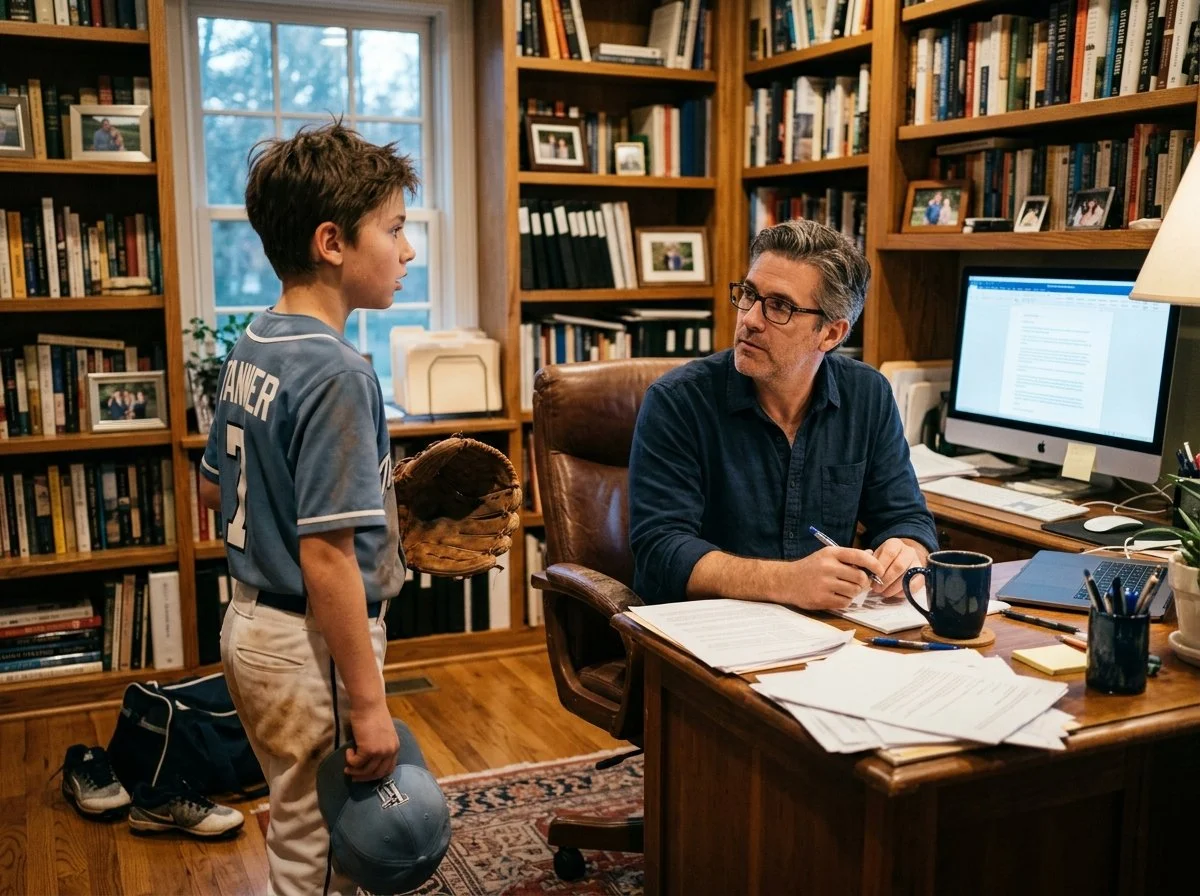
I heard the garage door. Then cleats on the hardwood, which is a sound I've told him a hundred times I don't want in the house. He didn't take them off. He came straight up the stairs and into my office and dropped his bag on the floor by the bookshelf. Then he kicked off the cleats right there on the rug, one landing on its side.
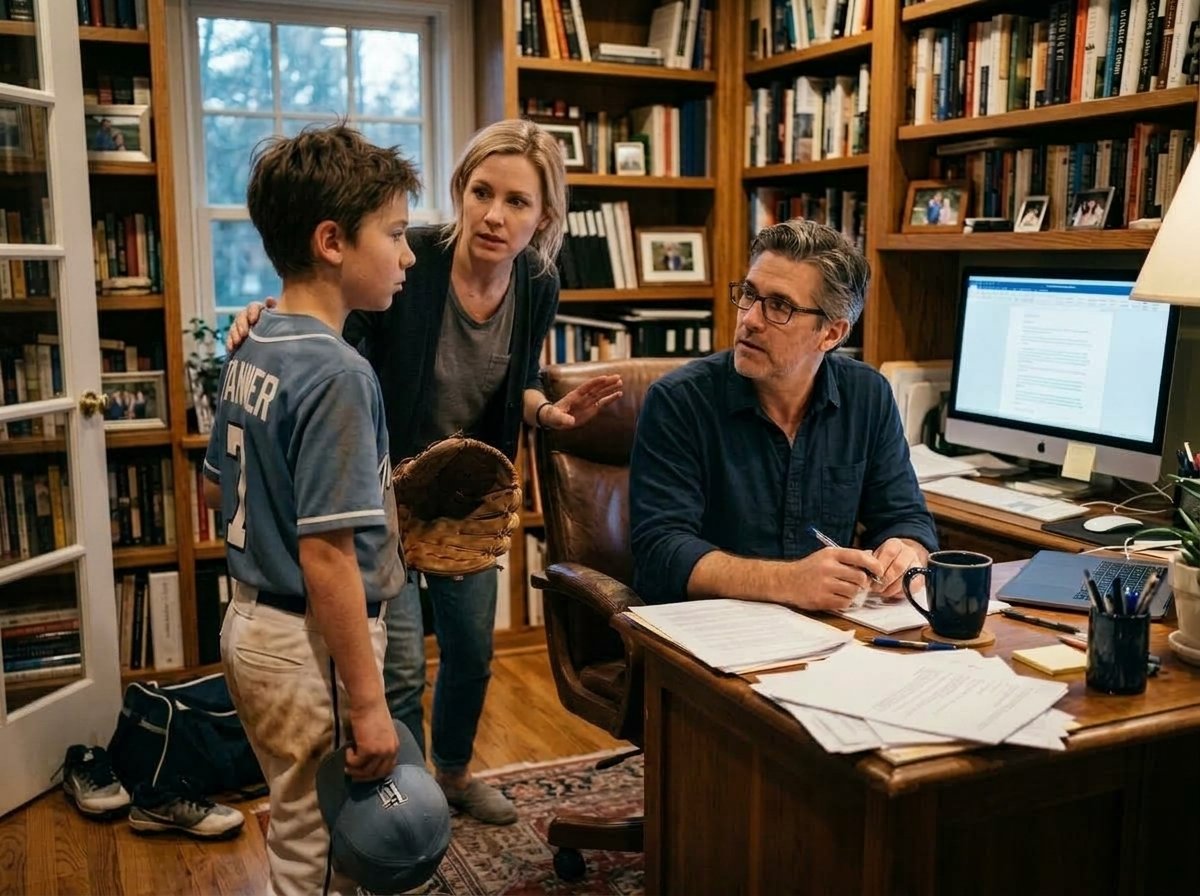
He was still in his uniform. Light blue, number seven, dirt ground into the knees of his white pants from a slide I hadn't been there to see. He had his glove on one hand and his cap in the other, hanging by the brim. He didn't sit down. He stood at the edge of my desk with the lamp throwing warm light across all my papers, and he looked at me the way an umpire looks at a manager who's already been warned.
His voice was flat and even, the way a kid's voice goes when he's trying to hold his jaw together.
"Why would you do that and not tell me?"
I had no answer for him then. I still don't have one that holds water.
I opened my mouth, and that's when I heard her on the stairs. Fast. Taking them two at a time.
My wife came through the door with her keys still in her hand, blonde hair falling out of the clip she'd put it in that morning. She'd stayed behind in the garage on the phone with Caius's mother. I'd learn that later. She put one hand on Tanner's shoulder, gentle, and set his glove on the corner of my desk when he let it slip. For a moment she was every inch the peacemaker I married.
"Okay," she said. "Okay. Tanner, honey, let him talk. Cliff, he deserves to hear it from you. Not from the dugout."
So I tried. I said something about golf. Something about how it started small, how Caius had questions, how it was nothing.
She let me get about three sentences in. Then her other hand came up, fingers spread, and the peacemaker stepped out of the room.
"Nothing," she said. "You took another woman's son to a bar."
"A grill."
"Don't." She didn't raise her voice. She didn't have to. "Dana Whitfield leaned over in the fourth inning and asked me if I'd seen the signed putter. And I said yes, of course, because I'm your wife, and I assumed you'd tell me if a seventh-grader was spending Saturdays in your office. Do you know what it's like to defend your husband to forty parents and realize halfway through the sentence that you don't know if you're lying?"
I looked at the bookshelves. I don't know why. Maybe because it was easier than looking at either of them. And there they were, all those framed photos I'd walked past a thousand times. Tanner at four in a cap three sizes too big. The three of us at the lake. Our wedding, her laughing at something I can't remember saying.
"You told me you were at the office," she said. "And you were. You were right here. With him." She pointed at the spare chair in the corner. It still had his golf magazine on it. I hadn't moved it.
Then she said the thing I've been carrying for nine days.
"Who were you when you were with that boy? Because whoever he is, the guy who talks for two hours and laughs and shows off his putters, I would really like to meet him. So would your son."
Tanner didn't say anything. He just looked at the magazine on the chair. Then he picked up his glove from my desk, walked out, and left his cleats on the rug.
It came at me the way those things always come. Fast, and from a direction you technically should've been watching. Like a stone off the highway that cracks the windshield before you've even registered the truck in front of you. One moment you're moving at speed, in control, radio on. The next moment you're looking at the world through a spiderweb of your own making.
But I'll tell you what's true. It wasn't really out of nowhere. I had been driving behind that gravel truck for months. I simply preferred the road to the reckoning.
First: Secrecy, even around innocent things, is an act of cowardice. A grown man has no legitimate business keeping undisclosed company with another man's child. Full stop. I told myself his mother knew, because she'd dropped him at the range once. I told myself it was harmless, so it needed no announcement. But here is the test, and it is not complicated: if it is truly harmless, you say it out loud. You don't calculate. You don't edit the story before you walk back into your own house. The moment a man begins curating what his wife and son are permitted to know, he has already made a choice, and it is not an honorable one. Caius's parents had every right to be furious with me. They were. I don't contest that for a second.
Second: Pride is patient. It will find your softest wall and lean against it until the thing gives. I was not spending time with Caius for his benefit. I was spending time with him for mine. Because he looked at me the way I had wanted my own son to look at me. Because he cared about what I cared about. Because with him, I felt legible, admired even, in a way I had quietly stopped expecting at home. That is not mentorship. That is not generosity. That is a forty-four-year-old man extracting validation from a seventh-grader because he couldn't tolerate the ambiguity of his real relationship with his real son.
Third: The wrong crowd rarely announces itself. It doesn't always wear the obvious markers. Sometimes it's a well-mannered boy with a textbook swing and a Shirley Temple. The problem was never who Caius was. The problem was who I was, what I was avoiding, and what I was substituting for the harder, slower, more honest work of fatherhood. I had grown men in my orbit I could have golfed with. I had a son under my own roof I could have sat with, on his terms, in his sport, in his world. I chose the option that asked nothing of me, cost me nothing, and made me feel exceptional for exactly zero investment.
Fourth, and this one I didn't see coming, because it came from her. I never thought of my wife as part of this. I thought of it as a thing between me and Tanner, a private ache I was entitled to manage on my own. But a secret in a marriage is never kept by one person. The second I lied to her about where I'd been, I made her a co-signer on a debt she never agreed to. I sent her into those bleachers with my reputation in her hands and no idea what it weighed. She stood up for me in public before she knew what she was standing up for. That isn't loyalty I earned. That's loyalty I spent.
And her question, who were you when you were with that boy, wasn't really an accusation. It was grief. She'd been living with the quieter, shut-down version of me for years. She'd stopped expecting the other one, the same way I'd stopped expecting things from Tanner. Then she found out he'd been alive the whole time. He just wasn't showing up for her.
And here is the one I keep returning to. The one that cuts deepest.
I was out there building the relationship I wanted instead of doing the work on the one I already had. Tanner didn't want golf. Fine. That's his right, and it costs me nothing to respect it. But when did I ever sit in that mancave and watch baseball with him? When did I take him to the grill and let him pick the sport on the screen? When did I skip the contracts and sit in the bleachers, so I'd be the one who saw the slide that put that dirt on his knees? When did I ask him, with real curiosity and nowhere else to be, what kind of man he's trying to become?
I went looking for a son already shaped to my specifications. I found one. And he was not mine to keep.
I stood on Caius's parents' porch and apologized. In person. Hat off, shoulders square, no hedging. I told them it would not happen again, and I meant it with everything I have. I spoke to Caius directly, his father standing beside him, and I told him clearly: this was my error, not his. He's a good kid who was simply being a kid. I was the adult. I was the one who should have known better, and I didn't hold the line.
That night I sat across from my wife at the kitchen table, not behind my desk. I told her everything. Every range session, every Saturday, every time I said "the office" and let her fill in the rest. She listened. Some of it she already knew. Some of it she didn't. When I was done, she said, "I don't need you to be perfect. I need to stop being surprised by you." I have no rebuttal for that, and I'm not looking for one.
Tanner hasn't said much. My wife has said plenty, and she is not wrong about any of it. The team mothers have formed their opinions with the efficiency and permanence of concrete. I've earned all of it.
His cleats sat on my office rug for two days. I didn't move them. I couldn't tell you why, except that it felt like the most honest thing in the room.
Saturday morning, I carried them downstairs and asked Tanner if he'd let me throw with him in the backyard.
He said maybe.
That is the finest word I have heard in nine days.
So I am going to keep asking. I am going to keep my life out in the open where a man's life belongs, visible to the people who are supposed to know it.
If any of you have walked this particular road, I would value the counsel. And if any of you are behind that gravel truck right now, telling yourself it's harmless, telling yourself it's fine, telling yourself no one needs to know—
Change lanes, brother.
Before the stone flies.
—Clifford (by Deck & Mitchell)
Epilogue: The gravel truck is never as far ahead of us as it seems. What Clifford describes is not rare; it's human. There is a peculiar blindness we permit ourselves—a quiet avoidance of the crack forming in our own reflection. The stone on the highway is never the real surprise. It's the road we've chosen, knowing all along where it might lead. Secrets, no matter how harmless they appear, carry weight. They burden the one who keeps them and fracture the trust of those who uncover them. Relationships—especially the most precious ones—demand transparency, even when it exacts a cost.
Clifford's moment of reckoning is a timeless theme. Amidst his “failure” lies a lesson both sobering and redemptive. We are called not to shape others to fit our expectations, but to widen our hearts to meet them as they are. Fathers and sons, companions and peers—all relationships worth keeping ask for this humility. To honor them is to walk the harder road, to sit with discomfort when our wants and their needs collide, and to trust that tending to what is true will always outlast the illusion of what we wish.
Change lanes, then, before the stone flies and the glass breaks. And if it is broken, as it was for Clifford, take solace in this—no windshield needs to stay shattered forever. A son saying "maybe" carries the beginnings of an answer, if only there is courage enough to ask, again and again.