
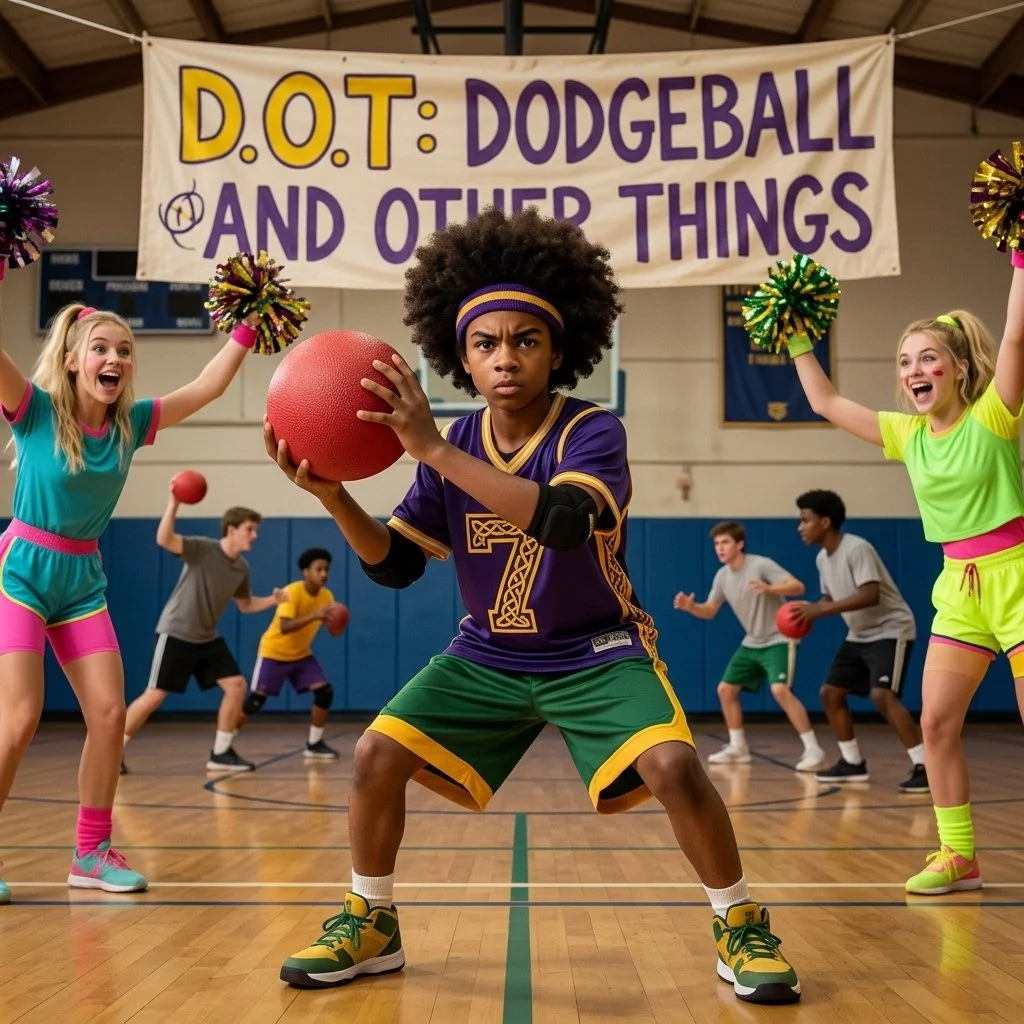
The photos you see here? Darling, they are in no way affiliated with the Agoura Rec Center—don’t get it twisted. This is a fictional piece of art, pure and simple, captured in the heart of the Fashion District by none other than Mitchell Royel on 10/4/26. And while we're setting the mood for these vibes, we're tuned into "Soldier of Love" by Sade... an oldie but goodie that still knows how to hit all the right notes.
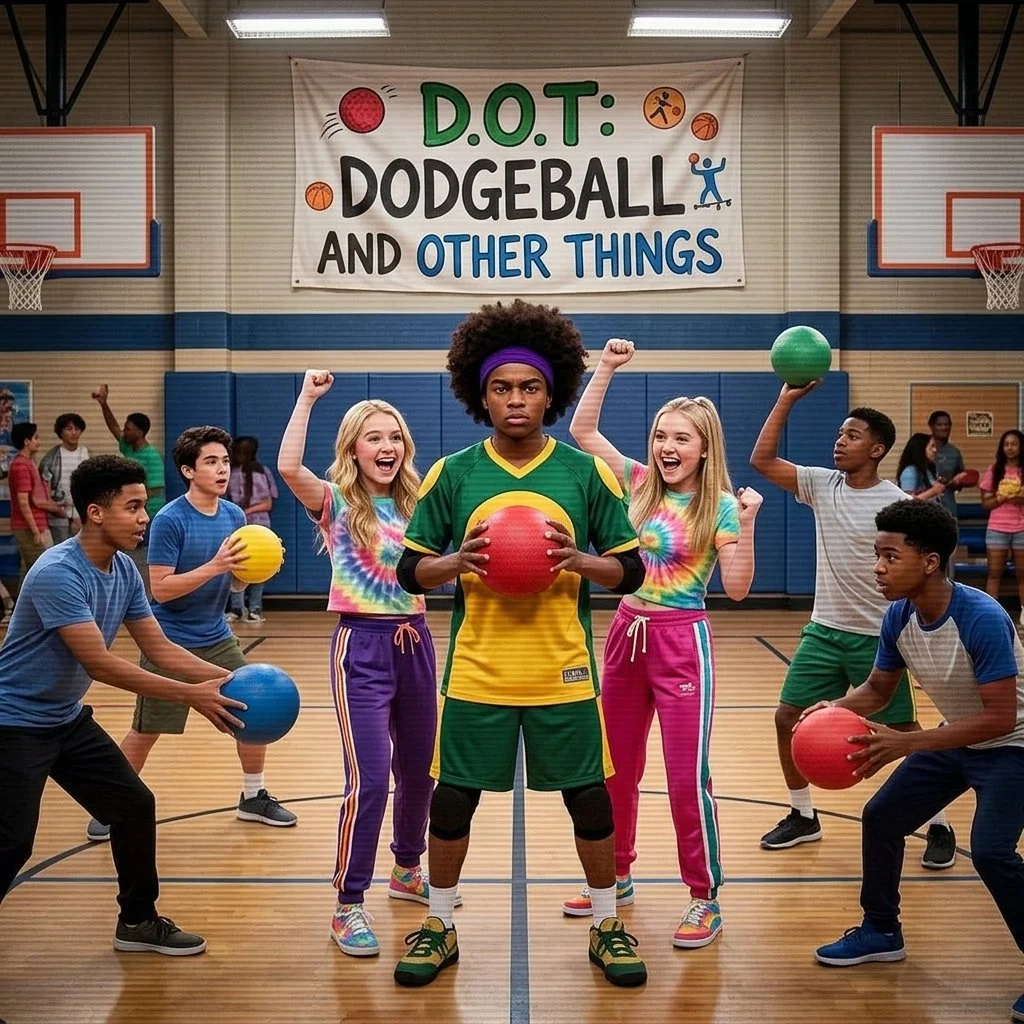
This photograph, a visual note paying homage to the spirit of Huey Freeman from The Boondocks, is a reflection, not a replication. It’s a riff on the essence of the character, a celebration of his revolutionary cool. But make no mistake, this is an independent creation, untethered and unaffiliated with Adult Swim, the producers, or any entities behind the show. It exists as its own groove, orbiting in a whole other galaxy of artistic expression.
Let me be clear about one thing before my brain starts telling this story the flattering way. I was not good at dodgeball. I was not secretly good. I was not a hidden talent waiting for the right coach. I was bad in a way that was almost scientific. You could have studied it.
And yet here I am, standing at center court in the Agoura Recreation Center, wearing a purple jersey with a gold number seven on the chest, holding a red rubber ball like it owes me money. There's a banner hanging from the ceiling trusses that says D.O.T.: Dodgeball And Other Things in letters big enough to see from the parking lot. Two volunteers in neon green and teal are jumping around with pom-poms like the Lakers just walked in. My headband is purple and gold. My afro is round enough to pass a geometry test.
I am the host. Somebody gave me a microphone. On purpose.
Nine years. Almost ten. That's how long it's been since I walked through those double doors with a backpack heavier than my self-esteem and signed in for after-school care. The sign-in sheet was on a clipboard by the front desk. The pen was tied to it with a piece of string, because apparently the rec center had a serious pen-theft problem. Even then I thought that said a lot about how they saw us.
The floor still smells the same. Floor wax, old sneakers, and that strange cafeteria-pizza smell that has no clear source. I don't know who designs these buildings, but they all smell like the inside of a gym bag that has seen things.
Back then, the main event every afternoon was Kings Court.
If you've never played, here's the setup. It's dodgeball, but with a crown. One kid gets to be King, and the King stays on the court as long as he can survive. Everybody else is trying to take him out. In theory it's a game about skill, reflexes, and strategy.
In practice, it was a game about who the tall kids decided to like that day.
I lasted, on average, about forty seconds. That's not an exaggeration. I know because one day I counted. I was eliminated so fast that I had time to wonder whether I'd been out before the game officially started. Somebody would yell "Go!" and I'd hear a thwap and feel that red ball sting my shoulder, and the gym would go quiet for half a second in that way it does when everyone silently agrees something was obvious.
Then I'd walk off. Not run. Walk. There's dignity in a slow walk. I learned that early.
The table was along the side wall, right under the window that looked out onto the hallway and the front office. That's where the eliminated went to wait. Most kids hated the table. It was exile. For me it was something closer to home.
Most of my friends back then were girls. People like to say things like that with a little pause after it, like it's a confession. It's not. It's just a fact. The girls at that table were the smartest people in the building. They had their homework done before the boys had even finished arguing about who was really out. They had opinions about books, about teachers, about which counselor was clearly going through a divorce. They had a full, detailed news service running on the conversations of everyone in that gym.
And we gossiped. Let me not pretend we were above it.
We'd sit there with our math worksheets and watch the boys play, and we'd provide commentary. Who was showing off for who. Who threw the ball way too hard at a kid half his size. Who cried in the bathroom after the last game and came back pretending he'd just been "getting water." We knew everything. We were the press box. Nobody asked for our coverage, but we gave it anyway, free of charge.
I remember being fourteen and feeling two things at once. The first was relief that I didn't have to be out there anymore. The second was a quiet, annoying ache, the kind you're too proud to name. Because even if you know a game is silly, it still stings to be the first one told you don't belong in it.
So here's where it gets interesting.
About twenty minutes into today's event, while I'm explaining the rules to a group of kids who are clearly not listening (respect), I glance over at that same window. Same window. Same spot. The table is gone now. They've replaced it with a vending machine, which feels like a metaphor I don't have time to unpack.
And walking past the glass are three of the men who run this place.
I recognize them immediately. I'd recognize them anywhere. They're older now, softer around the middle, grayer at the edges. But they have the same walk they always had, that slow, keys-on-the-belt, I-have-access-to-the-supply-closet walk. They used to stand by the door during Kings Court with their arms folded, nodding approvingly at the boys who threw hardest. They were the referees, the judges, and the audience, all in polo shirts.
One of them looks in. Then he slows down. Then he stops.
He looks at me. He looks at the banner above my head. He looks back at me. I can actually see his brain trying to match two files that don't belong in the same folder. The kid at the table with his worksheet and his girl friends. The guy at center court in the purple jersey, holding the mic and the ball and the room.
And then his face turns red. Not pink. Not flushed. Red. Tomato red. Ripe, farmers-market, ready-for-sauce red. The other two follow his eyes and the same thing happens to them, like a slow-moving chain reaction of embarrassment. Three grown men, glowing like stoplights in a hallway.
I didn't do anything. I want that on the record. I didn't wave. I didn't smirk. I just kept talking about the rules for the obstacle round. But inside? Inside, something very small and very old sat up and paid attention.
Now, I could tell this story as a revenge story. That's the easy version. The underdog comes back. The doubters are humbled. Cue the slow clap and the swelling music.
But that's not quite what happened, and pretending it is would be its own kind of lie.
Here's what I actually think was going on behind those red faces. I don't think they felt guilty, exactly. I'm not sure they remember enough to feel guilty. I think they felt disoriented. Because they had a story about how this place works, and I was never in it as anything but a background character. In their version, the kids who mattered were the kids who could throw. The kids at the table were furniture.
And furniture isn't supposed to come back holding the microphone.
That's the part I find funny. Not in a cruel way. In an honest way. People build whole worldviews out of who wins at games that don't matter. They decide who's going to be something by watching who's loudest in a gym at four in the afternoon. And then life happens, slowly and without asking permission, and the categories quietly stop working.
I wonder if, when they saw me, they also saw that table. I wonder if they shook that old picture out of their heads like an Etch A Sketch. A fourteen-year-old kid, out first, laughing with the girls about the boys who were still playing, pencil behind his ear, not bothered, or at least doing a very good impression of not bothered.
Just a thought. I'm not going to ask them.
The thing nobody tells you about full-circle moments is that they're not loud. They're not dramatic. They happen while you're busy doing your actual job. Somebody needs the extension cord. A kid has lost one shoe and somehow also a juice box. The DJ wants to know if he can play something with "a little more bass" at a family event. You don't get a pause button to soak it all in.
You get maybe four seconds. A window. Three red faces. And then a seven-year-old is tugging on your jersey asking if he can be on the team with the cheerleaders.
So I took my four seconds. And here's what I noticed.
I didn't need them to be embarrassed. I didn't need anything from them, actually. That surprised me more than anything. For years I think some part of me was waiting for a moment like this, rehearsing it the way you rehearse arguments in the shower. And when it finally came, it was almost gentle. A quiet confirmation of something I already knew.
The table was never exile. It was where I learned to watch. To listen. To read a room before the room could read me. Those girls taught me how to see what people were really doing underneath what they said they were doing. That's the entire skill set of a host, by the way. That's the whole job.
Turns out I trained for this. I just did it sitting down.
Later, near the end of the event, I'll run a round of dodgeball. Of course I will. It's in the title. And I'll make sure of a few things. Nobody gets picked last, because the teams are random. Anybody who gets out early goes to a station where they can still play. And there's a table along the wall, right by the window, with snacks and markers and room for anybody who'd rather watch and talk.
Not because I'm making a statement. Mostly because I know exactly who's going to end up there.
And honestly? They'll probably have the best seats in the house.
-Mitchell +
Deck (of Mitch Leyor)